Quick Answer:
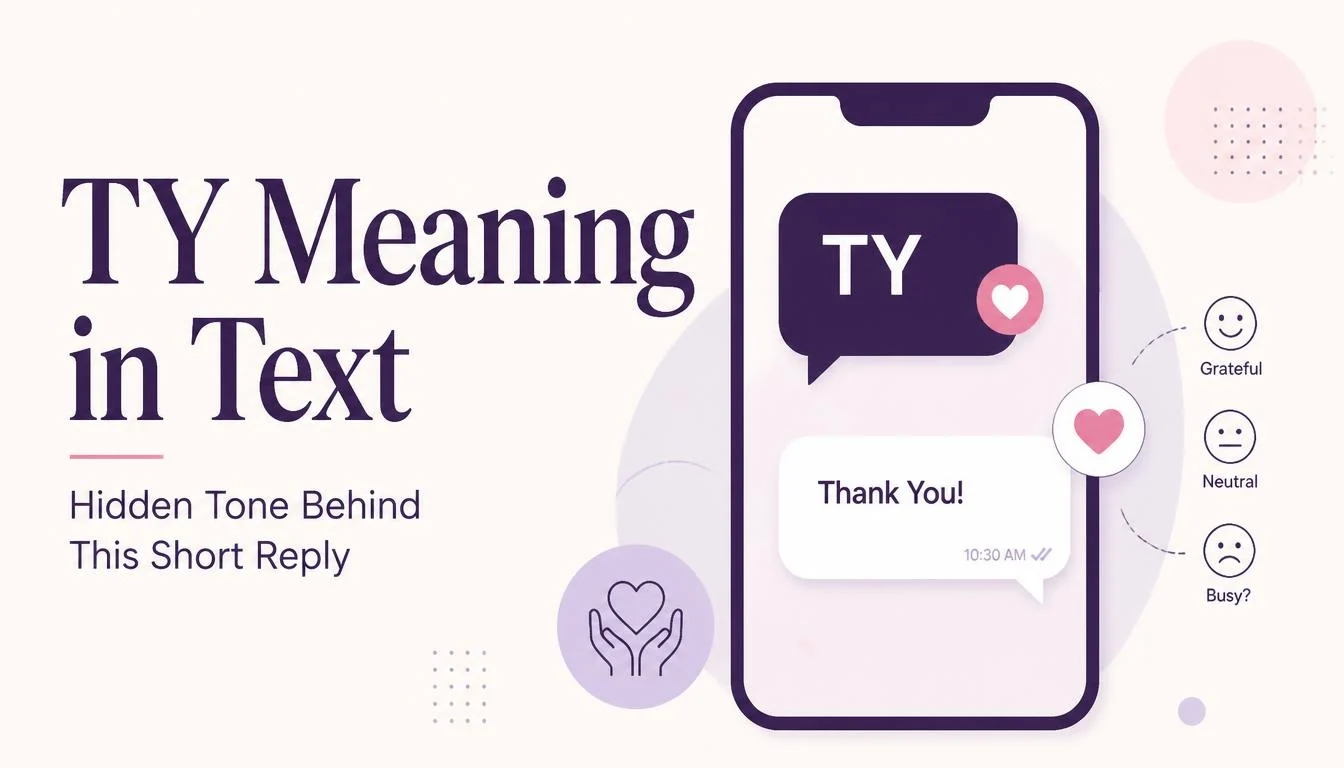
TY means “Thank You” in text messages and online conversations. People use it to express gratitude quickly and casually when chatting with friends, family, coworkers or someone on social media. It is a shorter alternative to typing the full phrase.
If someone sends you “TY” after you help them, share information, or do them a favor, they’re saying thank you. It’s a short, informal way to express appreciation without typing the full phrase. You’ll commonly see it in text messages, social media comments, direct messages, and online chats. Dictionary.com+1
Although TY is simple, the tone can depend on the conversation. A quick “TY!” may sound friendly and appreciative, while a plain “ty” can feel more neutral. The abbreviation itself isn’t rude or romantic. The surrounding message and your relationship with the other person provide the context.
What Does TY Mean in Text?
TY means “Thank You.” It’s an informal abbreviation used to express gratitude, acknowledge a favor, or show appreciation in digital conversations.
For example:
- “TY for helping me with my homework!”
- “TY! I really needed that.”
- “I got the pictures. TY 😊”
In each example, TY communicates the same basic message as “thank you.” It simply makes the reply shorter and more casual.
TY is often called texting slang or an internet abbreviation. More precisely, it is an initialism because its letters represent the first letters of two separate words. People generally use it in informal writing rather than formal documents. Wiktionary, the free dictionary+1
Why Do People Use TY in Messages?
The main reason people use TY is convenience. In a fast-moving conversation, typing two letters can be easier than writing a complete phrase.
However, TY isn’t only about saving time. It also fits the relaxed style of online communication, where short replies are common.
Here are some everyday situations in which you might see it.
1. To Thank Someone for Their Help
When someone solves a problem, explains something, or helps you finish a task, TY is a quick way to acknowledge their effort.
Example:
Alex: “I fixed the formatting in your document.”
Jordan: “TY! You’re a lifesaver.”
Jordan is thanking Alex for taking the time to help.
2. To Acknowledge Information
You might use TY after receiving an address, a link, directions, or an answer to a question.
Example:
Mia: “The meeting is at 3 p.m. in Room 204.”
Sam: “TY, I’ll be there.”
The abbreviation shows that Sam received the information and appreciates the update.
3. To Respond to a Compliment
TY can also be a simple response when someone says something nice about you.
Example:
Friend: “Your new profile picture looks great!”
You: “TY 😊”
Here, TY means “thank you” and acknowledges the compliment without making the conversation feel formal.
4. To Thank Someone in a Group Chat
In a group conversation, a short reply can keep things moving without interrupting the discussion.
Example:
Taylor: “I uploaded the notes from today’s class.”
Morgan: “TY!”
Morgan is expressing appreciation for the shared notes.
These examples show that TY works in many situations, but its basic meaning remains the same: thank you.
What Does TY Mean on Social Media?
TY usually means “thank you” across social media platforms. The exact setting may change how people use it, but the abbreviation generally carries the same meaning.
TY on Instagram
On Instagram, you might see TY in direct messages, comment replies, or responses to Story mentions.
Example:
Comment: “Thanks for sharing my post!”
Reply: “TY for the support!”
The reply expresses appreciation. It can also be used when someone tags you, recommends your account, or shares something you’ve posted.
TY on Snapchat
On Snapchat, TY can appear in private chats and quick replies to Snaps.
Example:
Friend: “Here’s the picture you asked me to send.”
You: “TY!”
The message is a casual thank-you. There’s no special Snapchat-only meaning that you need to learn.
TY on TikTok
On TikTok, people may use TY in comments, creator replies, and direct messages.
Example:
Viewer: “Your explanation finally made this make sense.”
Creator: “TY! Glad it helped.”
In this case, the creator is acknowledging the compliment and expressing gratitude.
TY on WhatsApp
WhatsApp messages often include short abbreviations, especially in everyday conversations with friends, relatives, and coworkers.
Example:
A: “I’ve sent you the location.”
B: “TY, see you soon.”
The recipient thanks the sender and confirms the next step in the conversation.
TY in Online Gaming
TY is also useful in multiplayer games and gaming chats, where players may need to communicate quickly.
Example:
Player 1: “Dropped some supplies for you.”
Player 2: “TY!”
The second player is thanking the first for sharing resources.
Across these settings, TY generally retains its standard meaning. You don’t need to interpret it as a separate slang term simply because it appears on a particular platform.
Does TY Sound Friendly, Rude, or Cold?
A two-letter reply can feel different depending on the situation. TY is generally polite, but its brevity doesn’t communicate every emotion that a longer message might.
Consider these examples:
| Message | Possible impression |
|---|---|
| “TY!” | Friendly and appreciative |
| “TY 😊” | Warm and casual |
| “TY so much!!” | Enthusiastic gratitude |
| “ty” | Brief and neutral |
| “TY for everything ❤️” | Warm and personal |
| “Fine. TY.” | Potentially distant, depending on context |
These interpretations aren’t fixed rules. Some people naturally write short messages, even when they’re genuinely grateful. Others use punctuation, emojis, or extra words to convey warmth.
The important distinction is that TY itself isn’t rude. A short reply may seem cold if the conversation calls for a more thoughtful response, but you shouldn’t assume someone is annoyed just because they used two letters.
For example, if a friend spends an hour helping you prepare for an interview, replying “TY” might feel a little brief compared with “Thank you so much for helping me. I really appreciate it.”
Both express gratitude, but the longer message acknowledges the effort more explicitly.
TY vs. TYSM vs. TYVM vs. THX
Several texting abbreviations express gratitude. They share a similar purpose, but some communicate a slightly different level of emphasis.
| Abbreviation | Full form | Typical use |
|---|---|---|
| TY | Thank you | A quick, casual thank-you |
| TYSM | Thank you so much | More emphatic appreciation |
| TYVM | Thank you very much | Emphasized or especially polite thanks |
| THX | Thanks | Short, informal gratitude |
| TIA | Thanks in advance | Thanking someone before they help |
| YW | You’re welcome | A common response to thanks |
| NP | No problem | Reassuring someone that helping was fine |
These forms are established in online messaging shorthand, although individual preferences vary. Wiktionary, the free dictionary+2
TY vs. TYSM
TY is a straightforward thank-you, while TYSM means “thank you so much.”
For example:
- “TY for the link.” — A simple expression of gratitude.
- “TYSM for helping me prepare!” — A more emphatic expression of appreciation.
Use TYSM when you want to sound more enthusiastic or acknowledge a meaningful favor.
TY vs. TYVM
TYVM stands for “thank you very much.” Like TYSM, it adds emphasis, although the tone depends on the message.
For example:
“TYVM for getting back to me so quickly.”
This can sound appreciative and slightly more deliberate than a short “TY.”
TY vs. THX
THX is a shortened spelling of “thanks,” while TY comes from “thank you.”
For most casual conversations, they serve nearly the same purpose.
- “THX for the heads-up!”
- “TY for the heads-up!”
Both are understandable and informal. Your choice comes down to personal preference and the style of the conversation.
How to Reply When Someone Sends TY
If someone texts you TY, you don’t need to send a long response. A simple acknowledgment is usually enough, and sometimes no further reply is necessary.
The best response depends on what you’re talking about and whether the conversation is continuing.
Casual Responses
Use these when a friend or acquaintance thanks you for something small.
- “YW!” — You’re welcome.
- “NP!” — No problem.
- “Anytime!”
- “Of course!”
- “No worries!”
Example:
Friend: “TY for sending the notes.”
You: “NP!”
This keeps the exchange friendly and relaxed.
Warm or Thoughtful Responses
If you helped someone with something important, a warmer reply may feel more natural.
- “You’re very welcome!”
- “Happy to help.”
- “Anytime, I’m glad it worked out.”
- “Of course! Let me know if you need anything else.”
Example:
Friend: “TY for being there for me yesterday.”
You: “Of course. I’m always happy to listen.”
The longer reply fits the emotional context better than a routine “YW.”
Professional Responses
For a work-related conversation, you can respond politely without relying on abbreviations.
- “You’re welcome.”
- “Happy to help.”
- “Glad I could assist.”
- “You’re welcome. Please let me know if you need anything else.”
Example:
Coworker: “TY for sending the updated report.”
You: “You’re welcome. I’ve included the latest figures.”
In a casual team chat, TY and YW are generally understandable. In a formal email to a client, manager, or unfamiliar professional contact, writing out the words is often the safer choice.
When You Don’t Need to Reply
Not every TY requires another message.
If someone thanks you at the end of a conversation, you can leave it there. If the person asks a follow-up question or the discussion is still active, respond as you normally would.
A conversation doesn’t need to continue simply because someone expressed gratitude.
Is TY Appropriate in Professional Messages?
TY is acceptable in many informal professional chats, but it isn’t ideal for every workplace situation.
For example, a quick “TY!” may be perfectly normal in a team messaging channel where colleagues regularly use abbreviations. In a formal email, a client proposal, or a message to someone you don’t know well, “Thank you” usually sounds more polished.
Use this simple guide:
- Friends and family: TY is usually fine.
- Casual work chats: TY is generally appropriate when it matches the team’s communication style.
- Emails to clients: Write “Thank you” unless the exchange is clearly informal.
- Formal letters and business documents: Use complete words and standard professional language.
- Academic writing: Avoid texting abbreviations in formal assignments unless the context specifically calls for them.
The distinction isn’t about TY being incorrect English. It’s about choosing a level of formality that fits your audience. Writing guides commonly distinguish casual text-message language from the conventions expected in academic and formal writing. apsu.edu+1
Is TY an Acronym or an Abbreviation?
TY is commonly described as an abbreviation, texting shorthand, or internet slang. The more precise linguistic term is initialism.
An initialism is formed from the initial letters of a phrase, with each letter representing a separate word. In this case:
- T stands for Thank.
- Y stands for You.
The letters are usually understood individually rather than pronounced as a single word. If you say TY aloud, you would typically pronounce the letter names “tee” and “why,” although people generally just say “thank you” in ordinary conversation.
An acronym, in the stricter sense, is formed from initial letters and pronounced as a word. In everyday usage, however, people often use acronym loosely to refer to both types of abbreviation.
You don’t need to know this distinction to understand a message. It simply explains why TY is more precisely classified as an initialism. Wiktionary, the free dictionary+1
Common Misunderstandings About TY
Although TY is straightforward, a few assumptions can lead to confusion.
1. Assuming TY Is Always Cold or Insincere
A short message doesn’t necessarily reflect a lack of appreciation. Someone may be busy, typing on a phone, or accustomed to brief replies.
Look at the broader conversation before judging the tone.
2. Thinking TY Means Something Romantic
TY doesn’t inherently mean “I like you,” “I love you,” or “I’m flirting with you.”
If someone sends “TY ❤️,” the heart may add affection or warmth. However, the meaning depends on your relationship and the context. The abbreviation alone is not a reliable sign of romantic interest.
3. Treating TY and TYSM as Identical in Tone
Both express gratitude, but TYSM explicitly adds “so much.” That extra emphasis may make the message feel more enthusiastic.
Still, people use abbreviations differently, so the distinction isn’t absolute.
4. Assuming TY Has a Special Meaning on Every Platform
The standard meaning remains “thank you” in ordinary texting, social media, and online chat. A specialized community could use the same letters differently, but you would need contextual evidence before assigning an alternative meaning.
If you see TY in a sentence about something unrelated to gratitude, read the surrounding message rather than forcing the usual interpretation.
Practical Examples of TY in Realistic Text Conversations
The following illustrative exchanges show how TY fits into different situations.
EXAMPLE 1 · A SMALL FAVOR
Can you send me the assignment instructions?
Just sent them over.
TY! 😊
Meaning: The recipient is thanking the sender for sharing the instructions.
EXAMPLE 2 · A COMPLIMENT
Your presentation was really good!
TY! I was nervous about it.
Meaning: The person appreciates the compliment and adds a little personal context.
EXAMPLE 3 · A WORK CHAT
I’ve updated the spreadsheet with the new numbers.
TY, I’ll review it this afternoon.
Meaning: The reply acknowledges the update and explains what will happen next.
EXAMPLE 4 · A PERSONAL MESSAGE
I really appreciate you checking in on me.
TY for saying that ❤️
Meaning: The person expresses gratitude for a thoughtful message. The heart adds warmth.
The useful lesson is that TY can stand alone or form part of a longer reply. You can keep it brief when the situation is simple or add more detail when you want to communicate stronger appreciation.
FAQs
What does TY mean from a guy or a girl?
TY means “thank you” regardless of who sends it. It doesn’t automatically signal attraction, friendliness beyond ordinary politeness, or disinterest. Interpret the rest of the conversation to understand the tone.
Does TY mean the same thing as thanks?
Yes, in ordinary texting, TY and “thanks” serve essentially the same purpose. TY is an abbreviation of “thank you,” while THX is a shortened spelling of “thanks.”
Can I write ty in lowercase?
Yes. Both “ty” and “TY” are commonly understood as “thank you.” Capitalization usually reflects personal typing habits or stylistic preference rather than a change in meaning.
Is TY appropriate in an email?
It can work in a casual email or informal workplace exchange. For formal or important professional communication, writing “Thank you” is generally a better choice.
What does TY mean when someone sends it without an emoji?
It usually means “thank you.” The absence of an emoji doesn’t prove that the sender is upset, uninterested, or being sarcastic. Consider the message and the conversation as a whole.
What should I say after receiving TY?
You can reply with “You’re welcome,” “No problem,” “Anytime,” or “Happy to help.” If the conversation has naturally ended, you don’t need to respond again.
Conclusion
TY is a simple, informal way to say “thank you” in text messages and online conversations. It works well for acknowledging help, responding to compliments, and showing appreciation without writing a full sentence.
When you receive TY, a brief “You’re welcome” or “No problem” is usually enough. If you’re deciding whether to use it yourself, consider the audience and setting. A casual chat is a natural place for TY, while formal communication often calls for the complete phrase.
Read More Related Articles:
- DILF Meaning | Why This Slang Term Is Trending Online In 2026
- “Show in Shared with You” Meaning | What This Option Really Does In 2026
- “Live” Mean on Find My iPhone | Complete Guide to Real-Time Location Sharing In 2026

Michael Turner is a U.S.-based content writer and blogger who enjoys uncovering the stories and meanings behind words. Through his work at Meanvora, he delivers well-researched, easy-to-read articles that help readers expand their vocabulary and gain a deeper understanding of language.










1 thought on “TY Meaning in Text | Hidden Tone Behind This Short Reply In 2026”