Quick Answer:
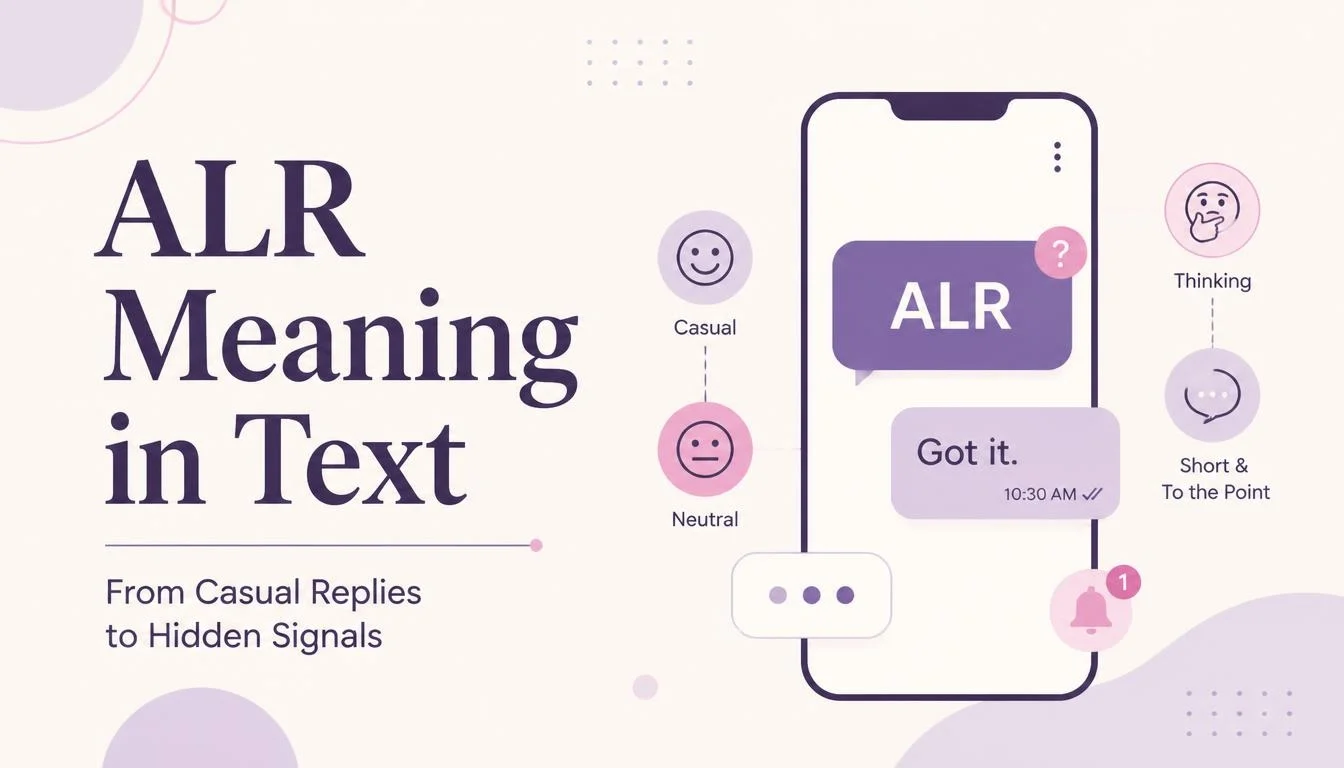
ALR means “Alright” in text messages and online conversations. It is a casual abbreviation used to agree with someone, acknowledge a message or show that everything is okay. People commonly use it on Snapchat, TikTok, Instagram and in everyday texting.
If someone texts you “alr” instead of “alright,” they are using a common shorthand found in casual digital conversations. You might see it in text messages, social media comments, gaming chats, or direct messages between friends.
ALR usually means “alright” in text messages. It can express agreement, acknowledgment, acceptance, or a simple response that shows someone has received your message. The exact tone depends on the conversation, so a quick “alr” can sound perfectly friendly in one situation and slightly dismissive in another.
What Does ALR Mean in Text?
ALR is an abbreviation of “alright.” People use it to save time when typing, especially in informal conversations where full words are unnecessary.
For example:
- Friend: “I’ll call you after work.”
- You: “alr”
Here, “alr” means “alright” or “okay.” It acknowledges the plan without adding much detail.
The abbreviation is informal and generally works best with friends, relatives, classmates, and people you know well. In professional emails, formal messages, or important conversations, writing “alright” or “okay” is usually a better choice.
Although ALR can have other meanings in specialized contexts, “alright” is the interpretation most relevant to everyday texting and online slang.
How People Use ALR in Conversations
The meaning of ALR stays close to “alright,” but its conversational purpose can change with the situation. It may confirm a plan, accept a suggestion, or simply keep a conversation moving.
1. To Agree With Someone
One of the most common uses of ALR is to show agreement. It works when someone suggests a plan or asks whether you are okay with something.
Example:
- Alex: “Wanna get pizza at 7?”
- Jordan: “alr bet”
Jordan is agreeing to the plan. The added phrase “bet” reinforces the sense of agreement, although the tone depends on how the people normally speak.
Another example:
- Friend: “Let’s meet outside the library.”
- You: “alr”
The response confirms that you understand and accept the suggestion.
2. To Acknowledge Information
Sometimes, you do not need to agree to anything. You simply need to show that you have read a message.
Example:
- Friend: “Your package should arrive tomorrow.”
- You: “alr thanks”
In this case, ALR acknowledges the update, while “thanks” makes the response warmer and more appreciative.
It can also work when someone gives a reminder:
- Friend: “Don’t forget to bring your notes.”
- You: “alr”
The reply means you have received the reminder and understand what to do.
3. To Accept a Change of Plans
ALR can communicate acceptance when plans change unexpectedly.
Example:
- Friend: “Sorry, I can’t make it today. Can we go tomorrow?”
- You: “alr, tomorrow works”
This response shows flexibility and makes the revised plan clear.
However, replying with only “alr” may not communicate whether you are genuinely happy with the change. If the situation matters, adding a few words can prevent confusion.
4. To End a Conversation
ALR can also function as a short closing response, particularly when a conversation has reached a natural stopping point.
Example:
- Friend: “Okay, I’ll text you later.”
- You: “alr”
Here, the message acknowledges the other person’s statement without inviting much further discussion.
That does not automatically mean the sender is annoyed or wants to stop talking. They may simply have nothing else to add.
5. To Respond Casually in Gaming Chats
Players often use short messages when coordinating with teammates during a game. ALR can confirm that someone understands an instruction or is ready to proceed.
Example:
- Teammate: “Wait here until the rest of us arrive.”
- Player: “alr”
The reply means “alright” and confirms that the instruction has been understood.
This use follows the same basic meaning as ordinary texting. The gaming context simply makes a brief response more practical.
This does not prove the sender is angry. A short reply can reflect their usual texting style, a lack of time, or uncertainty about what to say next.
What Does ALR Mean on Social Media?
The meaning of ALR generally stays the same across social platforms: it is shorthand for “alright.” What changes is how people use it in comments, private messages, and group conversations. Slang.net+1
ALR on Snapchat
On Snapchat, ALR may appear in a quick reply to a Snap or in a private conversation.
Example:
- Friend: “I’ll send you the pictures later.”
- You: “alr”
The sender acknowledges the message. There is no special Snapchat-specific meaning required to understand it.
ALR on TikTok
TikTok users may use ALR in comments and messages to react to content or introduce a casual opinion.
Example:
Someone posts a video showing a new outfit.
Comment: “alr this fit is fire 🔥”
Here, ALR works like “alright” at the beginning of a casual statement. The rest of the comment communicates the person’s positive reaction.
ALR on Instagram
In Instagram DMs, ALR can confirm plans, acknowledge a story reply, or keep a conversation moving.
Example:
- Friend: “Check your DMs. I sent you the link.”
- You: “alr, thanks”
The abbreviation is simply a shorter way to say “alright.”
ALR on WhatsApp and Discord
In WhatsApp group chats, ALR can confirm that someone has seen a message or accepted a plan. On Discord, it can serve the same purpose in direct messages or gaming channels.
For example:
- Group member: “Everyone ready for 8 PM?”
- You: “alr”
The message indicates acknowledgment or agreement. It does not necessarily mean the sender is excited; it just confirms their response.
Does ALR Sound Rude or Dry?
A one-word message can feel different from a longer reply, particularly when you are discussing something personal. However, ALR is not inherently rude. It is a brief, informal expression whose tone depends on the surrounding conversation.
Consider these examples.
Friendly
“alr haha, see you soon!”
The extra words and upbeat punctuation make the message sound relaxed.
Neutral
“alr, I’ll be there at 6.”
The sender confirms a plan without adding unnecessary detail.
Possibly dismissive
“alr.”
After a serious discussion, this brief reply may feel cold or signal that the sender wants to stop discussing the subject.
How Can You Tell What Someone Means?
Look at the broader conversation rather than judging the abbreviation alone.
- Their usual texting style: If they always send short replies, ALR probably means little beyond “alright.”
- The previous message: A simple plan needs less emotional response than an apology or a personal confession.
- The words around it: “Alr, no worries” sounds different from “alr, whatever.”
- The conversation’s direction: If the person continues asking questions or making plans, they are still engaging. If they repeatedly give short replies and stop responding, they may want to end the exchange.
If the message feels unusually cold, you can ask a calm follow-up instead of assuming the worst. For example, “Are we good?” gives the other person a chance to clarify.
ALR vs. Alright vs. Aight
These expressions are closely related, but they differ in spelling and informality.
| Expression | Meaning | Typical use |
|---|---|---|
| ALR | Alright | Short, casual texts and online chats |
| Alright | All right; okay | Everyday speech and writing |
| All right | Okay, acceptable, or satisfactory | Standard spelling in many contexts |
| Aight | Informal pronunciation-based form of alright | Casual speech and slang |
| OK / Okay | Agreement or acknowledgment | Both informal and many professional situations |
ALR is a compact texting abbreviation. “Aight” represents a more pronunciation-based slang spelling, while “alright” and “all right” are more recognizable in ordinary writing.
For example:
- “Alr, I’ll call you later.” — casual acknowledgment.
- “Alright, I’ll call you later.” — standard, conversational wording.
- “Aight, see you there.” — more slang-oriented and informal.
- “Okay, I’ll call you later.” — neutral and widely appropriate.
The difference is mostly stylistic. In many everyday conversations, the expressions communicate the same basic idea.
Is ALR an Acronym or an Abbreviation?
In everyday texting, ALR is best understood as a shortened written form of “alright,” rather than an acronym in which every letter stands for a separate word.
That distinction matters because there is no need to expand A, L, and R into three individual words. The letters are simply a compact representation of the familiar expression.
The capitalization is flexible. People may write “alr,” “Alr,” or “ALR” without intending different meanings. Lowercase “alr” often fits naturally into casual messages.
ALR vs. Other Texting Abbreviations
ALR is not the only short expression people use to acknowledge a message. Several alternatives have similar meanings, but each has its own conversational feel.
| Slang | Full form or meaning | Main difference |
|---|---|---|
| ALR | Alright | Casual acknowledgment or agreement |
| OK | Okay | Broadly understood and neutral |
| Bet | Sure; agreed | Often conveys confident agreement |
| K | Okay | Extremely brief and sometimes perceived as cold |
| IGHT | Aight / alright | Informal alternative to alright |
| NVM | Never mind | Tells someone to disregard something |
| FR | For real | Expresses sincerity or agreement, depending on context |
For example, if someone says, “Meet me at the mall at 5,” you could reply “alr,” “okay,” or “bet.” All three may confirm the plan, although “bet” can sound more enthusiastic or slangy.
By contrast, “nvm” does not mean the same thing. It usually tells the other person to disregard a previous request or statement.
These differences become useful when you are trying to interpret a short response without overthinking every letter.
When Should You Use ALR?
ALR works best when the conversation is relaxed and the other person is comfortable with texting slang. You do not need to use it in every message, and a complete word is often more appropriate when clarity matters.
Situations Where ALR Fits Naturally
- Texting friends: “Alr, I’ll meet you there.”
- Making plans: “Alr, let’s do Saturday.”
- Replying in group chats: “alr, got it.”
- Casual gaming conversations: “Alr, I’m joining now.”
- Responding to simple requests: “alr, I’ll send it.”
These examples are informal, but each communicates a clear response.
When to Choose a Different Expression
In professional emails, customer communications, formal requests, or sensitive conversations, consider using “okay,” “understood,” or “sounds good” instead.
For example:
Instead of writing:
“ALR, I’ll send the report.”
You could write:
“Understood. I’ll send the report this afternoon.”
The second version is more polished and tells the recipient what to expect.
You should also avoid relying on ALR when a message requires more than a simple acknowledgment. If someone shares a personal problem, for instance, a thoughtful response will usually communicate more care than a single abbreviation.
Common Misunderstandings About ALR
Although the meaning is usually straightforward, a few common mistakes can lead to confusion.
1. Assuming ALR Always Means Agreement
ALR often expresses agreement, but it can also acknowledge information without accepting a proposal.
If someone says, “I’ll send you the details later,” replying “alr” may simply mean you have understood the message.
2. Thinking ALR Always Signals Annoyance
A short reply is not reliable proof of someone’s mood. Some people naturally prefer concise messages, even when they are happy with a conversation.
Consider the relationship, previous messages, and the sender’s usual habits before interpreting the tone.
3. Treating ALR as a Completely Different Word
In ordinary texting, ALR usually represents “alright.” It is not generally a separate word with a hidden meaning.
Specialized communities may use the same letters differently, so context remains important. Slang.net+1
4. Confusing ALR With “Already”
Some informal writers use “alr” to mean “already,” but this interpretation is less common and depends on the sentence.
Compare:
- “Alr, I’ll do it.” — Here, “alright” makes sense.
- “I alr finished it.” — Here, the intended meaning may be “already.”
When the sentence is unclear, read the surrounding messages or ask the sender what they mean rather than assuming a less common interpretation.
FAQs
What does ALR stand for in texting?
ALR is a shortened form of “alright.” People use it in casual messages to communicate okay, understood, or agreed.
What does ALR mean from a guy or girl?
The meaning is generally the same regardless of who sends it: “alright.” It may express agreement, acknowledgment, or reluctant acceptance, but the abbreviation alone cannot tell you how the person feels about you.
Does ALR mean okay or yes?
It can communicate either idea, depending on the situation. If someone asks whether you are coming to a party and you reply “alr,” you may be confirming that you will attend. In another conversation, it might simply acknowledge information.
Is ALR appropriate for professional messages?
It can work in informal workplace chats when colleagues regularly use slang. For formal emails, client messages, and official communication, “okay,” “understood,” or “confirmed” is usually clearer.
How should I reply when someone texts ALR?
Respond according to the conversation.
- If they are confirming plans, you can say “see you then.”
- If they are acknowledging information, you may not need to reply at all.
- If you are unsure whether they understood you, ask a direct follow-up.
Is ALR the same as AIGHT?
They have essentially the same basic meaning in many casual conversations: “alright.” ALR is a shortened spelling, while AIGHT is a slang spelling based on pronunciation. The choice is usually a matter of personal style.
Conclusion
ALR is a simple piece of texting slang that usually means “alright.” It helps people agree, acknowledge messages, and confirm plans without typing a full response. When you encounter it, start with that meaning and use the surrounding conversation to understand the tone.
Read More Related Articles:
- DILF Meaning | Why This Slang Term Is Trending Online In 2026
- “Show in Shared with You” Meaning | What This Option Really Does In 2026
- “Soxer” Mean | Truth Behind This Confusing Term In 2026










2 thoughts on “ALR Meaning in Text | From Casual Replies to Hidden Signals In 2026”