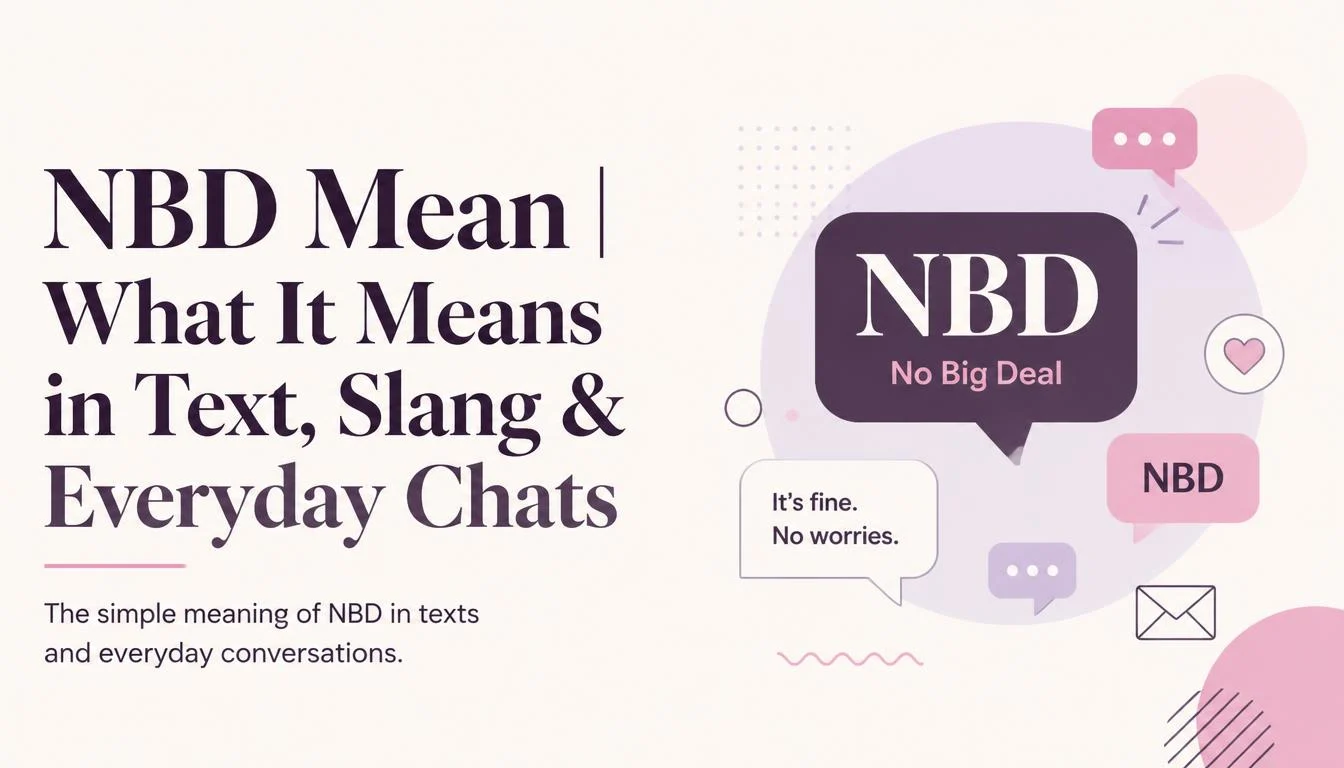
Quick definition:
NBD usually means no big deal. People use this casual abbreviation in texts, social media, online chats, and everyday conversations to say that something is not important, serious, difficult, or worth worrying about. Depending on the context, NBD can sound reassuring, modest, casual, or slightly dismissive.
If you’re wondering what NBD mean in a text message, it simply stands for “No Big Deal.” People use it to make a situation sound casual or reassure someone that something is not a problem.
You may see NBD in texts, social media comments, and everyday online conversations. It is a friendly abbreviation that helps keep messages short and relaxed.
NBD Mean & Definition
The most common nbd meaning is no big deal.
It is an informal internet and texting abbreviation that people use when they want to make something seem less serious or important. It can describe a minor problem, a small favor, an ordinary event, or something that does not deserve much concern.
For example:
A: Sorry I replied so late.
B: NBD, I was busy too.
Here, NBD means no big deal and communicates that the late reply did not bother the speaker.
What does NBD stand for?
NBD stands for No Big Deal.
| Abbreviation | Full meaning | Typical use |
|---|---|---|
| NBD | No big deal | Texting, chats, social media |
| TBH | To be honest | Sharing an honest opinion |
| IMO | In my opinion | Giving a personal view |
| IDK | I don’t know | Showing uncertainty |
| FYI | For your information | Sharing information |
| NP | No problem | Responding to an apology or request |
Although these abbreviations have similar casual communication styles, NBD specifically minimizes the importance of something.
Have you ever received a text that simply said NBD and wondered what those three letters meant? If so, you are not alone. Internet slang changes quickly, but NBD has remained a popular shorthand for one simple phrase: no big deal.
People commonly use NBD when they want to reassure someone, downplay a minor inconvenience, or show that they are not worried about something. You might see it after an apology, a small mistake, a favor, a delay, or an everyday inconvenience.
For example:
Sorry I forgot to call you yesterday.
NBD, we can talk today.
The speaker does not consider the forgotten call a serious issue.
However, the exact NBD meaning in text depends on tone and context. In one conversation, it can sound warm and forgiving. In another, it can sound dismissive or even passive-aggressive.
Understanding that difference can help you interpret messages more accurately.
Origin
The phrase no big deal existed in everyday English long before people started shortening it to NBD. As texting, instant messaging, forums, and social media became more common, users began turning frequently used phrases into quick abbreviations.
NBD developed as a convenient shorthand for no big deal. Like many texting abbreviations, it saves time while preserving the basic meaning of the original phrase.
Its popularity grew alongside digital communication because short expressions work especially well in text messages and online conversations.
The abbreviation follows the first letters of the three words:
N = No
B = Big
D = Deal
So:
N + B + D = NBD
The exact origin of the abbreviation is less important in everyday communication than its established meaning today. Most people encountering NBD in a casual English conversation will understand it as no big deal.
Popularity
NBD became particularly common through texting, instant messaging, social media, online forums, and casual digital communication.
People like the expression because it is short and flexible. Instead of typing:
It is really not a big deal.
someone can simply write:
NBD.
It also fits naturally into fast conversations.
Why people use NBD
There are several reasons people choose NBD instead of writing the complete phrase:
- It is quick to type.
- It sounds casual and relaxed.
- It works well in text messages.
- It can reassure someone after a mistake.
- It can minimize a minor problem.
- It can make a conversation feel less formal.
- It often communicates that the speaker is not upset.
You may see NBD in messages such as:
- NBD, don’t worry about it.
- I can send it tomorrow. NBD.
- NBD if you can’t make it.
- Thanks for helping! NBD.
- I forgot my charger, but NBD.
The abbreviation remains much more suitable for casual communication than formal business writing.
How It Is Used
The NBD meaning in texting can change slightly depending on the situation.
1. To reassure someone
This is one of the friendliest uses.
Sorry I made you wait.
NBD!
The speaker is saying that the wait did not cause a serious problem.
2. To downplay a minor problem
NBD can show that someone does not think an inconvenience is important.
I spilled some coffee on my notes, but NBD.
The person acknowledges the problem but does not consider it serious.
3. To respond to a small favor
Someone might use NBD to show that helping another person required little effort.
Thanks for picking up my package!
NBD.
In this case, NBD is close to you’re welcome or it was nothing.
4. To accept an apology
NBD can communicate forgiveness or reassurance.
Sorry I forgot your book.
NBD, just bring it tomorrow.
The speaker accepts the apology without making the situation dramatic.
5. To minimize an achievement
Sometimes NBD can be used modestly.
I finally finished the project!
Nice! NBD, right?
Depending on the context, this can be playful. However, saying NBD about someone’s genuine achievement can also sound like you are minimizing their accomplishment.
6. As a dismissive response
Not every use of NBD sounds friendly.
You didn’t invite me to the party.
NBD.
Here, NBD could suggest that the person does not care. But depending on the situation, it could also hide disappointment.
Tone matters significantly.
Examples
Friendly Examples
In friendly conversations, NBD often sounds relaxed and reassuring.
| Situation | Example | Meaning |
|---|---|---|
| Late reply | NBD, I know you’re busy. | Your late response is okay. |
| Small mistake | NBD, everyone makes mistakes. | Don’t worry about it. |
| Cancelled plan | NBD, we can meet next week. | The cancellation is okay. |
| Small favor | NBD, happy to help. | Helping was easy. |
| Minor delay | NBD, take your time. | The delay does not matter. |
A friendly NBD often appears alongside words such as don’t worry, it’s okay, all good, or no worries.
For example:
NBD, no worries at all.
This makes the reassuring tone especially clear.
Professional Examples
Although NBD is informal, people sometimes use it in relaxed workplace chats, especially when communicating with coworkers they know well.
For example:
Sorry, I sent the file five minutes late.
NBD, thanks for sending it.
Or:
I made a small formatting mistake.
NBD, I’ll fix it before the meeting.
However, avoid NBD in formal emails, official reports, client communications, or situations where professional language matters.
Instead of:
NBD, we’ll fix it later.
a professional message could say:
No problem. We can address it later today.
Funny Examples
NBD can also appear in humorous or exaggerated situations.
I accidentally ordered enough pizza for 12 people. NBD. 🍕
I studied for five hours and still forgot the answer. NBD. 😂
I walked into the wrong meeting like I belonged there. NBD.
In these examples, NBD creates humor because the situation may actually feel bigger than the speaker admits.
Social Media Examples
You may encounter NBD in captions and comments such as:
- Just casually finishing a marathon. NBD. 🏃
- Got front-row seats. NBD. 🎟️
- Finally learned how to cook. NBD. 🍳
- Accidentally matched with my celebrity crush. NBD. 😂
On social media, NBD can be used sincerely or sarcastically.
Comparison with Similar Terms
NBD is related to several common texting expressions, but they do not always communicate exactly the same thing.
| Term | Meaning | Tone | Example |
|---|---|---|---|
| NBD | No big deal | Casual | NBD, don’t worry. |
| No worries | It is okay | Friendly | No worries, you’re fine. |
| NP | No problem | Casual | NP, happy to help. |
| It’s okay | The situation is acceptable | Neutral/friendly | It’s okay, really. |
| All good | Everything is fine | Casual | All good, we’re set. |
| No problem | There is no issue | Neutral/casual | No problem, I’ll do it. |
| Don’t worry about it | You do not need to be concerned | Reassuring | Don’t worry about it. |
| It’s nothing | It was insignificant | Casual | It’s nothing, really. |
- NBD vs. No worries
- NBD and no worries often overlap.
- NBD focuses more on the size or importance of the problem:
I forgot to bring the documents, but NBD.
No worries focuses more directly on reassurance:
Sorry I forgot the documents.
No worries.
NBD vs. NP
NP usually means no problem, particularly as a response to a request, favor, or apology.
Thanks for helping me.
NP.
NBD can have a broader meaning:
I missed the first five minutes. NBD.
So, while both expressions communicate a relaxed attitude, they are not always interchangeable.
NBD vs. IDGAF
These expressions should not be treated as synonyms.
NBD means something is not a big deal.
IDGAF is a much stronger and more blunt expression meaning the speaker does not care.
For professional or polite communication, NBD is considerably safer.
Alternate Meanings
In ordinary texting and social media conversations, NBD almost always means no big deal.
However, abbreviations can have different meanings in specialized industries, organizations, or technical contexts. NBD may appear as an abbreviation for names, organizations, technical terms, or other phrases depending on the subject.
For example, an abbreviation can have a completely different meaning in medicine, finance, transportation, education, or business documentation.
That is why context matters.
If you see NBD in a casual message such as:
NBD, I’ll do it tomorrow.
the intended meaning is almost certainly no big deal.
If you encounter NBD in a technical report, database, academic document, or specialized industry, you should check the surrounding terminology before assuming it means no big deal.
Professional or Polite Alternatives
Because NBD is casual slang, you may want a more polished expression in professional settings.
Here are useful alternatives:
- No problem
- No worries
- That’s perfectly fine
- It’s not an issue
- There is no need to worry
- That’s okay
- It’s completely fine
- I understand
- Not a problem at all
- We can take care of it
- It shouldn’t be an issue
- There is no cause for concern
Formal alternatives
For a professional email, consider phrases such as:
That’s perfectly fine.
No problem at all.
There is no need to worry about it.
That should not be an issue.
We can address this without any problem.
These options communicate the same general reassurance without relying on texting slang.
Common Mistakes
Understanding what NBD means is easy, but using it appropriately requires some attention to context.
1. Using NBD in formal writing
NBD is informal.
Avoid using it in:
- Job applications
- Academic papers
- Formal reports
- Legal documents
- Official business letters
- Formal client emails
Use no problem, not an issue, or another professional alternative instead.
2. Assuming NBD always sounds friendly
The abbreviation can sound dismissive.
Compare:
NBD, don’t worry about it 😊
with:
NBD.
The first message clearly sounds reassuring. The second could sound cold or uninterested.
3. Using NBD when someone wants recognition
Suppose a friend says:
I finally got promoted!
Responding with:
NBD.
could make the person feel that you are minimizing their achievement.
A better response would be:
That’s awesome! Congrats!
NBD works best when the situation genuinely involves something minor or when the speaker intentionally uses it humorously.
4. Confusing NBD with NBM
Similar-looking abbreviations can have completely different meanings. Always consider the exact letters and the context before interpreting unfamiliar slang.
5. Overusing abbreviations
A message filled with abbreviations can become difficult to read.
For example:
NBD IDK TBH IMO NP
may save typing, but it can make communication unnecessarily confusing.
Use slang naturally rather than forcing an abbreviation into every message.
Quick Tips
If you want to use NBD naturally, keep these tips in mind:
- Remember the main meaning: NBD = no big deal.
- Use it mainly in casual conversations.
- Use context to understand the tone.
- Add emojis when you want to make the message warmer.
- Avoid it in highly formal writing.
- Do not use it to minimize someone’s important achievement.
- Use no problem or no worries when you want a clearer alternative.
- Pay attention to punctuation because a short NBD can sound blunt.
- Consider the relationship between the speakers.
- When in doubt, spell out no big deal.
Does capitalization matter?
Not much.
You may see:
- NBD
- nbd
- Nbd
All three can mean no big deal.
In texting and social media, lowercase nbd often feels especially casual.
For example:
nbd, I’ll figure it out
sounds relaxed and conversational.
Meanwhile:
NBD.
may look slightly more emphatic or final.
Do emojis change the meaning?
Yes, emojis can influence the emotional tone.
| Message | Likely tone |
|---|---|
| NBD. | Neutral or potentially dismissive |
| NBD 😊 | Friendly and reassuring |
| nbd lol | Casual and playful |
| NBD 😂 | Humorous |
| NBD! | Energetic reassurance |
| NBD, you’re good. | Clearly reassuring |
The words remain the same, but the surrounding cues help the reader understand the speaker’s intention.
FAQs
What does NBD mean in text?
NBD means no big deal in text messages. People use it to say that something is not important, serious, difficult, or worth worrying about.
What does NBD stand for?
NBD stands for no big deal. It is a common informal abbreviation used in texting, online chats, social media, and casual conversations.
Is NBD slang?
Yes. NBD is considered an informal texting and internet abbreviation. It works well in casual conversations but usually does not belong in formal or highly professional writing.
Is NBD rude?
NBD is not inherently rude. However, its tone depends on context. NBD, don’t worry 😊 usually sounds friendly, while a short NBD. can sometimes sound dismissive or uninterested.
What is the difference between NBD and no worries?
Both can reassure someone, but NBD means no big deal, while no worries more directly means that the other person should not feel concerned or apologetic. They can often be used in similar situations.
What does NBD mean on social media?
On social media, NBD usually means no big deal. Users may use it sincerely to downplay something or sarcastically to joke about an impressive, surprising, or inconvenient situation.
Can I use NBD in a professional email?
It is better to avoid NBD in formal professional emails. Use alternatives such as no problem, that’s perfectly fine, not an issue, or there is no need to worry.
What should I reply when someone says NBD?
Your reply depends on the conversation. You might say Thanks, I appreciate it, Glad to hear that, or simply continue the conversation. If someone uses NBD to dismiss a concern, you can clarify by asking whether everything is genuinely okay.
Conclusion
So, what does NBD mean? In everyday texting and online communication, NBD means no big deal. People use it to minimize a minor problem, reassure someone, respond to a small favor, accept an apology, or keep a conversation relaxed.
The phrase can carry slightly different tones depending on the situation. NBD 😊 can sound warm and reassuring, while NBD. may come across as short or dismissive. Context, punctuation, emojis, and the relationship between the speakers all influence how the message feels.
NBD works best in texts, DMs, social media comments, casual chats, and relaxed conversations. For formal emails, academic writing, and professional communication, phrases such as no problem, that’s perfectly fine, and not an issue usually make better choices.
The easiest way to remember it is simple:
NBD = No Big Deal = It is okay, it is not important, or there is nothing to worry about.
Read More Related Articles:
- Mercy Meaning | Powerful Lesson Behind Kindness and Forgiveness In 2026
- Mija Meaning In Spanish | Sweet Nickname You’ll Hear Everywhere In 2026
- Punta Meaning In Spanish | From Literal Meaning to Everyday Usage In 2026






4 thoughts on “NBD mean |What It Means in Text, Slang & Everyday Chats In 2026”