Quick Answer:
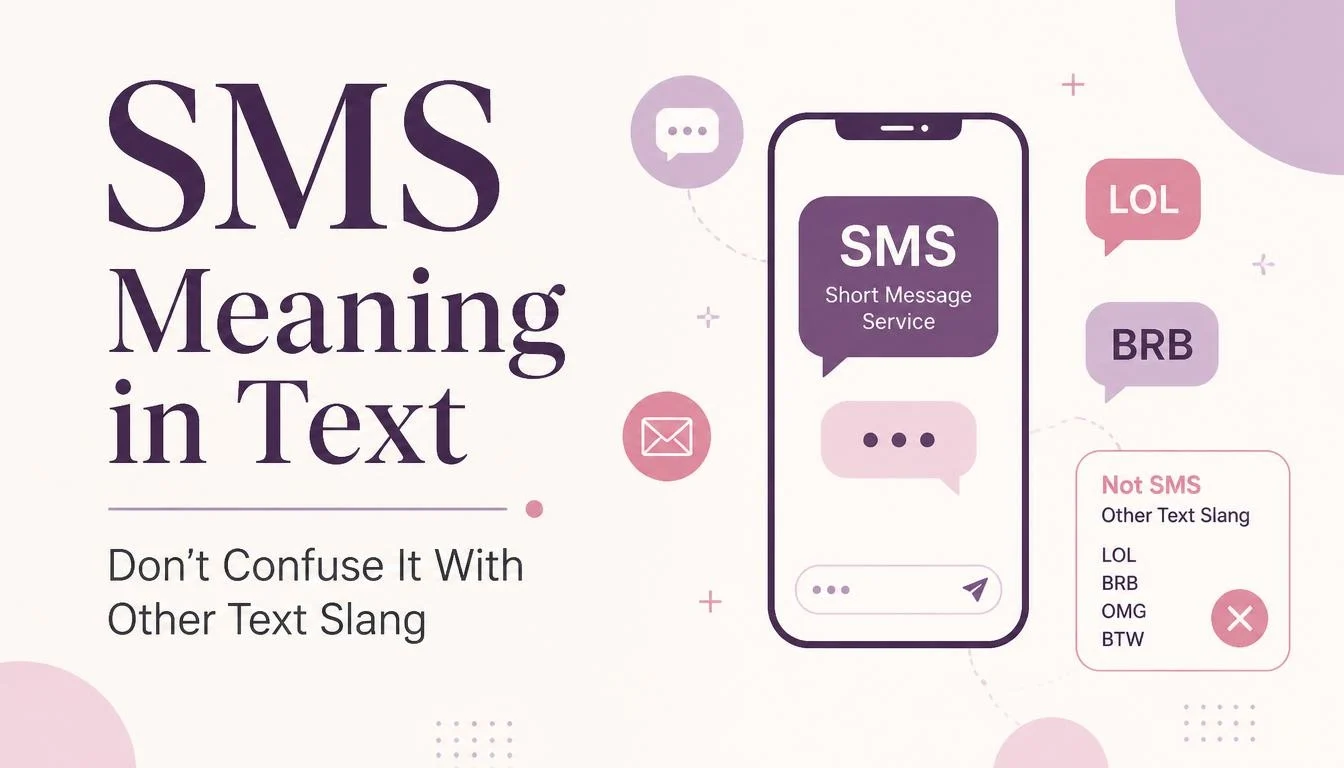
SMS means “Short Message Service.” In texting, SMS refers to standard text messages sent between mobile phones using a cellular network. People commonly use SMS to send short messages, updates and verification codes.
When someone mentions SMS in a conversation, they’re usually talking about a regular text message sent to a cell phone. You might see the abbreviation in your phone’s settings, a message from your wireless carrier, a verification code, or a conversation about texting.
SMS stands for Short Message Service. It refers to the technology used to send short text messages through a mobile network. Although people often use SMS and texting interchangeably, the terms can have slightly different meanings depending on the context. English meaning – Cambridge Dictionary+1
What Does SMS Mean in Text?
SMS means Short Message Service, a system that allows mobile phone users to send and receive text messages. In everyday conversations, it generally refers to a standard text sent through a phone number rather than a message exchanged through an internet-based messaging app.
For example, if a friend says, “I’ll send you an SMS when I arrive,” they mean they’ll text you. The phrase doesn’t carry a special emotional meaning or hidden slang definition. It’s simply a term for a type of mobile messaging.
Here are three common examples:
- Check your SMS for the login code.” This means you should look for a text message containing the code.
- I’ll send you an SMS later.” The person plans to text you using a mobile messaging service.
- The appointment reminder came by SMS.” The reminder arrived as a text message.
In casual American English, people are more likely to say “text me” or “send me a text” than “send me an SMS.” The abbreviation appears more often in technical settings, phone settings, business communications, and automated notifications. definition in the Cambridge English Dictionary+1
What Does SMS Stand For?
SMS stands for Short Message Service. Each word describes the basic idea behind the technology: a service designed to deliver short written messages between mobile devices.
The term comes from telecommunications rather than internet slang. It describes a messaging system, not a particular style of writing. An SMS can contain a complete sentence, a few words, a number, or a brief notification.
The word “short” has a technical background. A traditional SMS message can carry up to 160 characters when using the standard GSM character encoding. Other character sets, including those used for many emoji and non-Latin characters, can reduce the number of characters that fit into a single message. Longer texts may be split into multiple segments and displayed together on the recipient’s phone. CSRC+1
For everyday purposes, you don’t need to know the technical details. If your phone receives a standard text message through your mobile carrier, SMS is one of the technologies that may deliver it.
How People Use SMS in Everyday Life
SMS is used for both personal communication and practical tasks. The meaning stays the same, but the purpose of the message changes with the situation.
1. Sending a Personal Text
Friends and family use SMS to share quick updates, make plans, and stay in touch.
Examples include:
- “I’m outside. Come down.”
- “Can you pick up some milk?”
- “I’ll call you after work.”
Someone might describe any of these as an SMS, but in ordinary conversation, they’d usually call them texts.
2. Receiving Verification Codes
Websites and apps sometimes send a one-time code to a registered phone number. This code may help verify a login, confirm a transaction, or establish that someone has access to the number.
For example:
Your verification code is 482916. Do not share it with anyone.
This is an illustrative message, not a real verification code. If a service says it sent an SMS, check your regular text message inbox for the notification.
Be careful with unexpected codes. Never share a login or authentication code with someone who contacts you and asks for it.
3. Getting Appointment and Delivery Updates
Businesses use SMS to notify customers about appointments, deliveries, reservations, and account activity.
You might receive a message saying:
- “Your appointment is confirmed for Tuesday at 10 a.m.”
- “Your package is out for delivery.”
- “Your order is ready for pickup.”
In these situations, SMS identifies the delivery method rather than the message’s subject or tone.
4. Communicating With Businesses
Banks, retailers, clinics, and other organizations may use SMS for alerts, reminders, and customer service. Some services also let customers reply to a text to confirm an appointment or receive additional information.
If a business asks whether you’d like to receive SMS notifications, it’s asking whether you want updates sent to your phone as text messages.
SMS vs. Texting: What’s the Difference?
The terms are closely related, but they aren’t always interchangeable.
SMS is a messaging technology. Texting is the everyday activity of sending text messages.
When someone says, “I’m texting my brother,” they don’t necessarily mean the message is being delivered through SMS. Depending on their phone, settings, and the recipient’s device, it might be sent through a different messaging system.
For example, a person can send a message using a carrier’s SMS service or an internet-based app. Both actions involve typing and sending a message, but the underlying technology differs.
| Term | Meaning | Typical use |
|---|---|---|
| SMS | Short Message Service | Standard carrier-based text messages |
| Texting | Sending written messages electronically | Everyday conversations |
| Text message | A written message sent to a phone or through a messaging service | Personal or business communication |
| Instant messaging | Messaging through an internet-based app or service | Chats in apps such as WhatsApp or Messenger |
definition in the Cambridge English Dictionary+2
In everyday speech, someone might call an SMS a text, and that’s perfectly natural. The distinction matters most when discussing phone plans, delivery methods, messaging features, or technical support.
SMS vs. MMS vs. Internet Messaging
SMS is just one way to send a message. MMS and internet-based messaging services offer other ways to communicate, and knowing the differences can help explain why some messages arrive differently from others.
SMS (Short Message Service)
Used primarily for standard text messages sent through a mobile carrier. It is useful for quick updates, alerts, and short conversations.
MMS (Multimedia Messaging Service)
Designed to send multimedia content, such as pictures, audio, and video, through a carrier messaging service. The exact capabilities depend on the network and device.
Internet-based messaging
Apps such as WhatsApp and Facebook Messenger send messages over the internet. They can support photos, videos, voice messages, and other features, depending on the app.Twilio+2
Why Does the Difference Matter?
Imagine sending your friend a quick message that says, “I’m on my way.” That message might go through SMS.
If you attach a photo to a traditional carrier message, the phone may use MMS instead. If you send the same update through WhatsApp, the app uses its internet-based messaging system.
The exact behavior depends on your device, carrier, messaging settings, and the recipient’s phone. Modern messaging apps can also support features that go beyond the traditional SMS and MMS systems.
This is why a phone may display different labels for different conversations. Those labels generally describe how a message is being sent, not what the message means emotionally.
Does SMS Have a Special Meaning on Social Media?
Usually, no. SMS does not have a widely accepted, separate slang meaning in ordinary American texting. It generally refers to Short Message Service or a standard text message.
On social media, someone might mention SMS while discussing verification codes, phone notifications, mobile plans, or the difference between texting apps. In these contexts, the meaning remains technical rather than emotional.
Consider these examples:
Example 1: Instagram
“Instagram sent me an SMS code, but I haven’t received it yet.”
The person is talking about a verification code expected by text message.
Example 2: Snapchat
“My number is correct, but the SMS isn’t coming through.”
Here, SMS refers to a text message that the person expects to receive.
Example 3: A group chat
“Can you send me the address by SMS? I don’t check this app much.”
The sender wants the address delivered as a regular text message to their phone.
These examples illustrate ordinary usage; they aren’t quotations from actual users.
Is SMS a Slang Abbreviation Like LOL or BRB?
No. The difference is what the abbreviation represents.
- SMS: Short Message Service, a mobile messaging technology.
- LOL: Laughing out loud, a common expression used in informal conversations.
- BRB: Be right back, a shorthand expression indicating a brief absence.
- DM: Direct message, a private message sent through a platform or service.
SMS describes the method of communication, while LOL and BRB communicate reactions or intentions. DM describes a type of message or communication channel.
If you see SMS in a text, you generally don’t need to interpret it as a joke, a secret code, or a comment about someone’s feelings.
Why Do Businesses and Apps Use SMS?
SMS remains useful because it can reach people through their phone numbers without requiring them to use the same third-party messaging app. It is commonly used for notifications and brief messages, although successful delivery depends on factors such as carrier service, phone settings, and whether the number can receive texts. AWS+1
Here are several common reasons organizations use it.
Account Security
A service may send a verification code or security alert by SMS. These messages can help with account verification, but SMS codes are not immune to scams, interception, or other security risks.
Whenever possible, use the security options recommended by the service, and never share an authentication code with an unsolicited caller or texter.
Appointment Reminders
A doctor’s office, dentist, or salon may send a reminder so customers can confirm, cancel, or reschedule an appointment. These messages are often short because they need to communicate only the essential details.
Order and Delivery Notifications
Retailers and delivery services may use SMS to share order confirmations, shipping updates, and pickup instructions. A message that says “Your order has shipped” is an example of an informational text, not a special form of slang.
Alerts and Time-Sensitive Updates
Organizations may send notices about account activity, service interruptions, or schedule changes. SMS can be convenient when a brief notification needs to reach someone without relying on a particular social messaging app.
If you receive an unexpected message about a payment, delivery, or account problem, avoid clicking suspicious links. Open the official app or website directly to check whether the notification is legitimate.
Common Misunderstandings About SMS
Even though the term is straightforward, a few misconceptions can make it confusing.
SMS and Text Message Always Mean Exactly the Same Thing
In casual conversation, the terms are often used interchangeably. Technically, SMS refers to a specific messaging service, while “text message” can be used more broadly.
A text message might be sent using SMS, MMS, or an internet-based messaging service, depending on the context and how the phrase is being used. Twilio+1
Every Phone Message Is an SMS
Not necessarily. A message sent through a messaging app may use an internet connection rather than the carrier’s SMS service. Your phone’s messaging interface may combine different types of messages in one place.
SMS Always Costs Extra
The cost depends on your mobile plan, carrier, destination, and any applicable international messaging charges. Some plans include texting, while others may have different limits or fees. Check your current plan rather than assuming every SMS is free or that every SMS incurs a charge.
SMS Is the Same as a Verification Code
SMS is the service that delivers the text. A verification code is the content of a particular message.
For example, a bank might send a six-digit code through SMS. The code itself isn’t SMS, and SMS messages can contain many other kinds of information.
SMS Tells You How Someone Feels
The abbreviation does not inherently express affection, anger, excitement, or sarcasm. If someone says, “I’ll contact you by SMS,” they’re describing how they’ll reach you. Any emotional meaning comes from the surrounding conversation, not the abbreviation itself.
FAQs
1. How do you pronounce SMS?
SMS is pronounced by saying the three letters individually: “ess-em-ess.” It isn’t normally pronounced as a single word. definition in the Cambridge English Dictionary
2. Is SMS the same as iMessage?
No. SMS is a carrier-based messaging service, while iMessage is Apple’s internet-based messaging service. Depending on device settings and availability, an iPhone may use different messaging methods for different recipients.
3. Can I send an SMS without Wi-Fi?
Yes. Traditional SMS generally uses your mobile carrier’s network rather than Wi-Fi. You typically need cellular service that supports text messaging, although certain carrier and device features may affect how messages are sent.
4. Why does my phone say SMS instead of text message?
Your phone may display SMS to identify the type of message being sent or received. This label can appear in messaging settings, delivery information, or other technical interfaces. It doesn’t usually indicate a problem.
5. What does SMS mean when a website asks for my phone number?
The website is usually asking for a mobile number that can receive text messages. It may use that number to send verification codes, account alerts, or other notifications. Check the website’s privacy terms and make sure you trust the service before providing your number.
Conclusion
SMS stands for Short Message Service and refers to the technology behind traditional mobile text messaging. In everyday American English, it’s usually easier to say “text” or “text message,” but SMS is common in phone settings, verification notices, and business communications.
If you see SMS in a conversation, read it as a reference to sending or receiving a standard text message unless the surrounding context clearly indicates another meaning.
Read More Related Articles:
- “Soxer” Mean | Truth Behind This Confusing Term In 2026
- LWK Meaning in Text | Hidden Slang You’re Probably Missing In 2026
- Root “Bel” Meaning | Master This Word Root in Just Minutes In 2026

Michael Turner is a U.S.-based content writer and blogger who enjoys uncovering the stories and meanings behind words. Through his work at Meanvora, he delivers well-researched, easy-to-read articles that help readers expand their vocabulary and gain a deeper understanding of language.