Quick Answer:
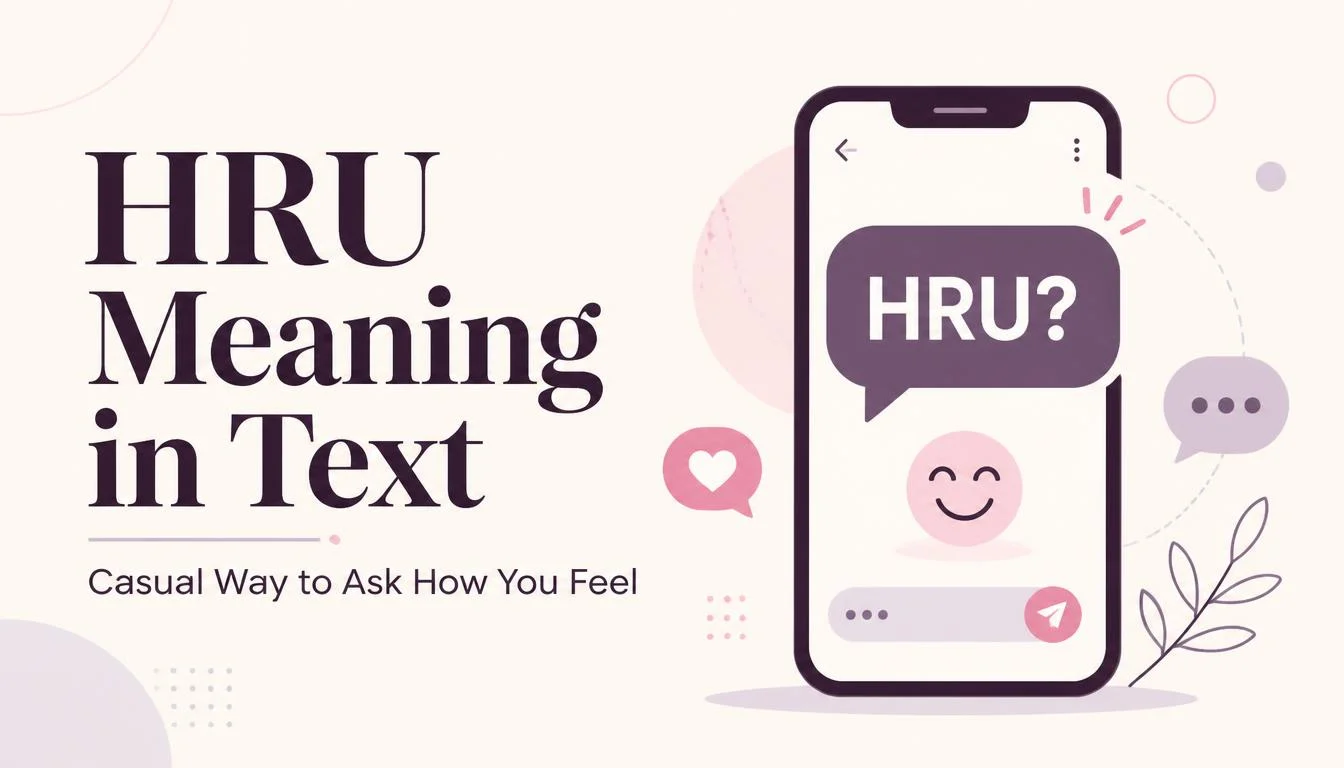
HRU stands for “How Are You?” in text messages and online conversations. People commonly use it on Snapchat, Instagram, TikTok and WhatsApp to check on someone or start a casual conversation.
Have you received a text that simply says “hru?” and wondered what the sender means? It’s a common abbreviation in casual conversations, especially when someone wants to start chatting without typing a complete sentence.
HRU stands for “How are you?” It’s an informal way to ask how someone is feeling or doing. You might see it in a message from a friend, an Instagram DM, a Snapchat conversation, or a text from someone you’re getting to know. Although the abbreviation is simple, the context can help you understand the sender’s tone and decide how to respond.
What Does HRU Mean in Text?
HRU means “How are you?” in text messages and online conversations. The letters represent the words in the original question:
- H = How
- R = Are
- U = You
Instead of typing the complete question, someone can simply write “HRU?” to ask how you’re doing.
For example:
Person A: Hey, hru?
Person B: I’m good! How about you?
In this exchange, HRU is simply a casual greeting and an invitation to continue the conversation.
The abbreviation doesn’t have a special emotional meaning by itself. Depending on the situation, the sender might be making small talk, checking in after a while, or showing interest in how your day is going.
The abbreviation is also listed with the meaning “How are you?” in Voice of America’s Texting Dictionary.
Why Do People Use HRU Instead of How Are You?
The main reason is convenience. HRU communicates a familiar question in just three letters, making it suitable for quick, informal exchanges.
However, people don’t necessarily use it because they’re in a hurry. Some prefer texting abbreviations because they fit the relaxed style of messaging friends and acquaintances.
Here are three common reasons someone might send HRU.
1. To Start a Conversation
When someone wants to talk but doesn’t have a specific topic in mind, HRU provides an easy opening.
For example:
“Hey! hru?”
The sender is greeting you and giving you an opportunity to respond. You can answer the question and ask something in return.
2. To Check In With Someone
A person might use HRU after you haven’t spoken for a few days or following an important event.
For example:
“Hey, it’s been a while. HRU?”
This message acknowledges the gap in communication and invites you to share an update.
3. To Keep a Conversation Going
HRU can also appear after someone shares something about their own day.
For example:
“My classes were exhausting today. hru?”
Here, the sender has shared a small personal update before asking about you. The abbreviation helps keep the exchange casual and conversational.
What Does HRU Mean on Snapchat, Instagram, and Other Apps?
HRU generally means the same thing across messaging platforms: “How are you?”
The app may influence how informal the conversation feels, but it doesn’t change the abbreviation’s usual definition.
| Platform | Meaning of HRU | Typical use |
|---|---|---|
| Snapchat | How are you? | Starting a chat or checking in |
| How are you? | Opening a DM or responding to a story | |
| How are you? | Checking in with friends or family | |
| TikTok | How are you? | Casual messages and online conversations |
| Discord | How are you? | Chatting with friends or community members |
| Regular text messages | How are you? | Quick personal conversations |
These are examples of how the abbreviation can be used, not a guarantee that every user on every platform communicates the same way.
HRU on Snapchat
If someone sends you “hru?” on Snapchat, they’re usually asking how you’re doing.
For example:
Them: Heyy hru
You: I’m good, just relaxing. You?
The extra letters in “heyy” can make the greeting feel more playful, but they don’t establish romantic interest. The meaning depends on the complete exchange.
HRU on Instagram
On Instagram, you might receive HRU in a direct message after following someone, replying to a story, or reconnecting with an old friend.
For example:
Them: Hey, hru?
You: Pretty good! Just got home. What’s up?
The message opens the door to a conversation without committing either person to a particular topic.
HRU in Regular Text Messages
In ordinary texting, HRU works as a quick alternative to the full question.
A friend might send it while making plans, checking on you, or simply saying hello. You can reply with a short answer or share more information if you feel comfortable doing so.
How to Reply to HRU in Text
The easiest way to respond to HRU is to answer honestly and ask the question back if you’d like to continue the conversation.
You don’t need to write a long message. Your response can be as brief or detailed as the situation calls for.
Here are some natural replies for different situations.
1. When You’re Feeling Good
If everything is going well, keep your response simple.
Examples:
- “I’m good, hbu?”
- “Doing great! You?”
- “Pretty good, thanks for asking.”
- “I’m good 😊 How are you?”
In these examples, HBU means “How about you?” It’s another common texting abbreviation that helps return the question.
2. When You’re Having an Average Day
You don’t have to pretend you’re having an amazing day if you’re simply feeling okay.
Try one of these replies:
- “I’m alright, just a little tired.”
- “Doing okay. How about you?”
- “Can’t complain. You?”
- “It’s been a long day, honestly.”
These responses answer the question while leaving room for a longer conversation.
3. When You’re Not Feeling Great
If someone you trust asks HRU, you can share as much or as little as you want.
For example:
- “Not the best day, but I’ll be okay.”
- “I’ve been feeling a little stressed lately.”
- “Honestly, I’m having a rough day.”
- “A bit overwhelmed, but thanks for checking in.”
You aren’t required to explain everything. A short response is perfectly acceptable if you don’t feel ready to discuss what’s happening.
4. When You Want to Sound Friendly or Playful
If you’re chatting with a close friend, you might prefer a more relaxed reply.
Examples:
- “I’m gooddd, what about you?”
- “Alive and surviving 😂 hbu?”
- “Pretty chill today. What’s up?”
- “Better now that I’m off work!”
These replies add personality without changing the original meaning of HRU.
5. When Someone You Don’t Know Well Sends HRU
If an acquaintance or a new online contact messages you, you can keep your answer polite and neutral.
For example:
“I’m doing well, thanks! How about you?”
If you don’t want to continue the conversation, you can simply answer without asking another question. You don’t owe someone an extended conversation just because they sent a greeting.
Does HRU Mean Someone Likes You?
Not necessarily. HRU is a casual question, not a direct expression of romantic interest.
Someone might send it because they’re interested in getting to know you, but they might also be making small talk or starting an ordinary conversation.
Consider these examples:
Message 1: “Hey, hru?”
This is a basic greeting. There’s no clear evidence of romantic interest.
Message 2: “Heyy 😊 hru? I was hoping you’d text me.”
The additional wording suggests more personal interest than HRU alone, although it still doesn’t prove romantic feelings.
Message 3: “Hru? You seemed upset earlier.”
This message suggests the sender may be checking on your well-being because of something they noticed.
The important distinction is that HRU tells you what the person is asking, not why they’re asking it. Look at the broader conversation and the person’s behavior rather than interpreting three letters as a hidden romantic signal.
Is HRU Friendly, Rude, or Flirty?
HRU is generally informal and neutral. It can sound friendly, but it isn’t inherently rude or flirtatious.
The surrounding words, punctuation, emojis, and relationship between the people involved can influence how the message comes across.
| Message | Possible interpretation |
|---|---|
| “Hey, hru?” | A casual greeting |
| “Hru today?” | A general check-in |
| “Heyyy hru 😊” | A potentially warm or playful greeting |
| “Hru? You okay?” | A question that may express concern |
| “hru” | A brief, informal question |
These interpretations are possibilities rather than fixed rules. A person who usually sends short messages might write “hru” without intending to sound distant.
Likewise, a friendly emoji doesn’t automatically mean someone is flirting. The best interpretation comes from the full context.
HRU vs. HBU vs. WYD: What’s the Difference?
HRU is easy to confuse with other texting abbreviations because they all appear in casual conversations. However, each one asks something slightly different.
| Abbreviation | Full form | What it asks |
|---|---|---|
| HRU | How are you? | How you’re doing or feeling |
| HBU | How about you? | Your answer or opinion in return |
| WYD | What are you doing? | What you’re doing at that moment |
| SUP | What’s up? | What’s happening or how things are going |
| RUOK | Are you okay? | Whether you’re all right |
For example, imagine a conversation between two friends:
Friend A: Hey, hru?
Friend B: I’m good! Hbu?
Friend A: Good too. wyd?
Translated into standard English, the exchange means:
Friend A: Hey, how are you?
Friend B: I’m good! How about you?
Friend A: Good too. What are you doing?
Notice how the questions build on one another. HRU starts the exchange, HBU returns the question, and WYD moves the conversation toward someone’s current activities.
When Should You Use Each One?
Use HRU when you want to ask how someone is doing.
Use HBU when you want to return a question or ask for the other person’s perspective.
Use WYD when you’re curious about what someone is doing at the moment.
These abbreviations can work together in a casual chat, but you don’t need to use all of them in every conversation.
Is HRU Formal or Informal?
HRU is informal texting shorthand. It works best in casual messages, social media conversations, and chats with people who are comfortable using abbreviations.
It’s generally unsuitable for professional emails, formal letters, academic assignments, and other situations where standard written English is expected.
Compare these examples:
Informal text:
“Hey, hru? Haven’t talked in a while!”
Professional message:
“Hi, I hope you’re doing well. How have you been?”
Both messages serve a similar purpose, but the second uses complete sentences and a more polished tone.
If you’re unsure whether HRU is appropriate, write out “How are you?” The full phrase is clear and works in a wider range of situations.
Is HRU Capitalized or Written in Lowercase?
You may see HRU written in several ways:
- HRU? — Uppercase letters.
- hru? — Lowercase letters.
- Hru? — Initial capitalization.
All three commonly communicate the same question in texting.
Uppercase letters don’t automatically indicate that someone is shouting, and lowercase letters don’t necessarily suggest that someone is uninterested. People often choose a style based on habit, personal preference, or the tone of the conversation.
In a casual message, “hru?” is perfectly understandable. In formal writing, use the complete phrase instead.
Common Misunderstandings About HRU
Although HRU is straightforward, its tone can sometimes be misinterpreted.
HRU Doesn’t Always Mean the Person Wants a Detailed Update
Someone asking “hru?” may simply be greeting you. A short answer such as “I’m good, you?” is usually enough to keep the exchange moving.
However, if the person asks follow-up questions, they may be interested in hearing more.
HRU Isn’t Automatically a Flirting Signal
A person can ask how you’re doing without having romantic intentions. Consider the rest of the conversation before deciding what the message means.
HRU Doesn’t Mean the Same Thing as WYD
HRU asks how you’re doing, while WYD asks what you’re doing. The questions can lead to similar conversations, but their meanings are different.
A Short Message Isn’t Necessarily a Cold Message
Some people prefer brief texts, especially when opening a conversation. A three-letter greeting alone doesn’t tell you whether someone is annoyed, bored, or uninterested.
The most useful approach is to read the message in context rather than assign a definite emotion to it.
FAQs
1. What does HRU stand for in texting?
HRU stands for “How are you?” It’s a casual abbreviation used to ask how someone is doing or feeling.
2. What does hru mean from a girl or a guy?
The meaning is the same regardless of who sends it. HRU means “How are you?” The abbreviation alone doesn’t reveal whether the sender is flirting or simply being friendly.
3. What does HRU mean when someone texts it at night?
It still means “How are you?” The sender might be starting a conversation, checking in before bed, or asking how your day went. The time of the message doesn’t change the standard meaning.
4. How do you pronounce HRU?
People generally read it as the individual letter names: H, R, and U. When speaking naturally, you would usually say the complete phrase, “How are you?”
5. Is HRU the same as HBU?
No. HRU means “How are you?” while HBU means “How about you?” HRU asks the initial question, whereas HBU commonly returns a question to the other person.
6. Should I use HRU in a professional message?
It’s better to avoid HRU in formal or professional communication unless you know the recipient is comfortable with informal shorthand. Writing “How are you?” is a clearer and more appropriate choice in most workplace situations.
Conclusion
When someone sends you HRU, read it as a casual “How are you?” The abbreviation is a straightforward way to greet someone, check in, or begin a conversation.
You can respond with a quick update, ask the same question back, or share more if you feel comfortable. There’s no need to search for a hidden meaning in the letters themselves. The surrounding conversation will usually tell you much more about the sender’s intentions.
Read More Related Articles:
- IK Mean | Viral Chat Acronym Made Simple In 2026
- TW Meaning | Avoid This Common Confusion In 2026
- Nymphology Meaning | Modern Culture and Mythology In 2026










14 thoughts on “HRU Meaning in Text | Casual Way to Ask How You Feel In 2026”