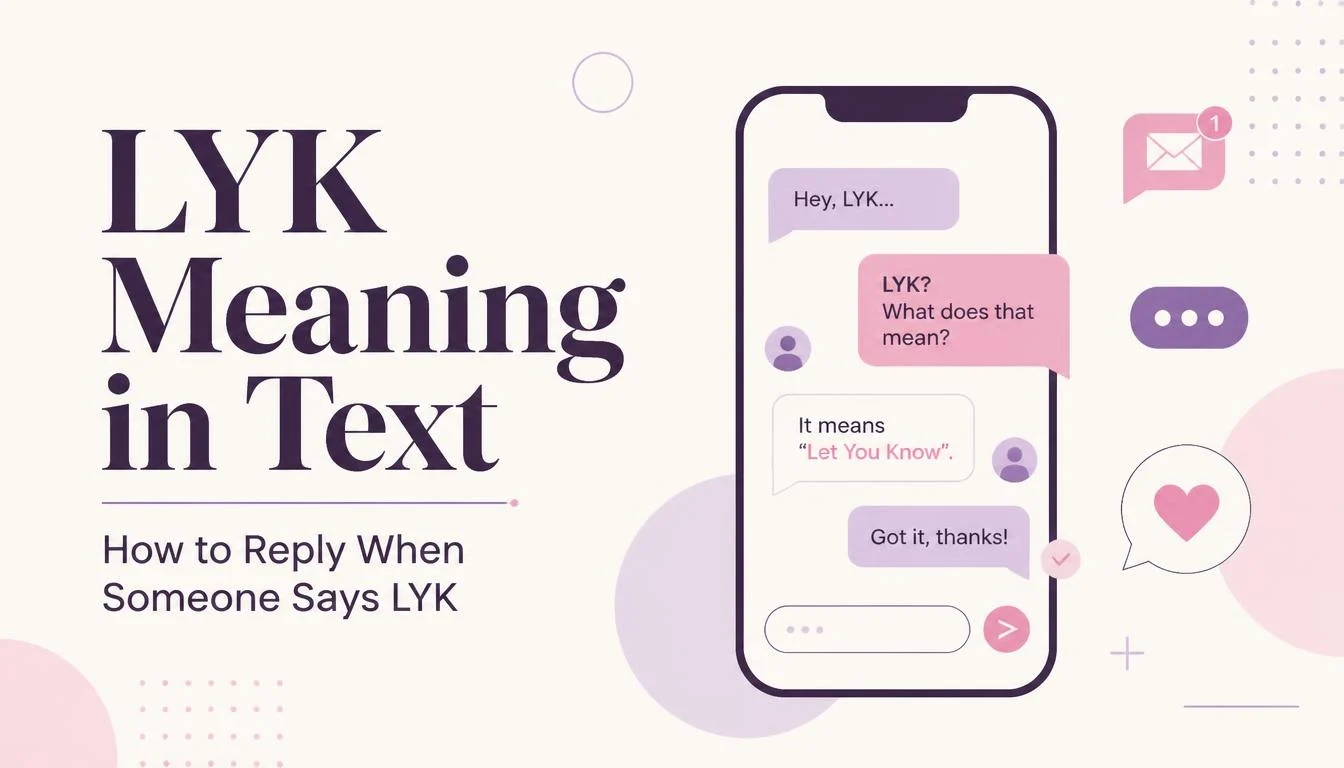
Quick Answer:
LYK means “Let You Know” in text messages and online conversations. People use it when they plan to share information or give someone an update later. For example, “I’ll LYK when I get there” means “I’ll let you know when I get there.”
You might see “LYK” in a text message when someone wants to share information, answer a question, or keep another person updated. It is a common texting abbreviation that makes everyday conversations quicker, especially when people are messaging friends, family, or coworkers.
The meaning is usually straightforward, but the context matters. A message such as “I’ll lyk tomorrow” sounds different from “Lyk if you need anything.” Understanding the abbreviation helps you follow the conversation and respond naturally.
What Does LYK Mean in Text?
LYK means “let you know.” People use it in text messages, direct messages, and online chats when they want to tell someone that they will provide information or an update.
For example, “I’ll lyk when I get there” means “I’ll let you know when I get there.”
The abbreviation is informal and convenient. It can refer to a future update, a decision, a change of plans, or information someone is waiting to receive. Its exact meaning depends on the surrounding message.
How LYK Is Used in Everyday Texting
LYK is useful when someone cannot provide an immediate answer but expects to have more information later. Rather than explaining the entire situation, they can send a short message and follow up when they know more.
Here are some common situations where it fits naturally.
1. Making Plans With Friends
Imagine your friend invites you to a birthday dinner, but you are not sure whether you will be available.
You might reply:
“I have to check with my family. I’ll lyk tonight.”
This means you will tell your friend whether you can attend after checking your plans. You have not accepted or declined the invitation yet.
2. Waiting for Information
LYK also works when someone needs to confirm a detail before answering.
For example:
“I’ll ask the manager and lyk tomorrow.”
The sender plans to share the answer after speaking with the manager. It communicates an intention to follow up rather than an answer that is already confirmed.
3. Keeping Someone Updated
Sometimes, people use LYK when a situation might change.
For example:
“We’re still waiting for the tickets. I’ll lyk when they arrive.”
Here, the sender promises to provide an update when something happens. This is useful for coordinating travel, events, deliveries, or other arrangements.
4. Responding Without Making a Commitment
LYK can also help someone avoid giving an answer before they are ready.
For example:
“I’m not sure if I can come this weekend. I’ll lyk.”
The person may be interested in attending, but they need time to decide. The message leaves the possibility open without making a firm promise about the plans themselves.
LYK Examples in Real Conversations
The surrounding words often make the meaning obvious. These illustrative conversations show how people might use the abbreviation in different situations.
Example 1: Weekend Plans
Alex: “Are we still going to the movies Saturday?”
Jordan: “I need to check my schedule. I’ll lyk.”
Meaning: Jordan will confirm after checking whether Saturday works.
Example 2: Asking About a Delivery
Sam: “Did your package arrive?”
Taylor: “Not yet. I’ll lyk when it gets here.”
Meaning: Taylor will send Sam an update after the package arrives.
Example 3: Making a Decision
Friend 1: “Do you want to join us for lunch?”
Friend 2: “Let me think about it and lyk.”
Meaning: The second friend will share their decision later.
Example 4: A School Assignment
Student 1: “Did the teacher change the deadline?”
Student 2: “I’ll check the class group and lyk.”
Meaning: The student will check the group chat and report what they find.
Example 5: A Casual Social Media Message
Person 1: “Can you send me the name of that song?”
Person 2: “Sure, I’ll lyk when I find it.”
Meaning: The second person will share the song’s name once they identify it.
Across these examples, the main idea stays the same: someone intends to provide information when they have it.
Does LYK Have Different Meanings?
Although “let you know” is the main meaning of LYK in texting, context can change how you interpret the letters.
A less common use is “like,” written informally as lyk. This spelling may appear in casual online writing, particularly when someone is using phonetic or shortened spellings.
For example:
“I lyk this song.”
In this sentence, lyk means like, not let you know. The word appears as part of a statement about a song rather than a promise to provide information later.
Compare the two examples:
| MessageIntended meaning | |
|---|---|
| “I’ll lyk tomorrow.” | I’ll let you know tomorrow. |
| “I lyk that movie.” | I like that movie. |
| “I’ll lyk when I’m free.” | I’ll tell you when I’m available. |
| “I lyk your new shoes.” | I like your new shoes. |
The sentence structure helps you distinguish the meanings. If LYK follows a phrase such as “I’ll” and introduces a future update, it almost certainly means “let you know.” If it appears where the verb like would normally go, the shortened spelling may be intended.
You do not need to assume that every unfamiliar message contains a hidden meaning. Reading the whole sentence is usually enough.
LYK vs. LMK, ILYK, and FYI
LYK is easy to confuse with other texting abbreviations because they appear in similar conversations. However, each has a different purpose.
| Abbreviation | Full form | Main purpose |
|---|---|---|
| LYK | Let you know | Refers to sharing information |
| LMK | Let me know | Asks someone to share information with you |
| ILYK | I’ll let you know | Explicitly promises a future update |
| FYI | For your information | Introduces information someone may find useful |
LYK vs. LMK
The difference between LYK and LMK is the direction of the information.
- LYK: “I’ll lyk when I arrive.” The sender will provide the update.
- LMK: “Lmk when you arrive.” The sender wants the recipient to provide the update.
A simple way to remember it is that you in LYK refers to the person receiving the information, while me in LMK refers to the person who wants to receive it.
LYK vs. ILYK
ILYK means “I’ll let you know.” It makes the future intention explicit.
For example:
- “I’ll lyk after my meeting.”
- “I’ll lyk after my meeting.”
Both communicate the same thing. The second wording simply uses the full abbreviation with the subject and auxiliary verb already included.
In practice, LYK commonly appears after “I’ll” or “will,” while ILYK can serve as a more compact version of the complete phrase.
LYK vs. FYI
FYI means “for your information.” It introduces information that the recipient should know, rather than promising to share information later.
For example:
- “I’ll lyk when the office opens.” The sender will provide an update later.
- “FYI, the office opens at 9 a.m.” The sender is sharing information now.
This distinction is useful when reading messages about appointments, work schedules, or other arrangements.
How to Reply to LYK
Your response depends on what the other person is promising to tell you. Most of the time, you can acknowledge the message without asking for additional details.
Here are a few natural replies.
When you are happy to wait
Them: “I’ll lyk tonight.”
“Okay, sounds good!”
When you need an update soon
Them: “I’ll lyk when I hear back.”
“Thanks! Just let me know when you can.”
When you are making plans
Them: “I’ll lyk if I can make it.”
“No problem. I’ll keep that in mind.”
When the information is time-sensitive
Them: “I’ll lyk later.”
“Sure. Could you let me know by 5 p.m.?”
You can also reply with “Got it,” “Thanks,” or “Sounds good.” There is no special response required simply because someone used an abbreviation.
If you need to make your own plans, it is reasonable to ask when they expect to know. That keeps the conversation clear without putting unnecessary pressure on the other person.
Is LYK Appropriate in Professional Messages?
LYK is generally best suited to informal communication. It works well in conversations with friends, classmates, family members, and colleagues who regularly use texting shorthand.
However, it may look too casual in a formal email, a message to a new client, or communication with someone who might not recognize the abbreviation.
Instead of writing:
“I’ll lyk once the report is ready.”
You could write:
“I’ll let you know once the report is ready.”
For a more polished business message, you might say:
“I’ll provide an update as soon as the report is ready.”
The meaning stays the same, but the wording is more appropriate for a professional setting.
There is no need to avoid LYK entirely at work. If your team communicates casually through instant messages, the abbreviation may fit the established tone. The important thing is to consider your audience and the purpose of the message.
FAQs
1. What does LYK mean from a guy or girl?
LYK usually means “let you know,” regardless of who sends it. It does not automatically indicate flirting, romantic interest, or a lack of interest. The rest of the conversation provides more useful clues about the person’s intentions.
2. Does LYK mean yes or no?
No. LYK usually means the person will provide an answer or update later. If someone replies “I’ll lyk” to an invitation, they have not necessarily accepted or declined it.
3. What does “I’ll lyk” mean?
I’ll lyk” means “I’ll let you know.” The sender intends to share information, confirm a decision, or provide an update when they have more details.
4. Is LYK the same as LMK?
No. LYK means “let you know,” while LMK means “let me know.” LYK usually refers to the sender sharing information with the recipient, whereas LMK asks the recipient to share information with the sender.
5. Should I write LYK in uppercase or lowercase?
Both LYK and lyk are used in informal digital communication. Neither capitalization style changes the usual meaning. Choose the form that looks natural in your conversation.
Conclusion
When you see LYK in a message, read it as “let you know” first. In most cases, the sender is saying they will share an answer or update later, not giving you a definite yes or no.
If the abbreviation appears in a sentence where like makes more sense, consider that less common interpretation instead. A quick look at the surrounding words will usually tell you which meaning fits.
Read More Related Articles:
- “Soxer” Mean | Truth Behind This Confusing Term In 2026
- LWK Meaning in Text | Hidden Slang You’re Probably Missing In 2026
- “Live” Mean on Find My iPhone | Complete Guide to Real-Time Location Sharing In 2026






2 thoughts on “LYK Meaning in Text | How to Reply When Someone Says LYK In 2026”