Quick Answer
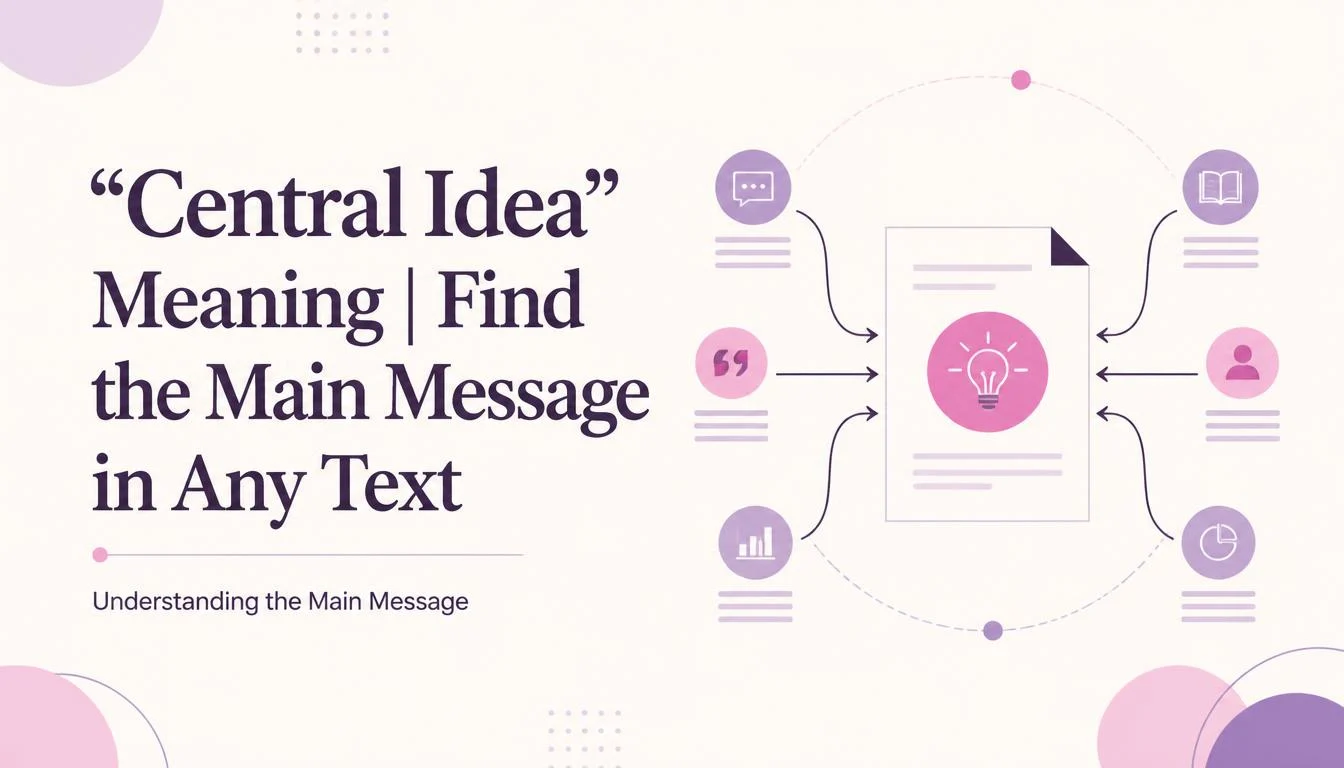
“Central Idea” Meaning refers to the main point or most important message of a text. It tells readers what the author primarily wants them to understand.
Understanding “Central Idea” Meaning makes reading and analyzing any text much easier. The central idea is the key point that connects the important details, examples, and information presented by the author.
Whether you’re reading a story, article, essay, or passage, identifying the central idea helps you understand what the text is mainly about. In this guide, we’ll explore its meaning, examples, and simple ways to find it.
Central Idea: Quick Definition
Central idea means the main point, core message, or overall takeaway that a piece of writing, speech, or artwork is built around. It’s the single most important idea that everything else in the text supports, explains, or develops.
In simpler terms: the central idea is the “so what?” of a piece of writing. Every supporting detail, example, and argument exists to back it up.
Think of it like the trunk of a tree 🌳 the branches (details, examples, arguments) all grow out of it, but the trunk is what holds everything together.
Where Does the Term “Central Idea” Come From?
The phrase isn’t slang, and it doesn’t have some viral origin story it’s an academic and literary term that’s been part of English education for generations. It grew out of classical rhetoric and composition theory, where writers and teachers needed a way to describe the “controlling thought” that unifies a piece of writing.
Here’s a quick breakdown of its roots:
- “Central” comes from the Latin centralis, meaning “at the center” the core, the middle, the anchor point.
- “Idea” traces back to the Greek idea, meaning “form” or “pattern” essentially, a concept or notion.
Put together, “central idea” literally means the idea sitting at the center of everything else. Teachers and textbooks picked up the phrase because it’s descriptive and easy to visualize much easier than more abstract terms like “thesis” or “controlling purpose.”
Why It Became So Popular in Classrooms
The term really took off in reading comprehension curricula, especially in K-12 education, standardized testing, and ESL (English as a Second Language) instruction. Reading tests (think state assessments, SAT-style questions, and English proficiency exams) frequently ask students to:
- Identify the central idea of a passage
- Choose a sentence that best expresses the central idea
- Summarize a text based on its central idea
Because it shows up so often in test prep and classroom instruction, “central idea” has become one of the most searched literacy terms online especially among students, parents helping with homework, and teachers building lesson plans.
How “Central Idea” Is Used in Real Life
While the term is most common in academic settings, it shows up far beyond the classroom. Here’s where you’ll actually encounter it:
- 📚 Reading comprehension exercises “What is the central idea of paragraph 2?”
- ✍️ Essay writing and composition courses “Make sure every paragraph supports your central idea.”
- 🎤 Public speaking and presentations “Keep coming back to your central idea so the audience doesn’t get lost.”
- 📰 Journalism and editing “This article buries the central idea in the fifth paragraph.”
- 💼 Business communication “Your slide deck needs one clear central idea, not five.”
- 🎨 Art and film analysis “The central idea of the film is about the cost of ambition.”
Basically, anywhere someone needs to boil down a large amount of information into one clear, unifying point, the phrase fits naturally.
Examples With Context
Context changes everything. Here’s how “central idea” sounds in different tones friendly, neutral, and a little more blunt or dismissive.
| Tone | Example Sentence | What It Implies |
|---|---|---|
| 😊 Friendly/Encouraging | “Nice work! Your central idea really comes through in the first paragraph.” | Praise the point is clear and well-supported. |
| 😐 Neutral/Academic | “The central idea of this passage is the impact of climate change on coastal cities.” | Straightforward description, no emotional weight. |
| 😕 Dismissive/Critical | “Honestly, I read the whole thing twice and I still can’t find a central idea.” | Frustration the writing feels unfocused or unclear. |
| 🧑🏫 Instructional | “Before you write your essay, jot down your central idea in one sentence.” | Guidance used as a teaching tool. |
| 💬 Casual conversation | “What’s the central idea here, though? Just tell me the point.” | Informal way of asking someone to get to the point. |
Notice how the phrase stays professional even in casual or critical use it doesn’t have slang baggage, which makes it safe to use in almost any setting, from a classroom to a boardroom.
Central Idea vs. Similar Terms
This is where a lot of confusion happens, because “central idea,” “main idea,” “theme,” and “thesis” often get used interchangeably but they’re not quite the same thing.
| Term | What It Means | Best Used For |
|---|---|---|
| Central Idea | The core message or unifying point of a whole text | Reading comprehension, longer texts, speeches |
| Main Idea | Very similar to central idea, but often used for a single paragraph or shorter passage | Individual paragraphs or short texts |
| Theme | The underlying message about life, society, or human nature (common in literature) | Fiction, poetry, film |
| Thesis Statement | A specific, arguable claim the writer sets out to prove | Argumentative or academic essays |
| Topic | The general subject matter broader and less specific than the central idea | Describing what something is “about” in one or two words |
A Simple Way to Remember the Difference
- Topic = What is this about? (e.g., “friendship”)
- Central/Main Idea = What is the text saying about that topic? (e.g., “true friendship requires honesty, even when it’s uncomfortable”)
- Theme = What deeper truth about life does it reveal? (e.g., “honesty is the foundation of trust”)
- Thesis = What is the writer arguing, specifically, that they intend to prove with evidence?
Once you separate these, “central idea” becomes much easier to spot it sits right between the broad topic and the deeper theme.
Are There Alternate Meanings?
Not really “central idea” doesn’t carry hidden meanings, slang usage, or alternate definitions the way some internet terms do. It’s used fairly consistently across contexts. That said, a few soft variations exist depending on the field:
- In literature classes, it sometimes overlaps loosely with “theme.”
- In business and design, it can mean the “big idea” or “core concept” behind a pitch, product, or campaign.
- In public speaking, it’s sometimes called the “key message” or “core message.”
None of these are wildly different they all point back to the same core concept: the one idea everything else is built around.
Polite and Professional Alternatives
If you want to switch things up in writing especially in professional, academic, or editing contexts here are some solid alternatives to “central idea”:
- Main point
- Core message
- Key takeaway
- Controlling idea
- Unifying idea
- Thesis (for argumentative writing)
- Big idea (more casual, often used in education/design)
- Focal point
Using varied phrasing also helps with natural, human-sounding writing instead of repeating the same term over and over which is good practice for both readability and SEO.
How to Identify the Central Idea (Practical Tips)
If you’re staring at a paragraph or essay and struggling to pin down the central idea, try this simple process:
- Read the whole passage first don’t stop at the first sentence and assume that’s it.
- Ask “What is this mostly about?” this gets you the topic.
- Ask “What is the writer saying about that topic?” this gets you closer to the central idea.
- Check the supporting details do they all connect back to one idea? If yes, you’ve found it.
- Try summarizing in one sentence if you can’t do it in one sentence, you may be capturing a detail instead of the central idea.
- Watch topic sentences in well-structured writing, the central idea is often (but not always) stated early, frequently as the topic sentence of an introductory paragraph.
💡 Pro tip: The central idea is usually implied through the whole piece rather than stated word-for-word in a single sentence especially in narrative or descriptive writing. Don’t expect to always find it in bold letters; sometimes you have to connect the dots yourself.
FAQs
1. What does central idea mean in simple words?
The central idea is the main point or overall message of a piece of writing. It represents the key takeaway the author wants readers to understand.
2. Is central idea the same as main idea?
They are very similar. Main idea is often used when discussing a paragraph or shorter passage, while central idea may describe the overall point of a longer text. In many situations, the terms can be used interchangeably.
3. How do you find the central idea of a paragraph?
Read the entire paragraph and consider what all the sentences are mainly trying to explain or support. The common point connecting those sentences is usually the central idea.
4. What’s the difference between central idea and theme?
A central idea describes the main point of a particular text, while a theme expresses a broader message or lesson about life, people, or human experiences. Themes are especially common in literary works.
5. Can a text have more than one central idea?
A focused text generally has one main central idea, supported by several related points. Longer or more complex texts can contain multiple major ideas, but they should still connect to the overall purpose of the writing.
6. Is central idea the same as a thesis statement?
No. A thesis statement usually presents a specific claim or argument in an academic or persuasive essay. A central idea is broader and can apply to essays, articles, stories, and many other types of writing.
7. Why is identifying the central idea important?
Finding the central idea helps readers understand a text more quickly and improves reading comprehension. It also helps writers keep their content focused and relevant.
8. How do you write a strong central idea for an essay?
Write it as one clear and specific sentence that explains the main point rather than simply naming the topic. Make sure the major points and paragraphs of the essay support that central idea.
Conclusion
At its core (pun intended), the phrase central idea is really just a tool a way to ask, “What’s this actually about, and what’s it trying to say?” Whether you’re a student prepping for a reading comprehension test, a writer trying to keep an essay focused, or just someone trying to figure out the point of a long email, the concept is the same everywhere: find the one idea that holds everything else together.
Key takeaways:
- The central idea is the core message a piece of writing revolves around.
- It’s different from but related to main idea, theme, topic, and thesis.
- It shows up constantly in education, writing, business, and everyday conversation.
- You can identify it by looking at what all the supporting details have in common.
- Strong writing usually supports one clear central idea rather than several competing ones.
Next time someone asks you, “What’s the central idea here?” you won’t just have an answer. You’ll actually know how to find one.
Read More Related Articles:
- Mercy Meaning | Powerful Lesson Behind Kindness and Forgiveness In 2026
- Mija Meaning In Spanish | Sweet Nickname You’ll Hear Everywhere In 2026
- Punta Meaning In Spanish | From Literal Meaning to Everyday Usage In 2026

Michael Turner is a U.S.-based content writer and blogger who enjoys uncovering the stories and meanings behind words. Through his work at Meanvora, he delivers well-researched, easy-to-read articles that help readers expand their vocabulary and gain a deeper understanding of language.




5 thoughts on ““Central Idea” Meaning | Find the Main Message in Any Text In 2026”