Quick Answer
Expanded Form Mean In Text usually refers to writing a shortened word, abbreviation, or acronym in its complete form. For example, “LOL” has the expanded form “Laughing Out Loud.”
If you’re searching for Expanded Form Mean In Text, it generally means finding out what an abbreviation or shortened term stands for when used in digital conversations. People commonly use short forms in texts, chats, and social media to communicate quickly.
Understanding the Expanded Form Mean In Text can make online conversations easier to follow, especially when unfamiliar acronyms appear in messages. This guide explains common examples and how to understand them from context.
What Does Expanded Form Mean:
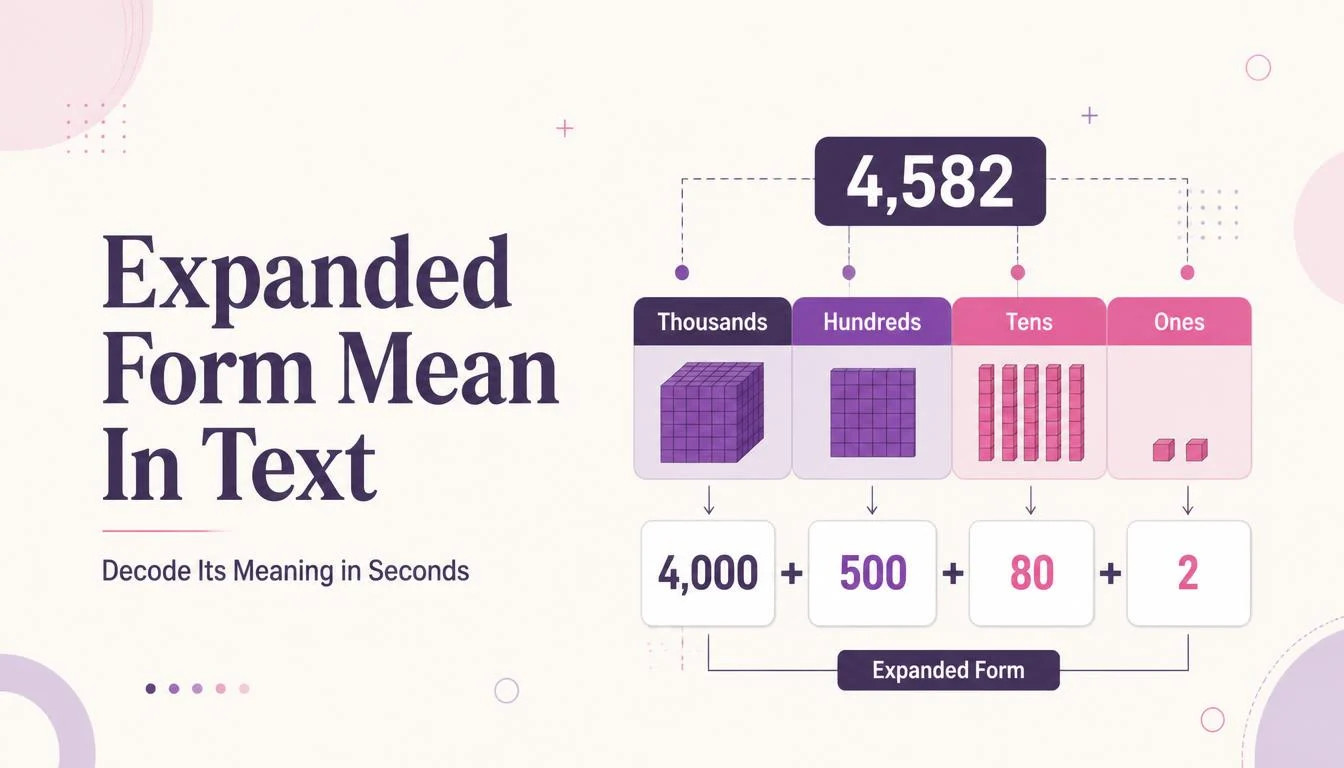
Expanded form is a way of writing a number that shows the value of each digit based on its place value, breaking the number into a sum of its parts. For example, the number 5,362 in expanded form is written as 5,000 + 300 + 60 + 2.
In short: expanded form takes a number apart and shows you exactly what each digit is contributing to the total.
That’s the core idea. Everything else in this article builds on that one simple sentence.
Where Did Expanded Form Come From: Origin and Background
Expanded form isn’t a modern invention or a trendy teaching gimmick. It’s rooted in the place value system, also called the base-10 or decimal system, which has been around for centuries and traces back to ancient Indian and Arabic mathematicians who developed the positional number system we still use today.
Before place value systems became widespread, many cultures used number systems like Roman numerals, where symbols didn’t shift value based on position. A “X” always meant 10, no matter where it appeared. But place value changed everything suddenly, a single digit like “3” could mean three, thirty, three hundred, or three thousand, depending on where it sat in a number.
Expanded form grew naturally out of this system. Teachers and mathematicians needed a way to visually demonstrate why position matters, and breaking numbers into place-value sums became the go-to method. It’s been a staple of elementary math education for generations, and it remains one of the first “aha” moments many students have with numbers.
Why Is Expanded Form Still So Widely Used Today?
Expanded form shows up constantly in classrooms, textbooks, and homework sheets, especially in grades 1 through 5. Its popularity comes down to a few simple reasons:
- It builds number sense. Kids who understand expanded form typically grasp addition, subtraction, and regrouping (carrying and borrowing) faster.
- It makes place value visible. Instead of just memorizing that the “3” in 300 is “worth more” than the “3” in 30, students can literally see the difference.
- It’s a bridge to other math skills. Concepts like scientific notation, polynomial expressions, and even algebra later on borrow the same “break it into parts” logic.
- It’s tested frequently. Standardized tests and common core curriculums in the U.S. (and similar frameworks elsewhere) include expanded form as a foundational skill, so it keeps getting reinforced year after year.
Basically, expanded form isn’t just a classroom exercise it’s a mental model that sticks with people long after elementary school, even if they don’t consciously think about it anymore.
How Expanded Form Actually Works With Examples
Let’s get into the mechanics with some real, relatable examples.
Whole Numbers
| Number | Expanded Form |
|---|---|
| 47 | 40 + 7 |
| 358 | 300 + 50 + 8 |
| 6,215 | 6,000 + 200 + 10 + 5 |
| 92,047 | 90,000 + 2,000 + 0 + 40 + 7 |
| 1,000,000 | 1,000,000 (already at the highest place value) |
Notice something in the 92,047 example? Even the zero gets acknowledged conceptually (it holds the hundreds place), though in practice it’s often just skipped since adding zero doesn’t change the sum.
Decimal Numbers
Expanded form works with decimals too, which surprises a lot of people.
| Number | Expanded Form |
|---|---|
| 3.45 | 3 + 0.4 + 0.05 |
| 12.6 | 10 + 2 + 0.6 |
| 0.789 | 0.7 + 0.08 + 0.009 |
Expanded Form with Exponents (Upper-Level Version)
Once students hit late elementary or middle school, expanded form sometimes gets a more advanced twist using powers of 10:
4,725 = (4 × 1,000) + (7 × 100) + (2 × 10) + (5 × 1)
Or written with exponents:
4,725 = (4 × 10³) + (7 × 10²) + (2 × 10¹) + (5 × 10⁰)
This version is especially useful once students move toward scientific notation or algebraic expressions, since it reinforces the idea that each place value is really just a power of 10.
Tone and Context: How “Expanded Form” Is Used in Real Conversations
Unlike slang terms or internet abbreviations, “expanded form” doesn’t really carry an emotional tone it’s a neutral, technical math term. You won’t see it used sarcastically or as an insult. That said, here’s how it typically shows up depending on context:
📘 Educational/Neutral Context
“Write 6,304 in expanded form before moving to the next problem.”
This is the most common usage instructional, straightforward, no emotional weight attached.
🧑🏫 Friendly/Encouraging Context
“Great job! You broke that number into expanded form perfectly. 🎉”
Teachers and parents often use this phrase warmly, especially with younger learners, since mastering expanded form is often treated as a small milestone.
😅 Frustrated/Struggling Context
“I keep mixing up expanded form and standard form on my homework, ugh.”
Here, the term itself isn’t negative, but the context around it (a student struggling) gives it a slightly exasperated tone. This is common in tutoring sessions or homework-help forums.
There’s no version of “expanded form” used dismissively or negatively toward another person it’s purely a mathematical descriptor, so you won’t find it functioning as slang or an insult anywhere.
Expanded Form vs. Similar Math Terms
This is where a lot of confusion creeps in, so let’s clear it up with a comparison table.
| Term | What It Means | Example (for 4,382) |
|---|---|---|
| Standard Form | The normal way we write numbers | 4,382 |
| Expanded Form | Breaking the number into place-value sums | 4,000 + 300 + 80 + 2 |
| Word Form | Writing the number out in words | Four thousand, three hundred eighty-two |
| Expanded Notation | Same as expanded form, sometimes used interchangeably; occasionally refers to the exponent-based version | (4 × 1,000) + (3 × 100) + (8 × 10) + (2 × 1) |
| Scientific Notation | Used for very large or very small numbers, written as a number times a power of 10 | 4.382 × 10³ |
Quick tip: “Expanded form” and “expanded notation” are often taught as the same thing in elementary school, but some curriculums reserve “expanded notation” specifically for the multiplication-based version (using × signs and powers of 10). If you’re not sure which your teacher or textbook wants, the safest move is to ask or provide both versions when in doubt.
Are There Other Meanings of “Expanded Form”?
Outside of math class, the phrase “expanded form” does pop up in a few other contexts, though far less frequently:
- Grammar/Writing: Occasionally used loosely to describe writing out abbreviations or contractions in full (e.g., “can’t” → “cannot”), though the more accurate term for this is usually “expanded contraction” or simply “full form.
- Biology (rare/informal use): Sometimes used casually to describe an organism or structure that has grown, unfolded, or extended beyond its resting state though this is informal usage, not a standardized scientific term.
- Legal/Administrative Forms: In some workplace or bureaucratic contexts, “expanded form” might loosely refer to a longer version of a document or application, as opposed to a “short form.” This is unrelated to math but does appear in casual conversation.
That said, in the overwhelming majority of cases especially when searched online “expanded form” refers to the math concept covered in this article.
Polite and Professional Alternatives / Related Phrasing
Since expanded form is already a neutral, professional term, there’s rarely a need to “soften” it. But depending on context, here are some phrasing alternatives that mean the same thing or are used interchangeably in classrooms:
- “Write the number in place-value form”
- “Break the number down by place value”
- “Show the expanded notation”
- “Express the number as a sum of its place values”
These are especially handy for teachers who want to vary their language across lessons so it doesn’t feel repetitive, or for parents helping with homework who want to explain the concept a different way if the first explanation doesn’t click.
Common Mistakes People Make with Expanded Form
A few patterns show up again and again, especially with younger learners:
- Forgetting zeros as placeholders. For 5,032, students sometimes write “5,000 + 3 + 2” and skip acknowledging the missing tens place, which can cause errors later when adding.
- Confusing expanded form with word form. These are two completely different skills, but they’re often taught back-to-back, so mix-ups are common.
- Struggling with decimals. Many students master whole-number expanded form quickly but stumble once decimals enter the picture, since tenths, hundredths, and thousandths feel more abstract.
- Misplacing commas or values in larger numbers. With numbers in the hundred-thousands or millions, it’s easy to drop a zero or misalign a place value.
If you’re teaching or tutoring someone, catching these specific errors early tends to prevent bigger confusion down the road.
FAQs
1. What does expanded form mean in math?
Expanded form means writing a number as the sum of the value of each digit according to its place value. For example, 632 can be written as 600 + 30 + 2.
2. What is the difference between expanded form and standard form?
Standard form writes a number normally, such as 632. Expanded form separates it into its individual place-value parts, such as 600 + 30 + 2.
3. How do you write a decimal in expanded form?
Break down each digit according to its decimal place value. For example, 4.56 can be written as 4 + 0.5 + 0.06.
4. What grade level typically learns expanded form?
Students usually begin learning expanded form in 1st or 2nd grade with basic whole numbers. The concept is later applied to larger numbers, decimals, and exponents in higher elementary grades.
5. Is expanded form the same as expanded notation?
They are closely related and are often used interchangeably. However, some teachers use expanded notation for forms that show multiplication and powers of 10.
6. Why is expanded form important to learn?
Learning expanded form helps students understand place value, which is an important foundation for skills such as addition, subtraction, multiplication, and later mathematical concepts.
7. How do you write a number in expanded form with exponents?
Each digit is multiplied by its corresponding power of 10. For example, 352 can be written as (3 × 10²) + (5 × 10¹) + (2 × 10⁰).
8. Can expanded form be used for negative numbers?
Yes. The same place-value principles apply to negative numbers. For example, -246 can be expressed as -(200 + 40 + 6).
Conclusion
Expanded form is a simple but important way to understand how each digit contributes to a number based on place value. It works with whole numbers, decimals, and exponent notation, making number structure easier to understand. Once you know the basics, you can avoid common mistakes with zeros and decimal places and build stronger overall number sense.
Read More Related Articles:
- DILF Meaning | Why This Slang Term Is Trending Online In 2026
- “Show in Shared with You” Meaning | What This Option Really Does In 2026
- “Live” Mean on Find My iPhone | Complete Guide to Real-Time Location Sharing In 2026











8 thoughts on “Expanded Form Mean In Text | Decode Its Meaning in Seconds In 2026”