Quick Answer
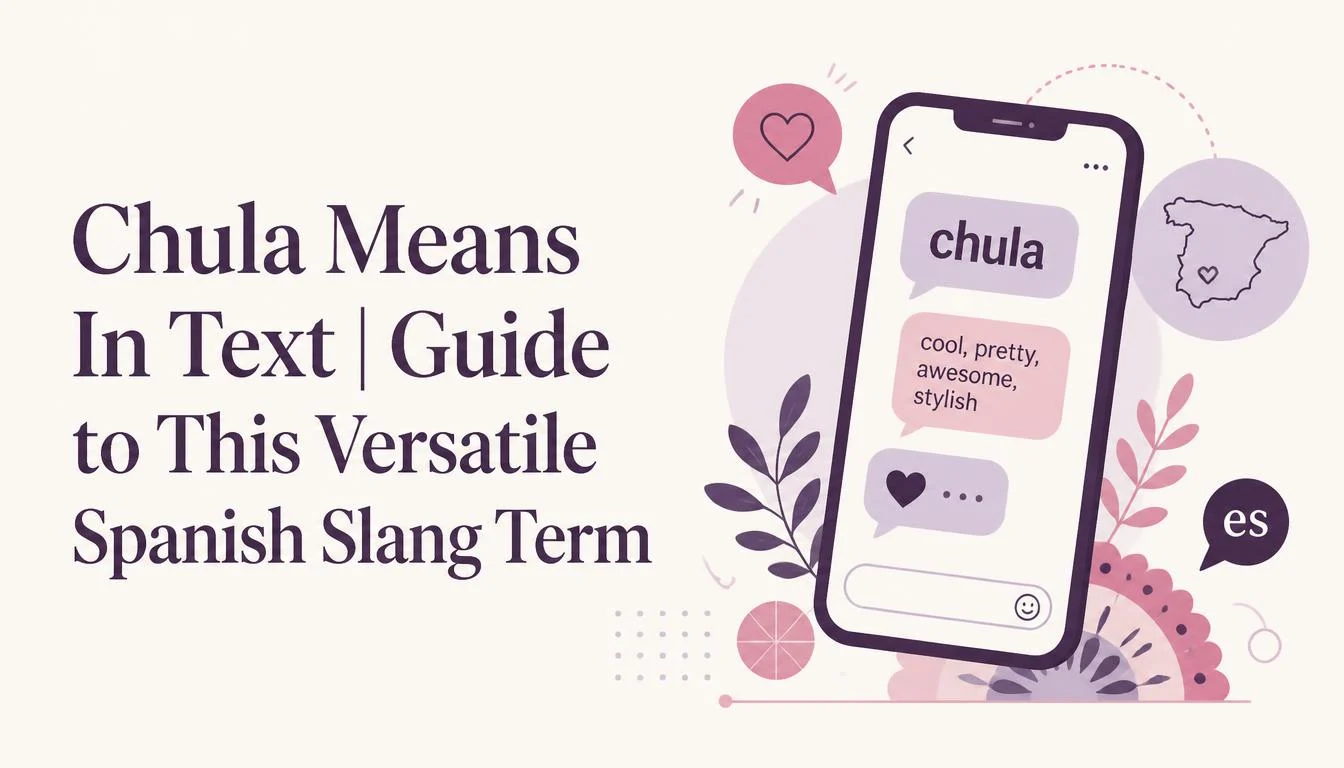
Chula means in text can vary by language and context, but it is often used as a slang or affectionate term in Spanish-speaking conversations. The exact meaning depends on who says it and how it is used.
If you’re wondering what Chula Means In Text, you’ve likely come across it in a message, social media post, or casual conversation. Chula can have different meanings depending on the language, region, and context, so understanding the tone is important.
In many informal Spanish contexts, chula can be used affectionately to describe someone as cute, pretty, or lovely. This guide explains the meaning of Chula Means In Text, how people use it, and what it can imply in different conversations.
Origin
To truly understand “chula,” we need to trace its linguistic journey through Spanish history and across different regions.
The Masculine Root: “Chulo” 👨
“Chula” is the feminine form of “chulo.” Understanding “chulo” is essential to grasping what “chula” means.
In European Spanish, “chulo” historically referred to a “pimp” or a “low-class, flashy person” from Madrid’s working-class neighborhoods. These “chulos” were known for their bold, ostentatious style and confident attitude. Over time, the word evolved to describe anyone who is cocky, flashy, or full of themselves.
In Mexican Spanish, “chulo” can mean “cute,” “pretty,” or “nice.” You might hear someone say “¡Qué chulo!” to describe a cute puppy or a nice dress. This is a much more innocent, wholesome usage.
Across Latin America, “chulo” carries the connotation of someone who is attractive, charming, and stylish but with a hint of roguishness or swagger.
The Feminine Form: “Chula” 👩
As the feminine counterpart, “chula” follows the same pattern of meaning. It can mean:
- Attractive or pretty (a compliment for a woman)
- Cool or nice (describing a thing or situation)
- Flashy or ostentatious (sometimes positive, sometimes negative)
- Cocky or full of oneself (often negative)
- A female pimp (in its most literal, offensive sense)
The Spelling and Pronunciation 📝
“Chula” is spelled with a “ch” (like in “cheese”), a “u,” an “l,” and an “a.” It’s pronounced “CHOO-lah” the “u” is pronounced like “oo,” the “ch” is soft, and the stress falls on the first syllable.
You might also see it spelled as “chula” in various contexts there’s no alternate spelling, though it’s sometimes used in combination with other words like “mami chula” or “chula vista.”
Popularity
So how did a Spanish slang term with potentially offensive undertones become a global pop culture phenomenon? Let’s trace its journey.
The Reggaeton and Latin Music Explosion 🎵
“Chula” truly went global thanks to the Latin music explosion of the early 2000s and continuing through today. Reggaeton, Latin pop, and regional Mexican music brought Spanish slang to audiences worldwide.
Countless songs feature “chula” in their lyrics:
- “Mami Chula” a common phrase in reggaeton and Latin pop
- “Chula” as a standalone song title by various artists
- Appearances in hits by Bad Bunny, Karol G, Daddy Yankee, and many others
The term’s musical association has made it instantly recognizable even to non-Spanish speakers.
Mainstream Crossover 🌎
By the 2010s and 2020s, “chula” had crossed over into mainstream English-language media:
- TV shows: Characters in shows like Jane the Virgin, Ugly Betty, and Modern Family used the term, often for comedic effect.
- Movies: Hollywood films featuring Latinx characters incorporated the slang.
- Social media: Today, “chula” is a staple of TikTok, Instagram, and Twitter, often used in hashtags, captions, and memes.
- Fashion and beauty: The term is frequently used in Latinx fashion and beauty content.
By the Numbers 📊
| Metric | Insight |
| Primary users | Spanish speakers, Latinx communities, and fans of Latin music worldwide |
| Peak usage | 2000s to present (ongoing) |
| Platforms | TikTok, Instagram, Twitter, music streaming services |
| Global recognition | Recognized by non-Spanish speakers in over 50 countries |
| Dictionary inclusion | SpanishDict, Urban Dictionary, and multiple Spanish-language dictionaries |
The Enduring Appeal 💫
What makes “chula” so enduringly popular? A few factors stand out:
- Musical association: The term is forever linked to catchy Latin beats.
- Cross-cultural appeal: It sounds unfamiliar and romantic to non-Spanish speakers.
- Versatility: It can be flirty, playful, sarcastic, or affectionate.
- Swagger factor: It captures a certain attitude that English words struggle to convey.
- Gender dynamics: As a feminine term, it carries specific cultural weight about femininity, confidence, and desirability.
How It Is Used
Understanding how to use “chula” is key to sounding like you know what you’re talking about. Let’s break down the different ways people use this word.
As a Compliment for a Woman 💃
The most common usage is as a compliment for an attractive, stylish, or charming woman. It’s the Spanish equivalent of calling someone “hot,” “pretty,” or “gorgeous.”
Examples:
- “¡Qué chula te ves hoy!” (“You look so pretty today!”)
- “Esa chica es muy chula.” (“That girl is very attractive.”)
- “¡Ay, qué chula!” (“Oh, how cute/pretty!”)
As a Term of Endearment 💕
Among romantic partners or close friends, “chula” functions as a term of endearment similar to “baby,” “honey,” or “gorgeous” in English.
Examples:
- “Ven aquí, chula.” (“Come here, gorgeous.”)
- “Buenos días, chula. ¿Dormiste bien?” (“Good morning, gorgeous. Did you sleep well?”)
To Describe Something Cool or Nice 😎
Beyond people, “chula” can describe things, situations, or experiences that are cool, nice, or impressive.
Examples:
- “¡Qué chula está tu casa!” (“Your house is so cool!”)
- “Esa canción está bien chula.” (“That song is really cool.”)
- “¡Qué chula la fiesta!” (“The party is so nice!”)
As “Mami Chula” (A Common Phrase) 🔥
“Mami chula” is a very common phrase that combines “mami” (an affectionate term for a woman) with “chula.” It means something like “gorgeous baby” or “hot mama.”
Examples:
- “¿Qué haces, mami chula?” (“What’s up, hot mama?”)
- “Esa mami chula me tiene loco.” (“That gorgeous woman has me wild.”)
As a Playful or Ironic Tease 😏
Among friends, “chula” can be used playfully or ironically especially if the person being addressed is not particularly stylish or is acting silly.
Examples:
- “Ay, qué chula te crees.” (“Oh, you think you’re so cute.”) said sarcastically
- “Mira, la chula.” (“Look, Miss Fancy.”) playful teasing
As a Derogatory Term (Female Pimp) ⚠️
In its most literal and potentially offensive usage, “chula” means a female pimp a woman who profits from the prostitution of others. This usage is less common in everyday conversation but still exists in certain contexts.
As “Chula Vista” (Place Name) 🌴
“Chula Vista” is a city in California, and the name translates to “beautiful view.” This is a more literal, non-slang use of the word.
Examples
Let’s look at how “chula” plays out in different contexts and tones.
Friendly Examples 😊
These are casual, often playful uses among friends or acquaintances:
- Complimenting a friend’s outfit: “¡Ay, mira ese vestido! Te ves bien chula.” (“Oh, look at that dress! You look so pretty.”)
- Teasing a friend: Your friend is acting extra confident today. You say: “¿Y esta chula? ¿Qué te pasó?” (“And who’s this Miss Fancy? What happened to you?”)
- People-watching: You see an attractive person walk by. You nudge your friend: “Mira, la chula de ahí.” (“Look, the cute one over there.”)
- Self-deprecating humor: You trip over nothing. You laugh and say: “Y yo pensando que era bien chula.” (“And I thought I was so cool.”)
- Describing something cool: “¡Qué chula está tu nueva bolsa!” (“Your new bag is so cute!”)
Professional Examples 💼
⚠️ Important: “Chula” is not appropriate for professional settings. However, here are some contexts where you might hear it in a work-adjacent environment:
- Casual office chat (among close colleagues after hours): “Did you see her presentation? She was looking chula and killing it.”
- Creative industries (very informal): “That new design is pretty chula, ngl.”
- Networking events (off the record): “She’s got that chula energy confident and stylish.”
Pro tip: Save this term for your personal life, group chats, and social media. In professional emails, meetings, or formal conversations, avoid it entirely.
Funny Examples 😂
These capture the humor and playfulness often found in “chula” usage:
- The reality check: “Me: I’m such a chula. Also me: walks into a glass door”
- The clueless guy: “Her: You’re so chula. Him: Thanks… I think? googles it later”
- The ironic friend: “Friend: wears a ridiculous outfit. Me: Okay, chula, calm down.”
- The dog owner: “My dog prancing down the street like she owns it. That’s my chula right there.”
- The catcall parody: “whistles* Hey chula! turns around and it’s just a guy with a dog”*
Comparison with Similar Terms
“Chula” doesn’t exist in a vacuum. Let’s compare it with other Spanish and English slang terms for attractive, stylish, or cool women and things:
| Term | Meaning | Tone | Origin | Key Difference |
| Chula | Attractive, stylish, cool (feminine) | Varies widely | Spanish | Versatile can be compliment or insult |
| Chulo | Attractive, stylish, cool (masculine) | Varies widely | Spanish | Masculine equivalent of “chula” |
| Mami | Mommy / baby / gorgeous | Affectionate, flirtatious | Spanish | More general term of endearment |
| Mamacita | Hot momma / gorgeous woman | Flirtatious | Spanish | More explicitly sexual than “chula” |
| Guapa | Pretty / handsome | Neutral to flattering | Spanish | Standard, non-slang term |
| Linda | Pretty / nice | Neutral to flattering | Spanish | More innocent, less slangy |
| Bonita | Pretty / beautiful | Neutral to flattering | Spanish | Standard, non-slang term |
| Hermosa | Beautiful | Formal, romantic | Spanish | More intense than “chula” |
| Bella | Beautiful | Romantic, poetic | Spanish | More formal and romantic |
| Cool | Stylish / impressive | Casual | English | Less culturally specific |
| Hot | Attractive / sexy | Flirtatious to objectifying | English | More explicitly sexual |
| Pretty | Attractive in a delicate way | Neutral | English | Less intense than “chula” |
Key Differences
- Gender: “Chula” is feminine; “chulo” is the masculine form. Using the wrong gender is a common mistake.
- Versatility: Few other terms can mean “attractive,” “cool,” “cocky,” AND “pimp” depending on context.
- Cultural specificity: “Chula” is distinctly Latin American it carries cultural weight that English equivalents lack.
- Musical association: Unlike most slang, “chula” is forever linked to reggaeton and Latin pop culture.
- Intensity: “Chula” is more intense and flirtatious than “guapa” (pretty) but less explicit than “mamacita.”
Alternate Meanings
While “chula” is overwhelmingly used as a compliment for an attractive woman or a cool thing, it has several other meanings worth noting:
1. Female Pimp (Literal Meaning) 🚨
In its most literal and potentially offensive usage, “chula” means a female pimp a woman who manages or profits from sex workers. This is the original meaning in some Spanish dialects and is still used this way in certain contexts.
2. Cocky or Full of Oneself 😏
In some contexts, “chula” describes a woman who is cocky, arrogant, or full of herself not necessarily in a good way. This meaning can carry over depending on tone.
3. Flashy or Ostentatious ✨
“Chula” can describe something that is flashy, showy, or ostentatious sometimes positive (stylish) and sometimes negative (tacky).
4. “Mami Chula” (A Common Phrase) 🔥
“Mami chula” is a very common phrase that combines “mami” (an affectionate term for a woman) with “chula.” It means something like “gorgeous baby” or “hot mama.”
5. “Chula Vista” (Place Name) 🌴
Chula Vista is a city in California, and the name translates to “beautiful view.” This is a more literal, non-slang use of the word.
6. “Chula” as a Nickname 💕
“Chula” can be used as a standalone nickname for a woman who embodies the qualities of being attractive, stylish, or charming.
7. “Chula” in Regional Mexican Music 🎵
In regional Mexican music (like banda, norteño, or corridos), “chula” is frequently used to describe an attractive woman or to express admiration.
Professional or Polite Alternatives
Let’s be real: “chula” is not a term you want to drop in a job interview, a client meeting, or anywhere professionalism matters. Here are some polished alternatives for when you need to keep it classy:
For Describing an Attractive Woman
| Instead of “chula” | Try this |
| “She’s so chula.” | “She’s very attractive.” |
| “That girl is chula.” | “That young woman is quite beautiful.” |
| “Chula vibes.” | “She has a very confident presence.” |
| “My chula.” | “My partner / girlfriend / wife.” |
For Describing Something Cool or Nice
| Instead of “chula” | Try this |
| “That’s so chula.” | “That’s very nice.” |
| “¡Qué chula!” | “How lovely!” / “How nice!” |
| “Your house is chula.” | “Your house is beautiful.” |
Context-Specific Alternatives
- Work email: “I was impressed by her presentation and professional demeanor.”
- Formal conversation: “She’s a very charming and attractive individual.”
- Dating app bio: “Looking for someone with confidence and a great smile.”
- Talking about a partner: “My girlfriend is so beautiful.”
- Complimenting a colleague: “You look very nice today!”
The bottom line: Know your audience. “Chula” is for casual conversations, flirtatious exchanges, and social media. When in doubt, stick with standard Spanish or English.
Common Mistakes
Even though “chula” seems straightforward, there are plenty of ways to get it wrong. Here are the most common pitfalls:
❌ Mistake 1: Using It in Formal Settings
Wrong: “Good morning, everyone. I’d like to introduce our new chula CEO.”
Right: “Good morning, everyone. I’d like to introduce our new CEO.”
Why it’s a mistake: “Chula” is informal, flirtatious slang with potential offensive undertones. It has no place in professional environments.
❌ Mistake 2: Mispronouncing It
Wrong: Pronouncing it like “chull-ah” with a hard “ch” and short “u.”
Right: Pronounce it “CHOO-lah” the “u” is long (like “oo”), the “ch” is soft, and the stress falls on the first syllable.
❌ Mistake 3: Using the Wrong Gender
Wrong: Calling a man “chula.”
Right: “Chula” is feminine it should only be used for women or feminine nouns. The masculine equivalent is “chulo.” Calling a man “chula” is grammatically incorrect and culturally confusing.
❌ Mistake 4: Using It With Someone You Don’t Know Well
Wrong: Walking up to a stranger and saying, “Hey, chula.”
Right: Save it for people you know and contexts where flirtatiousness or casual familiarity is appropriate. Using it with strangers can come across as disrespectful or creepy especially for men using it toward women they don’t know.
❌ Mistake 5: Assuming It’s Always a Compliment
Wrong: Thinking “chula” is always flattering.
Right: In some contexts, “chula” means “female pimp” and is definitely not a compliment. Additionally, using it sarcastically can make it an insult. Context and tone matter enormously.
❌ Mistake 6: Using It With Older Generations or Conservative Audiences
Wrong: Calling your abuela’s friend a “chula.”
Right: Older generations and conservative audiences may find the term inappropriate or offensive. Know your audience.
❌ Mistake 7: Overusing It
Wrong: Calling every woman you see “chula.”
Right: Like any slang, moderation is key. Overuse diminishes its impact and can make you sound like you’re trying too hard.
❌ Mistake 8: Confusing It With “Chula” (The Place)
Wrong: Thinking “chula” always refers to the city in California.
Right: While “Chula Vista” is a place, “chula” on its own is primarily a slang term. Don’t confuse the two.
Quick Tips
Ready to start using “chula” like a pro? Here are some quick tips to keep you on track:
✅ When to Use It
- In casual, flirtatious conversations with someone you’re romantically interested in.
- On social media TikTok, Instagram, and Twitter are prime territory.
- With close friends as a playful, ironic nickname.
- In Latinx cultural contexts where the term is understood and appreciated.
- When singing along to reggaeton it’s practically required.
- As a playful compliment for a friend who’s looking particularly sharp.
- To describe something cool a nice outfit, a great song, a beautiful view.
❌ When NOT to Use It
- At work avoid in emails, meetings, presentations, or any professional context.
- With strangers it can come across as disrespectful or overly familiar.
- With older generations unless they’re hip to slang, they may find it offensive.
- In formal writing essays, articles, reports, etc.
- When you’re not sure of the tone if in doubt, choose a safer word.
- In cultures where it means “pimp” be aware of regional differences.
- For men (use “chulo” instead) using the feminine form for a man is incorrect.
💡 Pro Tips
- Pair it with emojis for maximum impact: “chula 🔥” or “mami chula 💕”
- Know the regional variation in Mexico it might mean “cute,” in other places it might mean “pimp” or “flashy.”
- Listen to the tone is it flirty? Sarcastic? Playful? The tone tells you everything.
- Don’t take it too seriously like most slang, “chula” is often used with a layer of irony.
- Know your audience if you’re not sure they’ll get it, don’t use it.
- Remember the gender “chula” is for women/feminine things; “chulo” is for men/masculine things.
- Have fun with it “chula” is meant to be playful and expressive. Embrace the energy!
FAQs
1. What does chula mean in Spanish slang?
“Chula” is a Spanish slang term that primarily means “cute,” “pretty,” “cool,” or “attractive.” It’s the feminine form of “chulo.” However, depending on the context and region, it can also mean “flashy,” “cocky,” or even “female pimp.”
2. Is chula a compliment?
It depends on the context. In most casual, flirtatious settings, “chula” is a compliment it means someone is attractive, stylish, or cool. However, in some contexts, it can mean “female pimp” and is not a compliment. Additionally, using it sarcastically or with the wrong tone can make it an insult. Always consider who is saying it, to whom, and in what setting.
3. What is the difference between chula and chulo?
“Chula” is the feminine form and is used for women or feminine nouns. “Chulo” is the masculine form and is used for men or masculine nouns. Both have similar meanings attractive, stylish, cool but the gender must match the subject. Using the wrong gender is a common mistake.
4. Can you call a man chula?
No. “Chula” is a feminine term. The masculine equivalent is “chulo.” Calling a man “chula” is grammatically incorrect and culturally confusing. It would be like calling a man “pretty” in English when you mean “handsome” it just doesn’t work.
5. Is chula offensive?
It can be. In some Latin American contexts, “chula” literally means “female pimp,” which is highly offensive. Additionally, using it inappropriately with strangers, in professional settings, or with people who don’t appreciate the term can be disrespectful. Always consider the context and your relationship with the person.
6. What does chula mean in Mexican Spanish?
In Mexican Spanish, “chula” is most commonly used to mean “cute,” “pretty,” or “nice.” It’s often used as a compliment for a woman or to describe something attractive. However, it can also carry the “flashy” or “cocky” connotations depending on tone and context. Overall, Mexican Spanish usage tends to be more positive and less likely to carry the “pimp” meaning.
7. How do you pronounce chula?
“Chula” is pronounced “CHOO-lah.” The “u” is long (like “oo”), the “ch” is soft (like in “cheese”), and the stress falls on the first syllable.
8. What does mami chula mean?
“Mami chula” is a very common phrase that combines “mami” (an affectionate term for a woman, like “baby” or “honey”) with “chula.” It means something like “gorgeous baby,” “hot mama,” or “beautiful girl.” It’s a flirtatious, affectionate compliment used in casual and romantic contexts.
Conclusion
So there you have it everything you ever wanted to know about “chula” and then some.
What started as a Spanish slang term with potentially dark undertones has evolved into a global pop culture phenomenon. Rooted in the complex linguistic history of “chulo,” the feminine form “chula” has been embraced by reggaeton artists, social media influencers, and everyday people looking for a playful, flirtatious way to compliment an attractive woman or describe something cool.
But “chula” is more than just a catchy word. It’s a linguistic chameleon capable of conveying flirtation, affection, irony, or even insult depending on who’s saying it and how. It’s a term that carries the weight of Latin American culture, the energy of reggaeton, and the ever-evolving creativity of slang.
Key Takeaways
- “Chula” means an attractive, stylish, or cool woman or thing but it can also mean “female pimp” or “cocky” in certain contexts.
- It’s the feminine form of “chulo” use it for women and feminine nouns; use “chulo” for men and masculine nouns.
- Use it casually with friends, romantic partners, and on social media, but never in professional settings.
- Pronounce it “CHOO-lah” and don’t forget the soft “ch” and long “u.”
- Know your audience not everyone will appreciate or understand it, and in some contexts, it can be offensive.
- Context is everything the same word can be a compliment, a term of endearment, or an insult depending on tone and setting.
Read More Related Articles:
- Mercy Meaning | Powerful Lesson Behind Kindness and Forgiveness In 2026
- Mija Meaning In Spanish | Sweet Nickname You’ll Hear Everywhere In 2026
- Punta Meaning In Spanish | From Literal Meaning to Everyday Usage In 2026










2 thoughts on “Chula Means In Text | Guide to This Versatile Spanish Slang Term In 2026”