Quick Answer
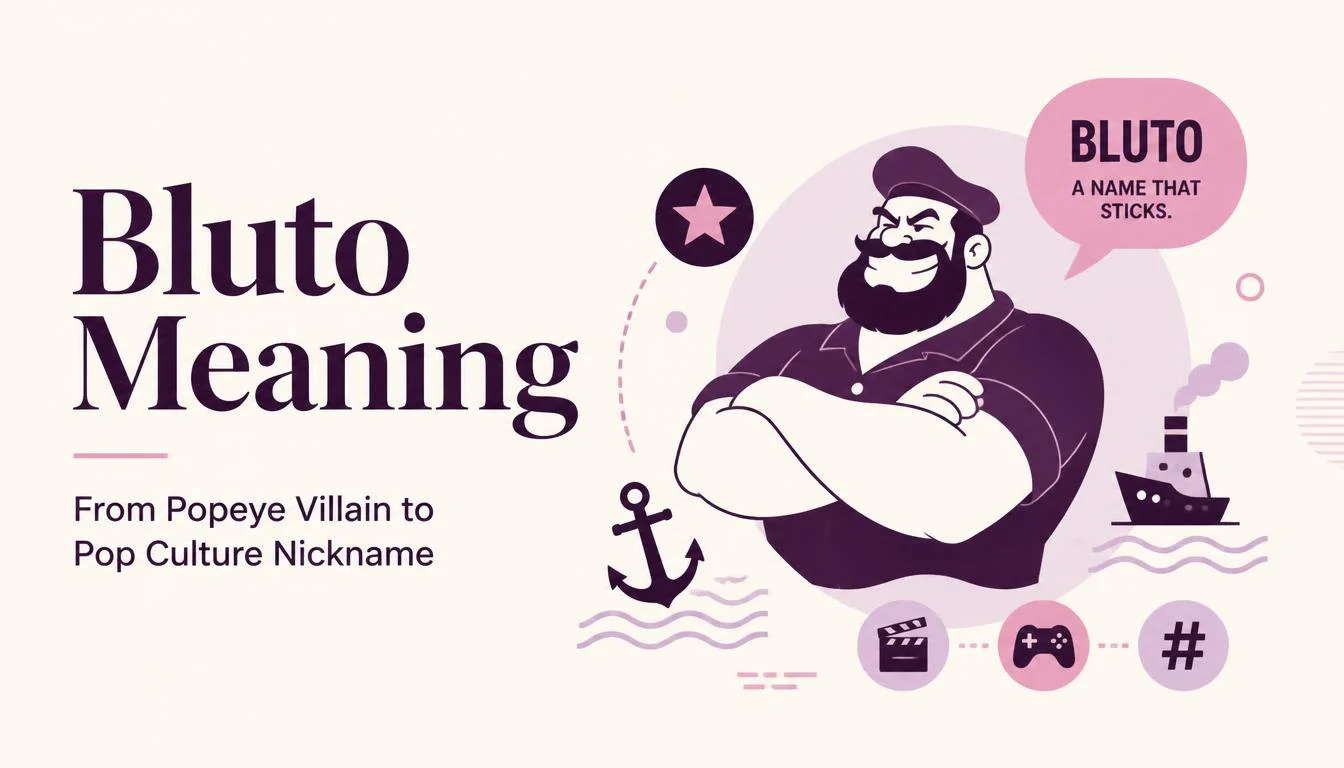
Bluto is best known as the large, aggressive rival of Popeye in the Popeye comic strip and cartoons. Elzie Crisler Segar introduced Bluto as “Bluto the Terrible” in Thimble Theatre in 1932, and Fleischer Studios brought the character into animation the following year.
If you have come across Bluto in a conversation, meme, movie reference, or online post, you may wonder what the name actually means. Its most famous connection is to the Popeye universe, where Bluto is known for his strong, aggressive personality and rivalry with Popeye.
Today, Bluto can also be used as a playful reference to someone who seems big, tough, or confrontational. Understanding the context is important because the word can refer to the character himself or describe a person with similar traits.
What Does Bluto Mean?
The word Bluto does not function like an ordinary English dictionary word with one fixed definition. It began primarily as a fictional character name and became recognizable through popular culture.
The original Bluto is Popeye’s powerful enemy. He is usually shown as a large, bearded, physically imposing man who relies on strength, intimidation, and sometimes clever schemes to challenge Popeye.
Over time, the name gained a secondary informal sense. Calling someone “a Bluto” can suggest that the person is unusually big, muscular, aggressive, crude, or physically intimidating.
That usage depends heavily on context. Someone might use the word jokingly about a large friend, while another person could use it to describe someone who behaves like a brute.
The name is therefore more cultural than linguistic. Its meaning comes from the personality and appearance associated with the fictional character.
Where Did the Name Bluto Come From?
Bluto was created by cartoonist Elzie Crisler Segar, the creator of Popeye. Segar had launched Thimble Theatre in 1919, and Popeye joined the strip in 1929. Bluto appeared several years later.
The official Popeye history records September 12, 1932, as the point when Popeye first encountered “Bluto the Terrible.” The character was subsequently adapted for animation by Fleischer Studios in 1933.
There is no strong reason to treat Bluto as a traditional personal name with a well established historical meaning. It was coined as a fictional character name.
That distinction matters because many websites try to assign elaborate ancient origins to unusual names. In this case, the safest explanation is much simpler: Bluto became a recognizable name because of a fictional character rather than because it was an established everyday given name.
Its sound also fits the character. “Bluto” feels short, heavy, and forceful. Whether that was deliberately designed to suggest brute strength is difficult to prove, so it is better treated as an impression rather than a documented fact.
Bluto in Popeye
Bluto’s most important meaning comes from his connection with Popeye the Sailor.
When Bluto appears in the classic stories, he is generally positioned as Popeye’s physical opposite. Popeye is wiry and distinctive, while Bluto is broad, muscular, and imposing.
Their conflicts often revolve around strength, rivalry, and Olive Oyl. Bluto’s interest in Olive creates another source of tension between the two characters.
The contrast works because Popeye does not look like a conventional superhero. He is thin, oddly shaped, and physically unusual. Bluto appears to have the obvious advantage before the fight even begins.
Yet Popeye repeatedly finds a way to overcome him.
That setup became one of the most recognizable patterns in the franchise. Bluto represents the intimidating opponent who seems unbeatable at first glance, while Popeye represents the underestimated character who eventually wins.
This is one reason the name developed a meaning beyond the character himself.
If someone says, “That guy looks like Bluto,” they may not be talking about Popeye at all. They may simply mean the person looks large, powerful, rough, or intimidating.
Bluto vs. Brutus: Why Are There Two Names?
One of the most confusing parts of the character’s history is the name Brutus.
For many years, viewers encountered Popeye’s big rival under the name Brutus instead of Bluto. This was not simply a completely different character appearing by coincidence.
After the theatrical Popeye cartoons stopped production in 1957, the character’s name was changed to Brutus. The reason was tied to a mistaken belief about ownership of the name Bluto. King Features believed Paramount Pictures had rights connected to the name and used Brutus instead.
The irony is that Bluto had originated in Segar’s comic strip, where King Features controlled the character’s publication rights.
This produced a strange period in Popeye history. Audiences could see essentially the same familiar antagonist while hearing a different name.
Later productions returned to Bluto, making the original name much more familiar again.
Bluto and Brutus Compared
| Feature | Bluto | Brutus |
|---|---|---|
| Main connection | Popeye’s rival | Alternate name for Popeye’s rival |
| Original comic history | Introduced by E.C. Segar | Later adaptation name |
| Major use | Comic strips and later productions | Especially 1960s television cartoons |
| Character type | Large, aggressive antagonist | Same basic rival role |
| Why the name changed | Original name was mistakenly believed to have rights problems | Used as a replacement |
| Modern recognition | Widely recognized as the original name | Recognized as an alternate version |
The name change is important because someone researching old Popeye material may find Brutus and wonder whether he was a separate villain.
For most of the character’s history, the answer is no. Bluto and Brutus refer to the same basic Popeye antagonist, although later comic material occasionally played with the idea that they were separate characters.
How Bluto Became an Informal Description
A fictional name can become a descriptive word when a character is visually distinctive enough.
That happened with Bluto.
The character is commonly portrayed as a big, muscular, rough-looking man. Because of that image, saying someone is “a Bluto” can suggest a person who is physically imposing or brutish.
For example:
“That linebacker is built like Bluto.”
Here, the speaker probably is not saying that the athlete is literally the Popeye character. The comparison focuses on size and physical strength.
Another example might be:
“He came charging through the door like Bluto.”
This version emphasizes aggressive behavior rather than body size.
The comparison can also be playful. Friends may use the name as an exaggerated nickname for someone who is unusually strong or bulky.
Still, the word is not a neutral synonym for “strong.” It can carry a rough or uncivilized feeling because the original character is frequently aggressive and intimidating.
Bluto in Animal House
There is another major reason people recognize the name.
In the 1978 comedy National Lampoon’s Animal House, John Belushi plays John Blutarsky, a college student commonly called “Bluto.”
This Bluto is very different from Popeye’s enemy, but the nickname creates a similar impression.
John Blutarsky is loud, rebellious, chaotic, and physically expressive. He is a member of the fictional Delta Tau Chi fraternity at Faber College.
Belushi’s performance became one of the defining parts of the movie. IMDb lists Belushi as John Blutarsky, while the character is repeatedly identified by the nickname Bluto.
The movie was released in 1978 and became a major comedy hit. Belushi’s performance helped turn the nickname into another recognizable piece of American pop culture.
This creates an interesting split in the word’s cultural identity.
For older cartoon audiences, Bluto immediately suggests Popeye’s rival.
For many movie fans, the name may instead bring up John “Bluto” Blutarsky.
Both characters share an exaggerated, physical, unruly image, so the nickname feels appropriate in both settings.
What Does Bluto Mean When Used About a Person?
When Bluto is applied to an actual person, the intended meaning usually depends on the surrounding sentence.
It can suggest several related ideas:
A Big or Muscular Person
This is probably the most straightforward informal use.
Someone who is extremely broad, muscular, or physically imposing may be compared to Bluto because of the character’s famous appearance.
A Rough Person
The comparison can focus on personality rather than body type.
A person who is aggressive, loud, intimidating, or lacking in manners might receive the nickname.
A Brute
In some contexts, Bluto functions almost like “brute.” It suggests someone who relies more on force than refinement.
A Chaotic or Rowdy Person
The Animal House association adds another layer. Someone who parties hard, acts recklessly, or behaves wildly might be called “Bluto” as a humorous reference to John Blutarsky.
These meanings overlap, but they are not identical.
A bodybuilder may be called Bluto because of his size. A loud partygoer might receive the nickname because of Animal House. Someone aggressive could be compared with the Popeye villain.
Context determines which association is strongest.
Famous Characters Connected With the Name
Several real and fictional figures help explain why the word remains recognizable.
| Name | Connection | Why It Matters |
|---|---|---|
| E.C. Segar | Creator of Popeye and Bluto | Established the original character |
| Popeye | Bluto’s main rival | Made the character famous |
| Olive Oyl | Central figure in the rivalry | Adds a recurring source of conflict |
| Bluto the Terrible | Original comic character | Established the name in 1932 |
| Brutus | Alternate identity/name | Appeared during a later period of Popeye media |
| John Belushi | Played John Blutarsky | Created a second major pop culture association |
| John Blutarsky | Character in Animal House | Popularized “Bluto” in a different setting |
| Fleischer Studios | Early animation producer | Brought Bluto into animated Popeye films |
The timeline is particularly useful here. Bluto first appeared in 1932, his animated adaptation followed in 1933, and Belushi’s famous Animal House version arrived in 1978.
Those dates show how the same nickname crossed different generations of American entertainment.
Why the Popeye Connection Matters More Than the Name Itself
The strongest meaning of Bluto comes from character recognition.
Think about names such as Wimpy, Popeye, or Olive Oyl. They are not ordinary words in the same way as “strong,” “hungry,” or “thin.” Their meanings become understandable because audiences know the characters attached to them.
Bluto works in much the same way.
A person who has never encountered Popeye may hear the name and think it is simply an unusual nickname. Someone familiar with the cartoons immediately has a visual image in mind: a huge, bearded antagonist standing opposite Popeye.
That instant mental picture is what gives the name its descriptive power.
It also explains why the term can be humorous rather than seriously insulting. Calling someone Bluto exaggerates a trait. The speaker is usually making a pop culture comparison.
Bluto, Brute, Bully, and Brutus: Are They the Same?
These terms are related in some contexts, but they should not be treated as interchangeable.
| Term | Basic Sense | Connection to Bluto |
|---|---|---|
| Bluto | Fictional name and informal character comparison | Original Popeye character |
| Brutus | A separate traditional name and also Bluto’s alternate Popeye name | Used for the same rival in certain Popeye productions |
| Brute | A person associated with physical force or crude behavior | Similar descriptive idea |
| Bully | Someone who intimidates or mistreats others | Can describe behavior associated with Bluto |
| Muscle | A person valued for physical strength | Focuses on strength rather than personality |
| Brutish | Rough, aggressive, or lacking refinement | Closest descriptive adjective in some contexts |
This distinction helps prevent a common misunderstanding.
Bluto does not literally mean “brute.” The two words can overlap in the impression they create, but Bluto is primarily a fictional name that later developed informal descriptive use.
Likewise, Brutus is not simply the dictionary definition of Bluto. It became an alternate name for the character during a specific period of Popeye history.
Is Bluto a Real First Name?
Bluto is extremely uncommon as an ordinary personal name.
Unlike names such as Michael, David, or Daniel, it does not have a long tradition as a mainstream English given name.
Its recognition comes mainly from fictional characters.
That does not prevent someone from using it as a nickname. Fictional names regularly become nicknames when a person resembles a character or shares a personality trait.
A particularly large friend might be called Bluto because of his build. A loud fraternity style partygoer might receive the nickname because of Animal House.
The nickname can be affectionate, teasing, or insulting depending on the relationship between the speakers.
Is Calling Someone Bluto Offensive?
It can be.
The word itself is not automatically offensive, but it is not always flattering either.
If the comparison focuses on strength, it may be playful:
“You’ve gotten huge at the gym. You’re turning into Bluto.”
If it focuses on aggression or poor manners, the same name can sound insulting:
“Stop acting like Bluto.”
Tone matters just as much as the words.
Among close friends, the nickname may be harmless. In a professional setting, however, calling someone Bluto because of their body or behavior could easily come across as disrespectful.
The safest interpretation is to treat it as an informal pop culture comparison rather than a formal compliment.
Bluto’s Place in Animation History
Bluto is more than a memorable cartoon villain. His history is tied to the development of the Popeye franchise across comics, theatrical animation, television, radio, and later films.
Popeye’s official history states that the character’s animated era included more than 600 Popeye cartoons, illustrating how extensively the franchise spread through popular entertainment.
Bluto’s introduction came only a few years after Popeye himself first appeared. Popeye entered Thimble Theatre in 1929, while Bluto arrived in 1932.
That timing helped establish Bluto as part of the classic group of characters surrounding Popeye.
His rivalry was also flexible enough to survive changes in medium and production company. Even when his name changed to Brutus, the basic character concept remained recognizable.
That durability explains why the name still works as a cultural reference many decades later.
Why People Still Recognize the Word
Pop culture names survive when they communicate an idea quickly.
Bluto does that particularly well.
One short name can suggest a large man, physical power, rough behavior, or an unruly personality. It can also point directly to one of two famous fictional characters.
The Popeye association gives the word its oldest cultural meaning. The Animal House association gives it a second layer that became especially familiar to movie audiences.
That combination makes Bluto unusual. It is both a proper name and an informal cultural comparison.
You do not need a dictionary definition to understand the reference if you know the characters.
FAQs
1. Who created Bluto?
E.C. Segar created Bluto for the Thimble Theatre comic strip. The character first appeared as “Bluto the Terrible” in 1932.
2. Did Bluto appear before Popeye?
No. Popeye was introduced into Thimble Theatre in 1929, several years before Bluto appeared in 1932.
3. Why was Bluto called Brutus?
The name was changed to Brutus after King Features mistakenly believed there could be rights issues surrounding the name Bluto. The original name was later restored.
4. Who played Bluto in Animal House?
John Belushi played John Blutarsky, whose nickname was Bluto, in the 1978 comedy National Lampoon’s Animal House.
5. Can Bluto be used as a nickname?
Yes. In informal speech, it can work as a humorous nickname for someone who is large, muscular, rough, aggressive, or particularly rowdy.
6. Is Bluto an ordinary English word?
Not originally. It began as a fictional character name and later developed an informal descriptive use based on the character’s recognizable traits.
Conclusion
The name Bluto has a surprisingly long pop culture history. It began with E.C. Segar’s “Bluto the Terrible” in the Thimble Theatre comic strip and became closely associated with Popeye’s powerful rival.
Its later appearance as John “Bluto” Blutarsky in Animal House gave the name another famous identity. Today, calling someone Bluto can suggest size, strength, roughness, aggression, or simply a wild personality. The exact sense depends on whether the speaker is thinking about Popeye, Animal House, or the informal nickname itself.
Read More Related Articles:
- TDY Mean | Military Term Explained in Simple Words In 2026
- GC Mean | Don’t Reply Until You Know This In 2026
- 224 Mean | Hidden Meaning Behind This Popular In 2026

Michael Turner is a U.S.-based content writer and blogger who enjoys uncovering the stories and meanings behind words. Through his work at Meanvora, he delivers well-researched, easy-to-read articles that help readers expand their vocabulary and gain a deeper understanding of language.










2 thoughts on “Bluto Meaning | From Popeye Villain to Pop Culture Nickname In 2026”