Quick Answer
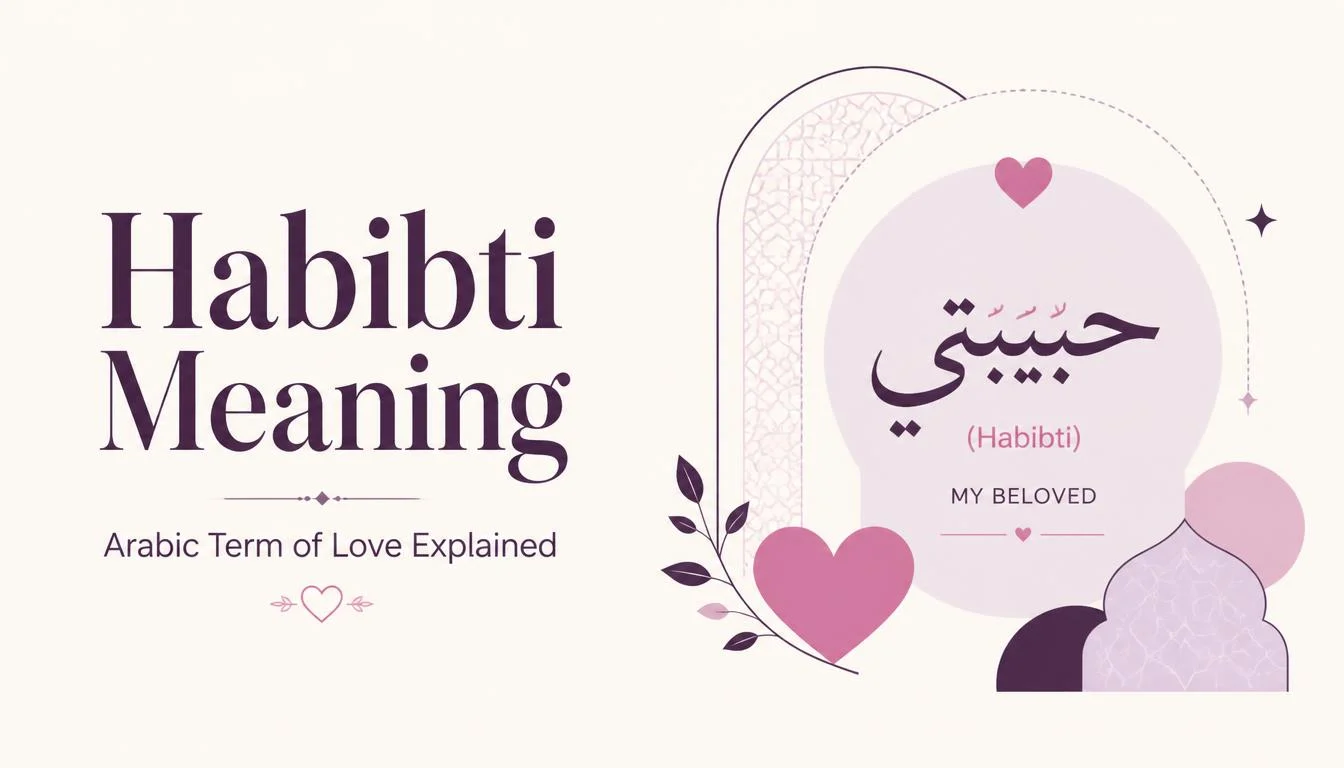
Habibti is an Arabic word that means “my beloved,” “my dear,” or “my darling” when addressing a woman. It comes from the Arabic word habib, which refers to someone who is loved or dear to the speaker. The ending -ti indicates that the person is female in this form of the word.
If you have seen someone use Habibti in a text or social media post, you may wonder what this affectionate Arabic word really means. Habibti is a warm way to address a woman and can express love, care, or deep affection depending on the relationship.
The Habibti meaning is closely connected to the Arabic word habib, which means beloved or dear. While the word often appears in romantic conversations, its meaning can also be friendly or familial when used naturally in everyday Arabic.
What Does Habibti Mean in Arabic?
The word habibti is written in Arabic as حبيبتي and is commonly transliterated into English as habibti, habibaty, or habibti. The most direct translation is “my beloved” or “my dear.”
The word is built from the Arabic root ḥ-b-b, represented by the Arabic letters ح ب ب. This root is associated with love, affection, and things or people that are dear to someone.
The masculine form is habibi, written as حبيبي. The feminine form is habibti, written as حبيبتي. So when someone says habibti to a woman, the grammatical form reflects the gender of the person being addressed.
That does not automatically make the word romantic. Arabic speakers can use affectionate words in ways that feel much broader than their literal English translations suggest.
For example, a mother may call her daughter habibti. Two female friends may use it with each other. A husband may say it to his wife. A person speaking kindly to a young girl may also use it.
The relationship provides the missing context.
The Literal Meaning Behind Habibti
Understanding the structure of the word makes its meaning easier to remember.
Habib can refer to a beloved or dear person. When the possessive ending associated with “my” is added in the feminine form, it becomes habibti, giving the sense of “my beloved” or “my dear female.”
Arabic often communicates grammatical information through word endings and attached forms. That is why the difference between habibi and habibti is not simply a matter of spelling.
| Arabic formCommon transliterationPerson addressedGeneral meaning | |||
|---|---|---|---|
| حبيب | Habib | Male noun or beloved person | Beloved, dear one |
| حبيبي | Habibi | Male | My beloved, my dear |
| حبيبتي | Habibti | Female | My beloved, my dear |
| حبيبة | Habiba | Female noun | Beloved woman, dear woman |
English translations cannot always capture the emotional range of these forms. Depending on the speaker, habibti might sound deeply romantic, gently maternal, warmly friendly, or simply affectionate.
Is Habibti a Romantic Word?
It can be romantic, but romance is not required.
This is one of the most important points to understand if you encounter the word in a message, song, conversation, or social media post.
If a woman receives habibti from her romantic partner, the word may carry a meaning close to “my love,” “my darling,” or “my beloved.” In that setting, it can be very intimate.
But imagine a mother speaking to her daughter. If she says habibti, she is not declaring romantic love. She is using a familiar term of affection.
The same idea applies to other family relationships. Arabic has many affectionate expressions that can sound more romantic when translated literally into English than they actually are in everyday speech.
Context matters more than the translation alone.
A message such as “Good morning, habibti” from a romantic partner will usually feel affectionate and intimate. A phrase such as “Come here, habibti” from a mother or older relative can be completely familial.
Even tone can change how the word feels.
Habibti vs. Habibi
The difference between habibti and habibi is mainly grammatical.
Habibi is generally used when addressing a male, while habibti is generally used when addressing a female.
This distinction can be useful when interpreting Arabic conversations because the ending gives you a clue about the person being addressed.
| Word | Arabic | Usually addressed to | Common English equivalents |
|---|---|---|---|
| Habibi | حبيبي | A male | My love, my dear, my beloved |
| Habibti | حبيبتي | A female | My love, my dear, my beloved |
| Habib | حبيب | A beloved person or male noun | Beloved, dear |
| Habiba | حبيبة | A beloved woman or female noun | Beloved woman, dear |
The distinction is about the grammatical form used for the person being addressed. It does not mean that one word is automatically more romantic than the other.
For example, a father can say habibi to his son, just as a mother can say habibti to her daughter.
How Habibti Is Used in Everyday Conversation
The everyday use of this expression varies across Arabic speaking communities. Arabic itself has many regional varieties, so pronunciation, spelling in Latin letters, and preferred expressions can differ.
You may see the word written as habibti, habibaty, or other informal transliterations online. Since Arabic script does not map perfectly onto English spelling, there is no single universal Latin spelling used by everyone.
Here are several situations where you might encounter it:
Between Romantic Partners
This is probably the context many English speakers recognize first.
A woman might be called habibti by her husband, boyfriend, or romantic partner. In this setting, it can mean:
- My love
- My darling
- My beloved
- My dear
The expression can sound tender without being overly formal.
Between Family Members
Parents and relatives may use affectionate terms with children and other family members.
A mother calling her daughter habibti is expressing affection rather than romantic interest. The same general idea applies when family members use affectionate language with one another.
Between Friends
Close friends may also use affectionate Arabic expressions. Whether habibti feels natural between friends depends on the speakers, their dialect, their relationship, and the conversational setting.
For someone unfamiliar with Arabic, this can be surprising. English tends to separate romantic pet names from ordinary forms of address more sharply.
In Music and Popular Culture
Arabic songs, films, television programs, and online content frequently use words associated with love and affection. Because habibti has a strong emotional quality, it can appear naturally in romantic lyrics and dramatic dialogue.
That exposure has also helped the word become recognizable outside Arabic speaking communities.
What Does Habibti Mean in Texting?
In texting, habibti usually carries the same basic meaning as it does in speech. The main difference is that digital communication removes many clues that would normally come from voice, facial expression, or body language.
Someone might text:
“Thank you, habibti.”
That could be translated naturally as:
“Thank you, my dear.”
A romantic partner might instead write:
“I miss you, habibti.”
Here, “my love” would usually capture the emotional tone better.
The word itself does not tell you exactly what the relationship is. You need to consider the surrounding conversation.
If someone you barely know suddenly calls you habibti, it may simply be a warm or culturally familiar way of speaking. If the person is already expressing romantic interest, the same word may carry a much more intimate meaning.
Does Habibti Mean “My Love”?
Yes, “my love” is a reasonable English translation, especially in romantic contexts.
However, it is not the only possible translation.
Depending on the situation, habibti may be better rendered as:
My dear
My darling
My beloved
Sweetheart
My love
Translation is not always a word for word process. A literal translation may sound unnatural in English even when the Arabic expression is completely ordinary.
For example, translating habibti as “my beloved female” would be technically awkward in normal English. “My dear” or “my love” usually communicates the intended feeling much better.
Habibti and Habiba Are Not the Same
Another word that can cause confusion is habiba.
Habiba and habibti are related, but they do not serve exactly the same grammatical purpose.
Habiba can function as a feminine noun meaning a beloved woman or a female loved one. It can also appear as a personal name in Arabic speaking cultures.
Habibti, on the other hand, is the form commonly used when directly addressing a female as “my beloved” or “my dear.”
That small difference matters.
Think of it this way:
Habiba describes a beloved woman.
Habibti addresses a woman as “my beloved” or “my dear.”
The relationship between the forms becomes clearer when you look at their grammatical endings rather than relying only on English translations.
The Arabic Root Behind the Word
The linguistic history of habibti becomes more interesting when you look at its root.
Arabic words are often organized around roots consisting of three consonants. The root associated with habib is Ḥ-B-B, or ح ب ب.
This root is connected with concepts involving love, affection, fondness, and being dear.
Related Arabic words include hubb, meaning love, and habib, meaning beloved or dear. The personal name Habib also comes from this same linguistic family.
The root system is one reason Arabic vocabulary can contain several words that feel connected in meaning while taking different grammatical forms.
For an English speaker, this may seem unfamiliar at first. Once you recognize the root, however, the connection between several related words becomes easier to understand.
How to Pronounce Habibti
A common pronunciation is approximately:
ha-BEEB-tee
The middle syllable is similar to beeb, while the final ti sounds like the “tee” in “tea.”
The exact pronunciation can vary depending on the speaker’s Arabic dialect and accent.
The Arabic spelling is:
حبيبتي
The pronunciation also contains the Arabic consonant represented by ḥ, which is a stronger throat sound than the ordinary English “h.” In casual English pronunciation, many learners use a simpler “h” sound.
That approximation is understandable, especially when the word is being used in an English conversation.
Examples of Habibti in Sentences
Seeing the expression in context can make its meaning much clearer.
Example 1: Romantic
“Good night, habibti.”
Natural meaning: “Good night, my love.”
The context suggests tenderness between romantic partners.
Example 2: Family
“Are you hungry, habibti?”
Natural meaning: “Are you hungry, sweetheart?”
A mother or another family member could use the expression affectionately.
Example 3: Friendship
“Thank you for helping me, habibti.”
Natural meaning: “Thank you for helping me, my dear.”
Here, the expression can sound warm and friendly rather than romantic.
Example 4: Reassurance
“Don’t worry, habibti. Everything will be okay.”
Natural meaning: “Don’t worry, my dear. Everything will be okay.”
The phrase conveys comfort and closeness.
These examples show why translating the word without context can lead to misunderstandings.
Cultural Context Matters
Arabic is spoken across a large geographic area, including countries in the Middle East and North Africa. Speakers do not all use the language in exactly the same way.
Vocabulary, pronunciation, social conventions, and levels of familiarity can vary between communities.
That means there is no single rule saying exactly how affectionate habibti must sound in every conversation.
A word that feels intensely romantic to an English speaker may be much more casual to someone who grew up hearing affectionate Arabic expressions at home.
This is similar to the way English speakers use words such as “dear,” “sweetheart,” or “honey.” Their meaning depends heavily on who says them, who hears them, and why they are being said.
The safest interpretation is therefore simple: the word expresses affection toward a female, while the relationship determines what kind of affection is intended.
Related Arabic Terms You May See
If you have encountered habibti online, you may also have seen several related terms.
Habibi
Habibi is generally the masculine counterpart of habibti. It is commonly used when addressing a male as “my dear,” “my beloved,” or “my love.”
Hubb
Hubb means love and is closely connected to the same Arabic root.
It is a noun rather than the affectionate form used to directly address someone.
Habib
Habib means beloved or dear person. It can also be used as a masculine personal name.
Habiba
Habiba is a feminine form connected to the idea of a beloved or dear woman. It is also used as a given name.
These words belong to the same broader family, but their grammatical roles are different.
Why the Word Can Feel More Emotional Than “Dear”
One reason habibti has become popular in English speaking online spaces is that it carries a recognizable sense of warmth.
The English word “dear” can sound formal in some situations. Habibti may feel more personal because it is strongly associated with affection and closeness.
At the same time, the word should not be treated as a secret romantic code.
If someone uses it, that does not automatically mean they are flirting. The speaker could be showing friendship, family affection, kindness, or romantic love.
The surrounding language is usually more revealing than the word by itself.
Is It Appropriate to Call Someone Habibti?
If you are learning Arabic and want to use habibti, context is important.
It is appropriate when you understand that you are addressing a female and the relationship allows for an affectionate form of address. With a close friend or partner, it may feel natural.
With someone you have just met, however, using an affectionate expression without understanding the local social norms could feel overly familiar.
If you are unsure, listening to how native speakers use affectionate terms is a good starting point. Arabic has many ways to communicate warmth, and what feels natural can vary from one community to another.
Common Misunderstandings About Habibti
It does not always mean “girlfriend”
A woman called habibti is not necessarily the speaker’s girlfriend. The expression can be used among family members and friends.
It does not always mean romantic love
The word expresses affection, but affection has many forms.
It is not the masculine form
Habibti is generally used for a female addressee. Habibi is generally used for a male addressee.
It is not limited to formal Arabic
You may encounter it in ordinary conversations, messages, entertainment, and informal communication.
English spelling can vary
Habibti is one common transliteration, but people writing Arabic with English letters may spell the same word differently.
FAQs
Can a woman say habibti to another woman?
Yes. The word can be used between women when the relationship and local usage make the affectionate form appropriate. It does not inherently indicate romance.
Can a man say habibti to his wife?
Yes. A husband can use habibti when affectionately addressing his wife. In that setting, “my love” or “my darling” may be natural English translations.
Is habibti a person’s name?
Usually, habibti is an affectionate expression rather than a personal name. Habiba, however, is used as a given name in Arabic speaking communities.
How do you write habibti in Arabic?
It is commonly written as حبيبتي. The Latin spelling habibti represents the Arabic pronunciation using English letters.
Does habibti have the same meaning in every Arabic country?
Its core meaning remains connected to affection toward a female, but pronunciation, frequency, and social use can vary among Arabic speaking communities.
Conclusion
Habibti is a warm Arabic expression that can mean “my beloved,” “my dear,” “my darling,” or “my love.” Its feminine form makes it distinct from habibi, which is generally used when addressing a male. The most important detail is context because the word can describe romantic affection, family love, or close friendship. Once you understand that flexibility, the expression becomes much easier to interpret when you hear or read it.
Read More Related Articles:
- Hoisin Mean | Unlocking the Bold Taste Everyone Loves In 2026
- Herpetofauna Meaning | Guide to Amphibians and Reptiles in Nature In 2026
- Fozzie Meaning | Real Story Behind This Popular Character Name In 2026











1 thought on “Habibti Meaning | Arabic Term of Love Explained In 2026”