Quick Answer:
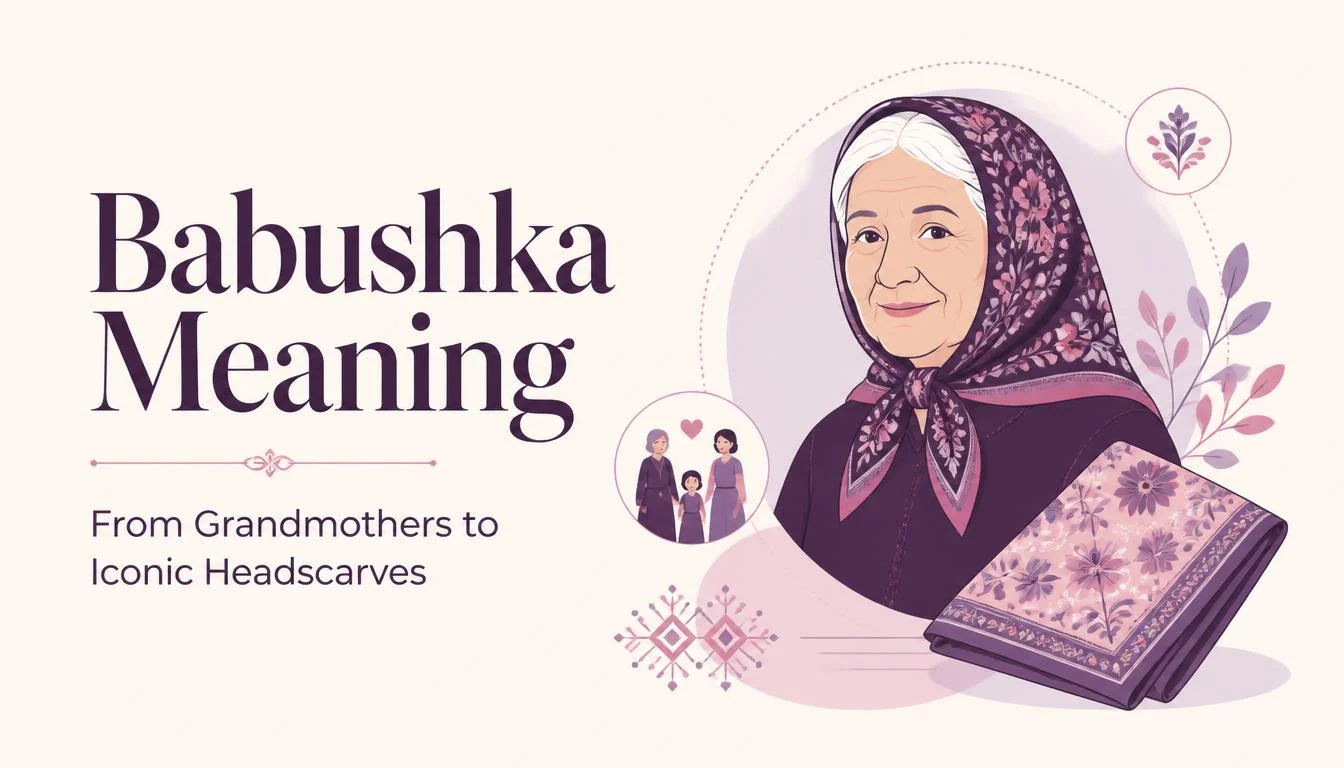
Babushka is a Russian word meaning “grandmother.” It is also associated with the traditional headscarf worn by some older women in Russia and Eastern Europe. Depending on the context, it can refer to a grandmother, an old woman or a scarf tied around the head.
The word Babushka Meaning is rooted in Russian language and culture. In everyday Russian, babushka means grandmother and is often used as a warm, affectionate term for an older female family member. It can bring to mind family traditions, wisdom and the special bond between grandparents and grandchildren.
Outside Russia, the word babushka is also commonly used to describe a headscarf tied under the chin or around the head. This traditional style has appeared in fashion, movies and popular culture. Understanding the meaning of babushka helps you recognize whether someone is talking about a grandmother, a cultural tradition or a particular style of scarf.
The Original Meaning and Russian Roots
In Russian, babushka (бабушка) means “grandmother” or “grandma.” It is a familiar family word used when talking about a grandmother or addressing her directly. Depending on the family and situation, it can sound affectionate, warm, and informal.
The word is pronounced approximately BAH-boosh-kah, with the stress on the first syllable. English speakers sometimes pronounce it differently, but the Russian pronunciation gives a useful guide if you want to say it naturally.
The Russian word belongs to a family of expressions connected with age and family relationships. The related word baba (баба) has several meanings depending on context, including an older woman or a woman in certain colloquial expressions. However, it can sound informal or even dismissive in some situations, so it should not automatically be treated as an interchangeable version of babushka.
Is Babushka a Formal or Informal Word?
In ordinary Russian family life, the word is familiar rather than formal. A child might use it when speaking to a grandmother, while an adult might use it when describing their grandmother to a friend.
For example, a Russian speaker could say, “My babushka lives in Moscow.” The sentence means that their grandmother lives in Moscow. In English, the speaker might keep the Russian word to express a cultural connection or because the family regularly uses it.
The word is not limited to old women who look a certain way. A grandmother can be young or old, live in a city or village, and dress in modern clothing while still being called babushka by her family.
That distinction matters because English-language media sometimes turns the word into a visual stereotype. Its original meaning is based on a family relationship, not a particular appearance.
How the Word Is Written
The Russian spelling is бабушка, written in the Cyrillic alphabet. The standard English transliteration is babushka, which represents the Russian sounds using Latin letters.
You may occasionally see variations in pronunciation among English speakers, particularly those who have learned the word from films or casual conversation rather than Russian language lessons.
The spelling is useful to recognize when reading Russian signs, family messages, or cultural material. If you are learning Russian, you will also see it in basic vocabulary lists alongside words for mother, father, grandfather, and other relatives.
How the Word Is Used in English
English speakers use the word in several ways. The most direct use refers to a grandmother, especially one from a Russian-speaking or Eastern European family. Another familiar use describes a headscarf associated with traditional clothing.
The difference between these meanings can be understood from the sentence itself.
Consider these examples:
- “My babushka makes the best dumplings.” Here, the word refers to the speaker’s grandmother.
- “The woman wore a red babushka.” Here, it likely refers to a headscarf.
- “We visited my friend’s babushka in St. Petersburg.” The word refers to a family member.
- “She tied her babushka beneath her chin before going outside.” The sentence describes clothing.
The word can also appear in storytelling, comedy, fashion descriptions, and discussions of Russian traditions. Writers may choose it because it creates a more specific cultural impression than the general English word “grandmother.”
Why English Has More Than One Meaning
The family meaning comes directly from Russian. The clothing meaning developed through English usage, where the word became associated with a traditional scarf worn by some older women in Russia and neighboring parts of Eastern Europe.
This is an example of how a borrowed word can develop a narrower or slightly different meaning in another language. English speakers may use it to describe an object or style that Russian speakers would identify using a different everyday word.
For instance, Russian has the word платок (platok), which can refer to a scarf or kerchief. A Russian speaker discussing a scarf would not necessarily call it a babushka. The word used in English clothing descriptions therefore does not always match the terminology a native Russian speaker would choose.
Context remains the easiest way to interpret the word correctly. If the conversation concerns relatives, family traditions, or visiting someone’s home, the grandmother meaning is likely. If it concerns fabric, clothing, or tying something around the head, the scarf meaning is more likely.
Babushka as a Traditional Headscarf


10
In English, a babushka can refer to a square scarf or kerchief worn over the head and tied beneath the chin or at the back. The fabric may feature flowers, geometric patterns, paisley designs, or other decorative prints.
This style is often associated with older women in traditional Russian and Eastern European imagery. It can also be seen in photographs, folk costumes, historical illustrations, and modern fashion.
However, the scarf itself is not exclusive to Russia. Head coverings have been worn by women across many cultures for practical, religious, social, and decorative reasons. Similar-looking scarves can have different names and meanings in different communities.
How a Babushka Scarf Is Worn
A traditional square scarf can be folded diagonally into a triangle. The folded edge rests along the forehead, while the two ends are brought under the chin and tied together.
Another style places the scarf over the head and ties the ends behind the neck. Some people wear similar scarves loosely around their hair, while others use them to protect their heads from wind, dust, or cold weather.
The exact method depends on the scarf’s size, the weather, personal preference, and local tradition. There is no single arrangement that every Russian woman or grandmother uses.
The fabric can also change the overall appearance. Wool or heavier materials offer more warmth, while cotton and silk scarves can be lighter and more suitable for mild weather.
Is Every Headscarf a Babushka?
No. In English, the term is most strongly associated with a particular style of headscarf rather than every kind of head covering.
A hijab, for example, is associated with Muslim practices of modest dress, although styles and interpretations vary. A bandana is often a square piece of fabric used as a head covering, neck accessory, or practical cloth. A kerchief is a broader term for a square or triangular piece of fabric worn on the head or neck.
These items may sometimes resemble one another visually, but their cultural contexts and typical uses are not identical.
Using the right word helps avoid confusing a general clothing item with a culturally specific garment or practice.
Cultural Significance in Russian and Eastern European Life
The word has cultural associations that extend beyond its dictionary definition. In many families, a grandmother is a source of stories, recipes, advice, and memories of earlier generations. The familiar term can therefore carry emotional meaning as well as a simple description of a relative.
Still, Russian families are diverse. Some use babushka frequently, while others use a grandmother’s name, a family nickname, or another affectionate expression. The word should not be treated as a complete description of how every Russian household operates.
Family, Food, and Generational Traditions
In films and stories about Russian family life, a grandmother may be portrayed as someone who prepares meals, looks after children, or passes on family customs. These portrayals often reflect familiar experiences of intergenerational family life, although individual families differ.
A simple example would be a grandchild visiting their grandmother to learn a traditional recipe. The word may evoke a relationship built around food, conversation, and shared memories.
A family might also use the term while discussing migration or ancestry. Someone whose grandparents came from Russia may use babushka as a reminder of their heritage, even if the family now lives in the United States, Canada, or another country.
The cultural meaning comes from the relationship and memories attached to the word. It does not depend on whether the grandmother wears a headscarf or lives in Russia.
The Image of the Traditional Older Woman
In Western media, the word often brings up an image of an older woman with a floral scarf, a long skirt, and a warm or stern expression. This image appears in illustrations, costumes, advertisements, and comedy.
It is recognizable, but it can also be limiting. Russian grandmothers are not a single type of person, and many dress like other modern adults. Some wear headscarves for practical or personal reasons, while others do not cover their hair at all.
The image is best understood as a cultural association rather than a universal fact. It may be useful in a description of a traditional costume, but it should not be used to assume someone’s nationality, age, or family role.
Cultural Meaning in Art and Popular Culture
Writers and artists sometimes use the word because it communicates several ideas quickly: family heritage, old-fashioned style, Eastern European identity, or the image of a grandmother.
A character might call an older relative babushka to suggest a close family connection. A fashion writer might use the same word for a scarf-inspired outfit. In a comedy sketch, it might be used to exaggerate a familiar stereotype.
These uses are not equally precise. The family meaning is the direct Russian definition, while the clothing and character associations depend more on English-language convention and the situation.
Babushka vs. Similar Words
Several words can seem interchangeable with this one, but each has a different meaning or cultural context. The following table explains the most useful distinctions.
| Word | Main meaning | Typical context |
|---|---|---|
| Babushka | Grandmother in Russian; also a headscarf in English | Family conversation and English clothing descriptions |
| Grandma | Informal English word for grandmother | Everyday family conversation |
| Grandmother | A parent’s mother | General and formal English |
| Dedushka | Grandfather in Russian | Russian family relationships |
| Baba | A word with several meanings, including woman or older woman in some contexts | Russian and related Slavic-language contexts, depending on usage |
| Kerchief | A square or triangular piece of fabric | Clothing and accessories |
| Bandana | A square piece of fabric worn or used in several ways | Casual clothing and practical uses |
Babushka vs. Grandma
The difference is mainly linguistic and cultural. Grandma is a familiar English word, while babushka is Russian.
An English-speaking family might call a grandmother “Grandma” or “Nana.” A Russian-speaking family may use babushka. Some multilingual families use more than one term to distinguish between grandparents on different sides of the family.
Neither word automatically conveys more love or respect than the other. The emotional meaning depends on the speaker, family habits, and tone.
Babushka vs. Dedushka
These words refer to different family members. Babushka means grandmother, while dedushka (дедушка) means grandfather in Russian.
They may appear together when someone discusses their grandparents. For example, “My babushka and dedushka live near the city center” means that both the speaker’s grandmother and grandfather live nearby.
The distinction is useful for anyone learning Russian because the two words describe opposite sides of a common family pair.
Babushka vs. Kerchief
A kerchief is a type of cloth, often square or triangular, that can be worn on the head or around the neck. A babushka in English clothing usage usually suggests a headscarf worn in a traditional style.
The terms overlap, but they are not identical. A kerchief can be worn in many styles without evoking Russian or Eastern European culture. Calling it a babushka adds a particular cultural association that may or may not fit the item.
Examples in Everyday Conversations
Seeing the word in complete sentences makes its meaning easier to understand. These examples show how it can work in family conversations, cultural writing, and descriptions of clothing.
Examples Referring to a Grandmother
1. “I’m visiting my babushka this weekend.”
The speaker plans to visit their grandmother. The Russian word may reflect the family’s language or cultural background.
2. “My babushka taught me how to make traditional dumplings.”
Here, the term describes a grandmother who shares a family recipe or cooking tradition.
3. “I called my babushka to ask about our family history.”
This sentence shows the word in a conversation about family connections and earlier generations.
4. “His babushka moved to America when she was young.”
The word identifies his grandmother. The sentence does not imply anything about her clothing or appearance.
Examples Referring to a Scarf
5. “She wore a floral babushka to keep her hair covered.”
In this sentence, the word refers to a headscarf rather than a relative.
6. “The costume included a long skirt and a patterned babushka.”
The surrounding reference to a costume makes the clothing meaning clear.
7. “I tied my scarf beneath my chin in a babushka style.”
This describes a way of wearing a scarf. It does not suggest that the person is a grandmother or Russian.
Examples in Cultural Writing
8. “The story follows a child who spends the summer with her babushka.”
The word gives the grandmother a family and cultural context, though the rest of the story would be needed to establish her background.
9. “The painting shows an older woman wearing a bright red babushka.”
The word describes the woman’s head covering. The color and clothing details help the reader picture the scene.
10. “My friend uses the word babushka because her family speaks Russian at home.”
This sentence explains why someone might choose the Russian term instead of an English equivalent.
The key is to read the surrounding words. References to visiting, cooking, family, or grandparents usually point to the relative. References to tying, wearing, fabric, or patterns usually point to the scarf.
Common Misunderstandings
Although the word is relatively simple, a few misunderstandings are common, especially among English speakers who first encounter it in movies or fashion descriptions.
It Does Not Mean Every Old Woman
The direct Russian meaning is grandmother. It does not simply mean “old woman,” and it is not a label that automatically applies to every older person.
Using it to describe an unrelated woman may sound playful in some English conversations, but it can also feel stereotypical or disrespectful. If you do not know someone, “older woman” is usually a more neutral description.
It Does Not Mean Russian Headscarf in Every Context
The scarf meaning is familiar in English, but the word’s primary Russian meaning is a family relationship. A Russian speaker hearing babushka in a conversation would generally understand the grandmother meaning unless the surrounding context suggested otherwise.
For a particular scarf, the more appropriate Russian word may be platok. The precise term depends on the type of fabric and how it is being discussed.
It Is Not Exclusive to One Nationality’s Clothing
Headscarves appear in many countries and traditions. Similar designs can be found in parts of Eastern Europe, Central Asia, the Middle East, and elsewhere.
A scarf’s appearance alone does not establish the wearer’s nationality or religion. It is better to describe the garment itself unless its cultural background is known.
It Is Not Automatically a Nickname
Some families use the word as a regular way to address a grandmother. Others prefer a personal name or a different family term.
A person may also use babushka jokingly for a friend or character, but that is a separate use. Whether it sounds affectionate or insulting depends on the relationship and tone.
FAQs
1. Can You Call Your Own Grandmother Babushka If You Are Not Russian?
Yes. Anyone can choose to use a word from another language as a family nickname, and some multilingual or culturally mixed families do so. However, the word’s original meaning is Russian, so using it does not by itself establish Russian ancestry.
2. What Is the Plural of Babushka in English?
The usual English plural is babushkas. For example, “The film features several babushkas wearing traditional headscarves.” In Russian, the plural form is babushki (бабушки), so the form depends on which language you are speaking.
3. Is Babushka a Term of Respect?
It can be affectionate and respectful when used for a grandmother. Its tone depends on the relationship, the speaker, and the situation. Using it for an unrelated older woman may be perceived differently, particularly if it relies on a stereotype.
4. What Is the Male Equivalent of Babushka?
The usual Russian word for grandfather is dedushka (дедушка). It is the male family counterpart, although families may use different nicknames for grandparents.
5. Can Babushka Be Used as a Fashion Term?
Yes. In English, the word is sometimes used for a headscarf tied beneath the chin or for a style inspired by that look. Fashion descriptions may apply it to modern scarves as well as traditional garments, but this is an English usage rather than the word’s primary meaning in Russian.
Conclusion
Babushka is a Russian word that most directly means “grandmother,” often carrying a familiar and affectionate tone within a family. In English, it can also describe a traditional headscarf associated with older women in Russian and Eastern European imagery. Understanding the difference between these meanings makes the word easier to interpret in conversations, books, and fashion descriptions. Its most accurate meaning always comes from the context in which it appears.
Read More Related Articles:
- BBG Mean | From Simple Slang to Flirty Internet Code In 2026
- KMS Mean | Dark Humor or Serious Warning In 2026
- Fritz Meaning | Surprising Origin of This Everyday Phrase In 2026

Michael Turner is a U.S.-based content writer and blogger who enjoys uncovering the stories and meanings behind words. Through his work at Meanvora, he delivers well-researched, easy-to-read articles that help readers expand their vocabulary and gain a deeper understanding of language.










2 thoughts on “Babushka Meaning | From Grandmothers to Iconic Headscarves In 2026”