Quick Answer:
The word starling most commonly refers to a small to medium sized songbird known for its glossy feathers, often spotted appearance and ability to imitate sounds. As a name, Starling can symbolize freedom, intelligence, adaptability and a connection to nature.
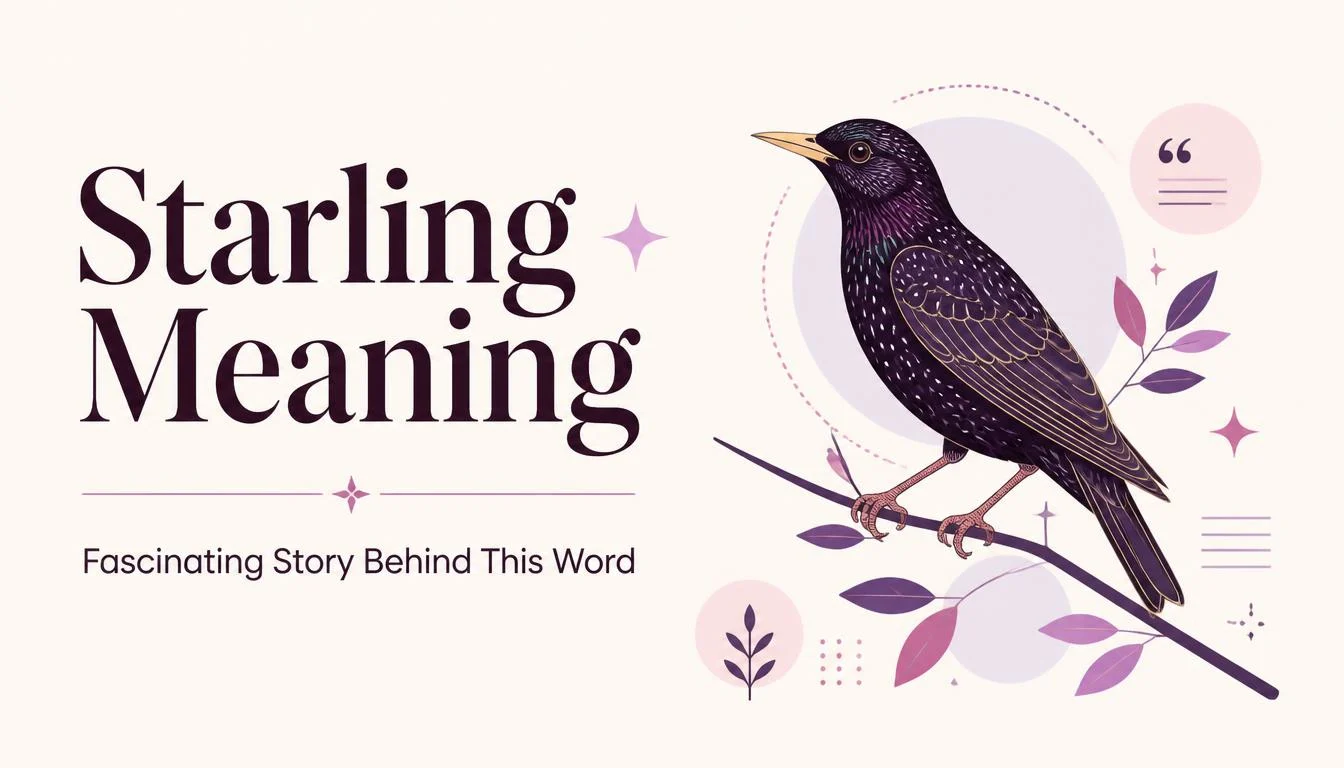
The Starling Meaning is closely associated with nature, intelligence and the beauty of birds. A starling is a bird recognized for its dark, shimmering feathers and remarkable vocal abilities. These birds often travel in large flocks, creating beautiful patterns in the sky that reflect unity and cooperation.
Beyond its connection to wildlife, Starling can also be used as a surname, a given name or a symbolic word in literature. People may associate it with freedom, communication and adaptability because of the bird’s behavior. Whether you encountered Starling as a name or in a conversation about nature, understanding its meaning helps reveal its different uses and associations.
What Does Starling Mean?
A starling is a bird recognized for its vocal ability, distinctive appearance, and social behavior. The name usually refers to a member of the bird family Sturnidae, which includes hundreds of species and related mynas found across different parts of the world.
Although many people picture a dark bird with an iridescent sheen when they hear the word, not all starlings look alike. Some have bright colors, unusual crests, or contrasting markings. Their appearance depends on the species, the season, and sometimes the bird’s age.
The term is used most often in everyday conversation to identify the bird itself. You might hear someone mention starlings gathering on a telephone wire, searching for insects in a lawn, or filling the evening sky with a moving flock.
However, the word can have a broader meaning in literature and personal interpretation. A writer might use a flock of starlings to represent unity, freedom, or the relationship between individuals and a larger group. These are symbolic interpretations rather than fixed dictionary definitions.
Where Does the Word Starling Come From?
The English word starling has historical roots in Old English, where forms such as stærlinc referred to the bird. The word is generally understood to be related to the older English name for a starling, with the ending associated with a smaller creature.
The connection between the bird’s name and the word star is particularly interesting. A European starling’s dark plumage can shimmer with purple, green, and bronze tones in sunlight. During certain seasons, its feathers also display pale spots that resemble tiny stars scattered across a dark background.
That visual resemblance makes the name memorable, although the bird’s English name should not be treated as proof that it has a special astronomical meaning.
Today, starling is primarily a zoological term. Its symbolic associations depend on the context in which someone uses it.
The Scientific Meaning of Starling
In biology, starlings belong to the family Sturnidae, a group of perching birds within the order Passeriformes. This order includes many familiar songbirds, such as sparrows, finches, and blackbirds. Starlings are recognized by their varied vocalizations, adaptable feeding habits, and tendency to form social groups.
The family includes the European starling, mynas, and several colorful species found in Africa and Asia. Although these birds share evolutionary relationships, they differ considerably in size, plumage, and habitat.
The European starling, scientifically named Sturnus vulgaris, is especially familiar in Europe and North America. Cornell University’s Lab of Ornithology reports that introduced populations have spread widely across North America, where the species is now found from Alaska to Mexico.
Important Scientific Terms
A few related terms help explain the subject more precisely.
- Iridescence: A visual effect in which feathers appear to change color as light strikes them from different angles.
- Passerine: A perching bird belonging to the order Passeriformes.
- Murmuration: A large, coordinated flock of starlings moving through the air in shifting formations.
- Plumage: The feathers covering a bird’s body.
- Mimicry: The ability to imitate sounds made by other animals or by the surrounding environment.
These terms describe different features of the birds. For example, iridescence concerns their appearance, while mimicry relates to their vocal abilities.
Types of Starlings and Their Differences
Starlings are not a single species. The family Sturnidae contains a wide variety of birds, and several are particularly interesting because of their appearance, distribution, or behavior.
The following examples show how much variation exists within the group.
| Species | Scientific name | Distinctive feature |
|---|---|---|
| European starling | Sturnus vulgaris | Dark, glossy plumage with seasonal pale spots |
| Common myna | Acridotheres tristis | Brown body, black head, and conspicuous yellow facial skin |
| Superb starling | Lamprotornis superbus | Bright blue and turquoise plumage with contrasting markings |
| Red-winged starling | Onychognathus morio | Dark plumage with reddish flight feathers visible in flight |
| Bali myna | Leucopsar rothschildi | White plumage, a blue patch around the eyes, and a prominent crest |
These examples demonstrate why identifying every starling as a plain black bird would be misleading. Some members of the family have striking colors that rival those of tropical songbirds.
European Starling
Scientific name: Sturnus vulgaris

The European starling is the species most people associate with the common English word. It has a relatively short tail, a pointed bill, and glossy plumage that can reflect green, purple, and bronze shades.
Its appearance changes throughout the year. In winter, pale feather tips create a spotted effect. As these tips wear away, the bird appears darker and more uniformly glossy during the breeding season.
Common Myna
Scientific name: Acridotheres tristis

The common myna is familiar across much of South Asia, including Pakistan and India. It has a brown body, a dark head, yellow skin around the eyes, and yellow legs.
Unlike the European starling’s seasonal speckled appearance, the common myna has a more consistent pattern of contrasting colors. It often feeds near people and adapts well to towns, gardens, and agricultural areas.
Superb Starling
Scientific name: Lamprotornis superbus

Native to parts of East Africa, the superb starling is known for its vivid blue upper body, orange-brown underside, and bright white chest band. Its appearance is much more colorful than that of the European starling.
This species is a useful reminder that the word starling describes a diverse bird family rather than one particular color or body shape.
Bali Myna
Scientific name: Leucopsar rothschildi

The Bali myna, also called the Bali starling, is native to Bali, Indonesia. It has mostly white feathers, dark wing and tail tips, a distinctive crest, and bright blue skin around its eyes.
It is also a conservation concern because its wild population has suffered from trapping and habitat pressures. Conservation programs have worked to protect the species through breeding and reintroduction efforts.
What Makes Starlings Unique?
Several characteristics distinguish starlings from other familiar birds. Their changing feather patterns, sound imitation, and social movements are especially noteworthy.
Their Feathers Can Look Like Different Colors
A European starling may look almost black from a distance. Under good lighting, however, its feathers can reveal green, purple, and bronze reflections.
This effect is called iridescence. It occurs because of the way light interacts with the microscopic structure of the feathers rather than simply because the feathers contain different pigments.
Seasonal changes add another visual detail. Fresh feathers grown in autumn have pale tips, which produce the bird’s spotted winter appearance. Those tips gradually wear away, revealing darker feathers underneath.
They Can Copy Unusual Sounds
Starlings are skilled vocal mimics. Some can imitate the calls of other bird species and sounds from their surroundings.
The European starling may copy sounds associated with other birds, alarms, or mechanical noises. Its vocal repertoire can include whistles, clicks, rattles, and varied musical phrases. This makes its song sound less predictable than the calls of many familiar garden birds.
Their ability to imitate sounds is one reason people have long found them fascinating. A sound that seems to come from another bird may actually be produced by a starling perched nearby.
Their Social Behavior Is Remarkable
Starlings often gather in groups when feeding, resting, or moving toward communal roosts. Some species are highly social, and their group behavior can be especially noticeable in places where food and suitable nesting sites are plentiful.
The European starling’s aerial displays are the best-known example. A large flock can shift direction rapidly, producing waves and curves that appear coordinated across the sky.
These movements are not simply a decorative performance. They emerge from the birds’ responses to nearby flock members and may help them reduce their vulnerability to predators.
Why Starlings Gather in Large Flocks

One of the most distinctive sights associated with starlings is a murmuration. Thousands of birds may twist, turn, and change formation together before settling at a shared roost.
The word murmuration is the collective term commonly used for a group of starlings, particularly when describing these aerial displays. It is also associated with the soft, collective sound produced by a large flock in motion.
How Does a Murmuration Work?
Each bird reacts to the movements of nearby birds. When several change direction, their neighbors respond quickly, and the movement spreads through the group.
This process can create dramatic changes in shape without requiring one bird to direct the entire flock. The birds continually adjust their positions, helping them maintain coordinated movement while avoiding collisions. Research on collective bird behavior has explored how local interactions allow information to spread through large groups.
Why Do Starlings Form These Displays?
Safety is a leading explanation. A large, rapidly moving group can make it harder for a predator to target an individual bird. The flock may also improve the chances that birds detect a nearby threat.
A study published in PLOS ONE in 2017 examined more than 3,000 reported murmurations. The researchers found an association between predator presence and larger or longer displays, supporting the idea that these formations help protect the birds. The findings do not mean every movement has one simple cause, but they provide useful evidence for the protective explanation.
Starlings also gather to roost together. A communal roost provides opportunities for social contact and may help birds conserve warmth during cold nights.
For people watching from the ground, the experience can be striking. The flock may stretch into a ribbon, compress into a dark cloud, and then split into several moving sections within seconds.
Starling Symbolism and Cultural Interpretations
Beyond its biological definition, the starling can carry symbolic meanings in literature, art, and personal reflection. These meanings are not universal, and they should be understood as interpretations rather than scientific facts.
Community and Cooperation
A murmuration offers a natural image of many individuals moving together. Writers and artists may use this behavior to represent cooperation, shared purpose, or the relationship between personal freedom and group identity.
The symbolism comes from observing the birds, not from a proven message that the species communicates to humans.
Adaptability and Resourcefulness
Starlings can live in different environments and take advantage of a variety of food sources. This flexibility may inspire associations with adaptability, resourcefulness, and making the best of changing circumstances.
Someone who uses the bird as a personal symbol might connect it with learning new skills or adjusting to an unfamiliar situation.
Freedom and Movement
The sweeping movement of a murmuration can suggest freedom or independence. A flock that changes direction without an obvious leader may also inspire thoughts about instinct and collective decision-making.
These associations depend on the observer. A poet might emphasize freedom, while another writer might focus on the comfort of belonging to a group.
What Does Seeing a Starling Mean Spiritually?
In spiritual or personal interpretations, seeing a starling may be taken as a reminder to communicate clearly, remain flexible, or pay attention to relationships with others.
There is no single established spiritual meaning that applies to everyone. A starling appearing in a dream or during an ordinary day does not prove that a supernatural message has been sent.
For a more grounded interpretation, consider what the bird represents to you personally. Its vocal abilities might bring communication to mind, while its flocking behavior might suggest community or shared effort.
Starling vs. Similar Birds
Starlings are sometimes confused with blackbirds, grackles, and mynas because these birds can have dark feathers and similar feeding habits. Looking at their body shape, color patterns, and behavior can help distinguish them.
| Bird | Common identifying feature | Main distinction |
|---|---|---|
| European starling | Compact body and pointed bill | Often shows pale winter spots and glossy plumage |
| Common blackbird | Male often has a yellow bill and eye ring | Belongs to the thrush family, Turdidae |
| Common grackle | Long tail and glossy, often iridescent body | Belongs to the New World blackbird family, Icteridae |
| Common myna | Brown body with black head and yellow facial skin | A member of the starling family itself |
The common myna is not a separate comparison at the family level because it belongs to Sturnidae. However, its appearance is quite different from that of the European starling.
Geography can help with identification, too.
- In Pakistan, the common myna is a familiar urban bird.
- In Britain, the European starling is well known for gathering in large winter flocks.
- In North America, both grackles and introduced European starlings may be seen around parks and lawns.
Are Starlings Helpful or Harmful?
The effects of starlings depend on the species and the environment. They can provide ecological benefits, but large populations may also cause problems for people and other wildlife.
Their Ecological Benefits
Many starlings eat insects and other small invertebrates. European starlings, for example, probe the soil with their bills to find insect larvae and other food.
This feeding behavior can influence the numbers of insects in fields and lawns. Starlings also eat fruit and seeds, depending on availability, and may contribute to seed movement in some settings.
Their role is not identical everywhere. A species feeding in its native habitat may interact with local wildlife differently from an introduced population living in a new region.
Problems Associated With Introduced Starlings
The European starling was introduced to North America in the nineteenth century. It established a large population and spread across much of the continent.
In places where it is introduced, the species can compete with native birds for nesting cavities and food. Large flocks may also damage agricultural crops or create sanitation problems around communal roosts.
These concerns do not mean every starling is harmful. Their effects depend on population size, local conditions, and the needs of other species.
Conservation Concerns
Not all starlings are abundant. The Bali myna, for example, has faced severe pressure from illegal trapping and habitat loss. Protecting remaining habitat and reducing the illegal wildlife trade are important parts of its conservation.
The European starling also illustrates why a bird’s status can differ by region. Although it is widespread in North America, its breeding population has declined substantially in the United Kingdom. The Royal Society for the Protection of Birds (RSPB) lists the species on its UK Red List of birds of high conservation concern.
A bird can therefore be considered an invasive species in one country and a conservation concern in another. Local evidence matters more than a general label.
FAQs
1. Is starling a common noun or a proper noun?
Starling is normally a common noun when it refers to the bird. It is capitalized at the beginning of a sentence and may also appear as a surname or part of a proper name.
2. What is a baby starling called?
A young starling is commonly called a chick. After leaving the nest, it may be described as a fledgling while it develops the ability to fly and becomes more independent.
3. Are starlings songbirds?
Yes. Starlings belong to the order Passeriformes, which includes many perching birds commonly described as songbirds. They produce varied calls and songs, and some species are skilled at imitating other sounds.
4. Why do starlings have spots in winter?
In European starlings, the pale spots come from the light-colored tips of newly grown feathers. As the tips wear away, the darker feathers underneath become more visible, changing the bird’s appearance over the course of the year.
5. Can the word starling refer to a person’s name?
Yes. Starling can be used as a surname and occasionally as a given name. When used as a personal name, its meaning depends on the naming context and any personal or family significance attached to it.
Conclusion
A starling is much more than a dark bird seen in a garden or flying across an evening sky. The name refers to a diverse family of birds with distinctive appearances, impressive vocal abilities, and fascinating social behavior. Its symbolic associations with cooperation, adaptability, and freedom add another layer of meaning, although these interpretations vary from person to person. Understanding the context makes it easier to appreciate both the word itself and the remarkable birds it describes.
Read More Related Articles:
- Slime Someone Out Mean | Real Story Behind This Slang In 2026
- Adjacent Mean in Math | Easy Way to Get It Right In 2026
- Congruent Mean in Geometry | Learn the Secret of Identical Shapes In 2026











2 thoughts on “Starling Meaning | Fascinating Story Behind This Word In 2026”