Quick Answer:
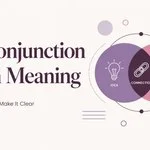
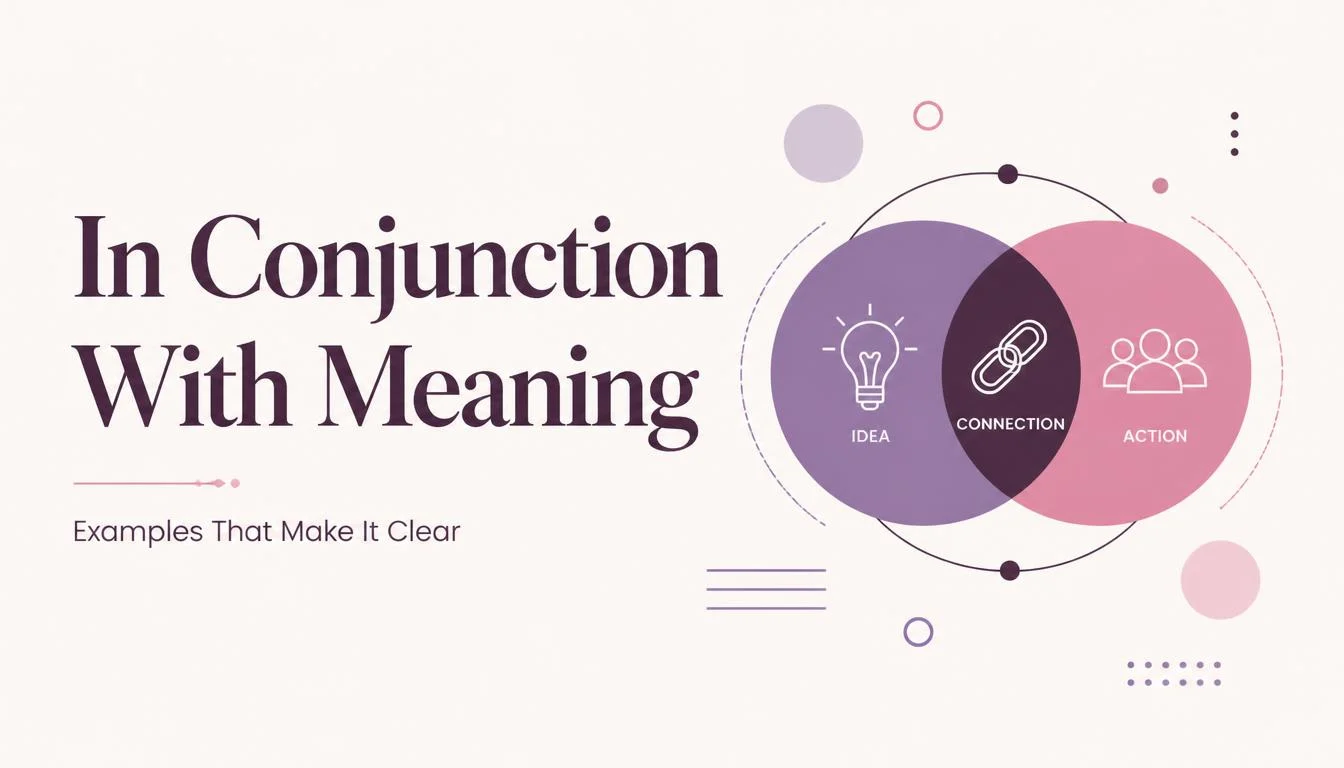
“In conjunction with” means together with, in combination with or working alongside something or someone. It describes two or more things happening or being used together to achieve a shared purpose.
The phrase in conjunction with is commonly used in everyday English, professional communication and academic writing. It explains how two people, ideas, organizations or activities work together. For example, a company might launch a new marketing campaign in conjunction with a product release.
Understanding the in conjunction with meaning can help you use this phrase naturally in sentences and understand it in different contexts. Whether you encounter it in a workplace email, a formal document or a conversation, it generally highlights cooperation, connection or the combined use of two things.
What Does In Conjunction With Mean?
The expression “in conjunction with” means that two or more things are connected, combined, or working together. It often describes cooperation between people, the combined use of methods, or events that occur alongside one another.
The key idea is a relationship between things that work or happen together. Depending on the context, that relationship might involve teamwork, coordination, timing, or a combination of different resources.
Consider this example:
The company launched its new product in conjunction with a national advertising campaign.
This means the company introduced the product while coordinating the launch with an advertising campaign. The two activities were connected rather than treated as completely separate efforts.
Here is another example:
The doctor recommended exercise in conjunction with a balanced diet.
In this sentence, exercise and a balanced diet are being used together as part of a broader health plan. Neither activity has to happen at precisely the same moment. The important point is that both contribute to the same overall approach.
The expression does not always mean that two things happen simultaneously. Sometimes, it simply means that they are combined or coordinated as part of one process.
The Simple Meaning
You can understand the phrase through three closely related ideas:
- Together with: One person or thing acts alongside another.
- In combination with: Two or more methods, ingredients, or resources are used together.
- In coordination with: People or organizations arrange their activities to support a shared objective.
The exact meaning depends on the sentence. Reading the surrounding words usually makes the intended relationship clear.
Origin and Structure of the Phrase
The expression comes from the word conjunction, which refers to a joining, connection, or bringing together.
The word has roots in Latin. It comes from coniunctio, meaning a joining or connection, which is related to coniungere, meaning to join together. The English word has retained that central idea of connection.
In grammar, a conjunction is also a word that connects words, phrases, or clauses. Words such as “and,” “but,” and “or” are familiar examples. However, the expression “in conjunction with” functions differently in a sentence.
It is a multiword prepositional expression. In practical terms, that means it introduces a person, thing, or activity that is connected with another one.
For example:
The research team collaborated in conjunction with a university.
Here, the phrase connects the team’s work with the university’s involvement.
The expression has become especially common in formal English because it can describe a relationship without specifying every detail of how the parties work together. It sounds appropriate in reports, policies, research summaries, business documents, and official announcements.
Still, a longer expression is not automatically better. In casual conversation, “with” or “alongside” may communicate the same idea more naturally.
How to Use It in a Sentence
The phrase usually appears after a verb or noun that describes an activity, arrangement, plan, or relationship.
A common pattern is:
Person or thing + action + in conjunction with + person or thing.
For example:
The school organized the event in conjunction with the local library.
The school organized the event together with the library, suggesting some form of cooperation or coordination.
Another common pattern is:
One method or resource + in conjunction with + another method or resource.
For example:
The software works in conjunction with the existing security system.
This sentence explains that the software and security system operate together.
Use It for Cooperation
When people or organizations cooperate, the phrase can show that their efforts are connected.
Example:
The charity worked in conjunction with local volunteers to distribute food.
The charity and volunteers contributed to the same activity. The expression sounds suitable for a report or public announcement.
Use It for Combined Methods
The phrase can also describe two methods that complement each other.
Example:
The student used practice tests in conjunction with revision notes.
Both resources were part of the student’s study approach. The sentence does not suggest that one resource replaced the other.
Use It for Connected Events
Sometimes, the phrase describes activities planned together.
Example:
The museum opened a new exhibition in conjunction with a public lecture.
The exhibition and lecture were connected parts of a wider program.
Use It for Systems and Equipment
In technical writing, the expression can describe components that operate together.
Example:
The monitoring device operates in conjunction with a central control unit.
The device and control unit function as connected parts of a system.
Real-Life Examples of In Conjunction With
Examples are often the easiest way to understand a formal expression. The following sentences show how its meaning changes slightly according to the situation.
| Sentence | Meaning |
|---|---|
| The teacher worked in conjunction with parents. | The teacher and parents cooperated. |
| The medicine was prescribed in conjunction with physical therapy. | The two treatments were part of a combined plan. |
| The department developed the policy in conjunction with legal advisers. | The department and advisers worked together. |
| The app operates in conjunction with a smartwatch. | The two devices or systems work together. |
| The festival was organized in conjunction with a local arts council. | The festival involved coordinated efforts. |
| The researcher analyzed interviews in conjunction with survey results. | Two sources of information were considered together. |
| The new rules were introduced in conjunction with staff training. | Training accompanied the introduction of the rules. |
| The school partnered with a nonprofit in conjunction with a community initiative. | The organizations were connected through a joint effort. |
Notice that the phrase does not always describe identical relationships.
In some sentences, it suggests direct cooperation. In others, it refers to complementary methods or coordinated activities. That flexibility is part of what makes the expression useful in formal English.
In Conjunction With in Different Contexts
The expression appears in many fields. Its basic meaning stays similar, but the relationship between the things being connected depends on the situation.
1. Business and Workplace Communication
In business, the phrase often describes partnerships, coordinated projects, or combined strategies.
For example:
The marketing department developed the campaign in conjunction with the sales team.
This suggests that both departments contributed to the work. The phrase can imply coordination without necessarily indicating that both groups had equal responsibility.
Another example is:
The company introduced employee training in conjunction with its new software system.
Here, training was connected with the software rollout. The activities were planned as related parts of an organizational change.
The expression is useful in reports because it communicates a relationship in a professional tone. However, if a document needs to specify exactly who made a decision or performed a task, a more direct sentence may be clearer.
2. Education
Teachers, students, parents, and school administrators often work together on educational projects.
For example:
The school counselor worked in conjunction with teachers to support students who needed extra help.
The phrase indicates that the counselor’s efforts were coordinated with those of the teachers.
It can also describe study methods:
Students can use flashcards in conjunction with practice questions.
This means the two resources can be used together. The sentence does not claim that the combination guarantees better grades.
In educational writing, the expression can help explain how separate activities contribute to one learning plan.
3. Healthcare
Healthcare professionals may use the phrase when discussing coordinated care or multiple treatment approaches.
For example:
The rehabilitation program included supervised exercise in conjunction with occupational therapy.
This indicates that the approaches were used as connected parts of a care plan.
However, the phrase itself does not establish that a treatment combination is medically appropriate or safe. That depends on the patient’s circumstances and the advice of qualified healthcare professionals.
In medical documents, the surrounding details matter. Readers should not assume that every treatment can safely be combined simply because the phrase describes two things being used together.
4. Technology
Technology provides some of the clearest examples of the expression.
Consider this sentence:
The mobile application works in conjunction with the device’s operating system.
It means the application and operating system interact or function together.
Another example:
The backup service operates in conjunction with cloud storage.
The sentence describes a connected technical arrangement. The precise relationship might involve saving files, synchronizing information, or managing access, depending on how the system is designed.
In this context, the phrase can refer to technical compatibility, coordinated processes, or connected components. It does not automatically mean that the systems are identical or that one depends entirely on the other.
5. Government and Public Services
Government agencies may use the expression when describing joint programs or coordinated services.
For example:
The city introduced its recycling campaign in conjunction with local schools.
This suggests that the city and schools participated in a related public initiative.
A similar sentence might describe cooperation between emergency services and community organizations.
Because government announcements often use formal language, the expression can sound natural in this setting. In a short public message, however, “together with” may be easier for readers to understand.
6. Science and Research
Researchers frequently compare different sources of evidence or combine methods to investigate a question.
For example:
The scientists analyzed laboratory results in conjunction with field observations.
The researchers considered both types of evidence as part of their investigation.
Another example:
The team used computer simulations in conjunction with physical experiments.
This means the simulations and experiments formed connected parts of the research process.
The phrase does not, by itself, establish that the results are accurate or that the methods are equally reliable. It simply explains how the methods were related in the work being described.
In Conjunction With vs. Similar Phrases
Several English expressions can replace “in conjunction with,” but they do not always communicate exactly the same relationship.
Choosing the right alternative can make a sentence shorter and more precise.
| Phrase | Main meaning | Best use |
|---|---|---|
| In conjunction with | In combination or coordination with | Formal writing and connected activities |
| Together with | Alongside another person or thing | General and everyday communication |
| Alongside | Next to, or working in parallel with | Parallel activities and collaboration |
| In combination with | Used together with something else | Methods, ingredients, tools, or treatments |
| In collaboration with | Working jointly with another party | Partnerships and shared work |
| In association with | Connected or linked with | Organizations, events, and relationships |
| Simultaneously with | At the same time as | Events occurring at the same time |
| As well as | In addition to | Adding another person, item, or activity |
In Conjunction With vs. Together With
These expressions often have nearly the same meaning.
The school worked in conjunction with the library.
The school worked together with the library.
Both sentences describe cooperation. The first sounds more formal, while the second is more conversational.
If you are writing an email to a colleague or speaking casually, “together with” will often feel more natural.
In Conjunction With vs. Alongside
“Alongside” can suggest that two activities occur in parallel, whether or not the participants directly cooperate.
For example:
The new service was introduced alongside the existing program.
This says that the two programs were present together. It does not necessarily mean that they were jointly developed.
By contrast, “in conjunction with” often suggests a closer connection or coordinated arrangement.
In Conjunction With vs. In Combination With
“In combination with” is especially useful when discussing methods, ingredients, tools, or other things used together.
For example:
The chef used lemon juice in combination with fresh herbs.
This sounds natural because the ingredients are being combined.
“In conjunction with” could also fit, but it would sound more formal than necessary in a recipe.
In Conjunction With vs. Simultaneously With
This is an important distinction.
“Simultaneously with” specifically emphasizes that two things happen at the same time. “In conjunction with” may describe simultaneous activities, but it can also refer to things connected within a broader plan.
For example:
The company launched its website in conjunction with a marketing campaign.
The campaign and launch were coordinated, but they do not necessarily have to begin at the exact same second.
Common Mistakes to Avoid
Although the phrase is straightforward, it can become awkward when used unnecessarily or placed incorrectly.
1. Using It When a Simple Word Is Better
A common mistake is choosing the longer phrase simply because it sounds professional.
Awkward:
I went to the store in conjunction with my brother.
More natural:
I went to the store with my brother.
The longer version is not necessarily grammatically impossible, but it sounds overly formal for a simple personal activity.
2. Assuming It Always Means Simultaneously
The expression does not require two things to happen at exactly the same time.
For example:
The company introduced staff training in conjunction with a new policy.
The training and policy may be part of the same rollout, even if the sessions happen over several weeks.
If exact timing is important, use “at the same time as” or “simultaneously with.”
3. Forgetting the Word “With”
The standard expression is “in conjunction with,” not simply “in conjunction” when you need to introduce the other person or thing.
Correct:
The school collaborated in conjunction with local organizations.
More concise:
The school collaborated with local organizations.
The first sentence may sound repetitive because “collaborated” already expresses cooperation. The second is usually the better choice.
4. Confusing Connection With Causation
If two things occur together, that does not automatically mean one caused the other.
For example:
The new policy was introduced in conjunction with improved test results.
This establishes a relationship in timing or planning, but it does not prove that the policy caused the improvement.
When writing reports, research summaries, or professional documents, make sure the sentence expresses only the relationship supported by the evidence.
5. Using the Phrase Too Often
Repeating the expression in every paragraph can make writing feel stiff.
Try alternatives such as “alongside,” “with,” “as part of,” or “in combination with” when they accurately express the intended meaning.
Good writing is not about using the most formal expression available. It is about making the relationship between ideas easy to understand.
Formal and Informal Alternatives
The best alternative depends on your audience and the relationship you want to describe.
For everyday conversation, “with” and “together with” are usually sufficient. In business reports, “in collaboration with” may be more precise when two parties actively share responsibility for a project.
For technical or academic writing, “in combination with” works well when methods or resources are used together. “Alongside” is useful when two activities occur in parallel without necessarily being managed jointly.
Here are a few quick examples:
- Formal: The department developed the guidelines in conjunction with external advisers.
- Neutral: The department developed the guidelines with external advisers.
- Collaborative: The department developed the guidelines in collaboration with external advisers.
- Concise: The department developed the guidelines alongside external advisers.
These sentences are similar, but each places slightly different emphasis on the relationship. Choose the version that best matches what actually happened.
Tips for Using the Phrase Naturally
If you want to use the expression confidently, focus on clarity rather than formality.
First, identify the relationship between the two things.
- Are people cooperating?
- Are tools being combined?
- Are events connected through a shared plan?
The answer will help you choose the most accurate wording.
Second, check whether the phrase adds useful information. If “with” communicates the same meaning, the shorter option may be preferable.
Finally, read the sentence aloud. If the expression makes an ordinary statement sound unnecessarily official, replace it with a simpler alternative.
For example, “The team worked in conjunction with the manager” may be appropriate in a formal report. In a conversation, “The team worked with the manager” is usually clearer.
The expression is most effective when the relationship genuinely deserves explanation.
FAQs
Is “in conjunction with” formal or informal?
It is generally considered formal or moderately formal. It is common in business documents, academic writing, technical explanations, and official announcements. In casual conversation, “with” or “together with” often sounds more natural.
Is “in conjunction with” grammatically correct at the beginning of a sentence?
Yes. It can begin a sentence when it introduces a related person, activity, or condition.
Example: In conjunction with the new training program, the company updated its employee handbook.
The sentence is grammatically sound, although the writer should ensure that the opening phrase clearly connects to the main clause.
Can “in conjunction with” be used for two people?
Yes. It can describe people who coordinate their efforts or participate in the same activity.
Example: The author prepared the presentation in conjunction with an editor.
However, “with an editor” or “in collaboration with an editor” may be more natural, depending on the context.
Does the phrase imply equal responsibility?
No. It indicates a connection or coordinated relationship, but it does not establish that everyone involved contributed equally.
For example, a company might develop a project in conjunction with a consultant who provides only limited advice. The phrase alone does not reveal how responsibilities were divided.
Can the expression describe things that are not people?
Yes. It is commonly used for tools, methods, treatments, systems, events, and sources of information.
For example, a researcher may analyze survey responses in conjunction with interview findings. The expression connects the two sources without suggesting that they are the same type of evidence.
Is “in conjunction to” correct?
The standard expression is “in conjunction with.” When introducing the related person or thing, use “with,” not “to.”
Correct: The campaign was organized in conjunction with local businesses.
Incorrect: The campaign was organized in conjunction to local businesses.
Conclusion
“In conjunction with” is a useful expression for describing things that work together, occur as part of a coordinated plan, or are used in combination. Its formal tone makes it suitable for professional, academic, and technical writing, although simpler alternatives often work better in everyday conversation. The most important point is to choose wording that accurately describes the relationship between the people, activities, or resources involved. When the phrase adds clarity rather than unnecessary formality, it fits naturally into a sentence.
Read More Related Articles:
- Hoisin Mean | Unlocking the Bold Taste Everyone Loves In 2026
- Herpetofauna Meaning | Guide to Amphibians and Reptiles in Nature In 2026
- Fozzie Meaning | Real Story Behind This Popular Character Name In 2026