Quick Answer:
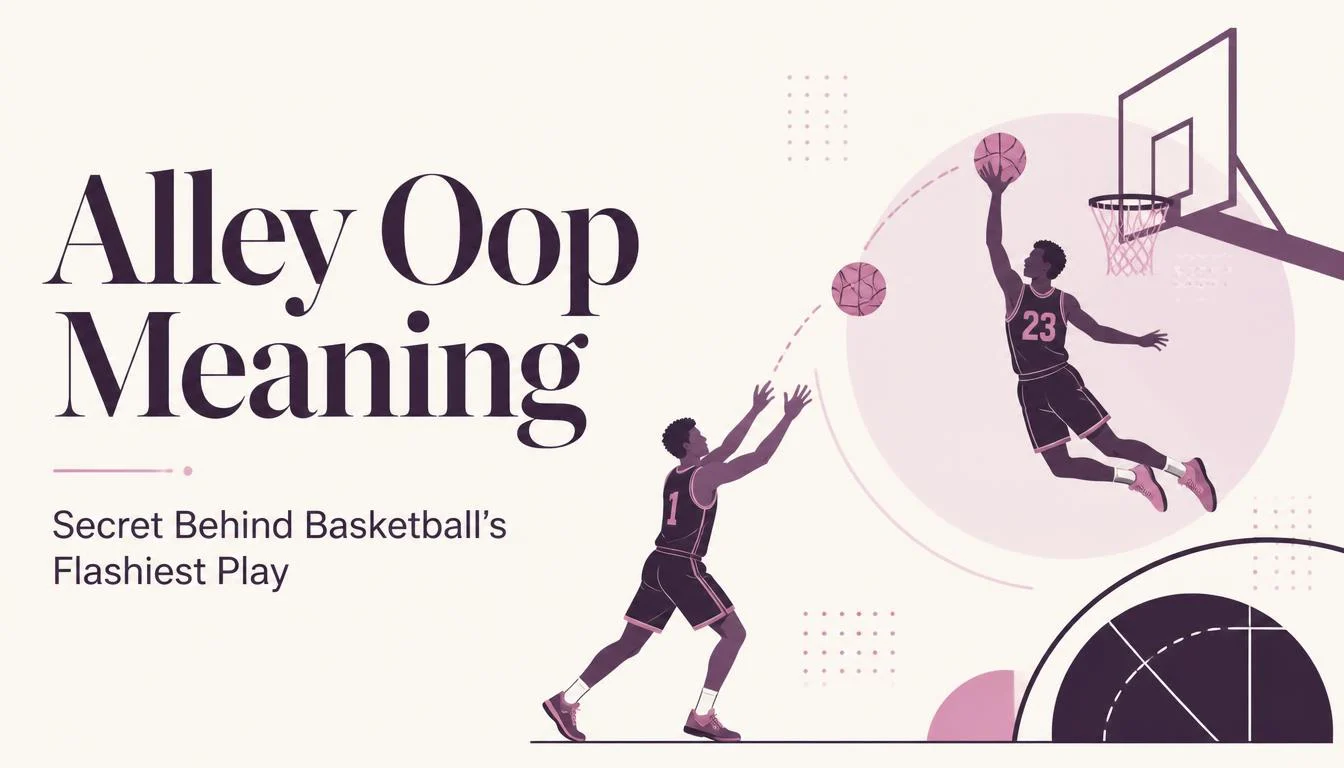
The term alley-oop refers to a basketball play in which one player throws the ball toward the basket and a teammate catches it midair and scores, usually with a dunk or layup. More broadly, it can describe a smooth, well-coordinated move that requires teamwork and perfect timing.
The alley oop meaning is most commonly associated with basketball, where two players work together to create an exciting scoring opportunity. One player tosses the ball near the rim while a teammate jumps, catches it in the air and puts it into the basket before landing. This play often brings energy to the game and highlights the players’ athletic skills and teamwork.
Outside basketball, an alley-oop can also describe a situation where one person sets someone else up for success. You might hear the term in sports commentary, casual conversations or online discussions when people talk about a perfectly timed assist or a smooth collaboration. Understanding the alley oop meaning helps you recognize how this popular basketball term can also describe teamwork in everyday life.
What Does Alley-Oop Mean?
The phrase alley-oop is most closely associated with basketball. It describes a coordinated scoring play in which one player sends the ball near the rim while a teammate jumps, catches it in midair, and finishes the play before landing.
The finish is often a dunk, but it can also be a layup or another close-range shot. The defining feature is that the receiving player catches the ball while airborne and turns the pass into a scoring attempt without first landing on the court.
For example, imagine a point guard driving toward the basket while a teammate cuts behind the defenders. The guard throws the ball high toward the rim, and the teammate leaps to catch it and dunk. That is a classic alley-oop.
The term also appears outside sports. In casual conversation, someone might use it to describe a helpful setup that allows another person to get an easy win, make a clever response, or take advantage of an opportunity.
Is Alley-Oop One Word or Two?
The standard spelling is alley-oop, with a hyphen. You may also see alley oop without the hyphen, particularly in informal writing, search queries, and social media captions.
Both forms generally refer to the same basketball play. In polished writing, the hyphenated spelling is a good choice.
The phrase is not a technical scientific term. It belongs to sports vocabulary and has developed additional figurative meanings through everyday speech and internet culture.
How an Alley-Oop Works in Basketball
A successful play usually begins before the ball leaves the passer’s hands. Both players must read the defense, recognize an opening, and move at the right moment. If either player reacts too early or too late, the opportunity can disappear.
Here is how a typical play unfolds.
- The passer creates an opening. A guard dribbles toward the basket or moves the ball to draw defenders away from the rim.
- The receiver makes a cut. A teammate moves toward the basket, often slipping behind a defender or running into open space.
- The ball is thrown high. The passer sends a lob, which is a high, curved pass, toward a point the receiver can reach while jumping.
- The receiver catches the ball in the air. The player times the jump to meet the pass near the basket.
- The player finishes the play. The receiver dunks the ball or guides it into the basket before returning to the floor.
The pass does not need to land directly above the rim. It only needs to reach a spot where the receiver can catch it and score.
Why Timing Matters More Than Height Alone
Jumping ability helps, but an alley-oop is not simply a contest to see who can jump the highest. The passer must judge the receiver’s speed, the defenders’ positions, and the distance to the basket.
A pass thrown too early gives the defense time to react. One thrown too late may force the receiver to slow down or miss the ball entirely. The best combinations make the exchange look effortless because both players understand the same movement.
That coordination is part of what makes the play so entertaining. Viewers see the dunk, but the setup often determines whether it succeeds.
Types of Alley-Oop Plays
Not every version looks the same. The direction of the pass, the receiver’s position, and the way the ball reaches the basket can change the entire play.
| Type | How it works | What makes it different |
|---|---|---|
| Standard alley-oop | One player throws a high pass to a teammate near the rim. | The most familiar version, often finished with a dunk. |
| Backdoor alley-oop | The receiver cuts behind a defender toward the basket. | It takes advantage of a defender watching the ball rather than the player. |
| Transition alley-oop | A player throws the pass during a fast break. | Speed makes it difficult for the opposing team to recover. |
| Self alley-oop | A player throws the ball toward the backboard or another reachable spot and catches it in the air. | The same player creates and finishes the scoring opportunity. |
| Alley-oop layup | The receiver catches the pass in the air and lays the ball into the basket. | It uses the same basic setup without requiring a dunk. |
These labels describe common variations rather than a rigid official classification. A single play can fit more than one category. For instance, a backdoor cut can lead to an alley-oop during a fast break.
Can an Alley-Oop Happen Without a Dunk?
Yes. A dunk is the most recognizable finish, but it is not a requirement. A player can catch the ball while airborne and softly guide it into the basket instead.
This distinction matters when describing a game. Calling every alley-oop a dunk overlooks plays in which the receiver uses a layup or a tip-in to complete the pass.
The key feature is the coordinated aerial catch and scoring attempt, not the amount of force used to put the ball through the hoop. The American Heritage Dictionary also defines the play in terms of a high pass and an airborne scoring attempt rather than requiring a dunk in every instance.
Why the Move Is So Effective
An alley-oop can turn a difficult offensive possession into a high-percentage scoring opportunity. Instead of dribbling through several defenders or taking a contested jump shot, the attacking team uses movement and a well-placed pass to get the ball close to the basket.
Its effectiveness comes from three main advantages.
It Exploits Defensive Positioning
Defenders often focus on the ball handler. A teammate who moves behind them can suddenly become available for a pass. This is particularly effective when defenders step forward to stop a drive or collapse toward the middle of the court.
A well-timed lob takes advantage of the short window between the defense’s reaction and its recovery. Even a tall defender may struggle to stop the play if the pass arrives beyond their reach.
It Creates Momentum
A successful dunk can energize a team and its supporters. The sudden change in pace makes the play memorable, especially when it follows a steal, a fast break, or a difficult defensive stop.
The effect is not purely emotional. A highlight can reflect the quality of the team’s transition offense and the players’ ability to recognize open space quickly. Still, the excitement should not be confused with guaranteed success. A poorly executed attempt can give the opposing team possession.
It Rewards Teamwork
The passer and receiver share the credit. The player who throws the ball must trust the receiver’s movement, while the receiver must trust that the pass will arrive in the right place.
This is one reason the move can serve as a useful example of teamwork outside sports. Neither player completes the play alone. The result depends on two actions fitting together at exactly the right moment.
Famous Players Associated With Alley-Oops
Several memorable basketball partnerships have helped make the play a familiar part of professional basketball.
The following are examples of notable players and partnerships, not a ranking of the greatest alley-oops.
Kobe Bryant and Shaquille O’Neal
The partnership between Kobe Bryant and Shaquille O’Neal produced one of the NBA’s best-known alley-oop moments. During Game 7 of the 2000 Western Conference finals, Bryant threw a pass that O’Neal finished with a dunk as the Los Angeles Lakers completed their comeback against the Portland Trail Blazers.
The play became a defining image of their partnership and the Lakers’ run toward the 2000 championship. The NBA itself highlights the moment in its historical coverage.
Chris Paul and Blake Griffin
The Los Angeles Clippers became widely associated with spectacular lobs during the early 2010s. Point guard Chris Paul regularly delivered passes that athletic forward Blake Griffin could catch and finish above the rim.
The team’s exciting style earned it the nickname “Lob City.” The partnership demonstrated how a skilled passer and an explosive finisher could turn the same basic play into a recognizable team identity.
Bill Russell and K. C. Jones
The history of the play goes back further than the modern NBA highlight era. Basketball accounts identify Bill Russell and K. C. Jones as early practitioners while playing for the University of San Francisco in the 1950s.
Their play illustrates that the idea of a high pass followed by an airborne finish existed long before modern highlight videos made the move widely recognizable. The exact development of the technique is difficult to assign to a single inventor, so it is more accurate to discuss early practitioners than to name one person as its creator.
Where Did the Phrase Come From?
The expression has a more colorful history than its modern basketball use might suggest. Dictionaries trace alley-oop to the French expression allez hop! or a related form, a cry associated with encouraging someone to jump, move, or perform a physical action.
The expression was used as an exclamation before becoming established basketball vocabulary. Dictionary.com traces its recorded use to the early twentieth century, while the Oxford Advanced Learner’s Dictionary also connects the phrase to French words of encouragement.
The phrase also appeared in American football during the 1950s. Accounts of the period associate it with high passes that allowed receivers to outjump defenders and catch the ball for touchdowns. Basketball later became the sport most strongly associated with the term.
There is another interesting detail: Alley Oop was also the name of a syndicated comic strip created by cartoonist V. T. Hamlin in 1932. The comic followed a prehistoric character, but that title should not be confused with the later sporting use of the phrase.
Although the expression sounds like it should refer to an actual alley or a hoop, its origin is not simply a description of a narrow street and a basketball rim. The words developed from an older exclamation associated with movement and jumping.
Alley-Oop in Slang and Everyday Conversation
Outside basketball, the phrase can describe a situation where one person sets another person up for an easy success. It can suggest cooperation, a helpful opportunity, or a perfectly timed action.
This figurative meaning makes sense when you consider the original play. One player delivers the ball, and another completes the score. In everyday speech, the ball becomes an opportunity, while the receiver becomes the person who benefits from the setup.
Here are some examples of how people might use the expression informally.
- In a conversation: “I mentioned your project to the manager. That was an alley-oop for you.” The speaker means they created an opportunity for someone else.
- On social media: “She gave him the perfect alley-oop with that question.” This suggests that her comment made it easy for him to deliver a clever reply.
- Among friends: “You set me up for that joke. Total alley-oop!” The person is saying that a friend’s remark created an easy opening for humor.
- At work: “The first team finished the research and gave us an alley-oop for the presentation.” Here, one group’s work makes the next group’s task easier.
- In a competitive setting: “That mistake was an alley-oop for the other team.” The mistake gave the opponent an easy opportunity to score or gain an advantage.
These are illustrative examples of figurative usage, not fixed dictionary definitions for every social setting.
What Does Alley-Oop Mean on TikTok or in Text Messages?
On TikTok, Instagram, and in text messages, the expression generally keeps the same idea of an easy setup or a well-timed assist. The meaning depends on the video, caption, or conversation.
For example, someone might post a clip of a friend asking an obvious question that leads to a funny answer and caption it, “Bro gave me an alley-oop.” The writer is comparing the situation to a basketball pass that makes scoring easy.
It can also refer to helping someone flirt, delivering a comeback, or giving a friend the perfect opening to say something funny. However, the phrase does not have one universal secret meaning in online slang. The surrounding context determines whether the speaker means basketball literally or is using the expression figuratively.
Alley-Oop vs. Assist vs. Lob
These basketball terms are related, but they do not mean exactly the same thing. Understanding the distinction makes sports commentary much easier to follow.
| Term | Meaning | Example |
|---|---|---|
| Alley-oop | A high pass that a teammate catches in the air and turns into a scoring attempt. | A guard throws the ball near the rim for a teammate to dunk. |
| Assist | A pass that directly contributes to a teammate’s made basket under the applicable scoring rules. | A guard passes to a teammate who scores with a jump shot. |
| Lob | A high, arcing pass that travels over or around defenders. | A player throws a high pass over a defender to a teammate near the basket. |
| Dunk | A shot in which a player puts the ball directly through the basket from above the rim. | A player jumps and forces the ball through the hoop. |
| Fast break | A quick offensive attack, usually following a change of possession. | A team races down the court after stealing the ball. |
The most important distinction is that an alley-oop describes a particular type of play, while an assist describes a contribution to a made basket. A lob describes the pass itself, and a dunk describes one possible way of finishing a shot.
A single sequence can involve all three. A player throws a lob, a teammate catches it in the air and dunks, and the passer may receive an assist under the official scoring rules.
How to Use Alley-Oop in a Sentence
If you want to use the expression naturally, think about whether you are describing a literal sports play or comparing a situation to one.
Here are five examples:
- “The point guard threw an alley-oop that ended with a powerful dunk.”
- “That pass was an alley-oop waiting to happen.”
- “My friend gave me an alley-oop by bringing up the exact topic I wanted to discuss.”
- “His question was an alley-oop, and she responded with the perfect joke.”
- “The team’s fast break ended with a beautiful alley-oop at the rim.”
In informal conversation, the figurative use is often playful. It suggests that someone has made another person’s job easier rather than claiming that a literal basketball move took place.
You can use the expression as a noun, as in “That was an alley-oop,” or refer to an “alley-oop pass” when describing the delivery of the ball.
FAQs
1. Is an alley-oop always worth two points?
Not necessarily. A successful basket made by a dunk or layup is generally worth two points because it is scored from inside the three-point arc. The value depends on the location of the shot and the applicable scoring rules, not simply on whether the play is an alley-oop.
2. Can a player throw an alley-oop to themselves?
Yes. A player can throw the ball toward the backboard or another legal spot, jump, catch it in the air, and finish the play. This is commonly called a self alley-oop. NBA footage documents Jamal Crawford performing a self alley-oop off the backboard against Washington in 2005.
3. Is alley-oop used in sports other than basketball?
Yes. The expression has historical associations with American football, where it described high passes that receivers could catch above defenders. Today, basketball remains its most familiar sporting use.
4. How do you pronounce alley-oop?
It is pronounced AL-ee-OOP, with the emphasis on the final part. The first part sounds like “alley,” while the second rhymes with “loop.” The standard American pronunciation is listed in the Cambridge Dictionary.
5. Does alley-oop mean helping someone succeed in slang?
It can. In casual speech, the phrase can describe giving someone a helpful opening, setting up a joke, or creating an easy opportunity. This is a figurative extension of the basketball play rather than a separate, universally fixed slang definition.
Conclusion
An alley-oop is one of basketball’s most recognizable plays because it combines a clever pass with an airborne finish. The expression also works in everyday conversation when someone creates the perfect opportunity for another person to succeed. Whether you hear it during a game or see it in a social media caption, the central idea remains the same: one person sets up the opportunity, and another makes the most of it.
Read More Related Articles:
- TDY Mean | Military Term Explained in Simple Words In 2026
- GC Mean | Don’t Reply Until You Know This In 2026
- 224 Mean | Hidden Meaning Behind This Popular In 2026










1 thought on “Alley Oop Meaning | Secret Behind Basketball’s Flashiest Play In 2026”