Quick Answer
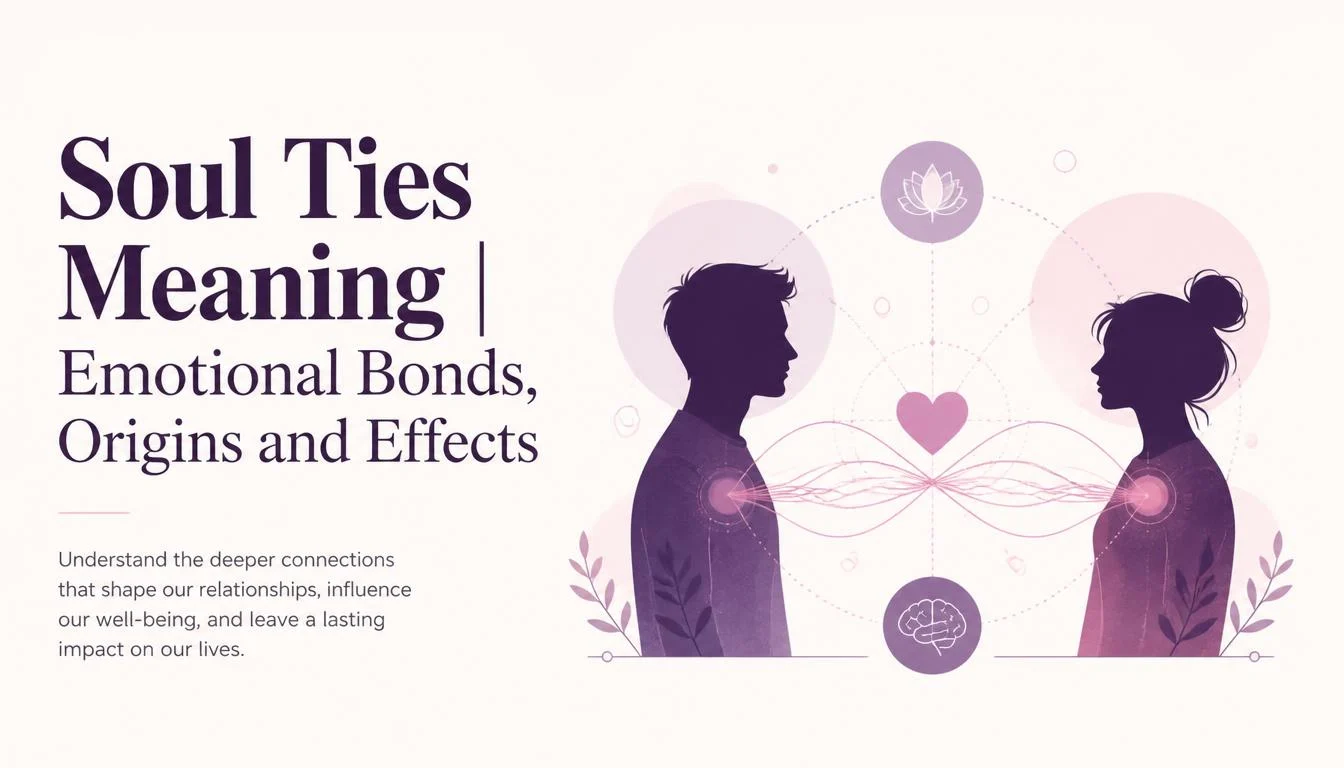
Soul ties refer to deep emotional and psychological bonds formed between two people, often through close relationships, intimacy, or shared experiences. The idea suggests that these connections can influence thoughts, emotions, and attachment patterns even after the relationship ends. While the term is not a formal scientific concept in psychology, it is widely used in spiritual and cultural discussions to describe strong relational attachment.
Soul Ties Meaning is often explained as a powerful emotional or spiritual connection between two individuals. This bond can form through relationships, friendships, or even intense life experiences. People usually feel a strong attachment that goes beyond normal emotional links, making the connection feel lasting and meaningful.
In simple terms, Soul Ties Meaning describes a situation where two people feel deeply connected even when they are apart. This concept is often discussed in spiritual and emotional contexts, where the bond can influence thoughts, feelings, and behaviors. It is believed that these ties can be positive or sometimes difficult depending on the nature of the relationship.
Definition of Soul Ties
Soul ties meaning generally refers to a perceived emotional link between two individuals that goes beyond ordinary connection. In everyday usage, people describe it as feeling “bonded” to someone in a way that persists even after separation.
Psychologically, this idea overlaps with concepts like emotional attachment, memory association, and dependency patterns. Strong emotional experiences can create lasting mental associations between people, especially when relationships involve trust, intimacy, or vulnerability.
Unlike formal psychological models such as attachment theory developed by John Bowlby, soul ties is not a clinical term. Instead, it belongs more to spiritual and cultural language used to explain intense interpersonal connections.
Origins and Cultural Context
The idea of deep invisible bonds between people appears in many cultures. Ancient philosophical traditions often described human connections as energetic or spiritual links.
In modern usage, the term became especially popular in spiritual and faith-based communities. It is often discussed in religious counseling settings, where relationships are viewed through a moral and emotional lens.
However, mainstream psychology does not define or measure soul ties. Instead, it explains similar experiences through established frameworks like bonding, reinforcement learning, and emotional conditioning.
Despite this, the term remains widely used because it gives people a simple way to describe complex emotional experiences.
Types of Soul Ties
People often describe different forms of emotional bonds under the umbrella of soul ties. These are not scientific categories but are commonly referenced in spiritual discussions.
| Type of Bond | Description | Common Context |
|---|---|---|
| Emotional Bond | Formed through deep emotional sharing and vulnerability | Close friendships, long-term partners |
| Physical Bond | Often linked with physical intimacy and closeness | Romantic or sexual relationships |
| Familial Bond | Naturally formed through family relationships and upbringing | Parents, siblings, relatives |
| Trauma Bond | Created through cycles of emotional stress and attachment | Toxic or abusive relationships |
Each type varies in intensity and emotional impact. Some may feel supportive and stable, while others can create confusion or emotional dependency.
Emotional and Psychological Perspective
From a psychological point of view, what people call soul ties can often be explained through attachment systems in the brain. Humans are wired to form bonds for survival and emotional stability.
When someone experiences strong emotional events with another person, the brain strengthens memory pathways connected to that person. Neurochemicals like oxytocin and dopamine play a role in reinforcing these associations.
For example, oxytocin is released during physical affection and trust-building interactions. This hormone strengthens feelings of closeness and security. Dopamine, associated with reward and pleasure, reinforces positive emotional experiences.
This is why certain relationships can feel “hard to forget,” even after they end.
Real-Life Relationship Patterns
Many people report experiencing lingering emotional attachment after breakups or separation. This is often interpreted as a soul tie.
Common patterns include:
- Thinking frequently about a past partner
- Feeling emotionally triggered by reminders
- Difficulty forming new relationships
- Idealizing a past connection
These experiences are not unusual. Psychologists often relate them to memory reinforcement and emotional conditioning rather than unseen energetic bonds.
For instance, studies in behavioral psychology show that the brain tends to prioritize emotionally significant memories over neutral ones, which explains why certain relationships remain mentally active long after they end.
Healthy vs Unhealthy Bonds
Not all strong emotional connections are harmful. Some relationships provide stability, trust, and emotional growth.
Healthy emotional bonds
- Based on mutual respect and support
- Allow personal independence
- Encourage emotional security
- Do not create dependency
Unhealthy emotional bonds
- Involve emotional dependency
- Create anxiety when separated
- Include manipulation or control
- Feel difficult to break even when harmful
Understanding the difference helps people recognize when an emotional connection is supportive versus when it becomes draining.
Spiritual Interpretations
In spiritual communities, soul ties are often described as energetic connections formed through deep emotional or physical experiences.
Some belief systems suggest that these bonds can influence thoughts and behavior even across distance or time. This interpretation is commonly found in pastoral counseling and spiritual healing practices.
However, it is important to note that these ideas are faith-based rather than scientifically validated. Institutions such as the American Psychological Association focus instead on measurable emotional and cognitive processes when studying relationships.
Still, many people find spiritual explanations meaningful because they provide emotional clarity during complex relationship experiences.
How Emotional Bonds Influence Behavior
Strong emotional connections can shape decision-making and behavior in subtle ways.
People may:
- Revisit memories repeatedly
- Compare new relationships to past ones
- Experience emotional triggers from familiar places or sounds
- Hold onto unresolved feelings
This happens because the brain stores emotional experiences with strong associative links. The hippocampus and amygdala work together to connect memory with emotion, which makes certain experiences feel more vivid and persistent.
These mechanisms explain why emotional bonds can feel long-lasting and sometimes difficult to release.
Soul Ties vs Attachment Theory
While soul ties is a spiritual concept, attachment theory is a scientific framework used in psychology.
Attachment theory, developed through the work of John Bowlby and later researchers like Mary Ainsworth, explains how early relationships shape emotional patterns in adulthood.
| Aspect | Soul Ties | Attachment Theory |
|---|---|---|
| Origin | Spiritual and cultural beliefs | Psychological research |
| Focus | Emotional or energetic bonds | Behavioral and emotional development |
| Measurement | Not scientifically measurable | Studied through experiments and observation |
| Usage | Popular in personal and spiritual language | Used in clinical psychology |
Both describe strong emotional connections, but they approach the concept from very different perspectives.
Emotional Release and Healing
People who feel emotionally attached after a relationship often look for ways to move forward. While approaches vary, psychological methods usually focus on emotional regulation rather than breaking unseen bonds.
Common supportive steps include:
- Building new routines
- Reducing exposure to emotional triggers
- Talking with supportive people
- Engaging in reflective journaling
Over time, the brain naturally weakens emotional associations when they are not reinforced. This process is part of normal emotional adaptation.
FAQs
Why do some relationships feel hard to forget?
Because emotionally intense experiences create strong memory links in the brain, making recall more frequent and vivid.
Can soul ties form outside romantic relationships?
Yes, people often describe strong emotional bonds with friends or family using the same concept.
Is soul ties a scientific concept?
No, it is not recognized as a formal psychological or biological term.
How long do emotional bonds last?
Duration varies widely depending on emotional intensity, repetition, and personal coping mechanisms.
Can new relationships replace old emotional attachments?
New experiences can gradually reshape emotional focus, but timing depends on individual emotional processing.
Conclusion
Emotional bonds between people can feel deeply persistent and meaningful. Whether described through spiritual language or psychological terms, these connections reflect how strongly human memory and emotion are linked. Understanding both perspectives helps make sense of why certain relationships leave a lasting imprint.
Read More Related Articles:
- “God Fearing” Mean | Complete Guide to Its True Interpretation In 2026
- OAT Mean in Text | Common Uses You Should Know In 2026
- BTW Mean in Text | Learn It in Under 1 Minute In 2026

Michael Turner is a U.S.-based content writer and blogger who enjoys uncovering the stories and meanings behind words. Through his work at Meanvora, he delivers well-researched, easy-to-read articles that help readers expand their vocabulary and gain a deeper understanding of language.









6 thoughts on “Soul Ties Meaning | Emotional Bonds, Origins and Effects In 2026”