Quick Answer
Adore means to love someone or something very much. It can describe deep affection for a person, strong fondness for an activity, or great enjoyment of something. The word is often warmer and more expressive than simply saying that you like something.For example, “I adore my grandmother” expresses strong affection, while “She adores classical music” means she enjoys it greatly. Depending on the situation, the word can sound romantic, affectionate, playful, or simply enthusiastic.
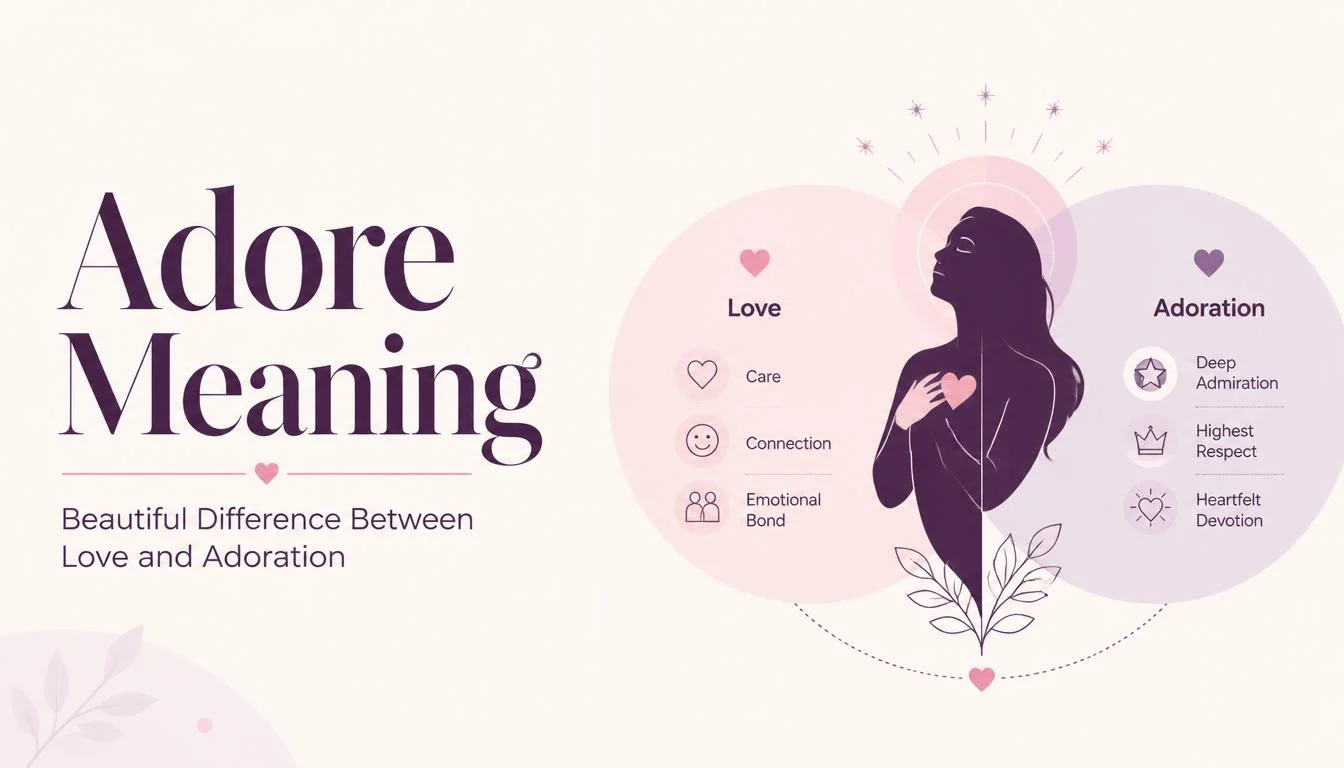
The adore meaning is closely connected with deep love, affection, and admiration. When someone says they adore a person, they usually mean they care for them greatly and feel a strong sense of fondness toward them.
The word adore can also describe strong appreciation for things, such as a favorite place, hobby, pet, or activity. Its meaning can range from heartfelt love to enthusiastic admiration depending on the context.
What Does Adore Mean?
The verb adore describes a strong feeling of love, affection, or intense enjoyment. When you adore someone, you have a particularly warm feeling toward that person. When you adore something, you usually mean that you like it a great deal.
The word can apply to people, animals, places, activities, food, art, and even small everyday things. A person might adore their partner, adore their dog, adore chocolate, or adore spending time outdoors.
That flexibility is one reason the word remains common in everyday English.
Consider these examples:
- “I adore my sister.”
- “He adores his new puppy.”
- “We adore this little café.”
- “She adores painting.”
- “They adore Italian food.”
The emotional strength changes slightly with context. Saying “I adore you” can sound deeply romantic. Saying “I adore this cake” is usually enthusiastic rather than romantic.
The Original Sense of Adore
The history of the word gives it an interesting background.
Adore comes from the Latin adorare, which was associated with worship, prayer, or addressing a deity. The Latin word combines ad, meaning “to,” with orare, meaning “to speak” or “to pray.”
Over time, the English word developed beyond its religious association. It became a way to express intense admiration or love toward people and things.
That older connection explains why the word can sometimes feel stronger than ordinary expressions such as “like” or “enjoy.” Modern speakers generally use it without any religious meaning.
For most everyday conversations, “adore” simply communicates powerful affection or enthusiasm.
Adore in Everyday English
You will hear this word in many different situations. It does not belong exclusively to romantic relationships.
Adoring a Person
When used for a person, it usually communicates strong affection.
“Maria adores her father.”
This means Maria has a deep and loving attachment to her father.
The relationship could be romantic, family based, or friendly. The surrounding sentence tells you which meaning is intended.
For instance:
“He adores his wife.”
This will normally sound romantic.
But:
“The children adore their teacher.”
This clearly describes admiration and affection rather than romance.
Adoring an Animal
People frequently use the word when talking about pets.
“She absolutely adores her cat.”
Here, the expression suggests more than simply enjoying having a pet. It presents a strong emotional bond.
The same construction works with dogs, horses, birds, and other companion animals.
Adoring an Activity
The object does not have to be a living thing.
“I adore reading mystery novels.”
This means the speaker gets a great deal of pleasure from reading them.
Similarly, someone might say:
“He adores cooking for his family.”
The sentence communicates genuine enthusiasm for the activity.
Adoring Food or Objects
English speakers also use the word for things they enjoy intensely.
“I adore fresh strawberries.”
“She adores that vintage handbag.”
“They adore their new house.”
These sentences are not necessarily dramatic declarations. In casual conversation, adore can simply make a positive opinion sound warmer and more enthusiastic.
Adore vs. Love vs. Like
These words overlap, but they are not always interchangeable.
| Word | General Strength | Typical Feeling | Example |
|---|---|---|---|
| Like | Mild to moderate | Positive preference | “I like this song.” |
| Enjoy | Moderate | Pleasure or satisfaction | “I enjoy this show.” |
| Admire | Moderate to strong | Respect or appreciation | “I admire her courage.” |
| Adore | Strong | Deep affection or intense fondness | “I adore this dog.” |
| Love | Strong | Deep affection, attachment, or passion | “I love my family.” |
| Cherish | Strong | Deep emotional value | “I cherish our memories.” |
The difference is especially noticeable with people.
- “I like him” can describe attraction, friendship, or general approval.
- “I love him” normally communicates a much deeper emotional connection.
- “I adore him” also expresses strong affection, but it can have a softer or more openly affectionate tone.
In some situations, adore and love are almost interchangeable. In others, the speaker chooses adore because it sounds warmer, sweeter, or more enthusiastic.
Is Adore a Romantic Word?
It can be, but it is not inherently romantic.
This distinction matters because context determines the emotional meaning.
Someone might tell their partner:
“I adore you.”
That can be an intimate declaration of affection.
A parent might say:
“I adore my children.”
A person could also say:
“I adore my best friend.”
None of these examples necessarily carries the same type of love.
The word describes the strength of positive feeling, while the relationship itself determines whether that feeling is romantic, familial, friendly, or affectionate.
It can even be used humorously:
“I adore you for bringing coffee.”
Here, the speaker is expressing strong appreciation in a playful way. They are not necessarily making a serious declaration of love.
Adore as a Verb
From a grammar perspective, adore is a transitive verb. That means it normally takes a direct object.
The basic pattern is:
Subject + adore + object
Examples include:
“I adore her.”
“She adores her children.”
“They adore classical music.”
“We adore this restaurant.”
The verb changes according to the subject and tense.
Present Tense
- I adore
- You adore
- We adore
- They adore
- He adores
- She adores
- It adores
The third person singular form adds s, giving us adores.
Past Tense
The past tense is adored.
“She adored her childhood home.”
“He adored that book when he was younger.”
Present Participle
The present participle is adoring.
“The children were adoring the puppy.”
However, in ordinary English, constructions such as “The children adored the puppy” are usually more natural when describing a completed or general feeling.
Adore in Texting and Social Media
Online, the word often appears in informal comments, captions, and messages.
Someone may write:
“I adore this outfit!”
Or:
“Adore this photo.”
The second version is an informal shortened expression. The writer has omitted the subject and auxiliary wording because the meaning is obvious from the context.
On social media, adore can also function as an enthusiastic compliment.
For example:
“I absolutely adore your new haircut.”
This communicates stronger enthusiasm than “I like your haircut.”
People also use phrases such as “absolutely adore,” “simply adore,” and “just adore” to intensify the statement.
Common Expressions With Adore
Certain combinations sound especially natural in English.
“I Adore You”
This is one of the most direct affectionate expressions.
It can be romantic, familial, or friendly depending on who says it and why.
“Absolutely Adore”
This intensifier makes the emotion sound stronger.
“I absolutely adore this book.”
It means the speaker has an exceptionally positive opinion of the book.
“Adore Someone”
This is the most straightforward personal construction.
“She adores her grandmother.”
It indicates strong affection and admiration.
“Adore Something”
The same structure works with objects and ideas.
“He adores old movies.”
The speaker is expressing a strong preference.
Adore vs. Admire
These words can appear similar, but they focus on different emotions.
Admire usually involves respect, appreciation, or approval. You might admire someone’s honesty, intelligence, discipline, or talent without feeling personally close to them.
Adore is more emotionally affectionate.
For example:
“I admire Serena Williams for her determination.”
This focuses on respect for an achievement or quality.
By contrast:
“I adore my little niece.”
This focuses on personal affection.
A person can admire someone without loving them. Adoration generally carries more emotional warmth.
Adore vs. Cherish
Cherish suggests that something is deeply valued and emotionally treasured.
You might cherish a memory, a friendship, a family tradition, or a person who means a great deal to you.
Adore tends to emphasize affection or intense fondness.
Compare these sentences:
“I adore my dog.”
“I cherish the memories I have of my childhood dog.”
The first expresses affection toward the animal. The second emphasizes the lasting emotional value of memories.
Both words can be powerful, but they point toward slightly different feelings.
Adore vs. Worship
The historical connection between these words can make the comparison interesting.
Worship normally has a religious meaning involving reverence toward a deity. It can also be used figuratively when someone is treated with extreme admiration.
Adore has a much broader modern use.
You can adore a person, a song, a meal, a pet, or a hobby without suggesting religious devotion.
For everyday English, these words should not be treated as simple synonyms.
Examples of Adore in Different Situations
Seeing the word in different contexts makes its range easier to understand.
Romantic
“I adore everything about you.”
This expresses deep personal affection.
Family
“The children adore their grandfather.”
The sentence describes a strong emotional bond.
Friendship
“I absolutely adore my best friend.”
This communicates warmth and appreciation without requiring romance.
Pets
“He adores his rescue dog.”
The word emphasizes affection toward the animal.
Hobbies
“She adores gardening.”
This means gardening gives her considerable pleasure.
Food
“I adore homemade pasta.”
Here, the word means the speaker is extremely fond of the food.
Entertainment
“They adore old Hollywood movies.”
The sentence describes a strong preference.
Places
“We adore this quiet mountain town.”
The speakers have a particularly positive emotional response to the place.
How Strong Is the Word Adore?
There is no universal emotional scale for words such as “like,” “love,” and “adore.” Speakers choose them based on personality, culture, relationship, and context.
Still, adore usually communicates more enthusiasm than like.
For example:
“I like your dress.”
This is a positive compliment.
“I love your dress.”
This sounds more enthusiastic.
“I adore your dress.”
This can sound especially warm, excited, or affectionate.
Interestingly, the strength of the word does not always make the situation serious. English speakers often exaggerate affection for humorous effect.
Someone might say:
“I adore this little spoon.”
They are not necessarily emotionally attached to a spoon. The exaggeration simply makes the sentence playful.
Why Context Matters So Much
A dictionary definition cannot capture every shade of meaning.
Consider the sentence:
“She adores him.”
Without additional information, you cannot know exactly what relationship exists between them.
She could be his mother, sister, friend, partner, teacher, or admirer.
Now compare:
“She adores him and wants to marry him.”
The romantic meaning becomes clear.
Or:
“His grandmother adores him.”
The family relationship changes the interpretation.
This is why understanding a word involves more than memorizing a definition. The surrounding words often reveal the speaker’s intended emotion.
Five Real Literary and Cultural Connections
The word has a long history in English and appears naturally across literature and popular culture.
William Shakespeare used forms of the word in his works, reflecting the broader tradition of English expressions of affection and admiration.
Jane Austen’s novels frequently explore affection, attraction, admiration, and marriage. While the exact word choice varies by character and passage, the emotional territory covered by “adore” is central to her treatment of relationships.
The word also appears in the language surrounding The Beatles, whose songs frequently use direct vocabulary of love and affection. “Adore” fits naturally into the broader vocabulary of popular romantic expression.
In modern entertainment, Taylor Swift and many other contemporary songwriters use related vocabulary to describe affection, attraction, attachment, and admiration. The word itself remains part of the wider emotional vocabulary of English rather than belonging to one particular genre.
Its continued appearance across literature, conversation, advertising, and social media shows how adaptable the term has become.
When Should You Use Adore?
Use adore when you want to communicate strong affection or enthusiasm.
It works especially well when “like” feels too weak.
For example:
“I adore spending Sundays with my family.”
This sounds more emotionally expressive than:
“I like spending Sundays with my family.”
It is also useful when you want your compliment to feel warmer.
“I adore your sense of humor.”
That sounds personal and affectionate.
Still, the word should fit the relationship. Saying “I adore my new stapler” may be perfectly funny among friends, but it would sound unusual in a formal business report.
Common Mistakes With Adore
One common mistake is assuming that adore always means romantic love. It does not.
Another is treating it as exactly identical to admire. Admiration can be based mainly on respect, while adoration usually contains stronger emotional affection.
It is also easy to overuse the word. Because it is emotionally strong, repeating it several times in the same paragraph can make the writing feel exaggerated.
A good rule is simple: use it when you genuinely want the sentence to sound warmer or more enthusiastic.
FAQs
Can adore be used for a place?
Yes. You can say, “I adore Paris,” or “We adore our hometown.” The expression means that you have a strong affection or fondness for the place.
Is adored a past tense form?
Yes. Adored is the simple past and past participle form of adore. For example, “She adored her childhood pet.”
Can you use adore in formal writing?
Yes, but its suitability depends on the subject. It can work in personal essays, literary writing, reviews, and descriptive prose. In technical or highly objective writing, a more precise term may be better.
What is the noun form of adore?
The main noun is adoration, which means intense love, affection, or admiration. For example, “The child looked at her mother with adoration.”
What is the adjective form related to adore?
Adoring can describe someone who shows great affection. For example, “He gave her an adoring look.” The adjective adorable is related historically but has a different everyday meaning, usually describing someone or something charming or cute.
Conclusion
Adore is a warm and expressive word for strong affection, love, or enthusiastic enjoyment. Its meaning stretches beyond romance, which makes it useful for describing feelings toward people, animals, hobbies, places, food, and countless other things.
The best way to understand its exact tone is to look at the context. Whether someone says “I adore you” or “I adore this song,” the word adds a noticeable sense of warmth and enthusiasm to the sentence.
Read More Related Articles:
- Slime Someone Out Mean | Real Story Behind This Slang In 2026
- Adjacent Mean in Math | Easy Way to Get It Right In 2026
- Congruent Mean in Geometry | Learn the Secret of Identical Shapes In 2026











1 thought on “Adore Meaning | Beautiful Difference Between Love and Adoration In 2026”