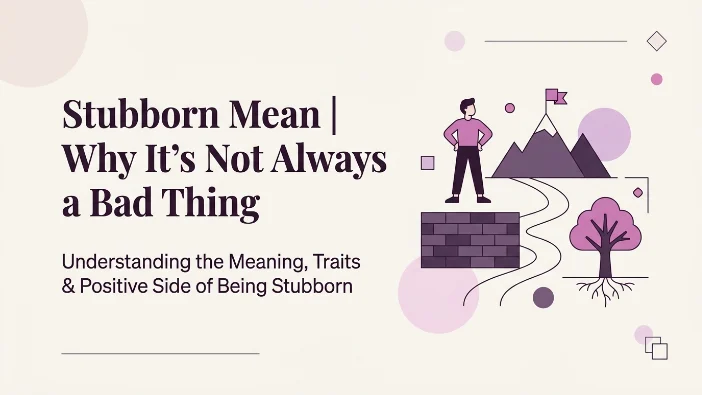
Have you ever tried to change someone’s mind, only to feel like you’re arguing with a brick wall? Or perhaps you’ve been called “stubborn” yourself, and it didn’t exactly feel like a compliment. We’ve all been there. In our fast-paced world where adaptability is often praised, being labeled “stubborn” can feel like a social scarlet letter. But is it always a bad thing?
The truth is, “stubborn” is one of those powerful, double-edged words in the English language. It can describe a determined hero who refuses to give up or a frustrating colleague who won’t listen to reason. The secret lies in understanding the “stubborn mean”—the precise meaning and how context, tone, and intention can change the story entirely.
In this comprehensive guide, we’ll unpack everything you need to know about the word “stubborn.” We will explore its origins, its range of meanings, and practical examples. We will also compare it with similar terms and offer professional alternatives. By the end, you’ll be equipped to use this word with confidence and clarity.
Stubborn Mean: The Definitive Definition
When we ask, “What does stubborn mean?” we are touching on a concept that is both simple and surprisingly complex.
The Core Definition
At its most basic level, to be stubborn means to be unreasonably unwilling to change your mind, action, or opinion. It involves a firm resistance to any attempt to alter a chosen course . It can also refer to things that are difficult to handle, manage, or overcome, like a “stubborn stain” or a “stubborn cough” .
The Full Spectrum of Meaning
While the core definition is straightforward, the “stubborn mean” expands into several nuanced categories:
- Refusing to Comply: Someone who is stubborn refuses to agree, give in, or comply with requests or commands .
- Fixed in Purpose: This is the more positive side. It signifies being resolute, determined, and unwavering in one’s goals .
- Difficult to Overcome: This applies to inanimate objects or problems, suggesting they are persistent, tough, and resistant to treatment or removal . A “stubborn lock” is hard to open; a “stubborn illness” is hard to cure.
In essence, being stubborn always involves a powerful, unwavering force, whether in a person’s character or in a physical object. It describes a quality of being unyielding and resolute .
The Origin and Evolution of Stubborn
Have you ever wondered where this quirky word came from? The history of “stubborn” is a bit of a mystery. Its origins are “obscure,” meaning historians aren’t 100% sure where it came from, but it has been around in the English language since the Middle Ages.
A Middle English Mystery
The word first appeared in Middle English around 1350–1400 in forms like stiborn(e), styborne, or stuborn . The general consensus is that it likely evolved from earlier forms of English, but the exact root is unknown.
The Sense of “Untamable”
The most fascinating piece of its history is the early meaning. In Middle English, the word carried a sense of being “untamable, implacable” . This is a powerful image.
- Untamable: Like a wild animal that resists all attempts to be domesticated.
- Implacable: Like an enemy who cannot be appeased or pacified.
This early meaning still echoes in how we use the word today. Calling someone stubborn often implies they have a wild, untamable will—they simply cannot be “tamed” or forced to conform.
Real-World Usage and Tone
Understanding the definition is only half the battle. The real art lies in how we use the word “stubborn” in everyday conversation. Its meaning can completely shift based on context, delivery, and tone.
The Friendly and Admiring Tone
When we talk about someone’s “stubborn determination,” we are often praising their grit and perseverance . Think of an entrepreneur who failed multiple times but kept going. People might say their “stubborn refusal to give up” was the key to their success. It implies a positive, unwavering persistence and tenacity .
Example: “My grandmother is so stubborn when it comes to her daily garden work; she’s out there in the rain, determined to get her roses planted. I admire her drive.”
The Neutral and Informative Tone
“Stubborn” can also be used in a neutral, factual way to describe something that is simply difficult to deal with. There’s no emotional judgment here—just a statement of fact.
Example:
- “I tried everything to get this wine stain out of the tablecloth, but it’s incredibly stubborn.”
- “We’re looking for a new cleaning agent for these stubborn rust stains.”
The Negative and Dismissive Tone
Most often, when the word is directed at a person, it carries a disapproving or critical tone . It implies the person is being unreasonable, inflexible, and difficult to deal with . This is the classic “stubborn child” scenario.
Example: “He is so stubborn! I’ve given him all the facts, but he refuses to admit he was wrong.”
Summary Table: Tone and Usage of “Stubborn”
| Tone | Context | Example Sentence |
|---|---|---|
| Friendly/Admiring | Perseverance, Grit, Determination | “Her stubborn persistence is what got the team through the project.” |
| Neutral/Informative | Inanimate Objects, Problems, Stains | “This is a stubborn piece of rust; a wire brush might be needed.” |
| Negative/Dismissive | Personal Character, Unreasonable People | “My boss is so stubborn; he won’t even consider my proposal.” |
Comparison with Similar Terms
One of the most common questions is how “stubborn” compares to other words like “obstinate,” “determined,” or “mean.” While these words are related, they have important distinctions.
Stubborn vs. Obstinate
Stubborn and obstinate are often used interchangeably, as they both imply resistance to change. However, there’s a subtle difference:
- Stubborn implies more of an innate quality of character. It can be a part of who someone is . It’s also more frequently used for inanimate things.
- Obstinate specifically suggests a negative, unreasonable unwillingness to change in response to reason. It is almost always a criticism.
Usage: “He was too stubborn to give up,” vs. “He was too obstinate to listen to reason.”
Stubborn vs. Mean
This comparison helps clear up a common misunderstanding. mean in this context usually refers to being unkind, malicious, or offensive, or it can mean the mathematical average. It does not mean the same as being stubborn.
- Stubborn refers to a refusal to change.
- Mean refers to a lack of kindness or a low value.
Clarification: A person can be both stubborn and mean, but one does not equal the other. You are “mean” when you are cruel; you are “stubborn” when you are unyielding .
Stubborn vs. Determined vs. Persistent
These words sit on the more positive side of the spectrum, but they aren’t identical.
- Determined: Implies a firm decision to achieve a goal.
- Persistent: Means continuing to try even in the face of discouragement .
- Stubborn: Implies a fixed state of mind, which may or may not be related to a goal. It can be negative because it ignores reason, while determination is often seen as a virtue.
Common Expressions and Phrases
A word is often best understood through its idioms. These common phrases involving “stubborn” show how deeply the concept is embedded in our culture.
“Stubborn as a Mule”
This is the most famous idiom of all. It compares a stubborn person to a mule, a pack animal known for its incredible strength and refusal to move when it doesn’t want to. It means someone is extremely obstinate and difficult to persuade .
“Stubborn Streak”
This describes a persistent, sometimes negative, characteristic of someone’s personality that appears from time to time. “She has a stubborn streak that makes her difficult to work with.”
“To Dig In One’s Heels”
While not using the word “stubborn,” this phrase perfectly describes the action of someone who is being stubborn. It comes from the image of an animal refusing to move forward, literally digging its heels into the ground.
Politeness and Professional Alternatives
Because “stubborn” can have such a negative connotation, it’s often wise to choose a more polite or professional alternative, especially in the workplace. Here is a helpful guide:
- Instead of “He is stubborn,” try “He is determined” (if you want to compliment the goal) or “He is resolute” (if you want to compliment his commitment).
- Instead of “This is a stubborn problem,” try “This is a persistent problem” or a “challenging issue.”
- Instead of “Our client is being stubborn,” try “Our client is being firm on their requirements” or “Our client has a strong preference.”
- To describe someone who won’t budge, you can use the term “uncompromising” . This is often a more neutral way of saying the same thing.
FAQs
Is Stubborn a Positive or Negative Word?
Stubborn is generally considered a negative word because it describes someone who is unwilling to change their opinion or behavior, even when presented with good reasons. However, in some situations, it can have a positive meaning by highlighting determination, persistence, or resilience.
What Is the Difference Between Stubborn and Determined?
Although they may seem similar, determined and stubborn are not the same. A determined person stays focused on achieving a goal while remaining open to better ideas. A stubborn person resists changing their viewpoint, even when evidence or advice suggests they should.
What Is the Best Synonym for Stubborn?
Some of the most common synonyms for stubborn include obstinate, headstrong, unyielding, dogged, and persistent. Among these, obstinate is often considered the closest synonym.
What Is the Meaning of Stubborn in a Sentence?
Here are two examples:
- “The stubborn child refused to eat her vegetables.” (Refusing to cooperate.)
- “The stubborn stain wouldn’t come out.” (Difficult to remove.)
What Is the Opposite of Stubborn?
Common antonyms of stubborn include flexible, cooperative, compliant, tractable, docile, and obedient. These words describe someone who is willing to adapt or accept guidance.
Why Are People Stubborn?
People may be stubborn for many reasons, including fear of change, pride, a desire to be right, self-protection, or personality traits. Sometimes stubbornness is a way of maintaining control or standing firmly by personal beliefs.
How Do You Say “Stubborn” in a Nice Way?
If you want a more positive alternative, consider words like determined, tenacious, steadfast, persistent, resolute, or unwavering. These emphasize strong will and commitment without the negative tone.
What Is a Stubborn Person Called?
A stubborn person may be described as obstinate, headstrong, pig-headed, intractable, or mulish. The best choice depends on the tone and context, ranging from neutral to strongly critical.
Conclusion
So, what does stubborn mean? As we’ve uncovered, it’s a word with a rich history and a complex present. It describes an unyielding force, an untamable will, or an unshakable problem. While it often carries a negative charge—especially when describing people who refuse to listen to reason—the core of the word is simply about a firm resistance to change.
The real takeaway is that stubbornness is all about perception and context. Sometimes, it’s a flaw, leading to conflict and missed opportunities. Other times, it’s a superpower, embodying the persistence, tenacity, and determination needed to break barriers and achieve the impossible.
The next time you label someone stubborn or find the label applied to you, ask yourself: Is this an unreasonable refusal to change, or is it a commendable refusal to give up? Understanding the nuance allows you to use the word more effectively and appreciate the complex quality it describes. Whether it’s a stubborn stain on your shirt or a stubborn streak in your boss, you are now equipped to handle the meaning with confidence.
Read More Related Articles:
- KEKW Meaning | Viral Chat Meme You Keep Seeing In 2026
- Aggregate Meaning | Why Everyone Keeps Getting It Wrong In 2026
- OMS Meaning | Decode This Popular Internet Term In 2026









5 thoughts on “Stubborn Mean | Why It’s Not Always a Bad Thing In 2026”