Ever been scrolling through a Twitch chat, watching your favorite streamer completely lose it over something ridiculous, and suddenly the whole chat explodes with “KEKW KEKW KEKW”? If you’ve stared at your screen wondering what on earth that means, you’re not alone. Thousands of people search for this exact term every month, and the answer is simpler (and funnier) than you might expect.
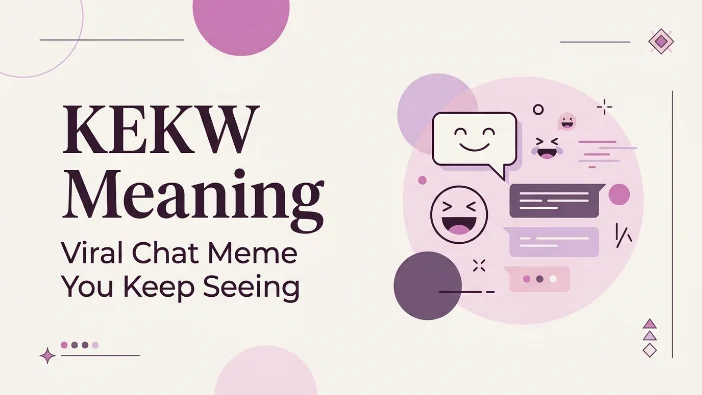
KEKW meaning, in short: KEKW is a Twitch and Discord emote used to express extreme laughter, similar to “LOL” or “LMAO,” but visually it shows a distorted, exaggerated laughing face and is dropped in chat whenever something is hilariously funny, cringeworthy, or absurd.
That’s the quick answer. But there’s a lot more to this little emote than meets the eye where it came from, how people actually use it, what it says about internet culture, and why it’s become one of the most spammed reactions in live-streaming history. Let’s break it all down.
What Does KEKW Mean?
KEKW is an internet slang term and Twitch chat emote that represents intense, uncontrollable laughter. It’s typically used as a reaction to something extremely funny, unexpected, embarrassing, or “so bad it’s good.” The emote itself is based on a real photo of a Brazilian voice actor mid-laugh, captured in an exaggerated, almost cartoonish expression.
Think of KEKW as the visual, streamer-culture cousin of:
- 😂 (Face with Tears of Joy)
- LMAO
- “I’m dead”
- “Bro I can’t breathe”
It carries the same energy pure, chaotic amusement but it lives specifically in the world of live streaming, gaming chats, and meme culture.
Where Did KEKW Come From? The Origin Story
To understand KEKW, you have to go back a bit further than the emote itself to the word “kek.”
The Word “Kek” Came First
“Kek” originated in World of Warcraft, where players on opposing factions (Horde vs. Alliance) saw each other’s “LOL” text translated into “KEK” due to an in-game language filter. Horde players couldn’t read Alliance chat properly, so “lol” appeared garbled as “kek.” Over time, players adopted “kek” as their own inside joke a strange, guttural way of saying “haha” that felt funnier simply because it was nonsensical.
From there, “kek” spread across gaming forums and eventually into broader internet meme culture, often associated with absurdist or ironic humor.
Enter KEKW: The Emote Era
Fast forward to the rise of Twitch and its emote culture. Streaming platforms thrive on quick, expressive reactions chat moves fast, and typing full sentences doesn’t cut it. Emotes fill that gap perfectly.
KEKW itself is based on a screenshot of Rakim “KEKW” actually, more accurately, the image is a screengrab of Brazilian voice actor Vinícius “Vinny” Franco, taken from a video where he was reacting with an intensely funny, wide-mouthed laugh. Someone captured that exact frame, turned it into an emote, and uploaded it to BetterTTV (BTTV), a popular third-party extension that adds custom emotes to Twitch chat.
The face was so perfectly exaggerated eyes squeezed shut, mouth wide open, clearly mid-laugh that it instantly resonated with viewers. Combine that visual with the already-established “kek” laughing sound, and KEKW was born.
Why It Took Off So Fast
A few reasons KEKW spread like wildfire:
- It’s visually funny on its own. Even without context, the face communicates “this is hilarious.”
- It fit an existing meme template. “Kek” already meant laughter in internet slang, so KEKW slotted in naturally.
- Streamers reacted to it. When streamers see chat spam KEKW, they often laugh at the emote itself, creating a feedback loop of humor.
- Third-party emote extensions made it accessible. BTTV and FrankerFaceZ (FFZ) let any Twitch viewer use KEKW, regardless of which channel they’re watching, massively increasing exposure.
How Popular Is KEKW Today?
KEKW isn’t just popular it’s one of the most iconic and widely used emotes in Twitch history. It regularly appears among the top most-used BTTV emotes globally, alongside other legendary reactions like PogChamp, monkaS, and OMEGALUL.
Here’s a quick snapshot of why it remains relevant:
| Factor | Why It Matters |
|---|---|
| Cross-platform use | Used on Twitch, Discord, YouTube live chats, and even TikTok comments |
| Meme longevity | Has stayed relevant for years, unlike many short-lived internet trends |
| Variations exist | KEKWait, KEKWalt, and other spin-off versions have emerged |
| Recognizability | Even casual streaming viewers instantly recognize the face |
Basically, if you spend any amount of time in gaming or streaming spaces online, you will run into KEKW sooner or later.
How Is KEKW Actually Used?
KEKW isn’t reserved for one specific type of moment it’s flexible. Here’s how people typically drop it into conversation, with different tones depending on context.
1. Genuine, Friendly Laughter
Used when something is just plain funny no shade, no sarcasm.
Streamer trips over their own cat mid-gameplay. Chat: “KEKW KEKW KEKW 😂”
Friend: “I studied all night and still failed the quiz because I read the wrong chapter.” Reply: “KEKW that’s rough buddy”
2. Neutral, “That’s Wild” Reaction
Sometimes it’s less about pure joy and more about disbelief at how ridiculous something is.
“He just quit his job over Discord voice chat KEKW”
“Bro really typed a 3-paragraph apology for being 2 minutes late KEKW”
3. Dismissive or Sarcastic Tone
This is where KEKW gets a little sharper. It can imply “that’s not actually impressive” or “you’re embarrassing yourself,” often used to poke fun rather than celebrate.
“He said he could beat the boss in one try… died in 4 seconds KEKW”
“‘I don’t even care proceeds to type 500 words about it. KEKW”
4. Self-Deprecating Use
People also use it on themselves, often paired with a bit of self-aware humor.
“Just spent 20 minutes looking for my phone while holding it. KEKW I’m not okay”
Quick Reference Table: KEKW Usage by Tone
| Tone | Example Sentence | Vibe |
|---|---|---|
| Friendly/Wholesome | “KEKW that clip was gold” | Pure amusement |
| Neutral/Surprised | “Wait he actually did that? KEKW” | Disbelief |
| Dismissive/Sarcastic | “‘Trust me I got this’ immediately fails KEKW” | Light mockery |
| Self-deprecating | “I locked my keys in my car again KEKW” | Laughing at yourself |
KEKW vs. Similar Terms and Emotes
KEKW doesn’t exist in isolation it’s part of a whole family of laughter-related internet slang and emotes. Here’s how it stacks up.
| Term/Emote | Meaning | Platform Origin | Tone |
|---|---|---|---|
| KEKW | Extreme, exaggerated laughter | Twitch (BTTV) | Chaotic, loud humor |
| OMEGALUL | Very similar over-the-top laughing reaction | Twitch (BTTV) | Almost identical use, slightly older |
| LULW | A grinning/smirking laugh, less intense | Twitch (BTTV) | Smug or mild amusement |
| Kek | The base word/sound for laughing | World of Warcraft origin | Ironic, meme-based laughter |
| LMAO | “Laughing my a** off” | General internet slang | Casual laughter, text-based |
| 💀 (Skull emoji) | “I’m dead” from laughing | General social media | Modern Gen Z laughter shorthand |
KEKW vs. OMEGALUL
These two are practically laughter twins. Both represent intense, chat-flooding laughter reactions. The main difference is largely aesthetic and generational OMEGALUL came slightly earlier in Twitch emote culture, while KEKW became the more dominant, frequently spammed choice in recent years. Functionally, they’re interchangeable in most conversations.
KEKW vs. LULW
LULW represents more of a smug, half-laughing, “I see what you did there” expression it’s less about explosive laughter and more about a knowing smirk. KEKW, by contrast, is full-blown, can’t-hold-it-in laughter.
Alternate or Related Meanings of KEKW
While the Twitch emote is by far the most common meaning, it’s worth noting a couple of related nuances:
- “Kek” in some online spaces has also been associated with darker or ironic meme subcultures unrelated to simple laughter. In everyday streaming and gaming chat, though, KEKW almost always just means “that’s hilarious” it does not inherently carry those associations for the average user.
- KEKWait / KEKWalt are spin-off emotes based on the same face but edited for different specific reactions (like nervous waiting or a more excited laugh), used far less frequently than the original.
For 95% of everyday conversations, KEKW simply means “I’m laughing really hard at this.
Professional or Polite Alternatives to KEKW
KEKW is very much internet slang, so it’s not appropriate for formal writing, workplace communication, or professional messaging. If you want to express the same sentiment in a more polished way, here are some solid swaps:
| Casual (KEKW) | Professional Alternative |
|---|---|
| “KEKW that’s hilarious” | “That’s genuinely funny” |
| “KEKW I can’t” | “I couldn’t stop laughing” |
| “KEKW bro really did that” | “I can’t believe that actually happened” |
| “KEKW rip” | “That’s unfortunate, but pretty funny in hindsight” |
Usage tip: Save KEKW for Discord servers, Twitch chats, gaming groups, or casual texting with friends who are familiar with internet/streaming culture. In emails, LinkedIn messages, or professional Slack channels, it’s best avoided it can come across as unclear or unprofessional to anyone not immersed in that culture.
Tips for Using KEKW Naturally
If you want to use KEKW without sounding like you’re forcing a trend, keep these tips in mind:
- Don’t overexplain it. Part of its charm is that it’s dropped quickly, not analyzed mid-conversation.
- Repeat for emphasis. “KEKW KEKW KEKW” is common and signals bigger laughter than a single use.
- Pair it with punctuation or emojis like 😂💀 for extra effect, especially outside of Twitch where the actual emote graphic won’t render.
- Context matters. Know your audience it fits gaming Discords and streaming chats far better than professional or unfamiliar spaces.
- Watch the tone. Since it can be sarcastic, be mindful it doesn’t come across as mocking someone in a hurtful way.
FAQs
1. What does KEKW mean in chat?
KEKW means intense or exaggerated laughter, similar to saying “LMAO” or “I’m dying laughing,” typically used in Twitch, Discord, or gaming chats.
2. Where did the KEKW emote come from?
The KEKW emote is based on a screenshot of a Brazilian voice actor mid-laugh, uploaded to BetterTTV, combined with the earlier internet term “kek,” which originated from a World of Warcraft chat-translation quirk.
3. Is KEKW a good or bad reaction?
It’s mostly a positive, humorous reaction, though it can carry a slightly sarcastic or mocking tone depending on the context in which it’s used.
4. Can I use KEKW outside of Twitch?
Yes many people use it on Discord, YouTube live chats, TikTok comments, and in text messages with friends, even without the visual emote rendering.
5. Is KEKW appropriate for professional use?
No, it’s considered casual internet slang and isn’t suitable for formal or workplace communication.
6. What’s the difference between KEKW and OMEGALUL?
They’re very similar and both represent intense laughter reactions; KEKW has become the more commonly used option in recent Twitch culture, while OMEGALUL was popular slightly earlier.
7. Does KEKW always mean someone is laughing at you in a mean way?
Not usually most uses are lighthearted, though tone and context can shift it toward playful sarcasm rather than pure joy.
8. Why do people spam KEKW multiple times in chat?
Repeating it (like “KEKW KEKW KEKW”) emphasizes how funny something is; live chats often move fast, and repetition helps convey bigger reactions quickly.
Conclusion:
At its core, KEKW is simply the internet’s way of saying “I’m laughing so hard right now.” Born from a gaming in-joke, turned into a viral Twitch emote, and now spread across nearly every corner of online chat culture, it’s become shorthand for genuine (and sometimes sarcastic) amusement.
Here’s the quick recap:
- KEKW meaning: An emote/slang term expressing extreme laughter
- Origin: Rooted in “kek” from World of Warcraft, later turned into a Twitch emote via BetterTTV
- Usage: Friendly, neutral, or lightly sarcastic depending on context
- Similar terms: OMEGALUL, LULW, LMAO, 💀
- Best used in: Twitch chats, Discord servers, casual texting
- Avoid using in: Professional emails, workplace chats, formal writing
Next time you see KEKW flooding a Twitch chat, you’ll know exactly what’s going on someone (or everyone) just witnessed something too funny to type out in words.