Quick Answer:
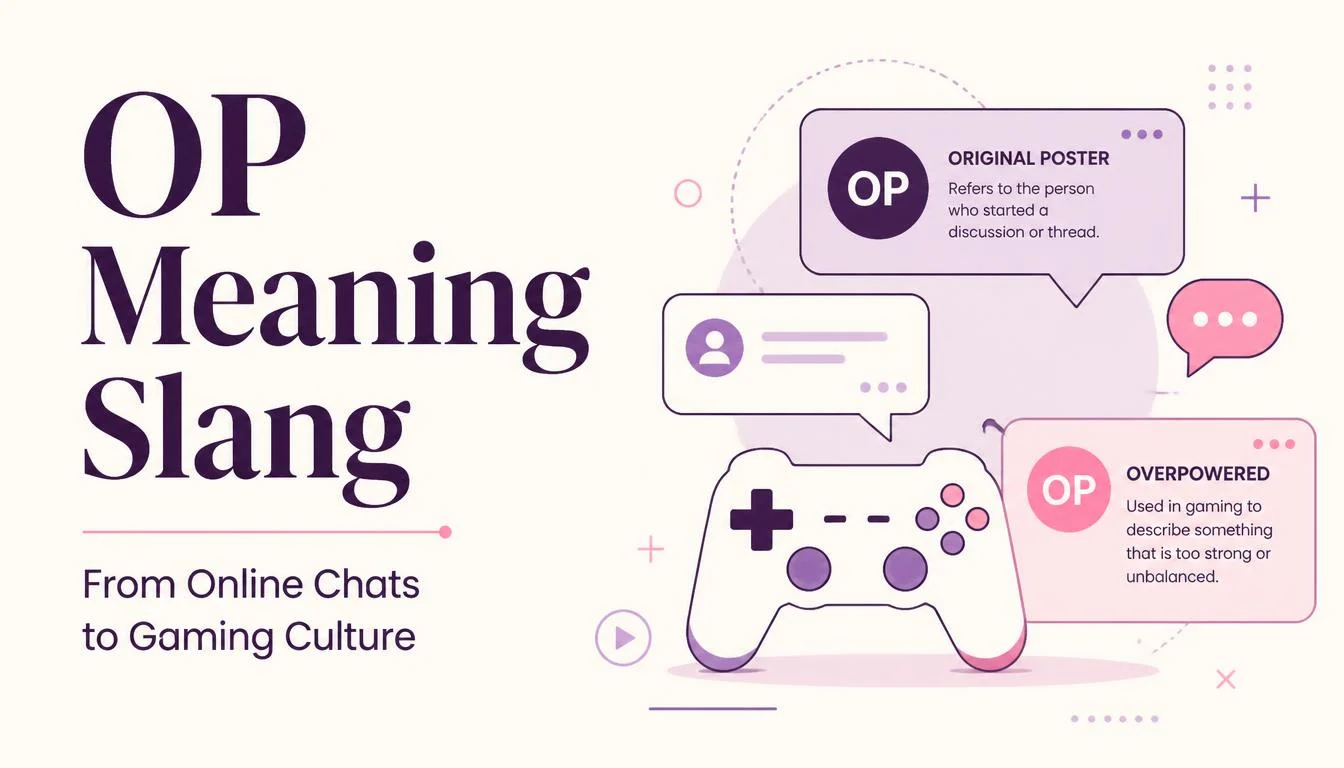
OP meaning in slang usually stands for “Original Poster,” the person who started a post or discussion on social media, Reddit or an online forum. In gaming, OP can also mean “Overpowered,” describing a character, weapon or ability that is unusually strong.
Have you seen someone use OP in a comment on Reddit, TikTok or another social media platform and wondered what it means? The OP meaning slang can vary depending on the conversation. Most commonly, it refers to the Original Poster, the person who shared the original post or started the discussion.
However, OP has another popular meaning in online gaming. Players often use it as shorthand for “Overpowered” when describing a character, weapon or ability that seems stronger than others. Understanding the context helps you identify which meaning someone intends in a text message, online comment or gaming chat.
What Does OP Stand For?
OP is a short abbreviation whose meaning changes according to the community using it. Unlike internet slang that has one widely accepted definition, this term serves several purposes across gaming, social networking, entertainment, and online discussions.
Two meanings account for much of its everyday online use. The first is “overpowered,” which describes something unusually strong or effective. The second is “original poster,” a label for the person who started a particular discussion.
For example, a gamer might write, “That new character is OP,” to complain that the character is too powerful. Someone replying to a Reddit discussion might say, “OP explained the situation clearly,” referring to the person who wrote the original post.
Neither usage is automatically more correct than the other. The topic and surrounding words determine what the abbreviation means.
Is OP an Acronym or an Abbreviation?
People commonly call OP an acronym or an abbreviation, although abbreviation is the more general and appropriate term. It shortens a longer expression into two letters. Since people usually pronounce the letters separately as “O-P,” it is also an initialism rather than an acronym pronounced as a word.
In casual conversation, the distinction rarely matters. What matters is recognizing the intended meaning without misunderstanding the message.
The Main Meanings of OP in Slang
The following table compares the most common interpretations and the situations in which you are likely to encounter them.
| Meaning | Common setting | Example |
|---|---|---|
| Overpowered | Video games and gaming chats | “This weapon is OP.” |
| Original poster | Reddit, forums, and comment threads | “OP already answered that.” |
| Opening or opening theme | Anime and entertainment communities | “The new OP is amazing.” |
| Original post | Online discussions | “Read the OP before replying.” |
| Out of print | Books, comics, and collecting discussions | “That edition is OP.” |
The final two meanings deserve a little attention. Some users use OP to mean the original post itself, while others use it to mean the person who published it. In book collecting, OP can mean “out of print,” referring to a publication that is no longer being printed by its publisher.
These are context-dependent uses, not interchangeable definitions. If someone says, “The OP contains all the details,” they probably mean the original post. If they say, “Ask the OP,” they almost certainly mean the person who posted it.
OP Meaning in Text Messages
In private messages, OP does not have one universal meaning. Friends who play games may use it to describe an unusually powerful character, while people discussing a shared online thread might use it to refer to the original poster.
Consider this text exchange:
Friend 1: “Did you try the new update?”
Friend 2: “Yeah, that character is so OP now.”
Here, the second person means that the character has become extremely powerful, perhaps making the game less challenging or less balanced.
Now consider another example:
Friend 1: “Who said the restaurant was closed?”
Friend 2: “The OP mentioned it in the group thread.”
In this case, OP refers to the person who started the discussion.
How People Use OP Casually
The abbreviation can make a message shorter and more natural, especially when both people understand the subject. Common examples include:
- “That build is OP.” The character setup is unusually powerful.
- “Ask OP for the details.” Contact the person who created the post.
- “OP said it was free.” The original poster provided that information.
- “This song is my favorite OP.” The speaker is talking about an opening theme.
- “The book is OP now.” In a collecting conversation, this may mean the book is out of print.
These examples show why it is risky to interpret the letters in isolation. A single abbreviation can communicate completely different ideas in different conversations.
Can OP Be Used as a Compliment?
Yes. When someone describes a person, ability, or creation as overpowered, the word can function as praise.
For example, “Your editing skills are OP” suggests that the person’s skills are exceptionally good. A gamer might also call a teammate OP because they consistently outperform everyone else.
However, the word can carry a negative tone. If a player complains that a weapon is OP, they may believe it gives its user an unfair advantage. The meaning can therefore range from admiration to frustration.
OP Meaning in Gaming
Gaming is one of the clearest places to encounter OP as slang for overpowered. Players use it to describe characters, weapons, abilities, strategies, and equipment that seem stronger than intended.
The term often appears when a game introduces new content or changes how existing characters perform. If a newly released character defeats opponents too easily, players may describe that character as OP.
What Makes Something Overpowered?
An overpowered item or ability can provide an advantage that feels excessive compared with other available choices. This might happen because it deals too much damage, has very few weaknesses, works at an unusually long range, or requires little effort to use effectively.
For instance, imagine a multiplayer game in which most weapons require several accurate shots to defeat an opponent. A new weapon that eliminates opponents almost instantly while remaining easy to aim could attract complaints about being OP.
The term is subjective, though. One player might consider a weapon unfair, while another believes it is balanced because it has a slow reload or limited ammunition.
Real Gaming Examples
These examples illustrate how players use the term in familiar games.
Minecraft
A player might describe a particularly effective weapon, enchanted equipment, or a powerful game mechanic as OP. The exact meaning depends on the game’s mode, available equipment, and rules.
League of Legends
Players may call a champion OP when its damage, durability, mobility, or combination of abilities seems stronger than competing champions.
Pokémon
A player might use OP to describe a powerful Pokémon or battle strategy, particularly when discussing matchups, team building, or competitive play.
These examples are not claims that every item or character is objectively unbalanced. They demonstrate how gamers use the same abbreviation to discuss strength and fairness.
OP vs. Balanced Gameplay
A powerful character is not necessarily overpowered. Game designers often create characters with different strengths so that players can develop varied strategies. A character might deal heavy damage but move slowly, while another has excellent mobility but limited defensive ability.
The complaint usually arises when an advantage feels too large relative to the available weaknesses or counters. Developers may respond by adjusting damage, cooldowns, movement speed, or other mechanics. Such an adjustment is commonly called a nerf, meaning a reduction in power.
This is why OP is more than a synonym for “good.” It often expresses an opinion about balance, fairness, or the level of challenge in a game.
OP Meaning on Reddit and Social Media
On Reddit and other discussion-based platforms, OP usually stands for original poster. This is the person who created the thread or discussion being discussed.
The abbreviation helps people refer to the person who started a conversation without repeating their username. It is especially useful in long threads where many participants contribute comments.
For example, someone might write:
“OP mentioned in the comments that the issue was fixed.”
This means the person who started the discussion later explained that the problem had been resolved.
What Does OP Mean on Reddit?
Reddit is particularly associated with this use because discussions often contain an original post followed by many comments and replies. Participants frequently refer to the author as OP when asking questions, clarifying details, or responding to the original story.
Imagine a user creates a post asking for advice about buying a used car. Several people respond with suggestions, and another commenter writes, “OP should get the vehicle inspected first.”
The commenter is advising the original poster, not referring to a vehicle feature or a gaming term.
Does OP Mean the Person or the Post?
It can mean either, depending on the sentence.
- “OP replied to my comment.” The person who created the thread replied.
- “The OP includes a list of recommendations.” The original post contains the list.
- “Read OP before asking.” The writer probably means the original post.
- “I agree with OP.” The writer agrees with the person who published it.
This distinction is useful when reading fast-moving comment sections. The abbreviation may refer to the author in one sentence and the content of the post in another.
OP on TikTok, Instagram, and Other Platforms
The meaning depends on the kind of content being discussed rather than the platform alone. In a gaming clip’s comments, OP may mean “overpowered.” Under a Reddit-style discussion or a social post seeking advice, it may mean “original poster.”
For example:
- “OP is cooking in this match.” In a gaming context, this praises the player or character’s performance.
- “OP, can you share the recipe?” In a discussion thread, this addresses the person who posted the content.
- “That ability is OP.” The ability seems excessively powerful.
There is no reliable rule that says OP has one meaning on TikTok and another on Instagram. Read the full sentence and consider what the post is about.
OP Meaning in Anime and Music
Anime fans frequently use OP to mean opening or opening theme. This refers to the song and accompanying opening sequence that appears near the beginning of an anime episode.
Fans may discuss the music, animation, visuals, lyrics, and performers associated with a series’ opening. In these conversations, OP has nothing to do with gaming balance or the person who uploaded a post.
For example, a fan might write, “The second OP is better than the first.” They are comparing the show’s opening themes, not discussing a powerful character.
Examples from Popular Anime
Naruto
A fan discussing one of the series’ opening songs might say, “The OP brings back so many memories.” The abbreviation refers to the opening theme and its associated sequence.
One Piece
Because the long-running series has used numerous opening themes, viewers may compare different OPs based on their music, visuals, or connection to particular story arcs.
Attack on Titan
A discussion about a favorite OP may focus on its soundtrack, imagery, or how well it captures the tone of the story.
The abbreviation is convenient because fans often discuss multiple opening songs across long series. It also appears in lists, fan rankings, reviews, and online music discussions.
What Is the Difference Between an OP and an ED?
Anime communities commonly use OP for an opening theme and ED for an ending theme. An opening usually appears near the beginning of an episode, while an ending generally appears near the end.
| Abbreviation | Full meaning | Typical placement |
|---|---|---|
| OP | Opening theme or sequence | Beginning |
| ED | Ending theme or sequence | End |
| OST | Original soundtrack | Music released for the production |
These labels describe different parts of a show’s presentation. Someone praising an anime’s OP is usually talking about its opening music or visuals, while someone praising its ED means the ending theme.
How to Tell Which Meaning Someone Intends
When you encounter an unfamiliar abbreviation, the easiest approach is to look at the words surrounding it. You rarely need to ask for clarification if the subject of the conversation is obvious.
Use these clues to identify the likely meaning:
Gaming, weapons, characters, or abilities
Interpret OP as “overpowered” in most cases.
Threads, comments, questions, or advice
Interpret OP as “original poster” or, in some sentences, “original post.”
Anime episodes, theme songs, or opening sequences
Interpret OP as “opening” or “opening theme.”
Books, comics, editions, or collectors
OP may mean “out of print.”
Pay Attention to the Grammar
The way OP appears in a sentence can offer another useful clue.
If someone says, “This is OP,” they are probably describing something as overpowered if the conversation concerns a game. If they say, “OP posted an update,” the abbreviation refers to a person. If they say, “I love this OP,” an anime or music conversation makes the opening-theme interpretation likely.
Grammar does not always settle the question, but it helps narrow the possibilities.
Consider the Community
Online communities develop their own shorthand. Gamers discuss damage, weapons, and character abilities, while forum users refer to posts and their authors. Anime fans discuss opening songs and episode sequences.
You do not need to memorize every possible definition. Learning the common meanings and recognizing the subject of a conversation will usually be enough.
OP vs. Similar Internet Abbreviations
OP can be confused with other short terms because many online abbreviations have overlapping uses. The following comparisons help clarify the distinctions.
| Term | Common meaning | Main difference |
|---|---|---|
| OP | Overpowered or original poster | Depends heavily on context |
| NPC | Non-player character | A character controlled by a game rather than a human player |
| Nerf | Reduce power or effectiveness | Describes weakening something in a game |
| Buff | Increase power or effectiveness | Describes strengthening something in a game |
| OOP | Out of place or object-oriented programming, among other meanings | Requires its own context |
| POV | Point of view | Identifies a perspective or viewpoint |
| ED | Ending theme in anime | Contrasts with an opening theme |
| OC | Original character or original content | Often identifies a character or creation made by a user |
OP vs. NPC
NPC stands for “non-player character,” a character in a game that is not directly controlled by a human player. OP, when used in gaming, describes excessive power rather than the character’s control status.
A character can be both an NPC and OP. For example, a powerful enemy controlled by the game could be described as an OP NPC.
OP vs. Nerf and Buff
These terms are related because they often appear in discussions about game balance. However, they describe different things.
Calling a weapon OP means it seems too powerful. Saying the developers nerfed it means they reduced its effectiveness. Calling a character buffed means the character received a change that increased its power or usefulness.
For example, “The weapon was OP, so the developers nerfed it” describes a complaint followed by a balancing change. It does not mean OP and nerf are synonyms.
OP vs. OC
OC commonly stands for “original character” or “original content,” depending on the community. It may describe a character created by an artist or a piece of content produced by the person sharing it.
OP identifies the person who made a post, while OC may identify something that person created. A person can be the OP of a discussion featuring their OC, but the abbreviations describe different things.
Why OP Became Popular Online
Short abbreviations make online communication quicker. They are especially helpful in gaming chats, comment threads, and conversations where people type rapidly or have limited room for a message.
The popularity of OP also comes from its usefulness across different communities. Gamers can describe an unfair advantage in just three letters, while forum participants can identify a thread’s author without repeating a username. Anime fans can refer to an opening theme without typing the full phrase every time.
Its meaning has developed through community usage rather than through one universal definition. As people move between gaming platforms, social networks, forums, and entertainment communities, they encounter different interpretations of the same letters.
This variety is not unusual in internet slang. Abbreviations often become efficient shorthand within a particular group before spreading to other online spaces. Context allows people to understand which meaning is intended.
Is OP Formal Language?
No. OP is primarily informal shorthand used in digital communication and community discussions. It is suitable for casual messages, gaming chats, forum posts, and conversations about entertainment.
In formal writing, it is usually better to spell out the intended phrase. For example, a report about game balance might use “overpowered character,” while an article about online discussion forums might use “original poster.”
Using the full phrase makes the meaning clear to readers who are unfamiliar with internet slang.
FAQs
1. Does OP mean good or bad?
It can mean either, depending on the context. In gaming, OP describes something that seems excessively powerful. A player may use it as a compliment when praising a strong character or as a complaint when arguing that a weapon gives someone an unfair advantage.
2. Can OP refer to a person in real life?
Yes, particularly when people are discussing an online post or shared conversation. OP generally identifies the person who created the original post. It is less common as a standalone label for someone outside that context.
3. What does OP mean when someone comments on a video?
It depends on the video and the comment. In a gaming clip, OP may mean “overpowered.” In a discussion about a post’s creator, it can mean “original poster.” In an anime video, it may refer to the opening theme.
4. Is OP the same as overpowered?
Not always. “Overpowered” is one of the most common meanings of OP, especially in gaming. However, the abbreviation also means “original poster” in discussion communities and “opening theme” in anime conversations.
5. What does OP mean in books and collecting?
In book, comic, and collectible discussions, OP can stand for “out of print.” It describes an edition or publication that is no longer being printed by its publisher. The precise status can vary, so collectors may need to check the publisher or edition details.
6. Should I use OP in professional messages?
Usually, it is clearer to write the complete phrase unless you know your audience understands the abbreviation. In professional gaming discussions, OP may be familiar shorthand, but in general business writing, spelling out “overpowered” or “original poster” avoids confusion.
Conclusion
OP is a flexible piece of internet slang that can mean different things in different online communities. Gaming conversations commonly use it for “overpowered,” discussion threads use it for “original poster,” and anime fans use it for an opening theme. The surrounding words and subject usually reveal the intended meaning. Once you recognize these common uses, interpreting the abbreviation becomes much easier.
Read More Related Articals
- Encanto Meaning in English | Magic Behind Disney’s Beloved Word In 2026
- “Branded Title” Meaning | Everything Every Car Buyer Should Know In 2026
- Adjacent Mean in Math | Easy Way to Get It Right In 2026

Michael Turner is a U.S.-based content writer and blogger who enjoys uncovering the stories and meanings behind words. Through his work at Meanvora, he delivers well-researched, easy-to-read articles that help readers expand their vocabulary and gain a deeper understanding of language.





10 thoughts on “OP Meaning Slang | From Online Chats to Gaming Culture In 2026”