Quick Answer:
Yeoh is a surname of Chinese origin, commonly associated with Chinese communities in Malaysia and Singapore. It is often a romanized form of a Chinese family name, with its exact meaning depending on the original Chinese character and dialect.
The Yeoh meaning is closely connected to Chinese family heritage, language and cultural identity. It is commonly found as a surname among Chinese communities, particularly in Malaysia and Singapore. Like many Chinese surnames, its pronunciation and meaning can vary depending on the dialect and the Chinese character used.
Today, the name Yeoh is recognized internationally, partly because of well-known personalities such as Malaysian actress Michelle Yeoh. Whether you have encountered Yeoh as a family name or are curious about its cultural background, understanding its origins can help explain its significance and how it is used across different communities.
What Does Yeoh Mean?
Yeoh is primarily a Chinese surname rather than a common English word with a single dictionary definition. Its meaning depends on the Chinese character represented by the spelling, the family’s linguistic background, and the romanization system used when the name was recorded.
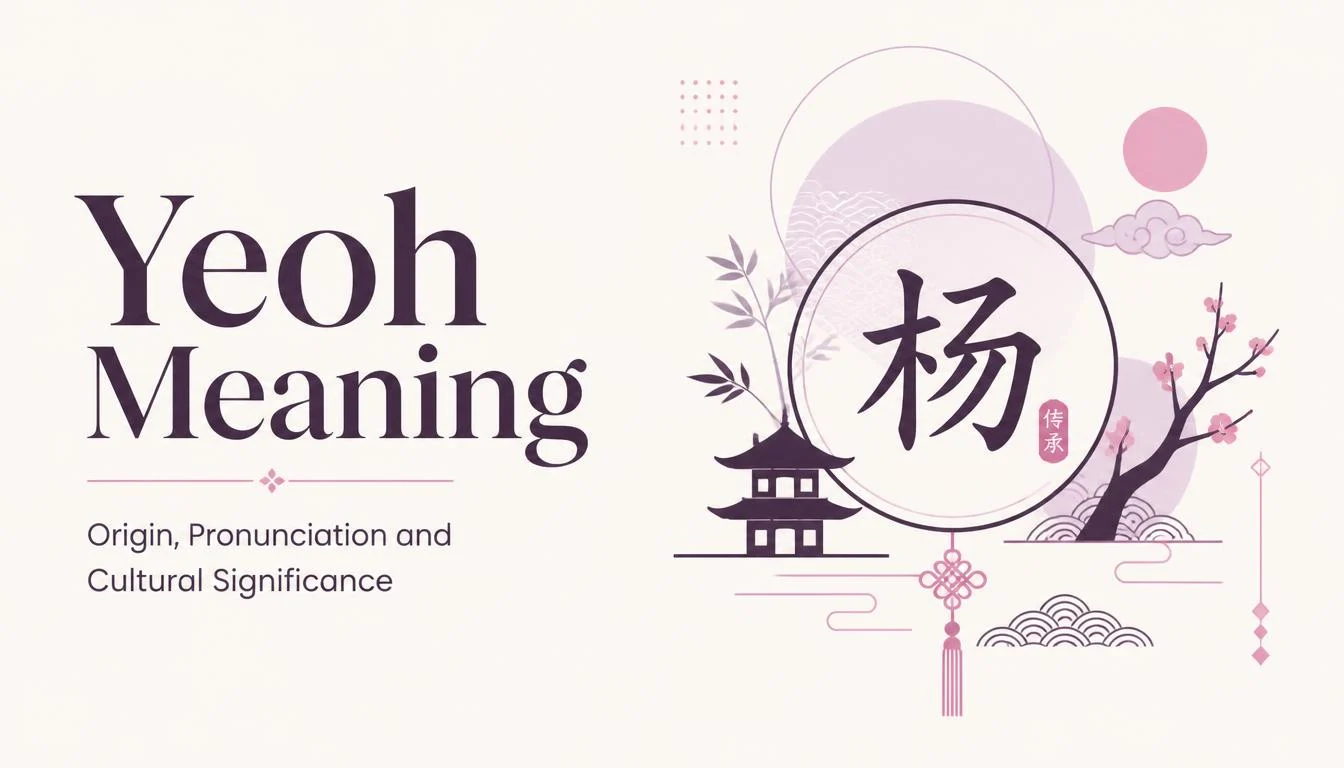
One important association is with 楊, a Chinese surname commonly written as Yang in Mandarin pinyin. The character is traditionally associated with the poplar tree, although the meaning of a family name should not automatically be treated as a personal description or a complete account of a family’s ancestry.
The spelling Yeoh is particularly familiar in Malaysia and Singapore, where Chinese surnames may reflect pronunciations inherited from regional Chinese languages rather than standard Mandarin. This helps explain why two families with the same Chinese surname may use different spellings in English.
Is Yeoh a First Name or a Last Name?
Yeoh is most commonly encountered as a last name, or family name. It appears in personal names, official records, professional credits, and family histories.
For example, the Malaysian actress Michelle Yeoh uses Yeoh as her family name. In her English-language professional name, Michelle is her given name and Yeoh is her surname.
Although a family name can sometimes be adopted as a given name, that is not the usual use of Yeoh. When you see it in a person’s name, the most reasonable starting point is to treat it as a surname unless the context indicates otherwise.
Does Yeoh Have a Literal Meaning?
There is no single literal meaning that applies to every person named Yeoh without knowing the corresponding Chinese character. Different Chinese characters can have different meanings, and similar-looking spellings do not necessarily represent the same name.
If a family uses Yeoh as a romanized form of 楊, the character’s association with the poplar tree provides a useful linguistic connection. Still, surname origins are more complicated than translating an individual character. Historical naming practices, regional pronunciations, and family traditions all influence how a name is understood.
The spelling alone cannot establish a person’s complete ancestry or tell you exactly which Chinese dialect their ancestors spoke.
Origin and History of the Surname
The surname has roots in Chinese naming traditions, with its spelling shaped by the movement of Chinese-speaking communities across different regions. To understand its history, it helps to separate the Chinese family name itself from the English letters used to represent it.
A major source of the spelling is the Hokkien pronunciation of 楊, a Chinese surname written as Yang in Mandarin pinyin. Hokkien is a Southern Min language traditionally spoken in parts of southeastern China and among communities whose ancestors came from that region. The spelling Yeoh reflects a regional pronunciation rather than a direct letter-for-letter translation of Mandarin.
How Chinese Migration Shaped the Spelling
Chinese migration helped spread surnames such as Yeoh to Malaysia and Singapore. Over generations, families maintained connections to their ancestral languages while adopting local customs, education systems, and official recordkeeping practices.
When names were written in English or other Latin-script languages, clerks and families often used spellings based on the sounds they knew. These spellings could become permanent parts of birth certificates, business records, passports, and family documents.
This is one reason a surname may look different from its modern Mandarin form. A family that has used Yeoh for generations does not necessarily need to change it to Yang simply because Yang is the standard Mandarin pinyin spelling.
Why Malaysia and Singapore Are Important
Malaysia and Singapore have long-standing Chinese communities with roots in different parts of southern China. Hokkien, Teochew, Cantonese, Hakka, and other Chinese languages have all contributed to the region’s naming traditions.
Yeoh is especially recognizable in Malaysia, where it appears in public life, business, politics, and entertainment. The surname also occurs in Singapore and among people of Southeast Asian Chinese heritage living elsewhere.
This regional background is useful when researching family history. A surname can provide a clue about linguistic heritage, but it cannot independently establish a family’s exact ancestral village, migration route, or ethnic subgroup.
How to Pronounce Yeoh
Yeoh is commonly pronounced like “Yoh” in English, with one syllable. The exact sound can vary by region and by the language or dialect a family uses.
People unfamiliar with the surname might try to pronounce every written vowel separately. That usually does not reflect the traditional pronunciation associated with the name.
A practical guide is:
- Yeoh: Often pronounced “Yoh.”
- Yeo: Often pronounced similarly, though individual preferences can differ.
- Yang: In Mandarin pinyin, the pronunciation differs from the common English reading of Yeoh.
The pronunciation of Yeoh is connected to its history as a regional romanization of a Chinese surname. It should not be assumed to follow ordinary English spelling rules.
Is Yeoh Pronounced the Same Everywhere?
No. Names travel between languages, and their sounds can change as people adapt them to local speech. A family may also preserve a pronunciation that differs slightly from the version used by other families with a similar spelling.
For that reason, the most reliable approach is to follow the pronunciation used by the person who bears the name. This is especially important in introductions, interviews, and professional settings.
If you are referring to Michelle Yeoh, the familiar English pronunciation is close to “Yoh.” Listening to the person’s own pronunciation is preferable to relying only on a phonetic guide.
Yeoh in Chinese Naming Traditions
Chinese names often combine a family name with one or more given-name characters. These characters may carry particular meanings, but their significance depends on the actual characters chosen rather than the way the name appears in English.
For example, Michelle Yeoh’s full Chinese name is written as 楊紫瓊 in traditional Chinese characters, or 杨紫琼 in simplified Chinese. Her surname is the first character, 楊 or 杨, while 紫瓊 or 紫琼 forms the given name.
This example illustrates an important distinction: the surname and given name have separate linguistic identities. Translating one character does not automatically explain the meaning of the whole name.
Why the Original Chinese Character Matters
A romanized spelling is a way of representing a name using another writing system. It may preserve a traditional pronunciation without showing the original Chinese character.
FamilySearch, a genealogy organization, lists Yeoh as a Teochew, Hokkien, and Taiwanese form associated with both 楊 and 姚. The latter is commonly romanized as Yao in Mandarin pinyin.
That distinction matters because the two characters are not interchangeable. A person researching the surname should not assume that every family called Yeoh has the same ancestral character or family history.
If the original character is unknown, the safest description is that Yeoh is a Chinese surname with established regional spellings. A family’s own records can provide a more precise answer.
What Does the Character 楊 Mean?
The character 楊 is associated with the poplar tree and related tree names in Chinese. This connection explains why some surname guides provide a tree-related interpretation of Yang and related spellings.
However, the meaning of a character and the history of a surname are not identical questions. A family name may have developed through historical clan names, places, titles, or other naming practices. Its modern character meaning does not necessarily tell the whole story of how a particular family acquired it.
It is therefore reasonable to mention the tree association when discussing the surname linked to 楊. It is less accurate to claim that every person with the English spelling Yeoh has a personal meaning such as “poplar tree” attached to their name.
Michelle Yeoh and the Name’s Global Recognition
For many people outside Southeast Asia, the first encounter with the surname comes through Malaysian actress Michelle Yeoh. Her success in international cinema has made the name recognizable to audiences who may not otherwise be familiar with Chinese surname traditions.
Michelle Yeoh was born in Ipoh, Perak, Malaysia, on August 6, 1962. She became known for action films and martial arts performances before taking on major roles in international productions. Her film credits include Tomorrow Never Dies, Crouching Tiger, Hidden Dragon, Foolish Rich Asians, and Everything Everywhere All at Once.
Why Michelle Yeoh Is Significant
In 2023, Yeoh won the Academy Award for Best Actress for her performance in Everything Everywhere All at Once. She became the first Asian woman to win that award, marking a significant moment in the history of the Oscars.
Her achievement brought attention to her name as well as her work. People searching for the surname may encounter it in film credits, interviews, award coverage, and discussions about representation in Hollywood.
Her career also demonstrates how a regional surname can become internationally familiar without losing its original spelling. The name remains closely connected to her Malaysian background, even as her work reaches audiences around the world.
Other Notable People With the Surname
Michelle Yeoh is not the only public figure who carries the name. Other people named Yeoh have worked in business, politics, sports, music, and academia.
Examples include:
- Hannah Yeoh: A Malaysian politician known for her involvement in public service.
- Francis Yeoh: A Malaysian businessman associated with the YTL business group.
- Bernard Yeoh: A Malaysian sport shooter.
- Brenda Yeoh: A Singapore-based academic known for work in geography.
- Dawn Yeoh: A Singaporean actress.
These examples show that the surname is not tied to one profession, nationality, or public identity. People who share a family name may have very different lives and achievements.
Yeoh vs. Yang, Yeo, and Other Similar Surnames
Chinese surnames can have multiple spellings because regional languages and romanization systems represent sounds differently. Although some spellings are closely related, they should not automatically be treated as interchangeable for every individual.
| Surname | Common association | Important distinction |
|---|---|---|
| Yeoh | Chinese surname associated with Hokkien and other regional forms | Especially familiar in Malaysia and Singapore |
| Yang | Mandarin pinyin form of 楊 | The standard Mandarin spelling for this character |
| Yeo | A regional spelling associated with certain Chinese surnames | May share an origin with Yeoh, depending on the family |
| Yeung | Common Cantonese spelling of 楊 | Reflects a different pronunciation tradition |
| Yao | Mandarin pinyin spelling of 姚 | A separate Chinese surname that can also be represented by Yeoh in some regional systems |
The relationships shown here are based on established surname and romanization patterns. Family-specific records remain important when identifying the exact character behind a name.
Why Yeoh and Yang Can Represent the Same Surname
Mandarin pinyin is a standardized system for writing Mandarin sounds with the Latin alphabet. Hokkien and Cantonese have different sound systems, so the same Chinese character may be written differently when represented through those languages.
The character 楊 is a clear example. It appears as Yang in Mandarin pinyin, Yeung in common Cantonese romanization, and Yeoh or Yeo in certain Southeast Asian contexts.
These differences do not necessarily indicate different family origins. They may reflect how a family’s ancestors pronounced the surname when it was first recorded in Latin letters.
Are Yeoh and Yeo the Same Name?
Sometimes, but not always. Both spellings are associated with the regional pronunciation of 楊, particularly in Southeast Asian Chinese naming traditions.
However, a surname’s spelling alone is not enough to prove that two families belong to the same lineage. Similar spellings may arise from related pronunciations, different historical records, or separate Chinese characters.
If you are researching a family connection, look for original Chinese characters, older documents, ancestral locations, and known family relationships. These sources offer stronger evidence than spelling alone.
Cultural Identity and Family Heritage
A surname can preserve a connection to family history long after a family has moved to another country. For people whose ancestors migrated from China to Malaysia, Singapore, or elsewhere, the spelling may reflect the language spoken by earlier generations.
Yeoh offers a useful example of this process. The surname can retain a Hokkien-associated form even when a family member speaks English, Malay, Mandarin, or another language in daily life.
Surnames as Historical Clues
Family names can help researchers identify possible connections between historical records. They may point toward a language tradition, a region, or a group of related spellings.
Still, a surname is only one piece of the evidence. Migration, intermarriage, adoption, changes in documentation, and personal choices can all affect how names are passed down.
A person named Yeoh may have a family history that differs considerably from another person with the same surname. Shared spelling does not guarantee shared ancestry.
How to Research a Yeoh Family History
If you are investigating your own family or trying to understand someone else’s surname, begin with the information closest to the family itself.
- Ask about the original Chinese characters. This is often the most useful step in distinguishing between possible surname origins.
- Check family documents. Birth records, marriage certificates, immigration papers, and older family registers may preserve earlier spellings.
- Identify ancestral locations. A village, town, or province can help narrow the historical context.
- Look for language or dialect clues. Family stories about Hokkien, Teochew, Cantonese, or another Chinese language may help explain the romanization.
- Consult genealogy records. FamilySearch and other reputable genealogy resources can help locate historical documents and potential relatives.
No single source is guaranteed to provide a complete answer. Combining family testimony with documentary evidence is a more reliable approach than relying on an online name-meaning page alone.
Common Misunderstandings About Yeoh
Several misconceptions can arise when people research names from languages that use different writing systems.
1. Yeoh Is Not an English Slang Word
In its established use, Yeoh is primarily a surname. It is not generally recognized as a standard English word with a slang definition.
If you encounter it in a message, comment, or social media post, the context may refer to a person’s name, a public figure, or a family. It is better not to assign it an unrelated slang meaning without evidence.
2. Everyone Named Yeoh Does Not Have the Same Family History
A shared surname does not establish a direct family relationship. Even when two families use the same Chinese character, their branches may have separated many generations ago.
Genealogical research requires evidence of relationships across generations. A matching surname is a useful starting point, not a final conclusion.
3. The Name Does Not Have One Guaranteed Translation
The association between Yeoh and 楊 explains one important origin, but sources such as FamilySearch also associate the spelling with 姚 in some regional Chinese naming traditions.
This is why it is important to identify the original character before claiming an exact meaning. A simple translation may explain one form of the name while overlooking another.
4. A Different Spelling Does Not Automatically Mean a Different Heritage
Yang, Yeoh, Yeo, and Yeung can represent related forms of the same Chinese surname. Their differences often reflect regional pronunciation and romanization rather than a simple change in ancestry.
At the same time, not every similar spelling has the same origin. The historical character and the family’s records provide the clearest way to distinguish related names from names that merely look alike.
FAQs
Is Yeoh a rare surname?
Yeoh is a recognizable surname in Malaysia and Singapore, particularly among Chinese communities. Its frequency varies by country and population. Without a reliable, comprehensive surname census, it is best not to assign an exact global ranking.
Is Yeoh a Chinese or Malaysian name?
It is a Chinese surname that is especially familiar in Malaysia and Singapore. Its regional spelling reflects Chinese linguistic traditions, while its presence in Southeast Asia reflects the long history of Chinese communities in the region.
Can Yeoh be used as a baby name?
It is possible to use a surname as a given name, depending on family preference and local naming practices. However, Yeoh is primarily established as a family name. Anyone considering it for a child may wish to understand the family’s cultural connection and the original Chinese characters first.
Does the surname Yeoh have a connection to royalty?
The spelling alone does not establish a royal connection. Chinese surnames can have long histories and may be associated with ancient states or historical lineages, but a specific family’s status requires separate historical evidence.
How can I find out which Chinese character my Yeoh surname represents?
Start with relatives who know the family’s Chinese name, then check official documents, family registers, or records from the family’s ancestral region. If the original character is unavailable, a genealogy service such as FamilySearch may help identify possible forms, though its results should be treated as clues rather than definitive proof.
Conclusion
Yeoh is a Chinese surname with strong connections to Malaysia, Singapore, and regional Chinese naming traditions. Its spelling reflects the way names can preserve older pronunciations as families move between languages and countries. While the surname is often associated with 楊, its exact origin should be confirmed through family records whenever possible. Understanding that history offers a more accurate appreciation of the name than relying on a single English translation.
Read More Related Articles:
- Slime Someone Out Mean | Real Story Behind This Slang In 2026
- Adjacent Mean in Math | Easy Way to Get It Right In 2026
- Congruent Mean in Geometry | Learn the Secret of Identical Shapes In 2026











1 thought on “Yeoh Meaning | Origin, Pronunciation and Cultural Significance In 2026”