Quick Answer
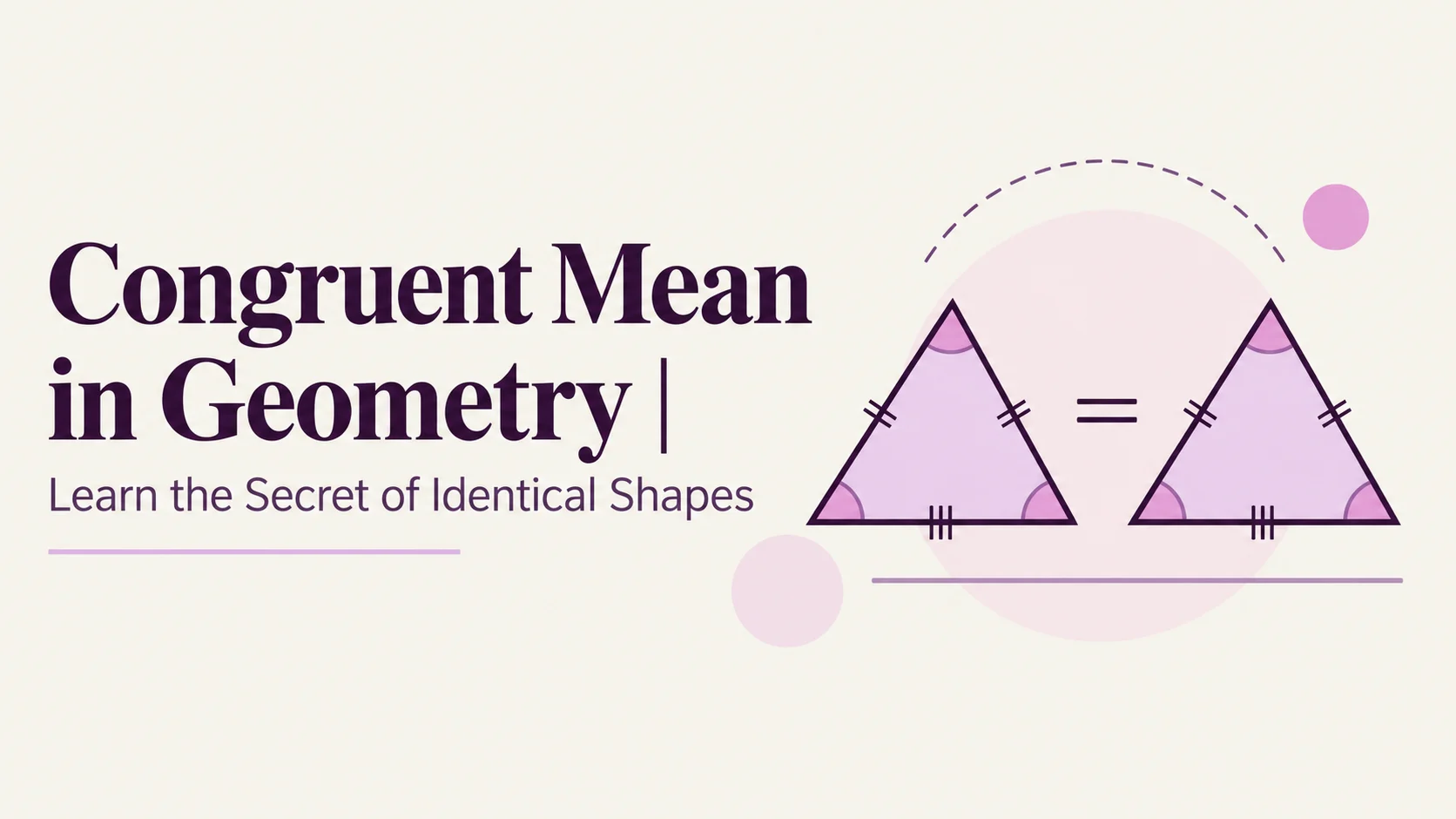
Congruent Mean in Geometry refers to shapes or figures that have the same size and the same shape. They can be moved, rotated, or flipped and still match exactly.
Understanding Congruent Mean in Geometry is important for learning how geometric figures can be compared. Two shapes are congruent when their corresponding sides and angles are equal.
In this guide, you’ll learn what congruent means, how to identify congruent figures, and how congruence is used in geometry with simple examples.
What Does Congruent Mean in Geometry?
In geometry, “congruent” means that two figures shapes, lines, or angles are identical in size and shape. One can be flipped, rotated, or slid on top of the other, and every point, every angle, and every side will match up exactly. If two shapes are congruent, one is essentially a perfect copy of the other, just possibly placed in a different position or orientation.
The math symbol for congruence is ≅, which is an equals sign topped with a tilde (~). So if triangle ABC is congruent to triangle DEF, you’d write it as:
△ABC ≅ △DEF
That little symbol is basically math’s way of saying “these two are twins, not just siblings.”
Where Does the Word “Congruent” Come From?
The word traces back to the Latin verb congruere, meaning “to come together, agree, or correspond.” Think of it the same way you’d think of the everyday word “congruous” when two ideas or plans “agree” with each other, they fit together without contradiction. Ancient Greek mathematicians like Euclid were already working with the concept of congruence over 2,000 years ago in his foundational work on geometry, even before the Latin-based term became standard in modern math textbooks.
Over time, “congruent” moved from general Latin usage into a precise mathematical term, and by the time formal geometry education became widespread in the 19th and 20th centuries, it had settled into the meaning we use today an exact match in size and shape.
Why Congruence Matters (Real Usage in Geometry)
Congruence isn’t just a vocabulary word teachers throw around to fill a chapter it’s a working tool. Here’s how it actually gets used:
- Proving shapes are identical without physically measuring every single side and angle.
- Solving for unknown values if two triangles are congruent, you automatically know all their matching sides and angles are equal, even if you were only given a few measurements.
- Engineering and architecture manufactured parts (like bolts, tiles, or window panes) need to be congruent so they fit together consistently.
- Design and art congruent shapes create visual balance and symmetry, which is why they show up constantly in logos, mosaics, and layouts.
- Everyday problem-solving anytime you need two things to match perfectly, you’re leaning on the idea of congruence, even if you never use the word out loud.
Congruent vs. Similar vs. Equal What’s the Difference?
This is where a lot of students (and honestly, a lot of adults) mix things up. These three words sound related but mean very different things in geometry.
| Term | What It Means | Key Requirement | Example |
|---|---|---|---|
| Congruent | Same size AND same shape | Sides and angles must match exactly | Two identical 5 cm × 5 cm squares |
| Similar | Same shape, but different size | Angles match; sides are proportional (scaled) | A small triangle and a larger version of the same triangle |
| Equal | Used for numbers, lengths, or angles not whole shapes | A single measurement matches another | Angle A = 90° and Angle B = 90° |
A friendly way to remember it: congruent shapes are clones, similar shapes are scaled photocopies, and “equal” is a word we reserve for individual measurements, not entire figures. You wouldn’t say “these two triangles are equal” in formal geometry you’d say they’re congruent (if they match exactly) or similar (if one is a resized version of the other).
Types of Congruence You’ll Encounter
Congruence isn’t limited to just triangles or squares it applies to several types of geometric objects.
1. Congruent Line Segments
Two line segments are congruent if they have the exact same length, regardless of where they’re positioned or how they’re oriented. A 4-inch line drawn horizontally is congruent to a 4-inch line drawn diagonally length is all that matters here.
2. Congruent Angles
Two angles are congruent if they have the same measure in degrees (or radians). A 45° angle is congruent to any other 45° angle, no matter which direction it opens toward.
3. Congruent Triangles
This is the big one triangle congruence shows up constantly in geometry proofs. Two triangles are congruent when all three corresponding sides and all three corresponding angles match exactly.
4. Congruent Polygons
For shapes with more than three sides (quadrilaterals, pentagons, hexagons, and so on), congruence means every corresponding side and every corresponding angle must match, in the same order around the shape.
Triangle Congruence Rules (The Shortcuts)
You don’t always need to measure all six parts (three sides and three angles) of a triangle to prove it’s congruent to another one. Geometry gives you handy shortcuts, often taught as postulates or theorems:
| Rule | Stands For | What It Checks |
|---|---|---|
| SSS | Side-Side-Side | All three sides of one triangle match all three sides of another |
| SAS | Side-Angle-Side | Two sides and the included angle between them match |
| ASA | Angle-Side-Angle | Two angles and the included side between them match |
| AAS | Angle-Angle-Side | Two angles and a non-included side match |
| HL | Hypotenuse-Leg | Used only for right triangles the hypotenuse and one leg match |
These rules exist so you don’t have to prove all six measurements are identical every time just enough of them, in the right combination, to guarantee the rest will follow.
Real-World Examples of Congruence
Congruence isn’t locked inside a textbook it’s genuinely everywhere once you start noticing it:
- 🧩 Puzzle pieces manufactured from the same mold are congruent by design.
- 🪟 Window panes in a grid-style window are usually cut congruent so they fit the frame evenly.
- 🏀 Sports equipment basketballs, soccer balls, and hockey pucks are manufactured to be congruent within strict tolerances, so gameplay stays fair.
- 🧱 Floor tiles are congruent so they lay flat with no gaps or overlaps.
- 📐 Road signs stop signs are all congruent octagons, no matter which intersection you’re at.
- ✂️ Paper crafts and origami rely on congruent folds to create symmetrical results.
Even something as simple as photocopying a document is an act of creating a congruent copy same shape, same size, just reproduced.
How to Tell If Two Shapes Are Congruent
Here’s a friendly, no-stress checklist:
- Count the sides and angles. Shapes need the same number of each to even be considered.
- Compare corresponding measurements. Match up each side and angle to its counterpart on the other shape.
- Check the order. The measurements have to correspond in the same sequence not just exist somewhere on both shapes.
- Try a mental (or physical) overlay. Imagine sliding, flipping, or rotating one shape onto the other. If it lines up perfectly, you’ve got congruence.
- Use the ≅ symbol correctly once confirmed and always list corresponding vertices in matching order (e.g., △ABC ≅ △XYZ means A matches X, B matches Y, and C matches Z).
Congruent vs. Other Related Terms
| Term | Meaning | How It Differs from Congruent |
|---|---|---|
| Symmetrical | A shape that mirrors itself across a line or point | Symmetry is about internal balance; congruence is about comparing two separate figures |
| Identical | Everyday word for “exactly the same” | Casual synonym, but not a formal geometric term |
| Proportional | Values that share a consistent ratio | Used in similarity, not congruence |
| Coincident | Objects that occupy the exact same position | Coincident points overlap completely; congruent shapes just need matching measurements, not the same location |
Does “Congruent” Have Meanings Outside Geometry?
Yes a few, actually:
- In everyday language: “Congruent” can describe ideas, values, or behaviors that align or agree with each other. For example, someone might say their actions are “congruent with their beliefs,” meaning the two are in harmony.
- In number theory: Two integers are called “congruent modulo n” if they leave the same remainder when divided by n this is the basis of modular arithmetic (used heavily in cryptography and computer science).
- In psychology: The term “congruence” describes a state where a person’s self-image aligns with their actual experience or behavior a concept popularized by psychologist Carl Rogers.
These meanings all circle back to the same root idea: things that fit together or match without conflict.
Polite and Professional Ways to Say “Congruent”
If you’re writing or speaking and want alternatives that still capture the meaning, depending on context:
- Identical in shape and size
- An exact match
- Perfectly aligned
- Equivalent in form
- A precise duplicate
For casual or non-mathematical writing, you might simply say “matching” or “the same” just keep in mind these lose some of the mathematical precision that “congruent” carries.
Common Mistakes Students Make with Congruence
- Confusing congruent with similar. Remember: similar shapes can be different sizes; congruent shapes cannot.
- Ignoring the order of vertices. Writing △ABC ≅ △DEF implies a specific correspondence mixing up the letter order changes the meaning.
- Assuming equal area means congruent. Two shapes can have the same area without being congruent (a 2×8 rectangle and a 4×4 square both have an area of 16, but they’re not congruent).
- Forgetting that rotation and reflection don’t break congruence. A shape flipped or turned is still congruent to its original position and orientation don’t matter, only size and shape do.
FAQs
1. What does congruent mean in geometry, in simple terms?
In geometry, congruent means two shapes have exactly the same size and shape. If you placed one directly over the other, they would match perfectly.
2. What is the symbol for congruent?
The symbol for congruence is ≅, which looks like an equals sign with a tilde above it.
3. Is congruent the same as equal?
Not exactly. Equal is generally used for numbers or measurements, while congruent describes shapes or figures that have the same size and shape.
4. What’s the difference between congruent and similar shapes?
Congruent shapes have the same size and shape, while similar shapes have the same shape but may be different sizes. Their corresponding sides remain proportional.
5. Can two triangles be congruent if they are rotated differently?
Yes. Rotation or reflection does not change whether shapes are congruent. What matters is that their corresponding side lengths and angle measures match.
6. What are the rules for proving triangles congruent?
The main triangle congruence criteria are SSS, SAS, ASA, AAS, and HL. Each identifies a specific combination of matching sides and angles that can establish congruence.
7. Do congruent shapes have to be the same color or orientation?
No. Color, position, and orientation do not affect congruence. Two figures are congruent as long as they have the same size and shape.
8. Where is congruence used outside of math class?
Congruence is useful in areas such as architecture, engineering, manufacturing, construction, and design, where matching dimensions and shapes are often essential.
Conclusion:
At its core, congruence is one of geometry’s simplest yet most powerful ideas: if two figures match exactly in size and shape, they’re congruent full stop. Here’s a quick recap to keep in your back pocket:
- Congruent means identical in size and shape, symbolized by ≅.
- Congruent is different from similar (same shape, different size) and equal (used for single measurements).
- Triangle congruence can be proven using shortcuts like SSS, SAS, ASA, AAS, and HL.
- Congruence applies to line segments, angles, triangles, and polygons alike.
- The concept shows up constantly in real life from tiles to traffic signs to manufacturing.
Next time you see two shapes that look like perfect twins, you’ll know exactly what to call them and why that little ≅ symbol carries so much meaning in just two characters.
Read More Related Articles:
- Bon Voyage Meaning | Complete Guide to This Popular Travel Expression In 2026
- Eggplant Emoji Mean | The Hidden Meaning Explained In 2026
- Name Ella Means| Royal History, Meaning & Beauty In 2026








6 thoughts on “Congruent Mean in Geometry | Learn the Secret of Identical Shapes In 2026”