Quick Answer
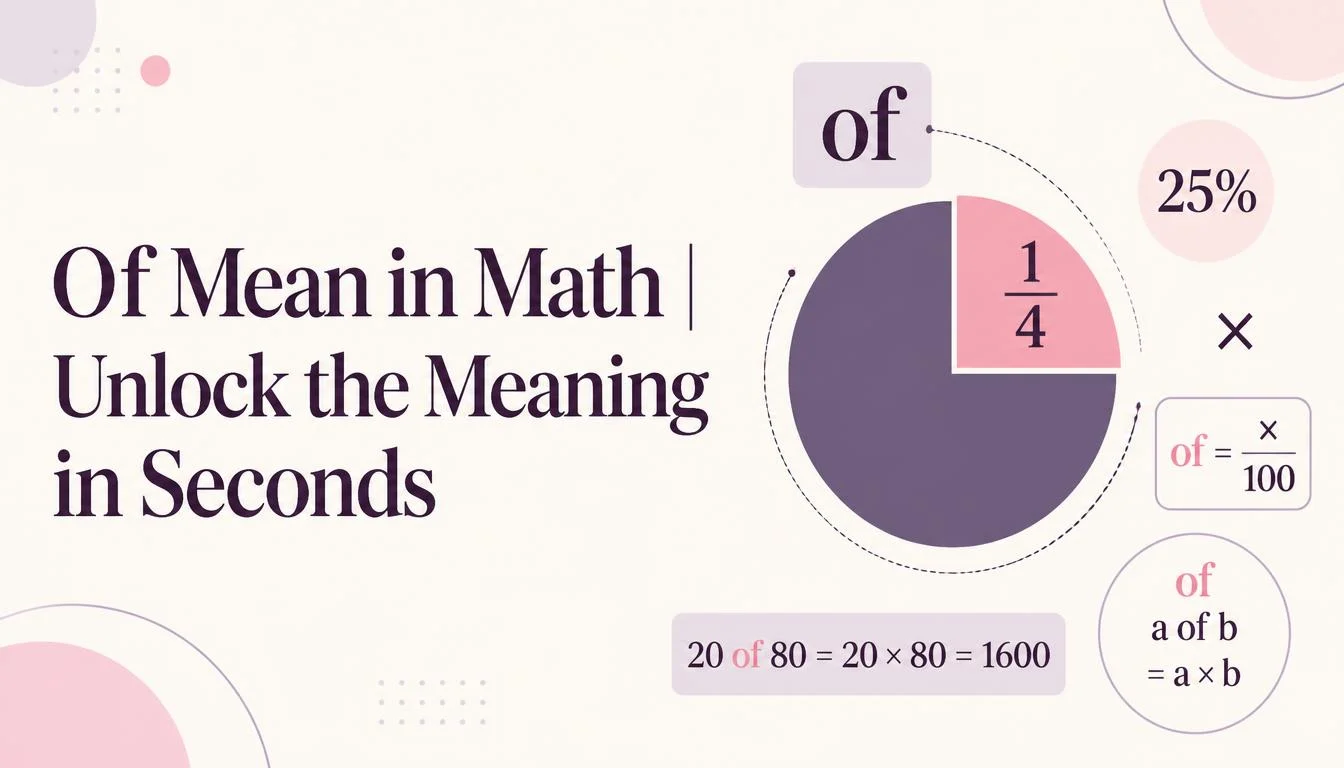
In math, “of” usually means multiplication. For example, “1/2 of 10” means 1/2 × 10 = 5.
If you’re wondering what “Of” Mean in Math, the term usually tells you to multiply one number or quantity by another. You’ll often see it in fractions, percentages, and word problems.
Understanding “of” Mean in Math can make these problems much easier to solve. Once you recognize that “of” often means multiplication, you can quickly translate phrases into mathematical expressions.
What Does “Of” Mean in Math?
In math, the word “of” almost always means multiplication. When “of” connects a fraction, percentage, ratio, or decimal to a number, it’s telling you to multiply the two values together.
- “Half of 20″ = ½ × 20 = 10
- “25% of 80″ = 0.25 × 80 = 20
- “One-third of 30″ = ⅓ × 30 = 10
That’s it. That’s the whole secret. Once your brain learns to swap “of” for a multiplication sign, math word problems suddenly get a lot less scary.
Now let’s dig into where this rule comes from, how it’s used in real classrooms and real life, and what other meanings “of” might carry outside a strictly mathematical context.
Why “Of” Means Multiply: The Origin of the Rule
Mathematical language didn’t spring up in a vacuum it grew out of everyday English, and math teachers borrowed common words to describe operations in a way that felt natural to read aloud. Think about how we talk about portions in daily life:
- “I’ll have half of that sandwich.”
- “Give me a third of the pizza.”
- “She ate most of the cake.”
In every one of these sentences, “of” is describing a part relative to a whole. Mathematically, taking “a part of a whole” is exactly what multiplying a fraction or percentage by a number does. So when early math textbooks needed a way to phrase “take this fraction and apply it to this number,” “of” was the obvious word to borrow because it already meant “a portion belonging to” in regular English.
Over time, this phrasing became standardized in arithmetic and algebra curricula worldwide. It shows up constantly in:
- Elementary school fraction lessons
- Percentage and discount problems
- Probability and statistics
- Ratio and proportion word problems
- Everyday situations like tipping, sales tax, and cooking measurements
Because it appears so early and so often in math education, “of” has become one of those quiet keyword-triggers that students are taught to watch for right alongside “sum” (meaning add), “difference” (meaning subtract), and “product” (meaning multiply).
How Popular and Common Is This Usage?
This isn’t a rare or regional quirk it’s baked into math curricula everywhere, from elementary school arithmetic to SAT/ACT prep to everyday retail math. Search engines see enormous volumes of queries like “what does of mean in math,” “of in math percentage,” and “does of mean multiply,” which tells you something important: this is a genuinely common point of confusion, especially for:
- Students learning fractions and percentages for the first time
- Parents helping with homework
- Adults brushing up on math for standardized tests
- People calculating discounts, tips, or measurements in daily life
It’s a small phrase with an outsized impact on how confident someone feels doing basic math.
Examples With Context: Seeing “Of” in Action
Let’s look at how “of” behaves across different real-world and classroom scenarios. I’ll include the tone or context each example might show up in, since “of” can appear in casual chats, formal test questions, or even sarcastic remarks.
🧮 Neutral / Classroom Examples
- “What is ⅔ of 18?” → (⅔) × 18 = 12
- “Find 10% of 250.” → 0.10 × 250 = 25
- “A quarter of the students passed.” → ¼ × (total students)
- “Three-fifths of the pie is gone.” → ⅗ × 1 whole pie
🛒 Real-Life / Practical Examples
- “This jacket is 30% of the original price!” (a sale sign) → 0.30 × original price
- “Add half of a cup of sugar.” (recipe instructions) → ½ × 1 cup
- “Only 40% of employees responded to the survey.” → 0.40 × total employees
😅 Casual / Everyday Tone
- “I only understood about half of that lecture.” (informal, not a strict calculation, but still implies “a portion of”)
- Give me a piece of that.” (not mathematical at all just means “a part”)
😒 Dismissive / Sarcastic Tone (Non-Math Use)
Sometimes “of” shows up in phrases that have nothing to do with math but are worth mentioning so you don’t confuse them:
- “That’s a fine kettle of fish.” (idiom, unrelated to math)
- “Speak of the devil!” (idiom)
- “What kind of answer is that?” (rhetorical, dismissive tone)
These non-math uses matter because context is everything. The presence of a number, fraction, or percentage right before “of” is your biggest clue that you’re dealing with the math version.
“Of” in Different Math Topics: A Breakdown
| Math Topic | Example Phrase | What It Means | Calculation |
|---|---|---|---|
| Fractions | “One-half of 40” | Multiply the fraction by the number | ½ × 40 = 20 |
| Percentages | “20% of 150” | Convert % to decimal, then multiply | 0.20 × 150 = 30 |
| Ratios | “3 of every 5 people” | Part-to-whole relationship | 3/5 as a ratio |
| Probability | “The probability of rain” | Not multiplication describes an event | P(rain) |
| Sets | “The union of A and B” | Describes a relationship between sets | A ∪ B |
| Word Problems | “Half of a number is 12” | Sets up an equation | ½x = 12 |
Notice that last row probability and set theory. This is important, so let’s talk about it next.
Important: “Of” Doesn’t ALWAYS Mean Multiply
While the multiplication rule covers the vast majority of cases (especially fractions and percentages), “of” also appears in math as a connecting word for relationships, not an operation. Here are the exceptions:
- “Probability of an event” this just names which event you’re finding the probability for. It’s not a multiplication cue.
- “Union of two sets” / “Intersection of two sets” describes a relationship between sets, not a multiplication.
- “Function of x” as in f(x), meaning “a function that depends on x.” No multiplication involved.
- “Derivative of a function” a calculus term describing an operation performed on the function, not multiplying by it.
- “Square root of 64” this is naming the operation (square root), and “of” is just the connector word introducing the number, not a multiply cue itself.
So the golden rule is: if “of” follows a fraction, percentage, decimal, or ratio and precedes a number, it almost certainly means multiply. If “of” is connecting a math term (like “probability,” “derivative,” “function,” or “set”) to its subject, it’s just descriptive language, not an operator.
Comparison: “Of” vs. Similar Math Terms
It helps to see “of” next to its cousins other keywords that signal specific operations in word problems.
| Keyword | Operation | Example |
|---|---|---|
| Of | Multiplication (with fractions/percentages) | “Half of 8” = 4 |
| Times | Multiplication (direct) | “6 times 3” = 18 |
| Product | Multiplication (result) | “The product of 4 and 5” = 20 |
| Sum | Addition | “The sum of 3 and 7” = 10 |
| Difference | Subtraction | “The difference of 9 and 4” = 5 |
| Quotient | Division | “The quotient of 12 and 3” = 4 |
| Per | Division / rate | “Miles per hour” |
| Out of | Ratio / fraction context | “3 out of 5 students” = 3/5 |
Notice that “out of” is a close cousin of “of” but leans more toward describing a ratio or fraction directly (like “3 out of 5”), while a standalone “of” typically pairs with a fraction or percentage already given (like “½ of 10” or “20% of 50”).
Polite and Professional Ways to Phrase “Of” Problems
If you’re writing math questions, tutoring materials, or professional reports and want to avoid ambiguity, here are some clearer alternative phrasings:
- Instead of: “Find 30% of the total.” Try: “Calculate 30% multiplied by the total value.”
- Instead of: “What is half of the amount?” Try: “Divide the amount by two to find the result.”
- Instead of: “A third of the class passed.” Try: “One-third of the students, calculated as (1/3) × total students, passed.”
These alternatives are especially useful in technical writing, textbooks aimed at English language learners, or workplace reports where precision matters more than casual phrasing.
Quick Tips for Solving “Of” Problems
Here’s a simple mental checklist you can use any time you see “of” in a math problem:
- Spot the fraction, percentage, or decimal right before the word “of.”
- Convert it if needed (percentages become decimals, mixed numbers become improper fractions).
- Replace “of” with a multiplication sign (×).
- Multiply straight across.
- Double-check your answer makes sense the result of “a part of a number” should always be smaller than (or equal to) the original number, unless the fraction or percentage is greater than 1 (or 100%).
That last tip is a great built-in error check. If someone asks “20% of 50” and you calculate 100, you know instantly something went wrong, since 20% of anything should be a smaller piece of the original number.
Real-World Situations Where You’ll Use This
- Shopping discounts: “Take 25% off” is really asking you to find 25% of the price and subtract it.
- Cooking and baking: Recipes often ask for “half of a cup” or “two-thirds of a teaspoon.”
- Tipping at restaurants: “Leave 18% of the bill” is a classic real-world “of” calculation.
- Statistics in the news: “60% of respondents agreed” is describing a portion of a total group.
- Splitting bills or chores: “Everyone pays a third of the total” straightforward, everyday math.
Understanding “of” isn’t just a classroom skill it’s something you’ll lean on constantly in adult life, often without even realizing it.
FAQs
1. Does “of” always mean multiply in math?
Not always, but “of” usually indicates multiplication when it connects a fraction or percentage to a number. For example, “½ of 10” means ½ × 10. In phrases such as “probability of an event,” however, “of” simply describes a relationship.
2. What does “of” mean in percentage problems?
In percentage problems, “of” generally means multiply. Convert the percentage to a decimal and multiply it by the given number. For example, 15% of 200 = 0.15 × 200 = 30.
3. How do you solve “what is a fraction of a number”?
Multiply the fraction by the number. For example, ¾ of 12 = ¾ × 12 = 9.
4. Is “of” the same as “times” in math?
Both can indicate multiplication, but they are used differently. “Times” directly connects two numbers, such as “4 times 5,” while “of” commonly connects a fraction or percentage with a whole, such as “½ of 10.”
5. Why do word problems use “of” instead of a multiplication sign?
Word problems use natural language to help students understand what a mathematical situation means. The word “of” makes relationships involving fractions, percentages, and quantities easier to express in everyday language.
6. What does “out of” mean compared to “of”?
“Out of” commonly represents a ratio or fraction, such as “3 out of 5,” which means 3/5. By contrast, “of” often indicates applying a fraction or percentage to a quantity.
7. Does “of” ever mean division in math?
Usually, no. When “of” connects a fraction or percentage to a quantity, it represents multiplication. For example, “½ of x is 10” becomes ½x = 10. You may divide later to solve for x, but “of” itself represents multiplication.
8. Where else does “of” appear in math outside of multiplication?
The word “of” appears in many mathematical expressions where it simply describes a relationship. Examples include “probability of an event,” “function of x,” “derivative of a function,” and “union of sets.”
Conclusion:
The word “of” might look like an ordinary, harmless little preposition but in math, it’s doing real work. Here’s what to remember:
- “Of” usually means multiply, especially when it follows a fraction, decimal, or percentage.
- Always convert percentages to decimals before multiplying.
- Watch for exceptions like “probability of,” “function of,” and “union of,” where “of” is descriptive rather than an operator.
- Compare “of” with related keywords like “times,” “product,” “sum,” and “out of” to build stronger word-problem instincts.
- Practicing with real-life examples discounts, recipes, tips, and surveys makes the concept stick far better than memorizing a rule alone.
Once you internalize this one small trick swap “of” for a multiplication sign whenever it follows a fraction or percentage a huge chunk of confusing word problems suddenly become simple, quick calculations. It’s a tiny linguistic shortcut with a surprisingly big payoff.
Read More Related Articles:
- Mercy Meaning | Powerful Lesson Behind Kindness and Forgiveness In 2026
- Mija Meaning In Spanish | Sweet Nickname You’ll Hear Everywhere In 2026
- Punta Meaning In Spanish | From Literal Meaning to Everyday Usage In 2026

Michael Turner is a U.S.-based content writer and blogger who enjoys uncovering the stories and meanings behind words. Through his work at Meanvora, he delivers well-researched, easy-to-read articles that help readers expand their vocabulary and gain a deeper understanding of language.







1 thought on ““Of” Mean in Math | Unlock the Meaning in Seconds In 2026”