Quick Answer
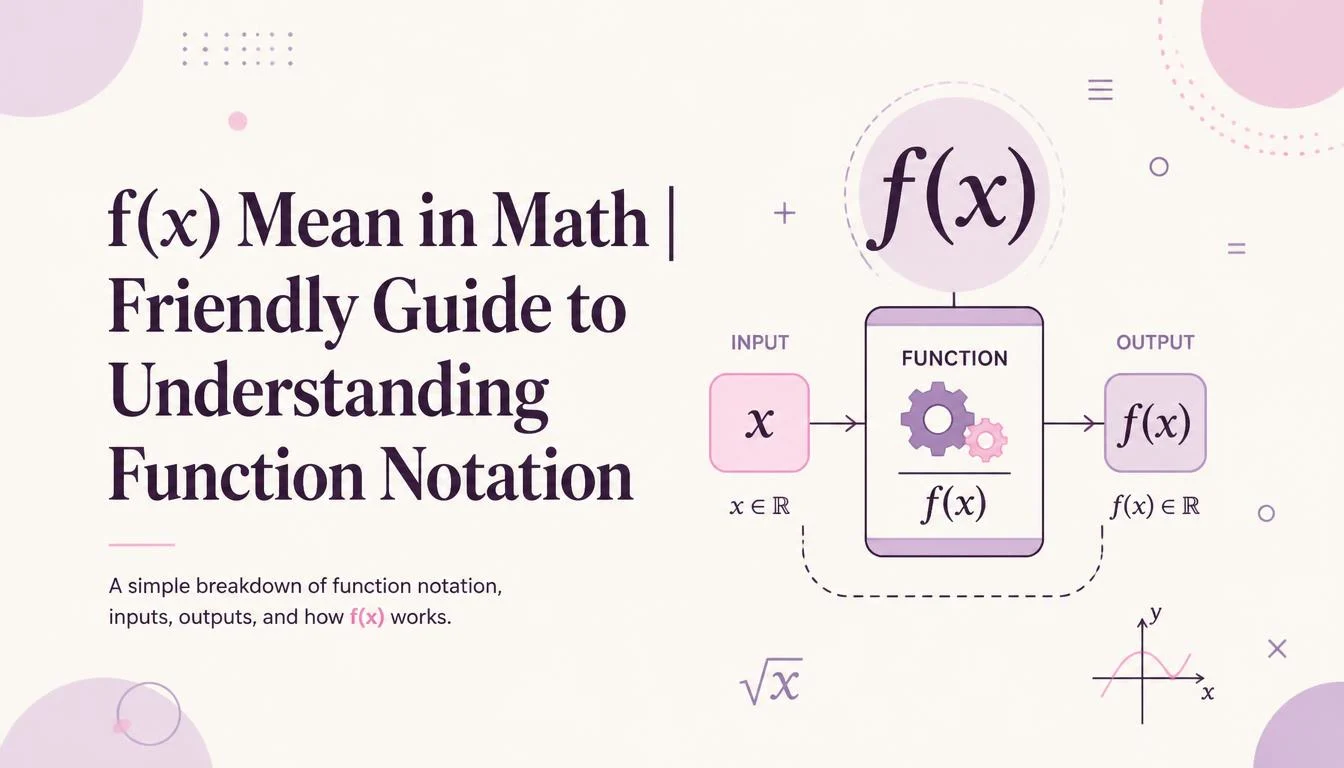
f(x) means the value of a function at the input x. In simple terms, it tells you what output you get when you put x into a function.
If you’re wondering what f(x) Mean in Math, it is a common notation used to represent a mathematical function. Here, f names the function, while x represents the input or variable.
Understanding f(x) makes it easier to work with equations, graphs, and functions. For example, if f(x) = x + 3, then f(2) = 5, because you replace x with 2.
What Does f(x) Mean in Math
f(x) is mathematical shorthand for “a function named f that depends on the variable x.” It represents the output value of a function when x is the input. In simpler terms, f(x) tells you what happens to x when you apply a specific rule or operation to it.
Think of f(x) as a machine: you feed it a number (x), it processes that number according to a rule, and it produces a result (f(x)). That result is essentially the same as y in a traditional equation like y = 2x + 3. So when you see f(x) = 2x + 3, it’s simply saying “the output equals twice the input plus three.”
The notation might look like multiplication at first glance and this is one of the most common misunderstandings but f(x) is NOT “f times x.” Instead, it’s read as “f of x,” emphasizing that f is performing an operation on x .
Why Do We Use f(x) Instead of Just y?
You might wonder: if f(x) essentially means the same as y, why bother with this fancy notation? The answer lies in clarity and practicality, especially as mathematics becomes more complex.
1. Naming Different Relationships
In real-world applications, you often work with multiple relationships simultaneously. Using y for everything becomes confusing fast. Function notation allows you to name each relationship meaningfully:
- H(t) might represent height as a function of time
- C(x) could be the cost of producing x items
- R(x) might stand for revenue based on x sales
- P(t) could represent population growth over time
This naming system makes it immediately clear which function you’re referring to in equations and discussions .
2. The Machine Metaphor
Function notation perfectly captures the “input-output” nature of functions. The x inside the parentheses is your input, and f(x) is the output. This visual clarity helps students grasp the fundamental concept that functions are processes or rules that transform inputs into outputs .
3. Building Blocks for Advanced Math
As you progress in mathematics, function notation becomes essential. When you encounter concepts like composition of functions (f(g(x))), inverse functions (f⁻¹(x)), or calculus operations, the f(x) notation provides the necessary framework to express these ideas clearly.
How to Read and Interpret f(x)
Understanding f(x) is easier than it might seem. Here’s a breakdown of the components:
| Component | Meaning | Example |
|---|---|---|
| f | The name of the function (often “f” for “function”) | Any letter works: g, h, or even descriptive names |
| (x) | The input variable or independent quantity | What you’re putting into the function |
| f(x) | The output value or dependent quantity | What comes out after applying the function rule |
Common Misconceptions
The most frequent mistake is treating f(x) as multiplication. Remember:
- Correct: f(x) means “f of x” a function named f applied to x
- Incorrect: f × x this would mean multiplying two things together, which is entirely different
For example, if f(x) = 3x + 2, then f(2) means we replace x with 2 and calculate:
f(2) = 3(2) + 2 = 6 + 2 = 8
Real-World Examples of f(x) in Action
Let’s explore how f(x) appears in everyday situations. These examples show why function notation is so practical:
Example 1: The Coffee Shop
Imagine you own a coffee shop. Your daily profit depends on how many cups of coffee you sell. You could write this as:
P(n) = 3n – 150
Where:
- P is your profit function
- n is the number of cups sold
- 3 represents profit per cup ($3)
- 150 represents your daily fixed costs
If someone asks “What’s your profit if you sell 100 cups?” you’d calculate P(100) = 3(100) – 150 = $150.
Example 2: The Road Trip
You’re planning a road trip and want to calculate distance based on time:
D(t) = 60t
Where:
- D is distance function
- t is time in hours
- 60 is your average speed in miles per hour
D(3) = 60(3) = 180 miles traveled in 3 hours.
Example 3: The Cell Phone Plan
Your cell phone bill might be represented as:
C(m) = 0.15m + 20
Where:
- C is cost function
- m is minutes used
- 0.15 is cost per minute
- 20 is monthly base fee
C(200) = 0.15(200) + 20 = $50 for 200 minutes of usage.
Different Letters, Same Concept
While “f” is the most common function name, you’ll encounter many others. Each letter often hints at what the function represents:
- g(x) or h(x) general functions when f is already used
- sin(x) sine function in trigonometry
- log(x) logarithmic function
- P(t) population as a function of time
- C(x) cost as a function of quantity
- V(r) volume as a function of radius
The flexibility of function notation means you can choose names that make sense for your specific problem .
Functions vs. Equations: What’s the Difference?
Understanding the distinction between functions and equations helps clarify why f(x) notation is valuable.
| Aspect | Function f(x) | Equation y = 2x + 1 |
|---|---|---|
| Purpose | Shows a relationship where each input has exactly one output | States that two expressions are equal |
| Input-Output | Explicitly names input (x) and output (f(x)) | Uses y as the output implicitly |
| Flexibility | Can have multiple functions (f, g, h) in one problem | Typically limited to y for one relationship |
| Advanced Use | Essential for composition, inverses, calculus | Limited to basic algebraic manipulation |
Key Distinction
The critical difference lies in the rule of functions: each input (x value) must produce exactly one output (f(x) value). While many equations represent functions, not all do. For instance, x² + y² = 1 (a circle) fails the “vertical line test” because an x-value of 0 gives two y-values (1 and -1).
Evaluating f(x): Step-by-Step Guide
Let’s work through evaluating functions systematically. This skill is fundamental to working with function notation.
Step 1: Identify the Function Rule
Given f(x) = 3x² – 2x + 1, identify what operations will be performed on x.
Step 2: Substitute the Value
To find f(3), replace every x with 3:
f(3) = 3(3)² – 2(3) + 1
Step 3: Follow Order of Operations
Calculate step by step:
- 3(9) – 6 + 1
- 27 – 6 + 1
- f(3) = 22
Practice Examples
| Function | Input | Calculation | Output |
|---|---|---|---|
| f(x) = 2x + 5 | x = 4 | 2(4) + 5 | 13 |
| g(x) = x² – 3 | x = 7 | 49 – 3 | 46 |
| h(t) = 16t² | t = 2 | 16(4) | 64 |
Common Variations and Related Notations
Input Doesn’t Need to Be a Number
Functions work with various input types:
- f(x²) function of x squared
- f(g(x)) composition (function of a function)
- f(x+h) function with an expression as input
Piecewise Functions
Sometimes functions are defined differently for different input ranges:
text
f(x) = { x², if x ≥ 0
       { -x, if x < 0
Multiple Functions
When working with several functions:
- f(x) and g(x) two different functions
- f(x) + g(x) adding outputs
- f(g(x)) applying g first, then f
Advanced Applications: Why f(x) Matters Beyond Basic Math
1. Calculus Foundation
In calculus, f(x) becomes essential for:
- Derivatives: f'(x) represents the derivative of f with respect to x
- Integrals: ∫ f(x) dx represents integration
- Limits: Understanding limits at specific f(x) values
2. Data Science and Technology
Function notation underpins:
- Machine learning algorithms: Functions map inputs to outputs
- Computer programming: Functions are fundamental to code
- Data visualization: f(x) relationships create graphs and models
3. Physics and Science
Scientists use function notation to describe relationships:
- Velocity: v(t) = speed as a function of time
- Force: F(a) = force as a function of acceleration
- Energy: E(v) = energy as a function of velocity
FAQs
1. Is f(x) the same as y?
Yes, in most contexts. f(x) is essentially a more formal way of writing y. When you see y = 2x + 3, you can rewrite it as f(x) = 2x + 3. The difference is that f(x) explicitly names the function and makes it clear that x is the input variable .
2. Does f(x) mean f times x?
Absolutely not! This is the most common misconception. f(x) means “f of x” a function named f operating on the value x. It has nothing to do with multiplication. If you see f(2), you’re finding the value of the function when x equals 2, not multiplying f by 2 .
3. Why do we use f instead of y?
Function notation allows you to:
- Name multiple relationships (f, g, h) clearly
- Show the input variable explicitly
- Prepare for advanced math concepts
- Make applications and word problems clearer
- Use meaningful names like C(x) for cost functions
4. How do you evaluate f(x)?
To evaluate f(x) at a specific value:
- Identify the function rule (what operations are performed on x)
- Replace every x with the given value
- Calculate following order of operations
For example, if f(x) = 2x² + 3x – 1, then f(2) = 2(4) + 6 – 1 = 13.
5. What’s the difference between f(x) and f(x+h)?
f(x) is the function’s value at x. f(x+h) is the function’s value at x plus some small change h. This distinction is crucial in calculus when calculating rates of change and derivatives.
6. Can any letter be used for function notation?
Yes! While f is most common, any letter or even meaningful names work. You might see:
- g(x) or h(x) alternative names
- P(x) profit function
- C(x) cost function
- sin(x) sine function
- log(x) logarithm function
7. What does f(0) mean?
f(0) means you’re evaluating the function when x = 0. It tells you the output value when the input is zero. For example, if f(x) = 2x + 5, then f(0) = 2(0) + 5 = 5, which is the y-intercept of the graph.
8. Is everything written as y a function?
No. An equation can be written with y without being a function. For instance, x² + y² = 1 is an equation but not a function because some x-values correspond to two different y-values. Functions must have exactly one output for each input .
Practical Tips for Working with f(x)
1. Read Aloud Correctly
Say “f of x” not “f times x.” This reinforces the correct meaning.
2. Think Input-Output
Visualize the function as a machine. What goes in (x)? What comes out (f(x))?
3. Practice with Different Inputs
Evaluate f(2), f(0), f(-3), f(a), f(x+1) to build confidence with various inputs.
4. Use Names That Make Sense
In applications, use meaningful function names like:
- P(t) for population over time
- V(r) for volume as a function of radius
- C(x) for cost based on quantity
5. Connect to Graphs
Remember that f(x) gives the y-coordinate. The graph of f(x) is all points (x, f(x)).
Conclusion
Understanding what f(x) means opens the door to practical mathematics and real-world applications. This simple notation:
- Clarifies relationships between variables
- Names functions for clear communication
- Prepares you for advanced math (calculus, linear algebra, statistics)
- Connects math to science, technology, and everyday problems
Whether you’re calculating profit, measuring distance, analyzing data, or pursuing a STEM career, f(x) will be your trusted companion. It’s not just mathematical notation it’s a universal language for describing how things change and relate to one another.
Remember: f(x) is simply “f of x” a function applying its rule to x. Once you see it this way, the mystery disappears, and a world of mathematical understanding opens up.
Read More Related Articles:
- “Service Engine Soon” Meaning | Complete Guide to Your Dashboard Warning Light In 2026
- L Meaning on a Car | Drive Smarter in Tough Road Conditions In 2026
- “Service Tire Monitor System” Meaning | Why This Warning Appears In 2026











5 thoughts on “f(x) Mean in Math | Friendly Guide to Understanding Function Notation In 2026”