Quick Answer
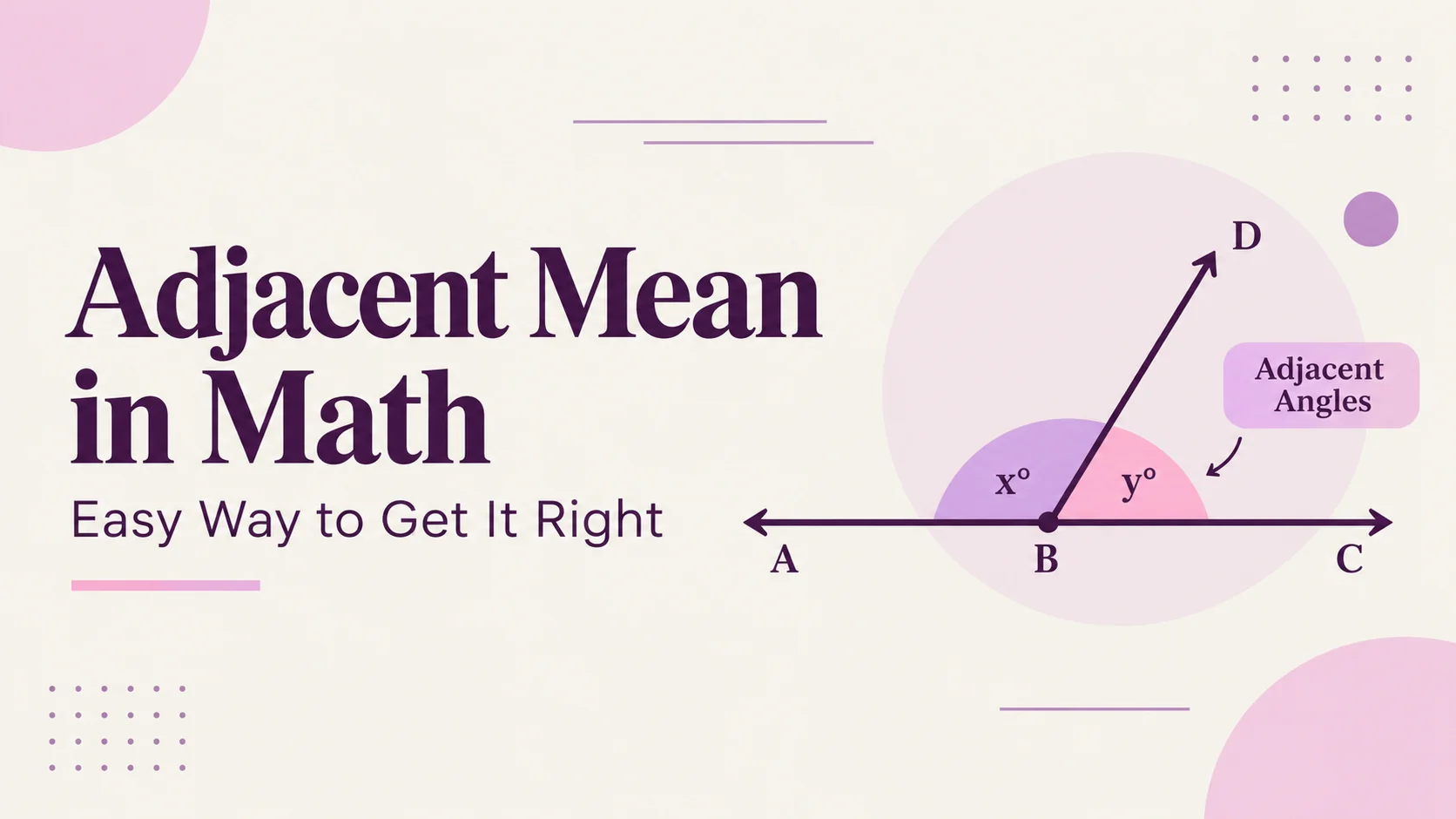
Adjacent Mean in Math refers to things that are next to or directly beside each other. In geometry, adjacent angles or shapes share a common side, vertex, or boundary without overlapping.
Understanding Adjacent Mean in Math is important because the word adjacent describes the position or relationship between mathematical objects. When two things are adjacent, they are located next to each other or share a common part.
In geometry, you may see this term when learning about adjacent angles, adjacent sides, and adjacent shapes. Knowing what adjacent means makes it easier to understand diagrams and solve geometry problems correctly.
What Does Adjacent Mean in Math?
In math, “adjacent” means next to or sharing a common point, side, or boundary. Two angles are adjacent if they share a vertex and a side but don’t overlap. Two sides of a shape are adjacent if they meet at a corner. In general, if two things touch or border each other directly, they’re described as adjacent.
That’s the core idea in one sentence: adjacent = touching or right next to, with something shared in common (a point, line, or edge).
Everything else in this article is just that idea applied to different corners of math literally.
Where Does the Word “Adjacent” Come From?
The word isn’t a math invention at all it’s borrowed straight from everyday English, and its roots go back to Latin.
- It comes from the Latin word adjacens, meaning “lying near” or “bordering.”
- Adjacens itself breaks down into ad- (meaning “toward” or “near”) and jacere (meaning “to lie” or “to throw”).
- So literally, something adjacent is something that “lies toward” or “lies next to” something else.
Mathematicians adopted the word for exactly the same reason regular English speakers use it because it perfectly describes things that sit right beside one another. There was no need to invent a new term; “adjacent” already meant “next to,” so it slid naturally into geometry, trigonometry, and later into graph theory and linear algebra.
How Popular and Common Is This Term?
“Adjacent” is one of the most frequently used positional terms in K–12 and early college math. It shows up:
- In elementary and middle school geometry, when students first learn about angles and shapes.
- In high school geometry and trigonometry, especially with right triangles (hello, SOH-CAH-TOA).
- In college-level math, in topics like graph theory, matrices, and even coding/computer science (adjacency lists, adjacency matrices).
- In everyday English, where it simply means “next door” or “bordering” like an “adjacent room” or a “property adjacent to the park.
Because it’s used in both casual English and formal math, it’s a word people encounter constantly but sometimes forget the precise math definition of, which is exactly why so many people search for it.
What Does Adjacent Mean in Different Areas of Math?
The general idea stays the same everywhere (“next to, sharing something”), but the specific meaning shifts a little depending on the topic. Here’s the breakdown.
1. Adjacent Angles
Two angles are adjacent angles when they:
- Share the same vertex (corner point)
- Share one common side (called the “arm”)
- Do not overlap they sit right beside each other, not on top of one another
Think of two slices of pizza cut from the same center point, lying side by side without any gap or overlap. The edge between them is shared, but the slices themselves don’t cross into each other’s space.
Example: If ∠ABC and ∠CBD share the vertex B and the side BC, and neither angle overlaps the other, then ∠ABC and ∠CBD are adjacent angles.
2. Adjacent Sides
In polygons (like triangles, squares, and rectangles), adjacent sides are two sides that meet at a common vertex (corner).
Example: In a rectangle ABCD, side AB and side BC are adjacent because they meet at corner B. Side AB and side CD, on the other hand, are not adjacent they’re opposite sides that never touch.
3. Adjacent Sides in Right Triangles (Trigonometry)
This is where a lot of students get tripped up, because “adjacent” here has a specific, angle-dependent meaning.
In a right triangle, relative to a chosen angle (not the right angle):
- The hypotenuse is always the longest side, opposite the right angle.
- The opposite side is the side across from your chosen angle.
- The adjacent side is the side next to your chosen angle that is not the hypotenuse.
This matters because the adjacent side changes depending on which angle you’re focused on. It’s not a fixed label on the triangle it’s relative.
This is the backbone of the classic mnemonic:
SOH-CAH-TOA
- Sine = Opposite / Hypotenuse
- Cosine = Adjacent / Hypotenuse
- Tangent = Opposite / Adjacent
4. Adjacent Vertices and Edges (Graph Theory)
In graph theory, two vertices (points) are adjacent if there’s a direct edge (a connecting line) between them. Two edges are adjacent if they share a common vertex.
This concept is the foundation of adjacency matrices and adjacency lists, which are used in computer science to represent networks think social media connections, road maps, or flight routes.
5. Adjacent Numbers / Adjacent Terms
Sometimes “adjacent” simply describes numbers that are next to each other in a sequence, list, or number line.
Example: In the number line …3, 4, 5, 6…, the numbers 4 and 5 are adjacent. In a sequence like 2, 4, 6, 8, the terms 4 and 6 are adjacent terms.
Adjacent vs. Similar-Sounding Math Terms
People often confuse “adjacent” with other positional or angle-related words. Here’s a clear side-by-side comparison.
| Term | Meaning | Example |
|---|---|---|
| Adjacent | Next to and sharing a point, side, or edge; not overlapping | Two puzzle pieces sitting side by side, touching |
| Opposite | Directly across from, not touching | The side across from a given angle in a triangle |
| Complementary | Two angles that add up to 90° | A 30° angle and a 60° angle together |
| Supplementary | Two angles that add up to 180° | A 110° angle and a 70° angle together |
| Congruent | Equal in size and shape | Two angles that both measure 45° |
| Vertical angles | Angles formed opposite each other when two lines cross | The angles across from each other at an “X” intersection |
| Parallel | Lines that never meet, always the same distance apart | Railroad tracks |
| Perpendicular | Lines that meet at a 90° angle | The corner of a square |
Key distinction to remember: Adjacent angles can also be complementary or supplementary those aren’t mutually exclusive categories. “Adjacent” just describes position (are they touching and sharing a side?), while “complementary” and “supplementary” describe a sum relationship (do their measures add up to a specific number?). You can have adjacent angles that add up to 90°, adjacent angles that add up to 180°, or adjacent angles that add up to neither.
Examples of “Adjacent” in Context
Let’s look at how the word actually gets used, both in strict math settings and in everyday sentences that borrow the same concept.
Friendly, Everyday-Style Usage 🙂
- “These two angles are adjacent see how they share that middle line?”
- “Grab the side adjacent to the 40° angle; that’s the one we need for cosine.”
- “In this graph, node A is adjacent to node B, so there’s a direct connection between them.”
Neutral, Textbook-Style Usage 📘
- “Adjacent angles share a common vertex and a common side, and their interiors do not overlap.”
- “The two adjacent sides of the parallelogram form a 60° angle at their shared vertex.”
- “In the adjacency matrix, a value of 1 indicates that the two vertices are adjacent.”
Slightly Dismissive or Casual Usage 😅
Occasionally in informal spoken math class settings, students use “adjacent” loosely, even sloppily:
- “It’s just the one right next to it, basically adjacent, don’t overthink it.”
- “Adjacent, opposite, whatever just plug it into the formula.”
While this casual tone is common in classrooms, it’s worth noting for anyone writing formal work (essays, exams, or professional documents) that precision matters “adjacent” has an exact geometric meaning and shouldn’t be used loosely when accuracy is being graded or assessed.
Polite and Professional Alternatives (When You Need a Synonym)
Depending on context, you might want a slightly different word instead of “adjacent.” Here are solid alternatives, along with when to use them:
- “Neighboring” good for informal or descriptive writing (e.g., “the neighboring angle”).
- “Bordering” useful when talking about shapes or regions that share an edge.
- “Next to” the plain-English equivalent, fine for casual explanations.
- “Contiguous” a more formal, academic-sounding synonym, often used in advanced math and geography.
- “Sharing a common side/vertex” the fully spelled-out, unambiguous version, best for formal proofs or exam answers where precision counts.
Use “adjacent” itself when you want to sound precise and mathematically correct it’s the industry-standard term and the one graders and textbooks expect.
Does “Adjacent” Mean Anything Different Outside of Math?
Yes and this is part of why the term feels so familiar even before you formally learn it in class.
- In everyday English: “Adjacent” just means next to or bordering something. “Our house is adjacent to the park.”
- In real estate/property terms: An “adjacent lot” is a piece of land bordering another.
- In computer science: Beyond graph theory, “adjacent” memory addresses or adjacent array elements refer to positions right next to each other in memory or in a list.
- In everyday slang (rare, informal): Some people use “X-adjacent” to mean “related to X but not quite X” (e.g., “tech-adjacent industries”). This isn’t a formal math usage, but it’s worth knowing since it’s common in modern writing and conversation.
None of these strays too far from the math definition they all circle back to the same core idea: something close by, touching, or directly connected.
Quick Reference Table: Adjacent in Different Math Contexts
| Context | What “Adjacent” Means | Example |
|---|---|---|
| Angles | Share a vertex and one side, don’t overlap | ∠ABC and ∠CBD sharing side BC |
| Polygon sides | Meet at a common vertex | AB and BC in rectangle ABCD |
| Right triangle trig | The non-hypotenuse side next to a chosen angle | Adjacent side in SOH-CAH-TOA |
| Graph theory | Vertices connected by a direct edge | Node A directly linked to Node B |
| Number sequences | Terms or numbers next to each other | 4 and 5 on a number line |
| General geometry | Regions or shapes sharing a boundary | Two adjacent countries on a map (informal use) |
Common Mistakes to Avoid
- ❌ Assuming adjacent angles are always equal they’re not; equality depends on other given conditions.
- ❌ Confusing “adjacent” with “opposite” in right triangles remember, adjacent is always relative to the angle you’re focused on, not a fixed side.
- ❌ Thinking adjacent sides must be equal in length they don’t have to be (a rectangle’s adjacent sides are often different lengths).
- ❌ Mixing up adjacent and vertical angles vertical angles are across from each other, not next to each other.
FAQs:
1. What Does Adjacent Mean in Math in Simple Terms?
In math, adjacent means next to or touching something. Objects are usually considered adjacent when they share a common point, side, or vertex.
2. What Are Adjacent Angles?
Adjacent angles are two angles that share the same vertex and one common side without overlapping one another.
3. What Is the Adjacent Side in a Right Triangle?
The adjacent side is the side next to a chosen angle, excluding the hypotenuse. Which side is considered adjacent depends on the angle you are using as your reference.
4. Are Adjacent Angles Always Equal?
No. Adjacent angles can have different measurements. They are equal only when additional conditions, such as symmetry or a given angle relationship, make them equal.
5. Can Adjacent Angles Be Supplementary?
Yes. If two adjacent angles form a straight line, they are supplementary, meaning their measures add up to 180°.
6. What Is the Difference Between Adjacent and Opposite?
Adjacent means objects are next to each other and share a point, side, or vertex. Opposite means they are positioned across from each other rather than directly touching.
7. What Does Adjacent Mean in a Triangle?
In a triangle, adjacent sides are two sides that meet at the same vertex. In trigonometry, the adjacent side is the side next to the selected angle, excluding the hypotenuse.
8. What Does Adjacent Mean in Graph Theory or Computer Science?
In graph theory, two vertices or nodes are adjacent when a direct edge connects them. This means you can move from one vertex to the other without passing through another vertex.
Conclusion:
“Adjacent” is one of those math words that seems intimidating until you realize it’s really just describing something touching or bordering something else. Here’s the quick recap:
- Adjacent = next to, sharing a common point, side, or vertex, without overlapping.
- It shows up in angles, polygon sides, right-triangle trigonometry, graph theory, and even simple number sequences.
- It’s different from opposite (across from, not touching), complementary (adds to 90°), and supplementary (adds to 180°) though adjacent angles can also be complementary or supplementary at the same time.
- In formal writing, stick with “adjacent”; in casual writing, “neighboring,” “bordering,” or “next to” work fine as friendly substitutes.
- Remember SOH-CAH-TOA for trigonometry: the adjacent side is always relative to the angle you’re working with.
Once you see “adjacent” as simply “touching and sharing something,” it stops being a scary vocabulary word and becomes just another tool in your math toolkit one you’ll recognize instantly in geometry class, trig problems, coding projects, and beyond.
Read More Related Articles:
- Mercy Meaning | Powerful Lesson Behind Kindness and Forgiveness In 2026
- Mija Meaning In Spanish | Sweet Nickname You’ll Hear Everywhere In 2026
- Punta Meaning In Spanish | From Literal Meaning to Everyday Usage In 2026











5 thoughts on “Adjacent Mean in Math | Easy Way to Get It Right In 2026”