Quick Answer
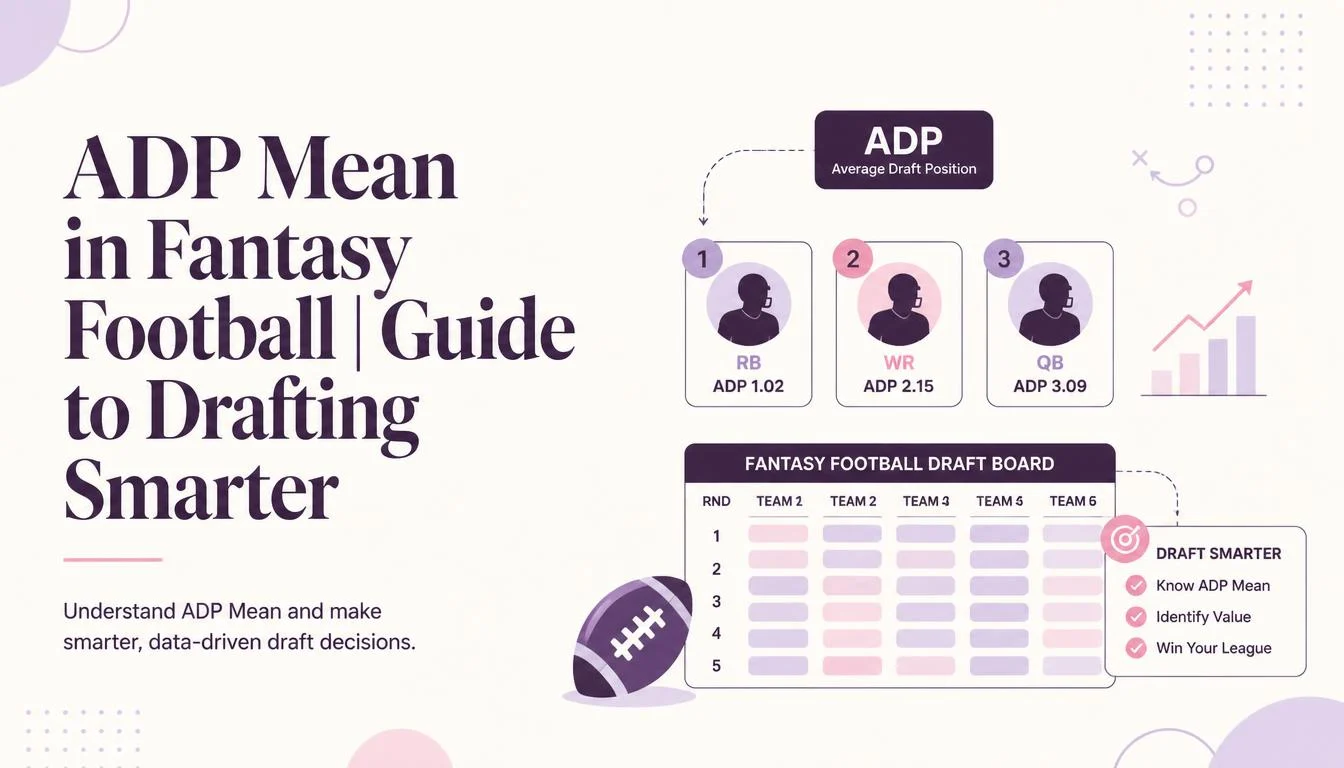
ADP in fantasy football stands for Average Draft Position. It shows the average spot where a player is being selected in fantasy drafts, helping managers decide when to draft them.
If you’re wondering what ADP Mean in Fantasy Football, it simply refers to Average Draft Position a useful metric that shows when players are typically drafted. It can help you understand a player’s perceived value before and during your fantasy draft.
Understanding ADP can make draft day easier by showing which players are being selected early, which ones tend to fall later, and where you might find potential value.
📊 ADP Fantasy Football Explained: The Wisdom of the Crowd
So, what is ADP in fantasy football in plain English? It is the average pick number at which a specific player is being drafted across thousands of mock drafts and real drafts on major platforms like ESPN, Yahoo, Sleeper, and CBS Sports .
Here is the golden rule: The lower the ADP number, the higher the player is being drafted.
For example, if a player has an ADP of 6.2, they are typically coming off the board around the 6th or 7th pick. If a player has an ADP of 110.5, they are a late-round dart throw.
Unlike a single expert’s opinion, ADP represents the collective behavior of thousands of fantasy managers. If a player is consistently drafted early, the market believes they will score big. If they slide, the market is skeptical. It’s a powerful tool because it helps you understand what your opponents are likely to do before they do it .
🧮 How is ADP Calculated?
To get the most out of ADP, you need to understand how it’s built. It’s not just some random number pulled from a hat.
- Data Aggregation: Platforms collect data from thousands of completed drafts.
- Averaging: They take the “Pick Number” where a player was selected in each of those drafts.
- The Formula: They add all those pick numbers together and divide by the number of drafts.
Important Caveat: ADP is not a one-size-fits-all number . It is specific to the platform and the scoring settings. An ADP from a Standard league looks very different from an ADP in a PPR (Point Per Reception) league, which looks different from a Superflex (2 QB) league. Running backs who catch a lot of passes receive a boost in PPR ADP, while quarterbacks get a massive boost in Superflex ADP .
Who is generating these ADPs?
According to industry experts, the platform matters a lot when analyzing ADP :
| Platform | Vibe Check | What the ADP Tells You |
|---|---|---|
| ESPN / Yahoo | The “Casual” Crowd | Reflects the masses. Often slower to react to news and more reliant on default rankings. Great for spotting values if the sharp community likes a player. |
| Sleeper | The “Engaged” Manager | Trendy. Often features higher ADP on breakout candidates and rookies. |
| NFFC / Underdog | The “Sharks” | High-Stakes and Best-Ball leagues. Very sharp, fast-moving ADP that reflects value-based strategies. |
✅ How to Use ADP to Win Your Draft
Knowing the definition won’t help you if you don’t know the strategy. There is a massive difference between a player’s ADP (where they are being drafted) and their Ranking (where an expert thinks they should be drafted). Understanding that gap is where you build a championship roster.
1. Hunt for “Value” (The Discount Bin)
“Value” occurs when you draft a player later than their ADP suggests they should go . This is the equivalent of buying a $100 bill for $80.
- Example: If you have a player ranked as a top-20 talent, but their ADP is 35, you want to target them at pick 30 or 32. You are getting a discount. The market is sleeping on them.
2. Avoid the “Reach” (Unless Necessary)
A “Reach” occurs when you draft a player earlier than their ADP .
- Example: Drafting a player with an ADP of 45 at pick 20.
- The Nuance: Reaching isn’t always bad. If you are at the turn of the 3rd/4th round and you know the guy you want won’t make it back to you, you reach. Just make sure you are doing it on purpose, not because you didn’t look at the ADP board.
3. Identify Player Tiers
ADP is best when used in conjunction with Tiers. Look at the ADP range of a particular tier of players. If you have 5 running backs you like equally, and their ADPs are scattered from picks 10 to 18, you might wait a round to take the one at the end of the tier rather than reaching for the one at the start .
⚖️ ADP vs. Related Terms
To be fluent in ADP, you need to distinguish it from similar-sounding terms:
- ADP vs. Rankings: Rankings are subjective, usually a single person’s or site’s opinion on who is the best player. ADP is objective data a summary of where people are actually being drafted. You should overlay your rankings on top of ADP to find discrepancies .
- ADP vs. ECR (Expert Consensus Ranking): ECR is the average ranking of a large group of experts. It represents “who the experts think is best.” ADP represents “where the public is drafting them.” If the experts love a player but the public is drafting them late (low ADP), you have a target .
- ADP vs. AAV (Average Auction Value): In auction drafts, there are no “picks.” Instead, players have a dollar value based on an imaginary $200 budget. AAV is the average salary a player commands; it is the equivalent of ADP for auction formats .
🗺️ ADP Across Different Formats (It Matters!)
ADP is not static. A player’s draft position swings wildly based on the league’s rules. Here is how scoring changes the landscape:
- Standard Leagues: Rushing yards and touchdowns are king. Ground-and-pound running backs and big-play wide receivers have higher ADPs here.
- PPR (Point Per Reception): This rewards volume. Receiving backs (think James Cook, Bijan Robinson) and high-volume wide receivers get a huge boost in ADP. A receiver with an ADP of 20 in Standard might move up to 15 in PPR .
- Superflex / 2QB: Quarterbacks are the most valuable asset. You will see 6-8 quarterbacks drafted in the first round. The ADP for QBs here is drastically higher than in standard leagues. Josh Allen and Patrick Mahomes are top-5 picks .
- Best Ball: Since you don’t have to set a lineup, managers chase “ceiling” and “boom-or-bust” players. High-variance receivers (guys who score 0 or 30 points) see a slight ADP bump because their spike weeks count automatically .
💬 Tone and Examples of ADP in the Wild
When you are in a draft room or on a subreddit, you’ll hear ADP used in specific ways. Here is how the tone affects the meaning.
- Neutral (Informational): “Hey, what is the ADP on Tyreek Hill right now? I’m picking 11th and I want to know if he’ll be there.”
- Excited (Positive Value): “I just grabbed Jahmyr Gibbs at pick 18! That’s amazing value. His ADP is normally around 14! 😍🚀”
- Frustrated (Negative/Reaching): “I can’t believe someone just took that kicker in the 7th round. His ADP is 180… terrible reach. Wasted pick.”
- Strategic: “I’m waiting on a QB. I like the value at the 6.0 ADP range; there’s no need to overpay for the top guys.”
FAQs
1. What does ADP mean in fantasy football?
ADP stands for Average Draft Position. It is the average draft position where a player is taken across thousands of fantasy football drafts, providing a market consensus on their value .
2. Is a higher or lower ADP better?
In fantasy football, a lower ADP is better because it means the player is drafted earlier. A player with an ADP of 3.0 is viewed as a top-3 overall pick. An ADP of 120.0 suggests they are a late-round sleeper .
3. Where can I find accurate ADP data?
You can find accurate ADP data on major hosting sites like ESPN and Yahoo, as well as aggregate sites like FantasyPros, RotoWire, and Underdog. Composite ADP (an average across multiple platforms) is often considered the most reliable .
4. Why does ADP differ between ESPN and Yahoo?
ADP differs because different platforms attract different types of players and have different default scoring rules. ESPN tends to skew toward casual players, while platforms like Sleeper attract more serious, data-driven managers, leading to discrepancies .
5. What is the difference between ADP and Ranking?
ADP is data on where players are being drafted. Ranking is an opinion on where a player should be drafted. Comparing the two helps you find “values” (players drafted later than their ranking) .
6. Should I always draft according to ADP?
No. ADP is a guide, not a rule. It tells you the market value so you know when to pull the trigger. You should always trust your own player evaluations and draft based on your gut, but use ADP to know if you are reaching too far.
7. What is “value” in relation to ADP?
“Value” occurs when you draft a player later than their ADP. For example, if a player has an ADP of 25 and you get him at pick 35, you have gained value relative to the market .
8. What does “reaching” mean?
Reaching” means drafting a player earlier than their ADP. It is often viewed negatively, but is sometimes necessary to secure a specific target if you fear they will not make it back to your next pick .
🏁 Conclusion:
Mastering ADP is the single best way to improve your fantasy football draft strategy. It turns a chaotic selection process into a strategic chess match. Remember:
- Understand the format: Make sure you are looking at ADP specific to your league (PPR vs. Standard vs. Superflex).
- Look for gaps: Compare ADP with expert rankings to find steals.
- Trust your gut: ADP tells you what the room is thinking, but you make the final call.
Think of ADP as a map of the market. It won’t tell you exactly what to do, but it will ensure you never get lost.
Read More Related Articles:
- JSP Meaning | Internet Acronym Everyone Gets Wrong In 2026
- What Does WTM Mean in Text | Common Uses You Should Know In 2026
- What Does ACC Mean | Every Meaning Made Simple In 2026










3 thoughts on “ADP Mean in Fantasy Football | Guide to Drafting Smarter In 2026”