Quick Answer
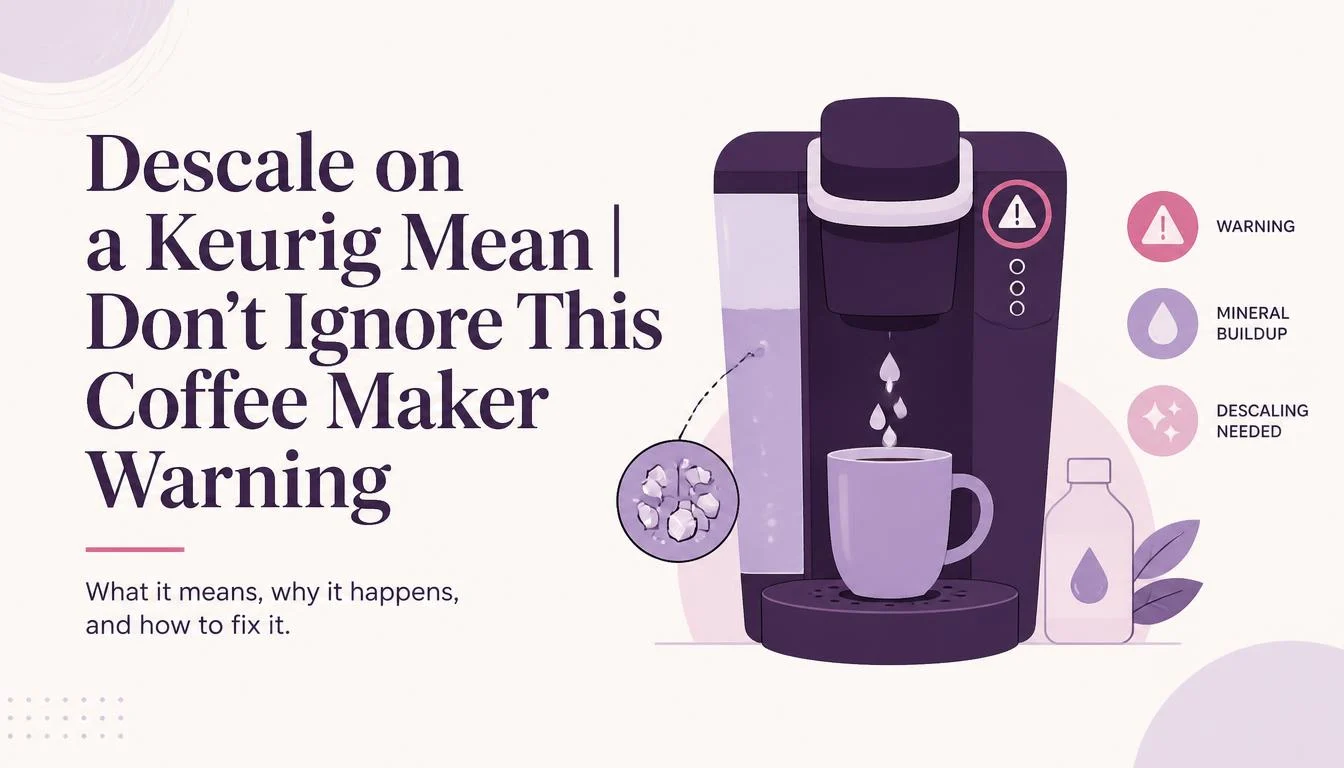
“Descale” on a Keurig means the machine needs to be cleaned of mineral buildup, mainly from hard-water deposits. Running a descaling cycle helps keep your Keurig working properly and improves its performance.
Wondering what “Descale” on a Keurig Mean? This message is a reminder that mineral deposits have built up inside your coffee maker and it’s time for a cleaning cycle.
Understanding “Descale” on a Keurig Mean can help you maintain your machine and prevent issues such as slow brewing, unusual noises, or weaker coffee. Descaling regularly keeps your Keurig running smoothly.
What Does “Descale” Mean on a Keurig
“Descale” on a Keurig means the machine is alerting you to remove mineral buildup mainly calcium and limescale from its internal water lines and heating element. This buildup comes from regular tap or filtered water and accumulates over time, gradually clogging the machine and affecting brewing performance. Descaling is simply the cleaning process used to dissolve and flush out that buildup, usually with a vinegar-and-water solution or a dedicated descaling solution.
In plain English: your Keurig is saying, “Hey, I’ve got some gunk built up inside me. Can you clean me out?”
It’s a maintenance reminder not an error, not a malfunction, and definitely not a reason to throw your coffee maker out the window (even on a rough Monday).
Where Does the Term “Descale” Come From?
The word “descale” isn’t unique to Keurig or even to coffee makers. It’s a general term used across household appliances kettles, dishwashers, washing machines, and espresso machines all use it too.
- “Scale” refers to the hard, chalky mineral deposits (mostly calcium carbonate) that form when water evaporates repeatedly in the same spot, leaving minerals behind.
- “De-scale” literally means to remove that scale.
This term became common household vocabulary as more people began using appliances that heat water internally. Since Keurig machines heat water every single time you brew a pod, they’re especially prone to scale buildup which is exactly why Keurig built a dedicated descale alert into its display panel starting with its more advanced models (like the K-Elite, K-Select, and K-Cafe lines).
So while the term feels techy or brand-specific, it’s actually just borrowed appliance terminology that Keurig turned into a clear on-screen prompt.
Why Does My Keurig Say “Descale”?
Your Keurig isn’t randomly nagging you. There’s real science behind it. Here’s what’s happening internally:
- Every brew cycle heats water inside a small internal reservoir and pump system.
- Minerals in the water (calcium, magnesium) don’t evaporate they stay behind as residue.
- Over weeks and months, this residue hardens into scale, coating the heating element and narrowing internal tubing.
- The machine has to work harder to heat water and push it through narrower passages.
- Once internal sensors detect this reduced efficiency (usually after roughly 3 months or 300 brew cycles), the “Descale” light or message appears.
If ignored long enough, this buildup can cause:
- Slower brewing
- Unusual gurgling or sputtering noises
- Weak-tasting coffee
- Partial cups or incomplete brews
- In severe cases, permanent damage to internal components
So really, the descale alert is your machine’s early warning system kind of like a “check engine” light, but for your coffee.
Real-World Examples of “Descale” in Use
The word shows up in a few different everyday contexts. Here’s how it typically plays out, tone and all:
| Context | Example Sentence | Tone |
|---|---|---|
| Casual kitchen chat | “Ugh, my Keurig’s asking me to descale it again already 🙄” | Mildly annoyed, humorous |
| Instruction manuals | “Descale your brewer every 3 months for optimal performance.” | Neutral, informative |
| Customer support | “If your Keurig displays ‘Descale,’ please run the descaling process before continuing to brew.” | Professional, helpful |
| Social media / reviews | “PSA: descale your Keurig regularly or it’ll basically retire early 💀” | Playful, dismissive |
| Product listings | “Includes a Keurig-compatible descaling solution for easy maintenance.” | Marketing, neutral-positive |
As you can see, the tone shifts depending on where it’s used technical manuals keep it dry and functional, while everyday users tend to joke about it (understandably, since nobody loves cleaning their coffee maker).
“Descale” vs. Similar Terms What’s the Difference?
People often mix up descaling with regular cleaning, so here’s a quick comparison to clear things up.
| Term | What It Means | Frequency Needed |
|---|---|---|
| Descale | Removing mineral/limescale buildup from internal water lines | Every 3 months (or when prompted) |
| Clean | Wiping down external parts, removing the drip tray, washing the pod holder | Weekly |
| Rinse cycle | Running plain water through the machine after descaling to remove leftover solution | Immediately after descaling |
| Deep clean | A more thorough manual cleaning of parts like the needle and exit needle | Monthly |
| Reset | Clearing the descale light after the process is done (a separate step entirely) | After each descale |
The key distinction: cleaning deals with visible dirt and coffee residue, while descaling deals with invisible mineral buildup hiding inside the machine’s plumbing. You genuinely need both, but they’re not interchangeable.
Does “Descale” Have Any Other Meanings?
Outside of coffee makers, “descale” pops up in a few other places:
- Fish preparation – “Descale the fish before cooking” means removing the physical scales from a fish’s skin. Completely unrelated to appliances, but same root word.
- Industrial equipment – Boilers, pipes, and HVAC systems also get “descaled” to remove mineral deposits, especially in areas with hard water.
- Metaphorical/business use (rare) – Occasionally used loosely to mean “downsizing” or “reducing complexity,” though this is informal and not standard usage.
For Keurig owners, though, 99% of the time you’ll only encounter it in the appliance-cleaning sense.
How to Actually Descale a Keurig
Since knowing the meaning naturally leads to “okay, so what do I do now,” here’s the short version:
- Empty the water reservoir and remove the water filter (if you have one).
- Mix a descaling solution either Keurig’s official solution or a 1:1 mix of white vinegar and water.
- Run the brewer (without a pod) using the descale setting, or repeatedly brew cycles until the solution runs out.
- Rinse thoroughly by running several cycles of plain water afterward to remove any taste or residue.
- Reset the descale light, usually by holding down a specific button combo (check your model’s manual, since this varies).
Most machines take about 30–45 minutes total, including rinse cycles.
Polite and Professional Ways to Talk About Descaling
If you’re writing customer support responses, product descriptions, or even just texting a roommate about chores, here are some more polished ways to phrase it:
- “Please descale your brewer to maintain optimal performance.”
- “Regular descaling helps extend the lifespan of your machine.”
- “A quick maintenance cycle (descaling) is recommended every 3 months.”
- “Keeping your Keurig scale-free ensures consistent brew quality.”
Versus more casual, everyday phrasing:
- “Gotta descale this thing before it dies on me.”
- “My Keurig’s throwing a tantrum descale time again.”
- “Time to give the coffee machine its quarterly bath.”
Both tones are fine depending on context just match the formality of your audience.
FAQs
1. What Does It Mean When My Keurig Says “Descale”?
It means mineral buildup, or limescale, has collected inside your Keurig. A descaling cycle is needed to remove these deposits and keep the machine working properly.
2. What Happens If I Ignore the Descale Light?
Ignoring it for a short time usually isn’t dangerous, but leaving it unresolved can cause slower brewing, unusual noises, weaker coffee, and eventually damage to internal components.
3. How Often Should You Descale a Keurig?
Most Keurig machines should be descaled about every three months. However, the ideal frequency can vary depending on your water hardness and how often you use the machine.
4. Can White Vinegar Be Used Instead of Descaling Solution?
Yes. A 1:1 mixture of white vinegar and water can be used as a budget-friendly alternative. However, you may need several rinse cycles afterward to remove the vinegar smell and taste.
5. Why Is the Descale Light Still On After Cleaning?
Some Keurig models require a manual reset after descaling. The light may not turn off automatically, so you may need to follow the button combination specific to your model.
6. Does Descaling Get Rid of Coffee Stains?
Not usually. Descaling is designed to remove mineral deposits rather than coffee oils or stains. For those, clean the water reservoir, pod holder, and exit needle separately.
7. Does Hard Water Make the Descale Light Come On More Often?
Yes. Hard water contains higher levels of minerals such as calcium and magnesium, which can cause scale to build up faster and increase the need for frequent descaling.
8. Can Filtered Water Prevent the Descale Light?
Filtered water can reduce mineral buildup and slow the scaling process, but it usually won’t eliminate the need for descaling completely. Most standard filters still allow some minerals to pass through.
Conclusion
So, what does “descale” on a Keurig actually mean? At its core, it’s simply your machine’s way of saying “clean my insides, please” specifically referring to removing mineral and limescale buildup from the water heating system.
Quick recap:
- Descale = removing mineral buildup, not a malfunction or error
- It typically appears every 3 months or after a set number of brew cycles
- Vinegar or Keurig’s official solution both work for the actual descaling process
- Ignoring it can lead to weaker coffee, odd noises, and long-term damage
- Descaling and regular cleaning are two different maintenance tasks, and you need both
The bottom line: don’t ignore that little “descale” message. It takes less than an hour, costs almost nothing, and keeps your coffee tasting the way it should strong, hot, and exactly how you like it.
Read More Related Articles:
- Safety Pin Necklace Mean | Why This Tiny Symbol Holds Big Meaning In 2026
- OBO Mean on Facebook Marketplace | Guide to Buying and Selling Smarter In 2026
- Outbox Mean in Email | Easy Explanation You Need In 2026

Michael Turner is a U.S.-based content writer and blogger who enjoys uncovering the stories and meanings behind words. Through his work at Meanvora, he delivers well-researched, easy-to-read articles that help readers expand their vocabulary and gain a deeper understanding of language.