Quick Answer
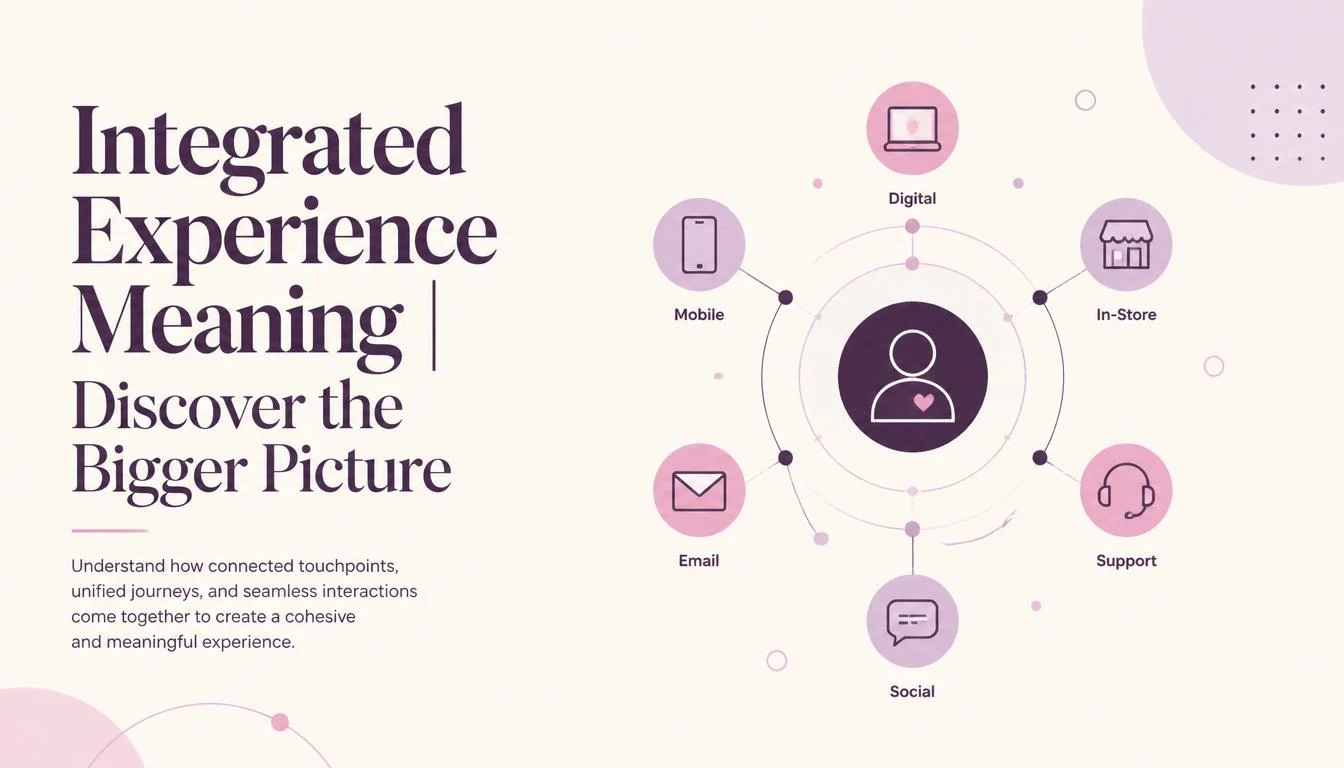
Integrated Experience Meaning refers to a smooth, connected experience where different services, systems, channels, or interactions work together as one. It helps users move between different touchpoints without feeling like they are dealing with separate systems.
Understanding Integrated Experience Meaning is important in business, technology, marketing, and customer service. It describes how different parts of a user’s journey are connected to create a consistent and seamless experience.
For example, a customer might browse a product on a website, check it through a mobile app, and complete the purchase in a physical store. When these interactions work together smoothly, they create an integrated experience.
Integrated Experience: Definition
Integrated experience refers to a seamless, connected process, system, or interaction where different parts, tools, channels, or steps work together as one unified whole, rather than functioning as separate, disconnected pieces.
In simple terms: instead of things feeling scattered or clunky, everything flows together smoothly like puzzle pieces that actually fit.
You’ll most commonly hear “integrated experience” in four main areas:
| ContextWhat It Usually Means | |
|---|---|
| Customer Experience (CX) | All touchpoints (app, website, store, support) work together smoothly |
| Education | Combining theory, hands-on practice, and real-world exposure into one learning journey |
| Workplace / Resume | A candidate who has combined skills across multiple roles or departments |
| Technology / UX Design | Software, hardware, or platforms that function together without friction |
So when someone asks “what does integrated experience mean,” the short answer is: things working together as one connected system instead of separate, isolated parts.
Where Did the Phrase Come From? Origin & Popularity
Unlike internet slang that pops up overnight, “integrated experience” has more formal roots. It grew out of business and design language in the late 20th century, when companies started noticing that customers didn’t think in terms of “departments” they thought in terms of one continuous journey.
Here’s a quick timeline of how it evolved:
- 1990s–2000s: Marketing and retail teams began using “integrated” language (integrated marketing, integrated systems) to describe combining previously separate business functions.
- 2010s: With the rise of smartphones, apps, and omnichannel shopping, “integrated experience” became a buzzword in customer experience (CX) and UX design circles.
- Present day: It’s now common in job postings, LinkedIn profiles, higher-education marketing, product reviews, and tech pitches.
Its popularity comes from a simple truth: people hate friction. Whether it’s switching between five apps to complete one task or getting different answers from customer service depending on which channel you use, disconnected experiences frustrate people. “Integrated experience” became the go-to phrase to promise the opposite.
How “Integrated Experience” Is Used in Real Life
The tone of this phrase shifts depending on context it can sound genuinely positive, neutral and descriptive, or even a little hollow and overused (especially in corporate speak). Here’s how that plays out:
✅ Friendly / Positive Usage
“I love how this banking app gives you a truly integrated experience you can check your account, pay bills, and message support all in one place.”
Tone: Genuine appreciation. The person means it the product actually delivers a smooth, connected feel.
😐 Neutral / Descriptive Usage
“The university offers an integrated experience combining classroom learning with internship placements.”
Tone: Informational. No strong emotion just explaining how a program is structured.
🙄 Dismissive / Skeptical Usage
“Every startup claims to offer an ‘integrated experience,’ but half the time the app still crashes when you switch tabs. 🙃”
Tone: Slightly sarcastic. This usage pokes fun at how the phrase has become a marketing cliché that doesn’t always match reality.
This range is important “integrated experience” is often used aspirationally in marketing copy, even when the actual product or service hasn’t fully delivered on it yet. Readers (and job recruiters) have grown wise to that gap.
Integrated Experience vs. Similar Terms
People often confuse “integrated experience” with a handful of similar-sounding phrases. Here’s how they actually differ:
| Term | Meaning | Key Difference |
|---|---|---|
| Integrated Experience | Different parts/systems work together as one whole | Focus on connection between components |
| Seamless Experience | An experience with no visible friction or interruption | Focus on smoothness, not necessarily multiple systems |
| Omnichannel Experience | Consistent experience across multiple channels (in-store, online, app) | Focus specifically on channels, mainly used in retail/CX |
| Holistic Experience | Considers the “whole person” or “whole journey,” including emotional factors | Focus on completeness, not just technical connection |
| Unified Experience | One consistent look, feel, or process across a product/service | Focus on consistency, often visual or branding-related |
Quick way to remember it: Integrated = connected. Seamless = smooth. Omnichannel = multi-platform. Holistic = complete. Unified = consistent.
They overlap a lot, which is exactly why companies mix and match them in marketing but if you’re writing a resume, essay, or professional email, picking the right one matters more than you’d think.
Alternate Meanings of “Integrated Experience”
While the core idea stays consistent, the phrase can carry slightly different shades of meaning depending on the field:
- In Psychology/Therapy: Sometimes refers to processing and making sense of past experiences (especially trauma) so they feel understood rather than fragmented a very different, more personal meaning than the business usage.
- In Software Engineering: Refers to systems, APIs, or tools integrated into a single development environment or workflow.
- In Real Estate/Architecture: Occasionally used to describe indoor-outdoor living spaces designed to feel like one continuous area.
These meanings are less common online than the business/CX usage, but worth knowing if the phrase pops up in a different context than you expected.
Polite & Professional Alternatives
If “integrated experience” feels overused, vague, or you want something more specific for a resume, pitch, or presentation, here are solid swaps:
- Cohesive experience great for describing consistent branding or design
- Streamlined process better when talking about efficiency
- End-to-end solution ideal for tech or service pitches
- Cross-functional collaboration better for describing teamwork across departments
- Connected ecosystem useful for apps, platforms, or product suites
- Well-rounded background a natural resume alternative to “integrated experience across roles”
Using a more specific term instead of the catch-all “integrated experience” often makes writing sound more confident and less like a template.
Example Usage Table
| Sentence | Tone | Context |
|---|---|---|
| “Our new platform delivers a fully integrated experience across mobile and desktop.” | Positive | Marketing/Tech |
| “She has an integrated experience of both design and development.” | Neutral | Resume/Hiring |
| They keep saying ‘integrated experience’ but the two apps don’t even sync properly. | Dismissive 🙄 | Customer Review |
| “The program blends classroom theory with an integrated field-work experience.” | Neutral | Education |
| “Finally an integrated experience that doesn’t make me re-enter my password five times! 🎉” | Friendly/Excited | Customer Feedback |
FAQs
1. What Does “Integrated Experience” Mean in Simple Words?
It means different parts, tools, or steps work together smoothly as one connected system rather than feeling separate or disconnected.
2. Is “Integrated Experience” a Technical Term or Casual Slang?
“Integrated experience” is a professional and business term commonly used in customer experience, education, technology, and hiring. It is not internet slang.
3. What Is an Example of an Integrated Experience?
A banking app that lets you check your balance, transfer money, pay bills, and contact support through one interface is a good example of an integrated experience.
4. How Is Integrated Experience Different From Seamless Experience?
An integrated experience focuses on different components working together, while a seamless experience emphasizes reducing friction, interruptions, or difficulties during use.
5. Why Do Companies Use the Phrase “Integrated Experience” So Often?
Companies use the phrase because customers value convenience and consistency. It suggests that different services, features, or channels work together rather than operating separately.
6. Can “Integrated Experience” Be Used on a Resume?
Yes. It can describe experience gained across multiple roles, departments, or skill sets that work together toward a common goal.
7. Does “Integrated Experience” Always Have a Positive Meaning?
Not always. The phrase can sometimes be used skeptically or sarcastically when a company claims its services are integrated but the actual experience feels disconnected.
8. What Are Good Alternatives to “Integrated Experience”?
Depending on the context, alternatives include cohesive experience, streamlined process, connected ecosystem, and end-to-end solution.
Conclusion
“Integrated experience” isn’t slang, and it isn’t complicated once you break it down it simply describes things (systems, skills, channels, or processes) working together as one connected whole instead of separate pieces.
Quick recap:
- Core meaning: Seamless connection between different parts of a system, service, or skillset
- Common contexts: Customer experience, education, technology, and resumes
- Tone varies: Can be genuinely positive, neutral/descriptive, or mildly sarcastic when overused
- Not the same as: Seamless, omnichannel, holistic, or unified experience though they overlap
- Pro tip: Use a more specific alternative when precision matters (like on a resume or pitch deck)
Next time you see “integrated experience” in a job listing, an app store review, or a college brochure, you’ll know exactly what’s being promised and whether it’s just a buzzword or the real deal.
Read More Related Articles:
- Corny Meaning | From Cheesy Jokes to Awkward Moments In 2026
- “Central Idea” Meaning | Find the Main Message in Any Text In 2026
- Grand Rising Mean |Guide to the Spiritual Morning Greeting In 2026