Quick Definition
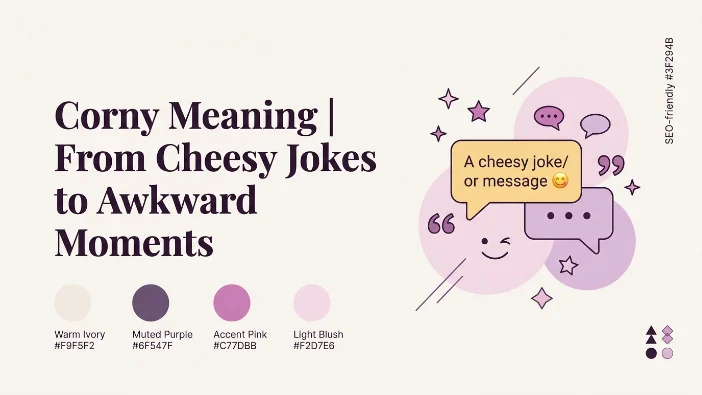
Corny (adjective) describes something that is overly sentimental, predictable, clichéd, or old-fashioned in a way that feels trite or unoriginal. It often refers to jokes, stories, pick-up lines, or romantic gestures that are so predictable they make you cringe but sometimes in a way that’s oddly charming.
Let’s be honest for a second: have you ever rolled your eyes at a dad joke so bad it was actually good? Or cringed at a Valentine’s Day card that rhymed “heart” with “apart”? If you have, you know exactly what it means when someone calls something corny.
Here’s the thing about corny, though: it’s a word with split personalities. On one hand, it’s a criticism a way of saying something is unoriginal, overly sentimental, or just plain cheesy. On the other hand, it’s become a badge of endearment. That dad joke? It’s so corny it’s hilarious. That cheesy love song? It’s corny, but it’s also your guilty pleasure.
In this comprehensive guide, we’re going to explore everything you need to know about what corny really means. We’ll dig into its surprising agricultural origins, track its journey from a description of rustic peasants to a critique of bad art, and explore how it’s used today in everything from dating apps to movie reviews. We’ll also clear up the confusion with similar words like cheesy, tacky, and clichéd, and give you practical tips on how to use it and maybe even embrace it.
Whether you’re here because your friend called your favorite movie corny, you’re trying to write a heartfelt message without crossing into cringe territory, or you’re just curious about this peculiar little word, you’re in the right place. Let’s dive in! 🌽
Origin
Words often have fascinating backstories, and corny is no exception. Its journey from farms to modern slang is surprisingly colorful.
The Agricultural Roots 🌾
The word corny first appeared in the English language in the 16th century, and it literally meant “pertaining to or producing corn.” It came from the noun corn, which in old English referred to any small grain or cereal crop (not just the yellow vegetable we think of today).
Back then, something that was “corny” was simply related to grain nothing more, nothing less.
The Shift in Meaning (1930s)
Here’s where it gets interesting. In the early 1930s, corny underwent a dramatic shift in meaning. It started being used to describe something that was “old-fashioned,” “rustic,” or “unsophisticated” essentially, the kind of simple, homespun quality associated with rural farming communities.
The term emerged in the American South and Midwest, where it was often used to describe:
- Simple folk music played on acoustic instruments
- Rustic storytelling with predictable happy endings
- The kind of sentimental humor you’d find at a county fair
The implication was that these things were “corn-fed” meaning they came from the countryside, not the sophisticated city.
The 1940s and Beyond
By the 1940s, the meaning had solidified into what we use today: overly sentimental, trite, or clichéd. Jazz musicians of the era used it to describe music that was too commercial or predictable. It later spread to other forms of entertainment and eventually to everyday conversation.
Interestingly, the word’s transformation reflects a broader cultural tension between “high” and “low” culture between sophisticated city life and simpler rural values. Calling something corny was a way of signaling that you were too worldly to be impressed by simple, unoriginal fare.
Popularity
So how popular is corny in modern usage? The answer is: very, and its popularity is actually growing.
Current Usage Trends 📊
According to linguistic research and Google Trends data, corny has maintained steady popularity over the past decade, with notable spikes around:
- Valentine’s Day (February) – People are talking about corny pick-up lines and sentimental gestures
- Wedding Season (Spring/Summer) – Discussions of corny wedding vows and traditions
- Movie Release Seasons – Critics and audiences debating whether certain films are “corny” or “heartwarming”
- Holiday Seasons – Christmas movies, Hallmark specials, and corny holiday cards
Who Uses It Most?
- Millennials and Gen Z: The word has been fully reclaimed as a term of endearment. “I’m such a corny person” is now almost a point of pride.
- Critics and Reviewers: Used to describe predictable plotlines, clichéd dialogue, or over-sentimental moments.
- Dating and Relationship Contexts: Extremely common in discussions of pick-up lines, romantic gestures, and what people find attractive or cringey.
Social Media and Pop Culture 📱
Corny has found new life on platforms like:
- Instagram: Often used in captions like “Feeling corny today 🍿”
- Reddit: Subreddits like r/dadjokes and r/cornypickuplines are dedicated to corny content
- Twitter: Used to describe anything from political speeches to celebrity apologies
The internet has embraced corny as part of the broader “so bad it’s good” aesthetic, where earnestness and lack of irony are celebrated rather than mocked.
How It Is Used
The way you use corny can vary widely depending on context, tone, and intention.
As Criticism 😐
When used negatively, corny suggests:
- Lack of originality: “The movie was so corny every twist was predictable.”
- Excessive sentimentality: “His speech was a bit corny for my taste.”
- Uncoolness: “My parents’ music is so corny.”
As Endearment 💖
When used positively or playfully, corny can mean:
- Charmingly old-fashioned: “I love how corny my grandparents are together.”
- Funny despite being predictable: “A corny joke is still funny if delivered well.”
- Authentic and unpretentious: “Our wedding was a little corny and we loved it.”
As Self-Description
Many people now proudly describe themselves as corny:
“I know I’m corny, but I still believe in love.”
“Yes, I listen to corny pop music and I don’t care who knows it.”
As a Social Signal
Using corny can also signal:
- Cultural savvy: Knowing what’s considered outdated or clichéd
- Affectionate teasing: “You’re so corny!” said with a smile
- Irony: Embracing something uncool in an ironic way
Examples
Let’s explore how corny plays out in different tones and contexts.
Friendly Examples 😄
These are lighthearted uses among friends:
- “Dave’s pick-up line was so corny it actually worked.”
- My dad sent me a corny pun in a text message: ‘I doughnut know what I’d do without you.’
- “We watched a corny romantic comedy and laughed through the whole thing.”
- “Honestly, I love how corny you are. It’s cute.”
- The group chat has been full of corny memes all day.
Professional Examples 💼
These are more formal or workplace-appropriate uses:
- “The advertising campaign was criticized for being corny and out of touch with younger audiences.”
- “The CEO’s motivational speech was a bit corny, but it seemed to resonate with employees.”
- “The branding relies on corny nostalgia rather than innovation.”
- “Reviews suggest the film fails because of its corny dialogue and predictable plot.”
Funny Examples 😂
- “He tried to serenade me with a corny song and I had to pretend my phone was ringing.”
- “My grandma’s Christmas card came with a corny poem that rhymed ‘snow’ with ‘glow.'”
- “The couple’s wedding vows were so corny they made everyone laugh and cry at the same time.”
- “I walked into the store and heard a corny Christmas song in August.”
- “My friend’s restaurant review was so corny, ‘The pasta was as good as a hug from a long-lost friend.'”
Dismissive Examples 🙄
These are more negative uses:
- “I can’t stand corny romantic movies. Give me something with substance.”
- “His attempts to be romantic come off as corny and desperate.”
- “The speech was so corny I had to look away.”
- “Please don’t sing a corny song at karaoke. It’s embarrassing.”
Comparison with Similar Terms
Corny is often used interchangeably with several other words, but they’re not exactly the same. Let’s break it down.
Comprehensive Comparison Table
| Term | Definition | Key Characteristics | Example | Tone |
| Corny | Overly sentimental or predictable | Old-fashioned, simple, earnest | “A corny greeting card poem” | Can be negative or playful |
| Cheesy | In poor taste, overly sentimental | Tacky, over-the-top, commercial | “A cheesy romantic gesture” | Usually negative, sometimes affectionate |
| Clichéd | Overused to the point of meaninglessness | Predictable, uninspired | “A clichéd plot twist” | Negative |
| Tacky | In bad taste or lacking style | Gaudy, inappropriate, low-class | “Tacky decorations” | Strongly negative |
| Sappy | Excessively sentimental | Emotional, tear-jerking, mawkish | “A sappy love song” | Negative, sometimes affectionate |
| Hackneyed | Worn out by overuse | Unoriginal, tired | “Hackneyed phrases” | Formal, negative |
| Old-fashioned | Outdated but sometimes charming | Traditional, nostalgic | “Old-fashioned values” | Neutral or positive |
| Mawkish | Excessively sentimental to the point of being nauseating | Overly sweet, cloying | “A mawkish tribute” | Strongly negative |
Key Distinctions
- Corny vs. Cheesy: Corny often implies simplicity and earnestness; cheesy implies something is tacky or over-commercialized. A homemade Valentine’s card might be corny; a cheap, glitter-encrusted store-bought one might be cheesy.
- Corny vs. Clichéd: All corny things might be clichéd, but not all clichéd things are corny. A clichéd action movie plot (“the hero saves the world”) isn’t necessarily corny. A clichéd romantic subplot with over-the-top declarations of love is likely corny.
- Corny vs. Sappy: Sappy is a more emotional word, suggesting something that makes you cry (or roll your eyes because it’s trying too hard to make you cry). Corny is broader, covering anything from jokes to fashion.
- Corny vs. Old-fashioned: Old-fashioned suggests something traditional that might be valued; corny usually implies it’s outdated in a way that feels silly.
Alternate Meanings
While corny is primarily used to describe something trite or sentimental, it does have other, less common meanings:
1. Agricultural/Literal Meaning 🌽
The original, literal meaning: pertaining to or containing corn.
- “The field was full of corny crops.”
- “The corny smell of the silo filled the air.”
2. “Corny” as in “Corny Nose” (Slang)
In some regional dialects, “corny” can refer to a bump on the nose, but this is very rare.
3. “Corny” in Music
In music criticism, corny might describe:
- Overly simple chord progressions
- Predictable song structures
- Excessive use of sentimentality
4. “Corny” as a Compliment (Irony)
Among some Gen Z users, corny has been re-appropriated ironically as:
- “That’s so corny it’s iconic”
- “I live for corny moments”
5. “Corny” in Pick-Up Lines
The term is virtually synonymous with:
- Dad jokes
- Cheesy pick-up lines
- Predictable compliments
Professional or Polite Alternatives
There are times when corny might be too casual, harsh, or potentially offensive. Here are more diplomatic alternatives:
| Instead of… | Try… | Context |
| “Your speech was corny” | “Your speech was very sentimental” | More respectful |
| “That joke was corny” | “That joke was predictable” | More neutral |
| “The movie was corny” | “The movie had formulaic elements” | More professional |
| “His approach is corny” | “His approach seems old-fashioned” | Less judgmental |
| “This design is corny” | “This design feels a bit dated” | More constructive |
| “Her writing is corny” | “Her writing tends toward the overly sentimental” | More precise |
| “Their marketing is corny” | “Their marketing is uninspired” | More professional |
| “The song is corny” | “The song is overly earnest” | Softer |
When to Use What
- Sentimental: When something is heartfelt (neutral)
- Formulaic: When something follows predictable patterns (professional)
- Dated: When something belongs to an earlier era (less harsh)
- Earnest: When something is sincere (often positive)
- Unoriginal: When something lacks creativity (objective)
- Nostalgic: When something evokes fond memories (positive)
Common Mistakes
❌ Mistake 1: Using “Corny” When You Mean “Cheesy”
Problem: They’re similar but not identical. Cheesy often suggests something is tacky or in poor taste; corny suggests something is old-fashioned or overly sentimental.
Solution: Ask yourself: is it the sentimentality (corny) or the tackiness (cheesy) that you’re reacting to?
❌ Mistake 2: Calling Something “Corny” That’s Actually Heartfelt
Problem: Using corny dismissively can hurt someone’s feelings if they’ve shared something genuine.
Solution: If in doubt, say something like “That’s very sweet” instead.
❌ Mistake 3: Using It in a Professional Setting
Problem: In a formal business meeting, saying a presentation is “corny” sounds unprofessional.
Solution: Use words like “uninspired,” “formulaic,” or “predictable” instead.
❌ Mistake 4: Confusing “Corny” with “Corn-Fed”
Problem: While they share roots, “corn-fed” means something entirely different (literally fed on corn, or figuratively, naive and wholesome).
Solution: Remember: corny is about sentimentality; corn-fed is about rural upbringing.
❌ Mistake 5: Using It Too Broadly
Problem: Overusing corny makes it lose its impact.
Solution: Save it for situations that truly deserve it.
❌ Mistake 6: Forgetting the Dual Nature
Problem: Not realizing that corny can be positive or negative depending on context.
Solution: Pay attention to tone and audience.
Quick Tips
Social Media
- Use corny to describe yourself ironically: “I’m embracing my corny side today
- Use it to share dad jokes: “Get ready for some corny humor 🌽”
- Pair with emojis: 🌽 😂 🙄 (sets the playful tone)
Dating and Relationships
- Acknowledging you’re corny can be endearing
- Corny pick-up lines can work if delivered with confidence
- Avoid calling someone corny if they’ve opened up emotionally
Professional Settings
- Stick to more formal alternatives
- If you must use it, frame it constructively
- Never use it to describe someone’s work directly
Writing
- Corny is informal; use sparingly in formal writing
- Show, don’t just tell: describe the sentimentality
- Use it in dialogue to show character voice
Everyday Conversation
- Tone is everything deliver it with a smile or a wink
- Use it to build camaraderie around shared cringe
- Accept it as a compliment if someone says you’re corny
When to Embrace the Corny
- Dad jokes (they’re supposed to be corny)
- Romantic gestures (some people love them)
- Nostalgic moments (it adds to the charm)
- Self-deprecating humor (it shows you’re comfortable)
FAQ
1. What does corny mean in slang?
In modern slang, corny describes something that is overly predictable, old-fashioned, or excessively sentimental but often in a way that’s charming rather than offensive. It can be used as mild criticism (“That joke was so corny”) or as affectionate teasing (“You’re such a corny person”).
2. Is corny the same as cheesy?
Not exactly. While they’re similar, cheesy often implies something is tacky, low-quality, or in poor taste. Corny implies something is old-fashioned, overly sentimental, or predictable. A homemade Valentine’s Day card with a heartfelt message is more likely to be called corny; a cheap, glittery store-bought card with a terrible rhyme is more likely to be called cheesy.
3. Is corny a positive or negative word?
It can be both! Positively, it can describe something charmingly old-fashioned, endearingly sentimental, or playfully predictable. Negatively, it can describe something unoriginal, cringe-worthy, or outdated. The tone and context matter hugely.
4. Why do they call jokes corny?
The term comes from the 1930s, when “corny” was used to describe simple, rustic, unsophisticated humor the kind you’d hear in rural farming communities. These jokes often relied on predictable punchlines, puns, and wholesome content. Over time, “corny” became shorthand for “old-fashioned and predictable,” which applies perfectly to dad jokes and puns.
5. Can a person be corny?
Absolutely! A “corny person” is someone who makes corny jokes, appreciates sentimental gestures, and generally embraces things that others might consider old-fashioned or predictable. It’s often used affectionately to describe someone who is genuinely earnest and unpretentious.
6. What are some examples of corny pick-up lines?
Some classic corny pick-up lines include:
- “Are you made of copper and tellurium? Because you’re Cu-Te.”
- “Do you have a map? I keep getting lost in your eyes.”
- Is your name Wi-Fi? Because I’m feeling a connection.”
- “Are you a magician? Because whenever I look at you, everyone else disappears.”
- “If you were a vegetable, you’d be a cute-cumber.”
They’re predictable, pun-filled, and often make people roll their eyes which is exactly the point.
7. What’s the difference between corny and cringe?
Corny implies something is old-fashioned, predictable, or overly sentimental. Cringe (or “cringey”) implies something is so embarrassing or awkward that you physically recoil. You can cringe at something that’s corny, but not everything corny is cringey. A corny dad joke might make you groan, but a cringey attempt at flirting might make you want to leave the room.
8. Is corny considered an insult?
It can be, but often it’s not meant seriously. Among friends, calling something or someone corny is usually playful teasing. In professional or critical contexts, it can be dismissive and negative. As with many slang terms, it’s all about context and delivery.
Conclusion
So, what does corny really mean? As we’ve seen, it’s a word with remarkable flexibility capable of being a put-down, a playful tease, or even a term of endearment.
Key Takeaways 📝
- The Core Definition: At its heart, corny means overly sentimental, predictable, or old-fashioned in a way that feels unoriginal.
- The Dual Nature: It can be negative (criticizing something as trite) or positive (embracing something as charmingly earnest).
- The Agricultural Roots: The word started as a literal description of grain, then became a way of describing rustic, unsophisticated things, and eventually settled into its current meaning.
- It’s Not the Same as Cheesy: Corny is about sentimentality and predictability; cheesy is about tackiness and poor taste.
- Know Your Context: What’s playful among friends might be dismissive in a professional setting.
- Embrace It: Many people now proudly wear the “corny” label as a sign of authenticity and self-acceptance.
Final Thoughts 🌽
In a world that often prizes irony, cynicism, and being “cool,” there’s something refreshing about embracing the corny. The dad jokes we groan at, the cheesy romantic comedies we secretly love, the over-sentimental greeting cards we buy these are the things that connect us to our humanity.
There’s a reason corny content persists: it speaks to something genuine. It’s unpretentious. It’s accessible. And sometimes, it’s exactly what we need.
So go ahead and tell that corny joke. Share that sentimental story. Wear your heart on your sleeve. Because as it turns out, being a little corny might just be the most authentic thing you can be. 🌽✨
Read More Related Articles:
- Safety Pin Necklace Mean | Why This Tiny Symbol Holds Big Meaning In 2026
- OBO Mean on Facebook Marketplace | Guide to Buying and Selling Smarter In 2026
- Outbox Mean in Email | Easy Explanation You Need In 2026






4 thoughts on “Corny Meaning | From Cheesy Jokes to Awkward Moments In 2026”