Quick Definition
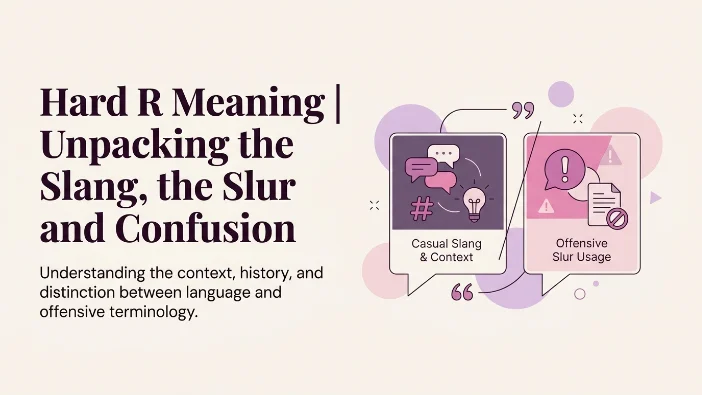
Hard R (or hard “r”) is a term with two primary meanings. In its most significant and sensitive usage, it refers to the pronunciation of a highly offensive racial slur the N-word with a pronounced “-er” ending, as opposed to the “-a” ending used in some communities. In the entertainment industry, it describes an R-rated movie with extremely intense violence, profanity, or sexual content.
The Hard R Meaning refers to a particularly offensive pronunciation of a well-known anti-Black racial slur. The term is often discussed when explaining the difference between its historical forms and modern slang usage.
Understanding the Hard R Meaning is important because the phrase carries a deeply racist history and can be extremely hurtful or offensive when used toward someone.
Whether you’re here because you’re genuinely curious, because you heard the term and didn’t want to ask, or because you’re trying to understand a controversy you saw online, you’re in the right place. Let’s break it down clearly, honestly, and with the sensitivity this topic deserves.
Origin
The story of “hard R” begins with the word it’s used to describe and that word has a long and painful history.
The Root of the Word
The racial slur at the heart of this term traces back to the Latin word niger, which simply means “black. During the 1500s, as Europeans began participating in the Atlantic slave trade, the term was used in a relatively neutral way to refer to Black people.
Over time, however, the word evolved. In the 1800s, “nigger” emerged as a Southern mispronunciation of “negro” and became firmly established as a derogatory term directed at African Americans. It became deeply intertwined with the horrors of slavery, segregation, and systemic racism.
The Emergence of “Hard R”
The specific phrase “hard R” emerged much later, as a way to distinguish between two pronunciations of the N-word that had developed.
- The “soft a” version (“nigga”): This pronunciation, ending with an “a” sound, became common in African American Vernacular English and in hip-hop culture. For many Black Americans, it functioned as a term of solidarity or friendship within the community.
- The “hard R” version (“nigger”): This pronunciation, with a clear “-er” ending, retained all the hateful historical weight of the original slur. It became associated with racism, white supremacy, and the violent oppression of Black people.
The phrase “hard R” became a way to refer to the more offensive version without actually saying the word itself. It’s a euphemism a linguistic workaround that allows people to discuss the slur without repeating it.
Popularity
The term “hard R” has seen a significant rise in visibility in recent years, driven by several factors.
Social Media and Online Culture
Platforms like TikTok, Twitter (now X), and Instagram have made discussions about language, race, and slurs more public than ever before. The term “hard R” frequently appears in:
- Controversy discussions: When public figures or influencers are caught using racial slurs, the term “hard R” is often used to describe what they said.
- Educational content: Creators explaining the difference between the “-a” and “-er” pronunciations often use “hard R” as a shorthand.
- Memes and viral moments: From the Stellar Blade graffiti controversy to the Peterbot Fortnite scandal, “hard R” has been at the center of several high-profile online debates.
The “Hard R” in Entertainment
In Hollywood and the film industry, “hard R” has been used for decades to describe movies that push the boundaries of an R rating. Films like Deadpool, Saw, and Logan have been described as “hard R” because of their intense violence, graphic nudity, or explicit language.
This usage has created confusion and sometimes controversy when actors or executives use the term without realizing its other, more offensive meaning.
Recent Controversies
The term has made headlines in several recent incidents:
- Stellar Blade (2024): A video game faced backlash when graffiti reading “HARD” appeared next to an “R Shop” sign, unintentionally creating the phrase “Hard R.” Sony quickly patched the game to remove the offending art.
- Peterbot (2025): A professional Fortnite player faced intense backlash after a video surfaced of him using the N-word with a hard R. The controversy led to memes, apologies, and discussions about accountability in gaming.
- Celebrity slip-ups: Actors like Glen Powell have been criticized for using “hard R” to describe movies, with critics pointing out the term’s racist connotations.
How It Is Used
The way “hard R” is used depends entirely on context. Here are the three main ways you’ll encounter it.
As a Euphemism for a Racial Slur
This is the most significant and sensitive usage. When people say “hard R,” they’re typically referring to the N-word pronounced with a hard “-er” ending.
Key points about this usage:
- It’s a way to discuss the slur without saying it
- It distinguishes the offensive version from the “-a” version used in some communities
- Using the actual word with a hard R is widely considered hate speech
In the Film Industry
In Hollywood, “hard R” describes movies that are:
- Extremely violent
- Filled with graphic content
- Pushing the limits of what’s allowed in an R-rated film
Examples include:
- Deadpool (2016) – known for its bloody action and crude humor
- Saw (2004) – notorious for its graphic torture scenes
- Logan (2017) – praised for its brutal, realistic violence
In Linguistics
In phonetics and dialect studies, “hard R” simply refers to:
- A strongly pronounced “R” sound
- Rhotic accents where the “R” is clearly enunciated
- The opposite of non-rhotic accents (like some British or Boston accents, where the “R” is dropped)
Example: An American saying “car” with a clear “R” vs. a British speaker saying “cah”.
Examples
Let’s look at how “hard R” plays out in different contexts.
Neutral/Linguistic Examples 🗣️
These uses are about pronunciation, not offense:
- “In a hard R accent, you pronounce the ‘r’ at the end of ‘car.'”
- “The Boston accent is known for dropping the hard R.”
- “Linguists study the difference between rhotic (hard R) and non-rhotic dialects.”
Entertainment Industry Examples 🎬
These describe movie content:
- “Deadpool is a hard R movie it’s not for kids.”
- “The director pushed for a hard R rating to keep the violence authentic.”
- “They cut some scenes to avoid a hard R and get a PG-13 instead.”
Serious/Sensitive Examples ⚠️
These involve discussions of racial slurs:
- “He used the N-word with a hard R that’s completely unacceptable.”
- “There’s a big difference between the ‘-a’ ending and the hard R.”
- “Many people use ‘hard R’ as a way to refer to the slur without saying it.”
Controversial Examples 🔥
These show how the term appears in real-world incidents:
- “The Stellar Blade graffiti controversy involved an unintentional Hard R reference.”
- “The Peterbot video showed him using the N-word with a hard R.”
- “Glen Powell faced criticism for using ‘hard R’ to describe his movie.”
Comparison with Similar Terms
Hard R” is often confused with other terms. Here’s how they compare.
Comprehensive Comparison Table
| Term | Meaning | Context | Tone |
| Hard R | The “-er” pronunciation of the N-word; or an intense R-rated movie | Racial discussion or film industry | Offensive (first meaning) or neutral (second meaning) |
| Soft A | The “-a” pronunciation of the N-word (“nigga”) | African American Vernacular English | Can be neutral or positive within community |
| N-Word | A euphemism for the racial slur itself | General discussion | Neutral (as a euphemism) |
| R-Rated | A movie rating restricting viewers under 17 | Film classification | Neutral |
| Hard R (linguistics) | A clearly pronounced rhotic “R” sound | Phonetics | Neutral |
| Hard R (slang) | A term for a racist person who uses racial slurs | Social commentary | Negative |
Key Distinctions
- Hard R vs. Soft A: The “hard R” version of the N-word is widely considered a hateful slur; the “soft A” version is used differently within the Black community.
- Hard R vs. R-Rated: “R-Rated” is the official MPAA rating. Hard R” is an informal term meaning the movie pushes the boundaries of that rating.
- Hard R vs. N-Word: “N-Word” is a broader euphemism for the slur. “Hard R” specifically refers to one pronunciation of it.
Alternate Meanings
Beyond the two primary definitions, “hard R” has a few other uses:
1. “Hard-R Slayer” (Internet Slang)
A niche term from Urban Dictionary referring to someone who aggressively calls out racism. Very rare and not widely used.
2. In Other Languages
In Spanish and other languages, “hard R” can refer to a trilled or rolled “R” sound, as opposed to a soft flap. This is purely linguistic and has no connection to the racial meaning.
3. In Phonetics
Linguists use “hard R” to describe rhotic consonants that are strongly enunciated, especially in contrast to non-rhotic accents where the “R” is dropped.
4. In Music
Occasionally used in music criticism to describe aggressive or intense vocal delivery, though this is uncommon.
Professional or Polite Alternatives
Given the sensitivity of the primary meaning, here are alternatives for different situations.
| Instead of… | Try… | When to use |
| “Hard R” (racial context) | “The N-word with an ‘-er’ ending” | When you need to be precise |
| “Hard R” (racial context) | “The offensive version of the N-word” | When explaining the distinction |
| “Hard R” (racial context) | “That racial slur” | In casual conversation |
| “Hard R” (movie context) | “An intense R-rated movie” | In professional settings |
| “Hard R” (movie context) | “A very graphic R-rated film” | When describing content |
| “Hard R” (movie context) | “An R-rated movie with extreme content” | For clarity |
When to Avoid “Hard R” Entirely
- In professional writing: Use more precise language
- When the audience might be confused: The term has multiple meanings
- In sensitive conversations: Focus on the issue, not the jargon
Common Mistakes
❌ Mistake 1: Using “Hard R” Casually Without Understanding Its Weight
Problem: The term’s primary meaning is associated with one of the most offensive racial slurs in English. Using it casually can signal ignorance or insensitivity.
Solution: Be aware of the context. In entertainment industry circles, it might be acceptable; in general conversation, it’s risky.
❌ Mistake 2: Confusing the Movie and Racial Meanings
Problem: When actors or executives use “hard R” to describe a movie, audiences may interpret it as a reference to the racial slur.
Solution: If you work in film, consider saying “very R-rated” or “intense R-rated” instead.
❌ Mistake 3: Assuming Everyone Knows the Distinction
Problem: Not everyone is aware that “hard R” has multiple meanings. Using it can lead to misunderstandings.
Solution: If you must use the term, clarify which meaning you intend.
❌ Mistake 4: Using It to Describe People
Problem: Saying someone “uses the hard R” or is a “hard R” person can be offensive and reductive.
Solution: Describe the behavior, not the person. Say “they used a racial slur” instead.
❌ Mistake 5: Thinking the “-a” and “-er” Versions Are Interchangeable
Problem: They are not. The “-er” version carries significantly more historical weight and is widely considered hate speech.
Solution: Understand the distinction and use language accordingly.
Quick Tips
Social Media
- Avoid using “hard R” unless you’re explaining its meaning
- If you’re discussing the term, provide context
- Never use the actual slur, even in quotes
Professional Settings
- Use “intense R-rated” for movies
- Use “the N-word with an ‘-er’ ending” for the slur
- When in doubt, err on the side of caution
Everyday Conversation
- Be aware that “hard R” has different meanings to different people
- If someone uses it, ask for clarification if needed
- Avoid using it to describe people or their behavior
Writing
- Define the term if you’re using it
- Provide context so readers understand which meaning you intend
- Consider whether a simpler alternative would work better
When Discussing the Racial Slur
- Use euphemisms like “the N-word” or “that slur”
- Explain the distinction between pronunciations if relevant
- Never repeat the slur itself
FAQ
1. What does “hard R” mean?
Hard R has two primary meanings. Most significantly, it refers to the pronunciation of the N-word with a hard “-er” ending, which is considered a highly offensive racial slur. In the film industry, it describes an R-rated movie with extreme violence, profanity, or sexual content.
2. What’s the difference between “hard R” and “soft A”?
The hard R version of the N-word ends with an “-er” sound (“nigger”) and is considered a hateful slur. The soft A version ends with an “-a” sound (“nigga”) and is used differently within the Black community, often as a term of solidarity or friendship.
3. Why is “hard R” offensive?
The “hard R” refers to the N-word pronounced with a hard “-er” ending. This version of the word is historically associated with slavery, segregation, and racial violence against Black people. It’s widely considered hate speech and is deeply hurtful to those it targets.
4. What does “hard R” mean in movies?
In the film industry, hard R describes a movie that pushes the boundaries of an R rating with extreme violence, graphic nudity, or explicit language. Examples include Deadpool, Saw, and Logan.
5. Is “hard R” a slur itself?
No, “hard R” is not a slur it’s a euphemism used to refer to a slur without saying it. However, because of its association with the N-word, it’s a sensitive term that should be used carefully.
6. Why do people say “hard R” instead of the actual word?
People use “hard R” as a way to discuss the N-word without actually saying it. This allows for conversations about racism and language without repeating the offensive slur itself.
7. What was the Stellar Blade “hard R” controversy?
In 2024, the video game Stellar Blade faced backlash when graffiti reading “HARD” appeared next to an “R Shop” sign, unintentionally creating the phrase “Hard R.” Sony quickly patched the game to remove the offending art.
8. Can “hard R” ever be used in a neutral way?
Yes, in two contexts: (1) in linguistics, to describe a clearly pronounced “R” sound in certain accents, and (2) in the film industry, to describe intense R-rated movies. However, given the term’s primary association with a racial slur, it’s best to use it carefully and provide context.
Conclusion
So, what does hard R mean? As we’ve seen, it’s a term that carries very different meanings depending on who’s using it and why.
Key Takeaways 📝
- The Primary Meaning: “Hard R” most commonly refers to the N-word pronounced with a hard “-er” ending a version of the word that’s widely considered a hateful racial slur.
- The Entertainment Meaning: In Hollywood, it describes movies that push the boundaries of an R rating with extreme content.
- The Linguistic Meaning: In phonetics, it simply means a clearly pronounced “R” sound.
- Context Is Everything: The same two words can mean something neutral, something offensive, or something in between depending entirely on context.
- Use It Carefully: Given the term’s association with a racial slur, it’s wise to use “hard R” thoughtfully and to provide clarity about which meaning you intend.
Final Thoughts 💭
Language is powerful. The words we choose and the way we pronounce them carry history, weight, and meaning. Hard R” is a perfect example of how a simple phrase can be loaded with significance.
The most important thing is to be aware. Know what you’re saying. Understand the context. And when it comes to racial slurs, the best approach is simple: don’t use them. Use euphemisms like “the N-word” or “that slur” when you need to refer to them. And if you’re in the entertainment industry, consider saying “very R-rated” instead of “hard R” it’ll save everyone a lot of confusion.
Words matter. Use them wisely. 🙏
Read More Related Articles:
- JSP Meaning | Internet Acronym Everyone Gets Wrong In 2026
- What Does WTM Mean in Text | Common Uses You Should Know In 2026
- What Does ACC Mean | Every Meaning Made Simple In 2026

Michael Turner is a U.S.-based content writer and blogger who enjoys uncovering the stories and meanings behind words. Through his work at Meanvora, he delivers well-researched, easy-to-read articles that help readers expand their vocabulary and gain a deeper understanding of language.








4 thoughts on “Hard R Meaning | Unpacking the Slang, the Slur and Confusion In 2026”