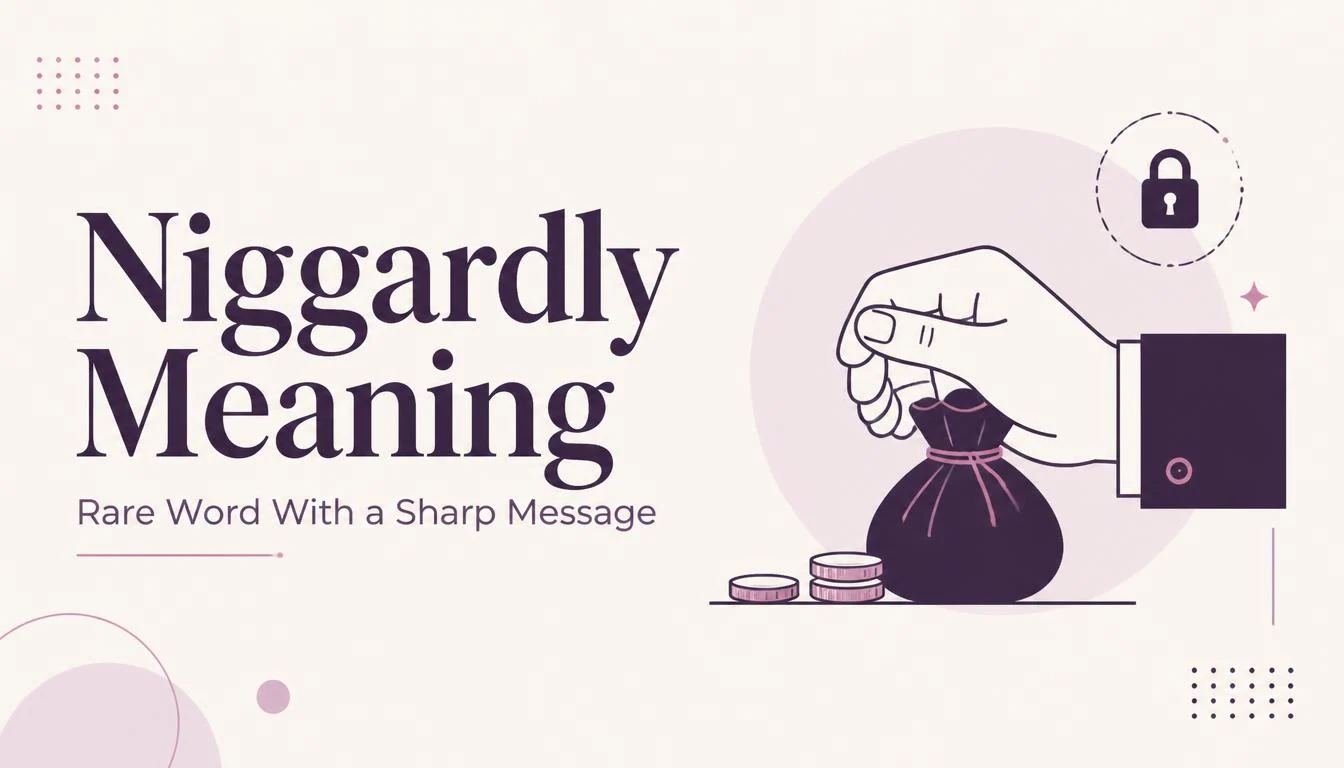
Quick Answer:
Niggardly means unwilling to spend money or give resources generously. It describes someone who is stingy, miserly or excessively reluctant to share. The word is unrelated in origin to the racial slur that it resembles in spelling and pronunciation.
The word niggardly meaning refers to a behavior marked by extreme unwillingness to spend money, share resources or give more than necessary. It is commonly used to describe a person who is excessively frugal or an action that reflects a lack of generosity. For example, someone who refuses to contribute a fair amount toward a shared expense might be described as niggardly.
Understanding the niggardly meaning also requires knowing its linguistic background. The word comes from an old Scandinavian term associated with stinginess and has no etymological connection to the racial slur with which it is sometimes confused. However, because the words sound similar, using niggardly can cause misunderstanding or discomfort in conversation. Choosing alternatives such as stingy, miserly or ungenerous may help communicate the intended meaning more clearly.
What Does Niggardly Mean?
Niggardly is an adjective that describes behavior marked by excessive unwillingness to spend, give, or provide something. It is most commonly associated with money, gifts, budgets, and the distribution of resources. When someone acts this way, they may be giving less than expected or refusing to spend what a situation reasonably requires.
For example, a company might offer a niggardly travel allowance to employees who must attend an important business conference. The allowance may technically cover part of the expense, but it could be so small that employees struggle to pay for basic necessities during the trip.
The word can also describe an amount rather than a person. A niggardly portion of food suggests a serving that is disappointingly small. Similarly, a niggardly contribution implies that someone has given very little compared with what was expected or what they could reasonably afford.
The central idea is not simply that something is small. It is that the small amount reflects a lack of generosity or an unwillingness to provide enough. A modest gift given thoughtfully is not necessarily niggardly, while a deliberately inadequate gift from someone who could easily afford more might be described that way.
Is It About Money Only?
No. Although money is the most familiar context, the word can refer to time, effort, information, or other resources.
Consider a manager who gives an employee a niggardly amount of feedback. The employee receives only a few vague comments when detailed guidance would have been helpful. The criticism concerns the limited amount of useful information, not financial spending.
Likewise, a writer might describe a government agency’s support for a community project as niggardly if the agency provides too little funding, staff time, or equipment to make the project successful.
In each case, the word communicates dissatisfaction with an inadequate level of giving. It often carries a stronger negative judgment than neutral words such as small, limited, or modest.
Origin and Etymology of the Word
The history of this word goes back several centuries, long before its modern spelling became a source of public confusion. English speakers have used related forms to describe stinginess since the Middle Ages. The word’s origins are generally linked to older Germanic languages, including a possible Scandinavian source.
The noun niggard referred to a miserly or stingy person. The adjective developed by adding the suffix -ly, which helps form adjectives and adverbs in English. Historical dictionaries trace the adjective to the 16th century, with etymological references recording its use during that period.
What Is the Difference Between Its Root and Its Modern Form?
The root word and the adjective are closely connected in meaning. A niggard is a person who is unwilling to give or spend generously, while niggardly describes that person’s behavior or the inadequate amount being provided.
For example:
- Noun: The miser was known as a niggard who rarely helped his neighbors.
- Adjective: The organization received a niggardly grant that barely covered its expenses.
- Adverb: The funds were distributed niggardly, leaving several important needs unmet.
The noun is now uncommon, and the adjective is also relatively rare in everyday conversation. Many modern speakers encounter the word primarily in dictionaries, older literature, or discussions about English vocabulary.
Is It Related to a Racial Slur?
No. Despite the similarity in sound and spelling, the words have different historical origins. Niggard is associated with older English and possible Scandinavian roots connected with stinginess. The racial slur comes through European words associated with the Latin word niger, meaning black or dark.
This distinction matters because a word’s appearance does not always reveal its origin. English contains many words that resemble one another without sharing a root or meaning.
However, knowing the etymology does not eliminate the potential for offense. A listener may hear the familiar sound of a racial slur before recognizing the intended word. That difference between historical origin and present-day perception is one of the most important aspects of understanding this term.
How to Use It in Everyday English
The adjective is generally used when someone wants to criticize a lack of generosity. It often appears in formal writing, political commentary, literary descriptions, and discussions of financial decisions. In casual conversation, people usually choose simpler alternatives.
The following examples show how its meaning changes slightly depending on the situation.
1. Describing Money or Spending
A person who has enough money but refuses to contribute a reasonable amount might be described as niggardly.
Example: The wealthy sponsor made a niggardly donation to the local charity.
The sentence suggests that the donation was disappointingly small relative to the sponsor’s apparent ability to give. It does not establish the sponsor’s actual finances, though, so context matters before making such a judgment.
2. Describing a Salary or Budget
The word can criticize an amount that fails to meet reasonable expectations.
Example: The employees rejected the niggardly salary offer because it did not reflect their responsibilities.
Here, the adjective expresses dissatisfaction with the compensation. It implies that the offer is meanly inadequate rather than simply lower than another offer.
3. Describing Time or Attention
Generosity is not limited to money. People also give their time, attention, and effort.
Example: The supervisor offered niggardly guidance to a new employee who needed proper training.
This describes support that is too limited to be useful. A manager may technically provide guidance while withholding the detail and attention required for the employee to succeed.
4. Describing Food or Physical Portions
The word can also refer to a small serving or an inadequate quantity of something tangible.
Example: Guests complained about the niggardly portions served at the banquet.
The criticism is directed at the amount of food provided. The portions may be sufficient to taste, but they fall short of what the guests expected from the occasion.
5. Describing Public Spending
The adjective can appear in commentary about governments, institutions, and public services.
Example: Residents criticized the city’s niggardly investment in public libraries.
This sentence suggests that the funding is insufficient for the community’s needs. Whether the investment is truly inadequate would depend on the available budget, competing priorities, and the services residents require.
These examples illustrate the word’s main pattern: it communicates a judgment about giving too little. In each case, the context determines whether the criticism is fair.
Real-World Context: Why the Word Became Controversial
The history of this word is not just a dictionary issue. It has also become a well-known example of how pronunciation, social history, and audience expectations can influence communication.
One widely reported American controversy occurred in January 1999. David Howard, then head of Washington, D.C.’s Office of Public Advocate, used the word while discussing a budget allocation. The episode attracted public attention because some listeners associated the sound of the word with a deeply offensive racial slur. Howard subsequently resigned, and the incident became a prominent example in debates about vocabulary and intent.
The event showed that a speaker’s intended definition does not always determine how a statement is received. A person may use a word accurately according to a dictionary and still create confusion or hurt because listeners hear a different, offensive term.
Why Correct Etymology Does Not Settle Every Conversation
There are two separate questions to consider:
- What does the word historically mean? It means stingy, miserly, or meanly inadequate.
- How might someone interpret it today? Some people may mistake it for a racial insult because of its similarity in sound.
Both points can be true at the same time. Explaining the history can clarify a speaker’s intention, but it does not require an audience to ignore the sound or its associations.
The most useful response to a misunderstanding is usually calm clarification. If someone objects to the word, explaining that a different meaning was intended is more productive than accusing the listener of ignorance. The goal should be to communicate clearly, not to win an argument about vocabulary.
Should You Avoid the Word?
In most ordinary situations, yes. That recommendation is based on practical communication rather than a claim that the word itself is a racial slur. Clear alternatives exist, and they usually convey the intended criticism without creating the same risk of misunderstanding.
For instance, stingy budget, miserly donation, inadequate funding, and meager allowance communicate the relevant idea directly. Choosing one of these expressions makes the sentence easier to understand, especially when speaking to a diverse audience.
The word may still appear in historical analysis, literary discussion, or a conversation specifically about language. In those settings, understanding its history can be useful. The important distinction is between explaining a word and choosing it when a clearer alternative would work just as well.
Niggardly vs. Similar Words
Several English words express a lack of generosity, but their meanings are not identical. Choosing the right synonym helps communicate whether the problem is selfishness, limited resources, or an amount that is simply too small.
| Word | Meaning | Example |
|---|---|---|
| Niggardly | Stingy or meanly inadequate | The committee offered a niggardly grant. |
| Stingy | Unwilling to spend or share | He is stingy with his money. |
| Miserly | Extremely unwilling to spend | She lived a miserly life despite her wealth. |
| Frugal | Careful about spending and avoiding waste | They follow a frugal household budget. |
| Meager | Too small or insufficient | The workers received a meager allowance. |
| Parsimonious | Excessively reluctant to spend or give | The director was parsimonious with company funds. |
| Ungenerous | Not willing to give or offer enough | The proposal included an ungenerous benefit package. |
| Cheap | Unwilling to spend money, sometimes in a negative sense | He was too cheap to replace the broken equipment. |
Niggardly vs. Stingy
Stingy is the most straightforward alternative. Both words can describe someone who refuses to spend or share a reasonable amount, but stingy is much more familiar in everyday English.
For example, saying that someone is stingy with tips is easy to understand. Calling the same person niggardly conveys a similar judgment but sounds more formal and may distract listeners from the intended message.
Niggardly vs. Frugal
These words express different judgments about spending habits. Frugality usually means using money carefully, avoiding waste, and making sensible financial decisions. It does not automatically imply selfishness or a refusal to help others.
A frugal family might prepare meals at home to save money while generously supporting relatives in need. A niggardly person, by contrast, is characterized by an unwillingness to give or spend enough.
The key difference is that frugality can be sensible, while niggardliness carries a negative judgment about generosity.
Niggardly vs. Meager
Meager describes an amount that is too small, limited, or inadequate. It does not necessarily suggest that anyone deliberately withheld resources.
A meager harvest might result from poor weather. A niggardly payment, however, suggests that the amount provided is meanly insufficient. The first describes the shortage, while the second often criticizes the attitude or decision behind it.
Synonyms and Antonyms
Understanding related words makes it easier to choose an expression that fits the situation.
Common Synonyms
- Stingy: Reluctant to spend money or share possessions.
- Miserly: Extremely unwilling to spend, even when spending would be reasonable.
- Parsimonious: Excessively economical or reluctant to give.
- Ungenerous: Unwilling to provide a fair or generous amount.
- Penurious: Extremely poor or excessively reluctant to spend, depending on context.
- Scanty: Present in an amount that is smaller than needed or expected.
- Meager: Inadequate in quantity, quality, or value.
Not every synonym works in every sentence. Scanty and meager are particularly useful when describing quantities, while stingy and miserly more directly criticize a person’s behavior.
Common Antonyms
Antonyms express the opposite idea.
- Generous: Willing to give or share freely.
- Charitable: Willing to help people in need.
- Lavish: Generous or abundant in spending or provision.
- Liberal: Giving freely or providing generously in a particular context.
- Munificent: Extremely generous, especially when giving money or gifts.
- Bountiful: Available in a plentiful amount.
For example, a generous donor might provide substantial funding for a community center. Describing that contribution as bountiful emphasizes its abundance, while calling it munificent highlights the donor’s exceptional generosity.
When Should You Use This Word?
Although the adjective has a recognized dictionary meaning, its practical usefulness depends on the audience and setting.
In Academic or Literary Writing
The word can be relevant when analyzing older texts, discussing historical vocabulary, or explaining an author’s choice of language. If a novel describes a miserly character through this adjective, the word may reveal something about the narrator’s attitude toward that character.
In an article specifically about etymology, the term is also appropriate because the spelling, history, and social controversy are central to the subject.
In Professional Communication
For workplace emails, budget reports, and business discussions, clearer alternatives are usually preferable. Words such as inadequate, insufficient, limited, and ungenerous can express criticism without distracting readers.
Consider the difference:
- Less suitable: The department received a niggardly budget.
- Clearer: The department received an inadequate budget for its needs.
The second sentence identifies the problem directly. It also leaves room to explain why the budget falls short, rather than relying on a judgment about the people who approved it.
In Casual Conversation
Most speakers do not need this word to express dissatisfaction with someone’s spending habits. Stingy, cheap, or unwilling to share will generally be easier to understand.
The choice is particularly important in settings where listeners may not know the word’s history. Avoiding unnecessary ambiguity is a practical communication skill, not a rejection of vocabulary or linguistic history.
FAQs
1. Is niggardly considered a bad word?
It is not inherently a racial slur in its historical meaning, but it can cause offense because it resembles one. Since clearer alternatives are readily available, avoiding it in everyday conversation is often the more considerate choice.
2. What does niggardliness mean?
Niggardliness is the noun form describing the quality or behavior of being stingy, miserly, or ungenerous. For example, The manager’s niggardliness frustrated employees who needed basic office supplies. The word is uncommon and carries the same potential for misunderstanding as the adjective.
3. What is the difference between niggardly and niggardliness?
Niggardly is an adjective that describes a person, action, or amount. Niggardliness is a noun that names the quality itself. You might describe a donation as niggardly or criticize the donor’s niggardliness.
4. Can niggardly describe something other than a person?
Yes. It can describe a payment, allowance, contribution, portion, budget, or amount of support. For example, a niggardly grant refers to funding considered meanly inadequate, rather than necessarily describing the person who approved it.
5. Is niggardly still commonly used in modern English?
It is relatively uncommon in everyday conversation, particularly in American English, where its resemblance to a racial slur can create confusion. It remains recognizable in dictionaries and discussions of vocabulary, but simpler alternatives are generally more practical.
Conclusion
Niggardly is an established English adjective that describes stinginess, unwillingness to give, or an inadequately small amount. Its historical roots are unrelated to the racial slur it resembles, but that distinction does not prevent misunderstandings in modern conversation. Understanding both its definition and its social context helps readers interpret it accurately. For everyday communication, words such as stingy, meager, and ungenerous usually express the intended meaning more clearly.
Read More Related Articles:
- Hoisin Mean | Unlocking the Bold Taste Everyone Loves In 2026
- Herpetofauna Meaning | Guide to Amphibians and Reptiles in Nature In 2026
- Fozzie Meaning | Real Story Behind This Popular Character Name In 2026

Michael Turner is a U.S.-based content writer and blogger who enjoys uncovering the stories and meanings behind words. Through his work at Meanvora, he delivers well-researched, easy-to-read articles that help readers expand their vocabulary and gain a deeper understanding of language.








8 thoughts on “Niggardly Meaning | Rare Word With a Sharp Message In 2026”