Quick Answer
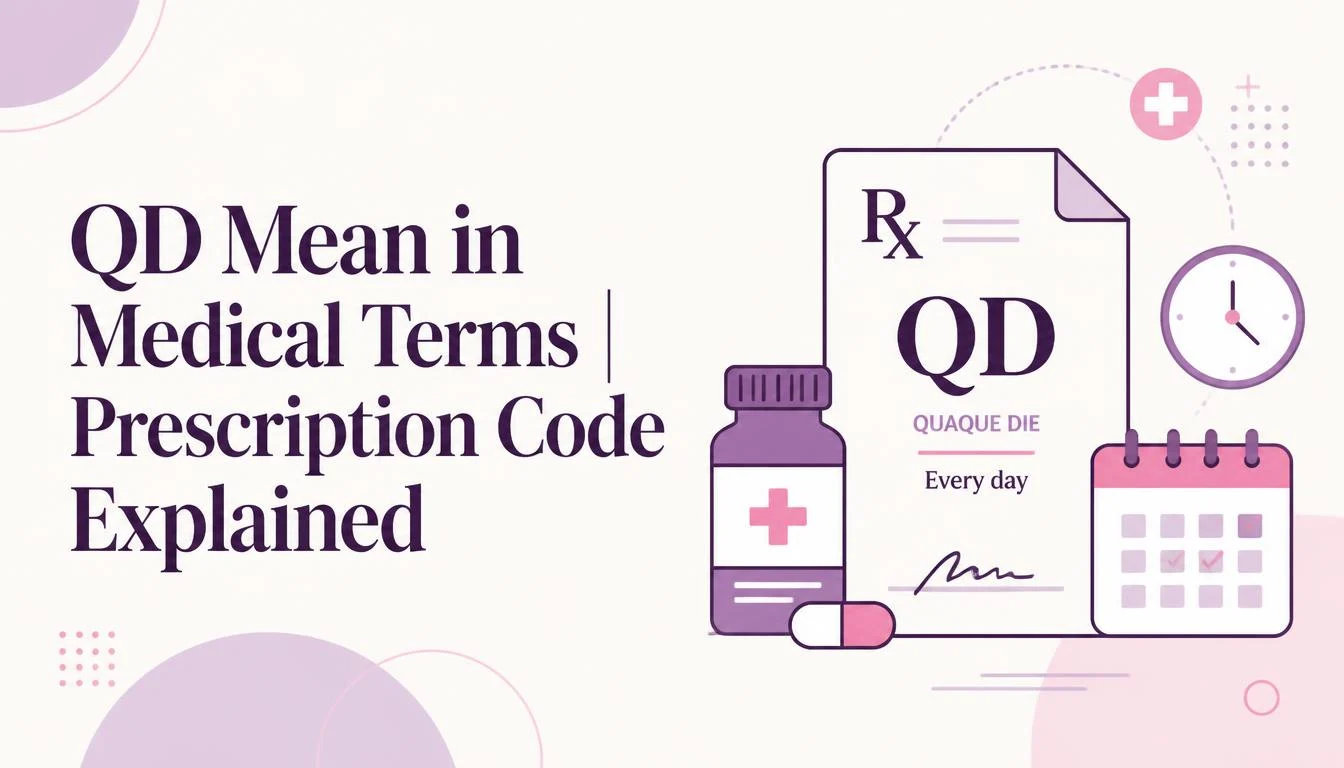
QD in medical terms means “once daily” or “every day.” It is a prescription abbreviation indicating that a medication should be taken one time per day.
If you’re wondering what QD Mean in Medical Terms, it generally means “once daily” and is commonly seen on medication instructions and prescriptions. Understanding this abbreviation can help you follow your dosage schedule correctly.
Although QD is widely recognized, medical abbreviations can sometimes be confusing. This guide explains QD Mean in Medical Terms, where you may see it, and how it differs from similar dosage abbreviations.
QD Meaning:
QD is a medical abbreviation that stands for “quaque die,” a Latin phrase meaning “every day” or “once daily.” It tells you (or a pharmacist, nurse, or caregiver) that a medication should be taken one time every 24 hours, typically at the same time each day.
So if your prescription says “Take 1 tablet QD,” it simply means: take one tablet, once a day, every day.
That’s the short answer. Now let’s dig into where this term came from, how it’s actually used today, and why it sometimes causes more confusion than it solves.
Where Does QD Come From? The Origin Story
Like a huge chunk of medical vocabulary, QD traces back to Latin the language that dominated medicine, law, and academia for centuries in Europe. Doctors and apothecaries needed a fast, universal shorthand to write prescriptions, and Latin abbreviations became the industry standard long before English became the dominant medical language.
Here’s a quick breakdown of the Latin roots:
- Quaque = “each” or “every”
- Die = “day”
Put together, quaque die translates to “every day,” which pharmacists shortened to the two-letter abbreviation QD.
This tradition isn’t unique to QD. Tons of prescription shorthand still comes from Latin, including:
- BID (bis in die) twice a day
- TID (ter in die) three times a day
- QID (quater in die) four times a day
- PRN (pro re nata) as needed
- HS (hora somni) at bedtime
QD has been used in medical charting for well over a century, passed down through generations of physicians, nursing schools, and pharmacy textbooks. It became second nature in clinical documentation until patient safety experts started raising red flags.
Why QD Is Becoming Less Common Even Though It’s Still Used
Here’s the twist: QD is technically still valid and you’ll still see it on some prescriptions, hospital charts, and older medical records. But many healthcare organizations including The Joint Commission and the Institute for Safe Medication Practices (ISMP) have flagged QD as a “do not use” abbreviation in official documentation.
Why? Because handwriting mistakes happen, and QD can easily be misread as:
- QID (four times a day) if the “D” is written sloppily and looks like it has an extra loop
- OD (a dangerous mix-up, since OD can also mean “right eye” in ophthalmology, or accidentally suggest “overdose” in casual shorthand)
Because a misread abbreviation can lead to a patient taking a medication far more often than intended, many hospitals now require staff to write out “daily” instead of QD. It’s a small change, but it’s a big deal for patient safety.
So while QD is still recognized and understood almost everywhere, spelling it out as “once daily” or “daily” is now considered the safer, more professional standard especially in written or electronic prescriptions.
Real-World Usage: How QD Shows Up in Everyday Medical Life
QD isn’t just a textbook term it shows up constantly in real medical situations. Here’s where you’re most likely to encounter it:
- Prescription labels: “Metformin 500mg QD” means take one dose of Metformin once daily.
- Hospital charts and nursing notes: Nurses may see QD listed in a patient’s medication administration record (MAR), though many hospitals now use “daily” instead.
- Medical school and textbooks: QD is taught early on as part of standard pharmacology shorthand, alongside BID, TID, and QID.
- Veterinary prescriptions: Yes, even your vet might write QD on your dog’s heartworm medication label.
- Older paper records: If you’re looking at a decades-old medical file, QD is far more likely to appear than in a modern electronic health record (EHR).
Examples of QD in a Sentence With Tone and Context
To really nail down how QD is used, here are some examples across different tones and situations:
😊 Friendly/Everyday Tone
“Your new blood pressure pill is QD, so just take it once every morning with breakfastnice and simple!”
🏥 Clinical/Professional Tone
“Patient prescribed Lisinopril 10mg QD for hypertension management, to be reassessed at the four-week follow-up.”
📋 Documentation/Chart Tone
“Medication administered QD per physician’s order; no adverse reactions reported.”
⚠️ Cautionary/Safety Tone
“Please double-check is this QD or QID? A misread abbreviation here could mean the difference between one dose and four doses a day.
🐾 Veterinary Tone
“Give one chewable tablet QD with food to prevent flea and tick recurrence.”
Notice how the meaning never changes “once daily” but the surrounding tone shifts depending on who’s speaking and why.
QD vs. Similar Medical Abbreviations: A Quick Comparison
One of the biggest reasons people search for “QD mean in medical terms” is because it’s easy to confuse with other dosage abbreviations that look or sound similar. Here’s a side-by-side breakdown to keep things straight:
| Abbreviation | Latin Origin | Meaning | Frequency |
|---|---|---|---|
| QD | Quaque die | Once daily | 1x per day |
| BID | Bis in die | Twice daily | 2x per day |
| TID | Ter in die | Three times daily | 3x per day |
| QID | Quater in die | Four times daily | 4x per day |
| QOD | Quaque altera die | Every other day | Every 2 days |
| PRN | Pro re nata | As needed | Varies |
| HS | Hora somni | At bedtime | 1x per night |
| AC | Ante cibum | Before meals | Timed around food |
| PC | Post cibum | After meals | Timed around food |
As you can see, QD sits at the “simplest” end of the spectrum one dose, one day, done. The confusion mostly comes from QID (four times daily), which is why so many hospitals have banned QD from written orders altogether.
Alternate Meanings of QD (Outside of Medicine)
While this article focuses on the medical definition, it’s worth noting that QD pops up in a few other contexts too, so context always matters:
- Quality Department used in manufacturing and corporate settings
- Quick Draw sometimes used in gaming, sports, or firearms terminology
- Query Definition occasionally used in database or programming shorthand
- Quarter Deck a naval term referring to a raised deck at the stern of a ship
None of these carry over into clinical use, but if you’ve seen “QD” somewhere outside a prescription label, it’s worth checking the context before assuming it’s medical shorthand.
Polite and Professional Alternatives to “QD”
If you’re a healthcare worker, student, or someone drafting medical documentation, it’s smart to know the safer alternatives that patient safety organizations now recommend:
- ✅ “Daily” the most common and widely accepted replacement
- ✅ “Once daily” slightly more explicit, often used in patient-facing materials
- ✅ “Once a day” the plain-English version, great for patient instructions
- ✅ “Every 24 hours” useful when precise timing matters (e.g., for antibiotics)
If you’re a patient trying to clarify instructions with your pharmacist or doctor, it’s always fine to simply ask:
Just to confirm, this means I take it once a day, right?
There’s nothing unprofessional about double-checking. In fact, pharmacists strongly encourage it misunderstood dosage instructions are one of the most common (and preventable) medication errors.
Quick Reference Table: QD at a Glance
| Category | Details |
|---|---|
| Full Latin Term | Quaque die |
| Literal Translation | “Every day” |
| Clinical Meaning | Once daily dosing |
| Common Field | Pharmacology, nursing, prescriptions |
| Status Today | Still recognized, but discouraged in favor of “daily” |
| Risk Factor | Can be misread as QID (four times daily) |
| Safer Alternative | “Daily” or “Once daily” |
| Where You’ll Still See It | Older records, some prescription labels, textbooks |
FAQs
1. What does QD mean on a prescription?
QD means “once daily.” It indicates that a medication should be taken one time each day, generally at a consistent time as directed by the prescriber.
2. Is QD the same as once a day?
Yes. QD is a Latin-derived medical abbreviation used to mean “once daily” or “every day.”
3. Why do some hospitals not use QD anymore?
Some healthcare organizations avoid QD because it can be mistaken for QID, which means four times daily. This type of misreading can result in serious medication errors, so writing “daily” in full is often preferred.
4. What’s the difference between QD and QOD?
QD means once every day, while QOD means once every other day. Because these schedules are significantly different, confusing the two can result in incorrect medication use.
5. Does QD mean the same thing in veterinary medicine?
Yes. QD can also mean “once daily” in veterinary medicine. However, pet owners should always follow the specific instructions provided by their veterinarian or the medication label.
6. Is QD still considered acceptable to use today?
QD is still widely recognized, but many medication-safety organizations recommend avoiding it because of the potential for confusion. Writing “daily” instead is generally considered clearer and safer.
7. What should I do if I’m not sure whether my prescription says QD or QID?
Do not guess. Ask your pharmacist or healthcare provider to clarify the instructions before taking the medication. Confirming the dosing schedule can help prevent a potentially serious medication error.
8. Are there other Latin abbreviations I should know as a patient?
Yes. Common prescription abbreviations include BID for twice daily, TID for three times daily, PRN for as needed, and HS for bedtime. If you are unsure about any abbreviation, ask your pharmacist or prescriber for clarification.
Conclusion
At the end of the day, QD is simply medical shorthand for “once daily” a straightforward, single-dose-per-day instruction rooted in centuries-old Latin. It’s still floating around in prescriptions, textbooks, and older medical records, but the healthcare industry has largely moved toward writing “daily” instead, purely for safety reasons.
Here’s your quick takeaway checklist:
- QD = “quaque die” = once daily ✅
- It’s easily confused with QID (four times daily) ⚠️
- Many hospitals now avoid QD in favor of spelling out “daily” 📝
- If you’re ever unsure, always ask your pharmacist or doctor to confirm 💬
- Knowing related abbreviations (BID, TID, PRN) helps you read prescriptions with confidence 📖
Medical abbreviations exist to save time, but when it comes to your health, clarity always wins over shorthand. So the next time you see QD on a label, you’ll know exactly what it means and why double-checking never hurts.
Read More Related Articles:
- JSP Meaning | Internet Acronym Everyone Gets Wrong In 2026
- What Does WTM Mean in Text | Common Uses You Should Know In 2026
- What Does ACC Mean | Every Meaning Made Simple In 2026










3 thoughts on “QD Mean in Medical Terms | Prescription Code Explained In 2026”