Quick Answer
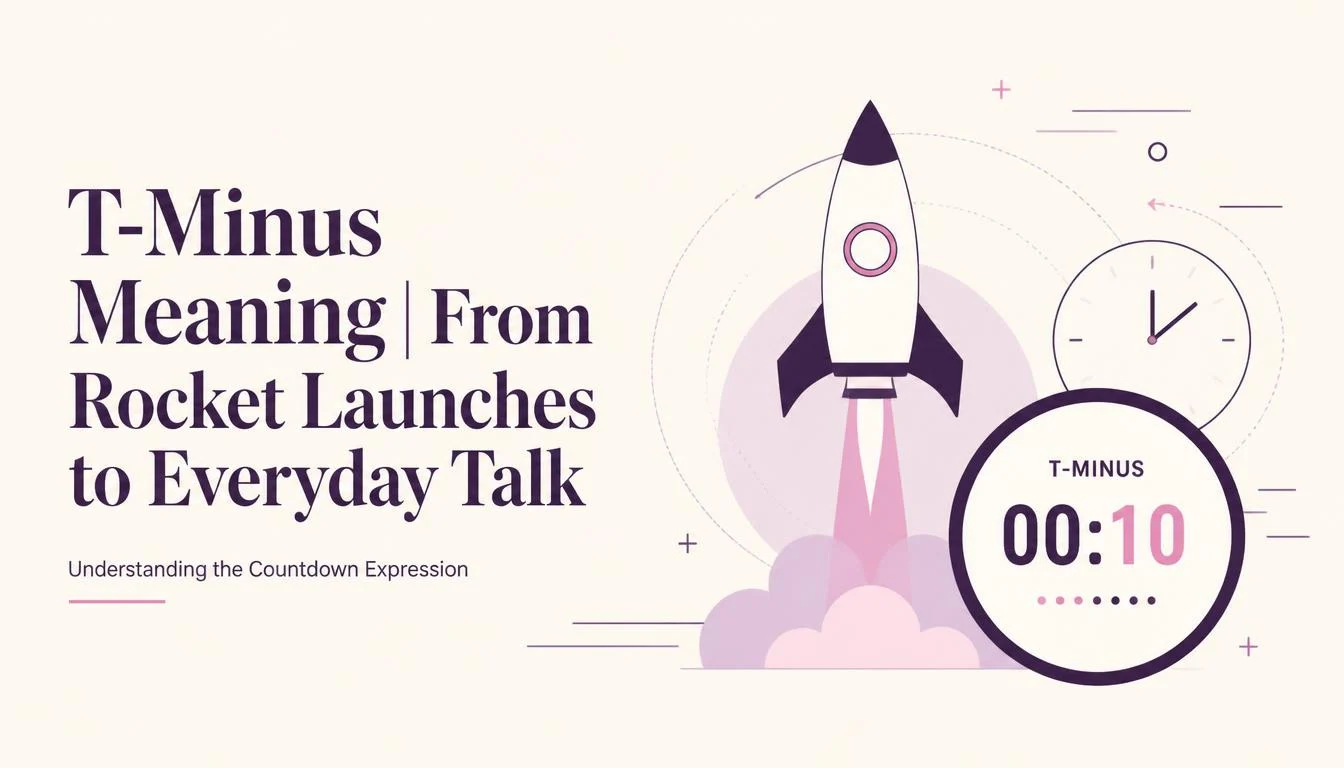
T-Minus Meaning refers to the amount of time remaining before a specific event happens, especially a launch or countdown. For example, “T-minus 10 minutes” means 10 minutes remain until the event begins.
Understanding T-Minus Meaning is easy once you recognize it as a countdown expression. It is commonly used before rocket launches, major events, deadlines, and exciting moments to show how much time is left.
You may also see T-minus used casually in everyday conversations or online posts. In this guide, we’ll explain what it means, where it comes from, and how to use it naturally with simple examples.
T-Minus: Definition
“T-minus” means the amount of time remaining before a scheduled event, where “T” stands for “Time” (specifically, the target time of the event) and “minus” indicates the countdown moving backward toward that moment. For example, “T-minus 30 minutes” means the event is scheduled to happen 30 minutes from now. It’s used to track and announce a countdown to a fixed, predetermined moment a launch, a deadline, a release, or any big reveal.
In short: T = the event time, and minus = how far away we are from it.
Where Does “T-Minus” Come From? Origin & History
The phrase has deep roots in aerospace and military engineering, and understanding its origin actually makes the meaning click instantly.
The Rocket Science Roots
“T-minus” was popularized by NASA and earlier rocket-testing programs in the mid-20th century, largely inherited from German rocket engineering terminology used during V-2 rocket testing in the 1940s. Engineers needed a standardized way to talk about time relative to a launch, because launch schedules often shifted a hold could be called, weather could delay things, or a technical check could push the clock back.
Instead of using clock times (which would need to be recalculated every time a delay happened), engineers used a relative countdown:
- T = the fixed moment of liftoff (Time Zero)
- T-minus = time before liftoff
- T-plus = time after liftoff
So “T-minus 15 minutes” simply means 15 minutes before launch, no matter what the actual clock says. This system made it easy to pause, hold, and resume a countdown without confusing everyone involved.
From NASA to Pop Culture
Once televised space launches became a national event in the 1960s (especially during the Apollo program), phrases like “T-minus 10 seconds and counting” became etched into public memory. From there, the phrase slowly bled into:
- Movies and TV shows (usually during dramatic countdown scenes)
- Military and aviation operations
- Corporate and startup culture (“T-minus 2 days to launch!”)
- Everyday casual speech (“T-minus one hour till the party”)
Today, it’s a widely recognized idiom, even among people who’ve never watched a real rocket launch.
How Popular Is “T-Minus” Today?
“T-minus” has moved well beyond its scientific origins. It shows up in:
- 📦 Product launches tech companies love saying “T-minus 3 days” before unveiling something
- 🎉 Event countdowns weddings, conferences, product drops, and livestreams
- 💼 Workplace deadlines project managers use it to build urgency
- 🎮 Gaming and esports countdown timers before matches or server resets
- 📱 Social media captions Instagram and TikTok captions before a big reveal
It has essentially become shorthand for “we’re getting close, and it’s exciting (or urgent).”
Examples of “T-Minus” in Real Sentences
Context changes everything with this phrase. Here’s how tone shifts depending on the situation.
Friendly / Excited Tone
- “T-minus 3 days until vacation! 🏖️ I can’t sit still.”
- “T-minus one hour to game night bring snacks!”
- “T-minus 10 minutes and the doors open, let’s gooo 🎊”
Neutral / Professional Tone
- “T-minus 24 hours to the product launch. Final checks are underway.”
- “T-minus 2 weeks until the fiscal quarter closes.”
- “The mission is currently at T-minus 45 minutes and holding.”
Negative / Dismissive or Sarcastic Tone
- “T-minus 5 minutes until my patience runs out. 🙄”
- “T-minus zero and the meeting still hasn’t started. Typical.”
- “T-minus one more excuse before I stop believing you.”
Notice how the phrase itself stays neutral it’s the surrounding words and punctuation (like emojis, exclamation points, or eye-roll energy) that shift the tone from cheerful to sarcastic.
“T-Minus” vs. Similar Terms
People often confuse “T-minus” with other countdown or deadline-related terms. Here’s a side-by-side breakdown.
| Term | Meaning | Common Use Case |
|---|---|---|
| T-minus | Time remaining before a scheduled event | Launches, countdowns, deadlines |
| T-plus | Time elapsed after the event has started | Tracking progress after liftoff or start |
| ETA | Estimated Time of Arrival | Travel, deliveries, logistics |
| Deadline | The final cutoff time for something | Work tasks, submissions |
| Zero hour | The exact moment an event begins | Military operations, dramatic emphasis |
| D-Day | A specific, decisive day an operation begins | Military history, big “launch day” events |
| Countdown | The general act of counting down to zero | Any timed event |
Key difference: “T-minus” is specifically a relative time marker tied to a fixed target moment, while terms like “ETA” or “deadline” are broader and don’t require the same military-style precision or built-in reversibility (holds, delays, resumes).
Alternate Meanings of “T-Minus”
While the countdown meaning dominates, “T-minus” occasionally shows up in a couple of other contexts:
- T-Minus (podcast/media title): Several podcasts and YouTube channels have used “T-Minus” as a branded name, especially ones covering space news and rocket launches.
- Gaming terminology: In some strategy or tactical games, “T-minus” timers are used for round starts, similar to its real-world meaning but stylized for gameplay tension.
- Casual slang drift: Occasionally used loosely to just mean “almost” or “very soon,” detached from any strict countdown structure (e.g., “T-minus done with this workday”).
These are minor compared to the primary, countdown-based definition, but worth knowing if you spot the phrase used a little differently online.
Polite & Professional Alternatives to “T-Minus”
If you’re writing something formal a business email, a report, or client communication “T-minus” might feel too casual or too “startup culture.” Here are some smoother alternatives:
- “We are approaching the deadline in [X time].”
- “The launch is scheduled in [X hours/days].”
- “Time remaining until go-live: [X].”
- “We have [X] left before the scheduled event.”
- “Countdown status: [X] remaining.”
These options keep the same urgency and clarity without leaning on aerospace slang, which is useful in client-facing or executive communication where tone matters.
Quick Reference Table: T-Minus Usage at a Glance
| Situation | Example Phrase | Tone |
|---|---|---|
| Rocket/space launch | “T-minus 60 seconds and counting” | Technical, dramatic |
| Office deadline | “T-minus 1 hour to submit the report” | Professional, urgent |
| Casual event hype | “T-minus 2 days till the concert! 🎶” | Friendly, excited |
| Sarcastic complaint | “T-minus 5 minutes till I lose it 😤” | Negative, dismissive |
| Marketing/product drop | “T-minus 24 hrs. Stay tuned.” | Neutral, buzz-building |
Tips for Using “T-Minus” the Right Way
- Pair it with a clear time unit. “T-minus 3” is vague say “T-minus 3 hours” or “T-minus 3 days” so people know the scale.
- Use it for anticipation, not confusion. It works best for events people are already looking forward to (or dreading).
- Match your audience. It’s great for casual chats, marketing captions, and internal team updates but consider a more formal phrase for client-facing documents.
- Don’t overuse it. Like any trendy phrase, repeating it constantly can water down its impact. Save it for moments that actually deserve the buildup.
- Emojis can help set tone. A rocket 🚀, clock ⏰, or party emoji 🎉 next to “T-minus” instantly signals whether you’re excited, urgent, or just having fun with it.
FAQs
1. What Does “T-Minus” Mean?
“T-minus” refers to the amount of time remaining before a scheduled event. The “T” represents the designated event time, or Time Zero, while “minus” indicates the time left before it occurs.
2. Is “T-Minus” Only Used for Rocket Launches?
Not at all. Although the term originated in aerospace and rocket testing, it is now commonly used for deadlines, special events, product launches, trips, and everyday countdowns.
3. What Is the Opposite of “T-Minus”?
The opposite is “T-plus,” which refers to the amount of time that has passed after a scheduled event begins. For example, T-plus 10 minutes means 10 minutes have elapsed since Time Zero.
4. Can “T-Minus” Be Used Sarcastically?
Yes. The meaning can change depending on the situation and tone. In casual messages, “T-minus” may convey excitement, anticipation, urgency, or even mild sarcasm or frustration.
5. Should It Be Written “T-Minus” or “T Minus”?
Both forms appear in informal writing, but “T-minus” with a hyphen is the more widely recognized form. It is especially common in aerospace-related and formal contexts.
6. Where Did the “T-Minus” System Originate?
The countdown terminology developed through rocket testing and aerospace operations, with early connections to rocket programs in the 20th century. It was later widely popularized through NASA’s space missions and televised launches.
7. What Are Professional Alternatives to “T-Minus”?
In formal communication, you can use phrases such as “time remaining until launch,” “time until the deadline,” “countdown status,” or “the event begins in X minutes.” These alternatives sound clearer and more professional.
8. Why Say “T-Minus” Instead of “In X Minutes”?
“T-minus” adds a sense of anticipation and excitement that a simple time estimate may not convey. It also creates a familiar countdown feeling, making an upcoming event seem more significant or dramatic.
Conclusion
“T-minus” started as precise engineering language for rocket launches, but it’s become a fun, flexible, and widely understood way to build anticipation for pretty much anything a product drop, a deadline, a party, or a long-awaited vacation. The core meaning never changes: it’s the time left before something happens. What does change is the tone, which shifts based on context, punctuation, and the situation around it.
Quick recap:
- “T” = the scheduled event time (Time Zero)
- “Minus” = the time remaining before it
- Originated from rocket/military countdown systems
- Now used casually across marketing, work, and everyday conversation
- Tone can range from excited to sarcastic depending on context
- Formal settings may call for a more professional alternative
Next time someone says “T-minus 10 minutes,” you’ll know exactly what’s counting down and maybe you’ll use the phrase with a little more confidence yourself.
Read More Related Articles:
- Mercy Meaning | Powerful Lesson Behind Kindness and Forgiveness In 2026
- Mija Meaning In Spanish | Sweet Nickname You’ll Hear Everywhere In 2026
- Punta Meaning In Spanish | From Literal Meaning to Everyday Usage In 2026