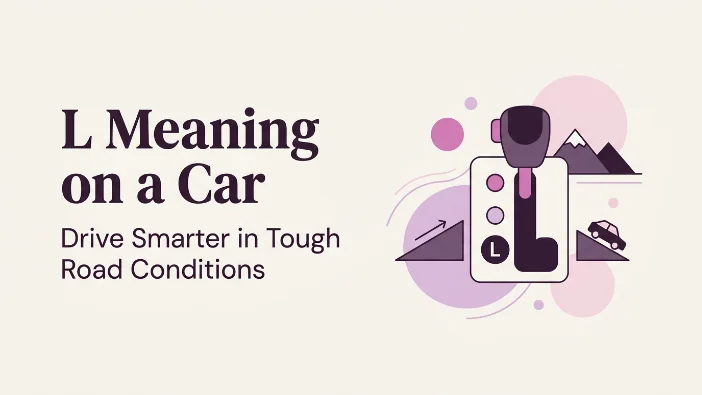
What Does L Mean on a Car Gear Shift?
In automatic transmissions, the “L” stands for “Low.” Engaging L mode locks the transmission into the lowest gears (typically 1st and 2nd), maximizing engine torque and control while limiting speed. This setting is ideal for towing, climbing or descending steep hills, and navigating slippery conditions like snow or mud.
Have you ever glanced at your car’s gear shift and noticed the mysterious “L” sitting there, quietly judging you? Maybe you’ve always wondered, “What on earth does L mean on a car?” or perhaps you’ve accidentally shifted into it and panicked as your engine suddenly roared like a lion. Don’t worry you are not alone! 😅
Most of us are familiar with the usual suspects: P for Park, R for Reverse, N for Neutral, and D for Drive. But when that “L” pops up, it can leave even experienced drivers scratching their heads. Some people think it stands for “Low,” others guess “Lift,” and a few might even joke it means “Let’s go fast!” (Spoiler alert: it’s definitely not that).
In this friendly, comprehensive guide, we are going to demystify the L gear once and for all. We’ll break down exactly what it does, when you should use it (and when to absolutely avoid it), and how it can actually save your brakes on a steep hill. By the time you finish reading, you’ll be the go-to car expert in your friend group, confidently explaining the magic of low gear. Let’s dive in! 🚗💨
What Does L Mean on a Car? The Definition
The “L” on a car’s gear shift stands for Low Gear. When you shift your automatic transmission into “L,” you are telling the vehicle to stay in the lowest gear ratio available (usually first or second gear) and to stop shifting up into higher gears automatically. This fundamental concept has been a staple of automatic transmissions for decades, yet many drivers remain unfamiliar with its purpose and potential.
How Does L Gear Work?
Think of it like riding a bicycle. When you are climbing a steep hill, you shift to a lower gear on the bike. Your legs spin faster (higher RPMs), but each pedal push gives you more power to conquer the climb. Conversely, on a flat road, you shift to a higher gear so you can pedal slower but travel faster.
The L gear in your car works exactly the same way. It prioritizes torque (the twisting force that moves your car from a standstill) over speed. By holding the car in a low gear, the engine produces more power at lower speeds, which is perfect for specific situations that we will discuss shortly. This mechanical advantage is why heavy trucks and off-road vehicles rely heavily on low-gear functionality for their demanding tasks.
The Origin and Evolution of the L Gear
Understanding the history of the L gear helps us appreciate its role in modern vehicles. The concept of low gear predates automatic transmissions entirely. Early manual transmissions always featured a low gear (first gear) for starting from a stop and climbing hills. When automatic transmissions became mainstream in the 1940s and 1950s, engineers realized that drivers still needed a way to manually override the automatic shifting system for specific situations.
The Early Days of Automatic Transmissions
General Motors introduced the first mass-produced automatic transmission, the Hydra-Matic, in 1940. These early automatics were relatively simple and didn’t always offer a dedicated low gear selector. As transmissions evolved and became more sophisticated, manufacturers began adding gear selection options beyond just “Drive” and “Reverse.”
By the 1960s and 1970s, most automatic transmissions featured some variation of a low gear selector, often labeled as “L” or “1” or “2.” This allowed drivers to manually control the transmission in challenging driving conditions, a feature that was particularly appreciated by those who lived in mountainous regions or frequently towed trailers.
Why Some Cars Have “L” and Others Don’t
You might notice that not every automatic car has an “L” on its gear selector. Here’s why:
- Older Vehicles: Most cars manufactured before 2010 typically featured an “L” or numbered gears (1, 2, 3) on their shifters.
- Modern Vehicles: Many newer cars have replaced the traditional “L” with more advanced transmission controls.
- Luxury and Sports Cars: These often feature paddle shifters or manual shift gates instead of a simple “L” designation.
- Hybrid Vehicles: Some hybrids, like the Toyota Prius, use a “B” (Brake) mode instead of “L” to maximize regenerative braking and engine braking.
The Decline of the Traditional “L”
As automotive technology has advanced, the traditional “L” gear has become less common. Modern transmissions with 8, 9, or even 10 speeds offer such sophisticated computer control that they can often handle hill descents and towing situations better than a human manually selecting “L.” Additionally, features like hill descent control, adaptive cruise control, and terrain management systems have made the manual selection of low gear less necessary for the average driver.
However, understanding what the L gear does remains valuable knowledge, especially if you drive an older vehicle, rent cars frequently, or find yourself in challenging driving conditions where you need maximum control over your vehicle.
When to Use the L Gear: Practical Applications
So, you know what it means, but when should you use L on a car? While most daily driving doesn’t require it, there are several critical scenarios where using Low gear is not just beneficial it’s safer for you and your vehicle. Understanding these situations can literally save your life in certain driving conditions.
1. Towing a Trailer or Heavy Load
If you are hauling a trailer, a boat, or any heavy load, your engine needs all the power it can get. In “D” (Drive), the transmission constantly shifts gears to find the most fuel-efficient option. However, this constant shifting can put tremendous strain on the transmission when you are pulling extra weight.
By shifting to “L,” you limit the transmission to the lower gears, which generates the massive torque needed to pull heavy loads without hunting for a higher gear. This prevents the transmission from “gear hunting” constantly shifting up and down as you encounter slight changes in terrain. It also reduces wear on your transmission by preventing unnecessary upshifts and downshifts.
Pro Tip: If you’re towing a trailer through hilly terrain, alternating between “L” and “D” as needed can help you maintain optimal performance while protecting your transmission.
2. Descending Steep Hills (Engine Braking)
Imagine you’re driving down a steep mountain pass. If you ride the brakes the entire way down, they can overheat, warp, or even fail a condition known as brake fade. This is one of the best uses for the L gear. By shifting into Low, your engine does the “braking” for you.
The resistance created by the engine spinning in a low gear slows the car down naturally (this is called engine braking). This not only saves your brake pads but also ensures you maintain better control of the vehicle on steep declines. Engine braking is particularly important when you’re descending a mountain pass that’s several miles long, as continuous brake use could lead to catastrophic brake failure.
How Engine Braking Works:
- The engine’s compression strokes create resistance
- This resistance is transferred through the drivetrain to the wheels
- The vehicle slows down without using the brake pads
- This method is much gentler on your braking system
3. Climbing Steep Inclines
Just as low gear helps you go down a hill safely, it also helps you go up one! When faced with a long, steep uphill climb, your car might struggle to find the right gear. It might downshift late or upshift too early, causing a loss of power.
Putting the car in “L” keeps it in the power band (higher torque) so you can climb the hill steadily without the transmission “gear hunting” or your engine lugging. This is particularly important when you’re climbing a long mountain pass with a fully loaded vehicle.
Signs You Need to Shift to “L” on an Uphill:
- Your car repeatedly downshifts and upshifts
- The engine feels like it’s struggling or “lugging”
- You feel a loss of acceleration despite pressing the gas pedal
- The transmission seems confused about which gear to select
4. Driving in Bad Weather Conditions
Slippery roads whether due to rain, snow, ice, or mud require maximum traction. In a higher gear, your wheels can spin too fast, leading to a loss of grip. In “L” mode, the wheels turn more slowly but with more force. This prevents wheel spin and provides better traction and control on treacherous surfaces.
Weather Conditions Where “L” Gear Helps:
- Heavy rain with standing water
- Snow-covered roads
- Icy patches
- Mud or gravel roads
- Off-road conditions
When you’re in “L” gear, the slower wheel rotation gives your tires more opportunity to find grip on slippery surfaces. This can be the difference between safely navigating a snowy road and sliding into a ditch.
5. Low-Speed Maneuvering
Navigating tight parking lots, off-road trails, or bumper-to-bumper traffic can be smoother in Low gear. It provides you with more precise control at low speeds without constantly tapping the brakes, making it easier to inch forward without the jerky feel of the transmission shifting.
Benefits of Using “L” for Low-Speed Maneuvering:
- Smoother acceleration from a stop
- Less need for constant brake application
- Better control in tight spaces
- Reduced transmission wear from frequent shifting
6. Off-Road Driving
If you enjoy off-roading, “L” gear is essential for navigating challenging terrain. Whether you’re traversing rocky trails, climbing sand dunes, or fording shallow streams, low gear gives you the torque and control needed to handle unpredictable surfaces.
Off-Road Situations Where “L” Gear Shines:
- Rock crawling at very low speeds
- Descending steep off-road inclines
- Navigating deep sand or mud
- Crossing streams or shallow water
When NOT to Use L Gear
It is equally important to know when not to use the L gear. Many drivers make the mistake of leaving it on, and it can be costly! 🚫
| Situation | Why You Should Avoid L | Potential Consequences |
|---|---|---|
| Highway Speeds | The engine will scream at high RPMs (Revolutions Per Minute). This causes excessive noise and dramatically reduces fuel economy. | Engine damage, wasted fuel, uncomfortable driving experience |
| Normal Daily Commuting | The transmission is designed to shift smoothly through all gears for the best balance of power and efficiency. L gear is for specific scenarios, not general driving. | Poor fuel economy, unnecessary engine wear, loud engine noise |
| Extended Driving Distances | Forcing the engine to work harder than necessary for long periods can increase wear on the engine and transmission components and burn more fuel. | Premature transmission wear, overheating, expensive repairs |
| High-Speed Passing Maneuvers | “L” gear limits your top speed, making it dangerous for passing or merging onto highways. | Risk of collision, inability to accelerate quickly |
Can you shift from L to D while driving? Yes! You don’t need to stop. However, you should ease off the gas pedal a bit, let the RPMs settle down, and then gently move the shifter from L to D to ensure a smooth transition. Many newer vehicles actually prevent you from shifting into “L” at speeds that could damage the engine, but it’s always better to be safe and reduce your speed first.
How L Gear Works: The Technical Details
To truly understand what the L gear does, it helps to know a bit about how automatic transmissions work. While you don’t need to be a mechanic to use “L” effectively, understanding the basics can help you make better decisions about when to use it.
Gear Ratios Explained
Your car’s transmission has several gear ratios, each designed for different driving conditions:
- First Gear: The lowest gear ratio, providing maximum torque for starting from a stop and climbing steep hills.
- Higher Gears: These provide less torque but allow the wheels to spin faster, making them ideal for highway driving.
When you shift to “L,” you’re essentially telling the transmission to stay in the first gear (and sometimes second gear) regardless of how fast you’re going. This gives you maximum torque at the expense of speed and fuel efficiency.
What Happens Inside the Transmission
When you select “L,” the transmission’s hydraulic system responds by:
- Disabling the shift solenoids that would normally move the transmission to higher gears
- Engaging specific clutch packs to keep the planetary gear set in a low ratio
- Allowing the torque converter to multiply torque even more effectively
The result is more power to the wheels at lower speeds, perfect for the challenging driving conditions we discussed earlier.
RPM and Engine Speed
One of the most noticeable effects of using “L” gear is the increase in engine RPM. When you’re in “L” at highway speeds, the engine might rev to 5,000 or even 6,000 RPM much higher than the 2,000-3,000 RPM you’d see in “D.” This is what creates that loud, aggressive engine sound many drivers notice when they accidentally shift into “L.”
While modern engines can handle high RPMs, keeping them there for extended periods is not recommended. Excessive heat builds up in the engine, increasing wear on internal components. Think of it like running a marathon: you can do it, but you shouldn’t do it every day.
Origin and Variations: Why Do Some Cars Not Have “L”?
The “L” designation has been around for decades, but its prevalence is changing. In older cars with 4-speed automatic transmissions, “L” strictly locked the transmission into first gear only. However, in more modern vehicles with 8, 9, or even 10-speed transmissions, selecting “L” might restrict the car to the first three gears to prevent engine damage from over-revving.
The “L” Gear in Different Types of Vehicles
Different manufacturers implement low gear functionality in various ways:
| Vehicle Type | How Low Gear is Implemented | Notes |
|---|---|---|
| Traditional Automatics | “L” on the gear shifter | Most common in older vehicles and some current trucks |
| Modern Automatics | “1,” “2,” “3” on the shifter | Common in many sedans and SUVs |
| Sports Cars | Paddle shifters or “S” mode | Allows manual selection of any gear |
| Hybrid Vehicles | “B” (Brake) mode | Maximizes regenerative braking and engine braking |
| Trucks/SUVs | Tow/Haul mode plus manual selection | Designed specifically for towing applications |
The Rise of “S” (Sport) Mode
Many modern cars feature an “S” mode that stands for “Sport.” This is often confused with “L,” but they serve different purposes:
- Sport Mode (S): Adjusts shift points for more aggressive acceleration. The car will hold gears longer and downshift more aggressively for sporty driving.
- Low Gear (L): Specifically locks the transmission in the lowest gears for maximum torque and engine braking.
Some vehicles combine these features, offering a “Sport” mode that includes manual gear selection, effectively replacing the need for a separate “L” gear.
The Introduction of “B” Mode in Hybrids
Hybrids like the Toyota Prius have a “B” mode instead of “L.” This stands for “Brake” or “Engine Braking.” When you shift into “B” mode, the car:
- Increases regenerative braking to recharge the battery
- Applies engine braking to slow the vehicle
- Reduces wear on the traditional brake system
While the effect is similar to “L,” the implementation is different because hybrids have different drivetrain configurations.
Comparison: L vs. 1, 2, and 3 on Gear Shifters
Sometimes you’ll see numbers like 1, 2, 3 on a gear shift instead of an “L.” What’s the difference? Understanding these variations can help you use your car’s transmission more effectively.
| Setting | Function | Compared to “L” | Best Used For |
|---|---|---|---|
| 1 | Locks the transmission into first gear only. | Old-school version of “L.” | Extreme torque, steepest hills |
| 2 | Limits the transmission to first and second gears. | Provides more speed than “1” but still strong engine braking. | Moderate hills, snow driving |
| 3 | Limits the transmission to first through third gears. | More versatile than “L” but still provides engine braking. | City driving, light towing |
| L (Low) | Typically locks in first gear (or first and second in modern cars). | Essentially functions as the “1” or “2” gear setting depending on the vehicle. | All low-gear applications |
When to Choose “2” or “3” Instead of “L”
If your car has numbered gears instead of “L,” here’s how to choose:
- Use “1” when: You need maximum torque for the steepest hills or off-road situations.
- Use “2” when: You need good torque but want to go slightly faster than first gear allows. Good for moderate hills and snow.
- Use “3” when: You want some engine braking but need to maintain moderate speeds. Good for long descents on mountain roads.
The Manual Shift Gate
Some vehicles feature a “manual shift gate” next to the “D” position. This typically allows you to move the shifter to the left or right and then up or down to select gears manually. This effectively replaces the “L” gear by giving you complete control over every gear.
Advantages of a Manual Shift Gate:
- Complete control over all gears
- Can choose any gear for any situation
- More engaging driving experience
- No need for a separate “L” gear
Common Misconceptions About the L Gear
Many drivers have incorrect assumptions about what the L gear does. Let’s clear up some of the most common misconceptions:
Misconception 1: “L” Stands for “Low Speed”
Reality: While “L” does limit your speed by keeping you in low gears, it’s actually about torque and control, not just speed. The primary purpose is to provide maximum power for challenging situations.
Misconception 2: Using “L” Will Damage Your Engine
Reality: Using “L” appropriately will not damage your engine. Modern engines are designed to handle high RPMs. The damage occurs when you use “L” for extended periods or at inappropriate speeds. Think of “L” as a tool use it correctly, and it works fine.
Misconception 3: “L” is Only for Old Cars
Reality: While many new cars have replaced “L” with other features, many modern vehicles especially trucks, SUVs, and off-road vehicles still feature “L” or its equivalent. It remains a useful feature for drivers who need maximum torque and engine braking.
Misconception 4: You Should Use “L” in Heavy Traffic
Reality: While “L” can help with low-speed maneuvering, using it in heavy traffic is usually unnecessary. Your car’s “D” gear is designed for stop-and-go traffic. Save “L” for situations where you need maximum torque or engine braking.
The Future of Low Gear: Is “L” Becoming Obsolete?
As automotive technology continues to advance, the traditional “L” gear is slowly being phased out. Here’s what the future looks like:
Advanced Transmission Technology
Modern automatic transmissions with 8, 9, or 10 speeds are incredibly sophisticated. They can:
- Analyze driving conditions in real-time
- Anticipate hills and adjust accordingly
- Provide engine braking automatically
- Adapt to your driving style
These advances mean that for many drivers, manual intervention is no longer necessary. The transmission can handle hills, towing, and even some off-road situations better than a human could.
The Rise of Terrain Management Systems
Many modern SUVs and trucks feature terrain management systems that automatically adjust transmission settings based on conditions. These systems offer modes like:
- Snow/Sand: Adjusts traction and shift points for slippery conditions
- Mud/Ruts: Changes shift strategy for deep mud
- Rock: Provides maximum torque and control
- Hill Descent Control: Automatically maintains a safe speed on descents
These systems effectively replace the “L” gear by offering more targeted control for specific conditions.
Hybrid and Electric Vehicles
Hybrids and electric vehicles (EVs) don’t need traditional transmissions in the same way that gasoline cars do. EVs typically have a single-speed transmission, making the “L” gear irrelevant. The “B” mode in hybrids serves a similar function but is specifically designed for regenerative braking.
Will “L” Disappear Completely?
While “L” is becoming less common, it’s unlikely to disappear entirely in the near future. Trucks, off-road vehicles, and cars with traditional automatic transmissions will likely retain some form of low gear selection for years to come. Additionally, many drivers appreciate the ability to manually control their transmission in challenging conditions.
Professional and Polite Alternatives
If you are discussing a car’s features and want to sound more technical or professional, here are some alternatives to the simple “L” gear terminology:
- “Low Gear Mode” – The most direct alternative
- “Torque Multiplication Setting” – Emphasizes the mechanical advantage
- “Engine Braking Mode” – Highlights the braking function
- “Low Speed Control Mechanism” – Emphasizes control aspect
- “Grade Select” – Some manufacturers use this term
- “Tow/Haul Mode” – In trucks and SUVs
When to Use These Alternatives:
- In professional automotive discussions
- When explaining to someone who is unfamiliar with cars
- In technical writing or documentation
- When discussing vehicle features in a formal setting
FAQs
What Does L Mean on a Car’s Automatic Transmission?
The “L” stands for Low Gear. It keeps your vehicle in the lower gears (usually 1st or 2nd) to provide more torque and stronger engine braking. This gives you better control and power at low speeds, making it useful in demanding driving conditions.
When Should You Use L Gear?
Use L gear when towing heavy loads, driving up or down steep hills, traveling through snow, mud, or ice, or driving off-road. It provides extra traction, improved control, and additional engine braking when normal Drive (D) isn’t enough.
Is It Bad to Drive in L Gear All the Time?
Yes. Driving in L during normal conditions increases engine RPM, reduces fuel economy, creates more engine noise, and can lead to unnecessary wear on the engine and transmission. Switch back to Drive (D) once you no longer need the extra power or braking.
Can I Shift From D to L While Driving?
Yes, but it’s best to slow down first. Most manufacturers recommend shifting into L below 20–30 mph. If you’re traveling faster, ease off the accelerator, allow the engine speed to decrease, and then shift into L.
What Is the Difference Between L and S on a Car?
L (Low Gear) keeps the transmission in lower gears for maximum torque and engine braking. S (Sport Mode) changes the transmission’s shift points so the engine stays at higher RPMs for quicker acceleration and a more responsive driving experience.
Why Is My Car So Loud in L Gear?
Your engine sounds louder because it’s operating at higher RPMs to produce more torque. This is completely normal when using L gear, but if you’re driving on flat roads or at higher speeds, you should shift back to Drive (D).
Does L Gear Use More Gas?
Yes. Since the engine stays at higher RPMs, L gear consumes more fuel than normal driving in D. Fuel economy can decrease significantly, so it’s best used only when extra power or engine braking is needed.
Do All Automatic Cars Have an L Gear?
No. Many newer vehicles replace L with manual shift modes, paddle shifters, or numbered gears such as 1, 2, or 3. Some hybrids also use B (Brake) mode instead of L.
What Does L Mean on a Hybrid Gear Shift?
Many hybrid vehicles use B (Brake) mode instead of L. It increases regenerative braking while also providing engine braking, helping control speed on downhill roads and improving battery charging during deceleration.
Can I Use L Gear for Downhill Driving?
Yes. L gear is ideal for driving down steep hills because it provides engine braking, helping you maintain a safe speed while reducing strain on your brake pads and preventing brake overheating.
Should I Use L Gear in Snow?
Yes. L gear can improve traction in snowy or slippery conditions by keeping the vehicle in lower gears and reducing wheel spin. Accelerate gently to avoid losing traction.
What Happens If I Shift Into L at High Speed?
Many modern vehicles have built-in protection that prevents harmful downshifts. However, shifting into L at high speeds in older vehicles may cause the engine to over-rev and potentially lead to damage. Always reduce your speed before selecting L gear.
Real-World Examples and Scenarios
Let’s look at some real-world scenarios where the L gear can make a difference:
Scenario 1: Mountain Driving
You’re on vacation in the Rocky Mountains, descending a 10-mile pass. Your brakes are starting to smell hot. By shifting to “L” (or “2” or “3”), you engage engine braking, which slows your vehicle without overheating your brakes. You make it down the mountain safely with plenty of braking power left.
Scenario 2: Towing a Boat
You’re towing a 2,500-pound boat to the lake. The road to the lake has several steep hills. In “D,” your transmission keeps shifting up and down, struggling to find the right gear. Shifting to “L” keeps you in the optimal torque range, making the climb smooth and protecting your transmission from unnecessary wear.
Scenario 3: Snowy Commute
A winter storm has left the roads covered in snow. In “D,” your wheels spin when you try to accelerate from a stop. Shifting to “L” provides better traction, allowing you to pull away smoothly without wheel spin. The lower gear also helps you maintain control on slippery surfaces.
Scenario 4: Off-Road Adventure
You’re exploring a rocky off-road trail. The terrain requires precise control at very low speeds. In “L,” you can crawl over rocks and through mud holes with maximum torque and minimal wheel spin. This gives you the control needed to navigate challenging obstacles safely.
Safety Tips for Using the L Gear
Using the L gear correctly enhances safety, but incorrect use can create dangerous situations. Here are some important safety tips:
Do’s:
✅ Do use “L” when descending long, steep hills to protect your brakes.
✅ Do shift to “L” when towing heavy loads up or down hills.
✅ Do use “L” in snowy or icy conditions to improve traction.
✅ Do use “L” for off-road driving where you need maximum control.
✅ Do reduce your speed before shifting from “D” to “L.”
Don’ts:
❌ Don’t use “L” on highways or at high speeds.
❌ Don’t use “L” during normal city driving.
❌ Don’t forget to shift back to “D” when the situation changes.
❌ Don’t use “L” if your vehicle has advanced features like hill descent control that handle the situation automatically.
❌ Don’t use “L” to brake suddenly, as this can cause loss of control in slippery conditions.
Emergency Situations
If your brakes fail while descending a steep hill:
- Shift to “L” immediately to engage engine braking.
- Use the parking brake gently to help slow down.
- Look for escape ramps or other safe stopping options.
- Use the horn and lights to alert other drivers.
While brake failure is rare, knowing how to use “L” gear in an emergency can save your life.
Conclusion:
So, the next time you glance at that gear shifter and see the “L,” you’ll know exactly what it means! It isn’t an ancient relic or a secret booster; it is a practical, safety-oriented tool that every driver should understand.
To summarize:
- Definition: “L” stands for Low Gear – it locks your transmission into the lowest gears for maximum torque and engine braking.
- Function: It prioritizes torque over speed, keeping the transmission in first or second gear to give you maximum power at low speeds.
- Best Uses: Perfect for towing, navigating steep hills (up and down), and bad weather conditions where you need better traction and control.
- Avoid: Do not use it on highways or during regular commutes where it will waste fuel and put unnecessary wear on your engine.
- Alternative Names: Look for 1, 2, B, or manual modes if you don’t see an “L” on your shifter.
- Modern Alternatives: Many newer vehicles use paddle shifters, manual gates, or terrain management systems instead of “L.”
- Safety First: The L gear is primarily a safety feature that gives you better control in challenging conditions.
Remember: Use “L” for control and safety, and switch back to “D” for efficiency. Understanding this simple feature can make you a more confident and capable driver, whether you’re navigating mountain passes, towing a trailer, or just driving through a winter storm.
Now, go out there and drive with confidence! 🚗💨
Read More Related Articles:
- Clemency Meaning | Pronunciation, Definition & Examples In 2026
- Mercy Meaning | Powerful Lesson Behind Kindness and Forgiveness In 2026
- Stubborn Mean | Why It’s Not Always a Bad Thing In 2026

Michael Turner is a U.S.-based content writer and blogger who enjoys uncovering the stories and meanings behind words. Through his work at Meanvora, he delivers well-researched, easy-to-read articles that help readers expand their vocabulary and gain a deeper understanding of language.










1 thought on “L Meaning on a Car | Drive Smarter in Tough Road Conditions In 2026”