Quick Answer:
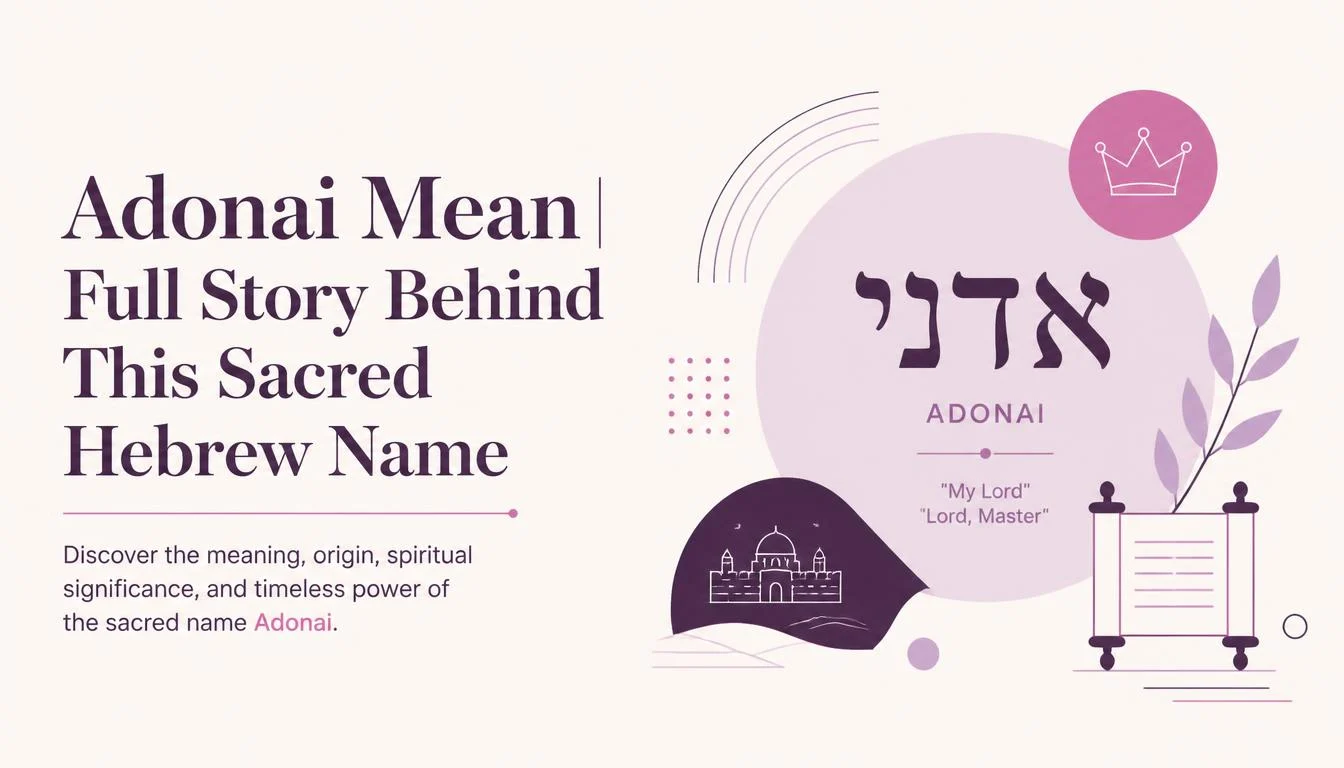
“Adonai” is a Hebrew word meaning “My Lord” or “Lord”. It is commonly used in Judaism as a respectful way to refer to God instead of pronouncing the sacred name of God directly.
The term Adonai mean comes from Hebrew and is widely used in religious contexts, especially within Judaism. It translates to “My Lord,” expressing deep respect and reverence when referring to God. Instead of speaking the divine name, followers use “Adonai” as a substitute.
Understanding Adonai mean helps in grasping its spiritual importance. It is not just a name but a title that reflects honor, authority, and devotion. In prayers and scriptures, it is frequently used to show reverence toward God in a respectful and traditional way.
Adonai Meaning: Definition
Adonai (אֲדֹנָי) is a Hebrew word meaning “my Lord” or “my Master,” used in the Hebrew Bible as a reverent title for God. It’s a plural form of “adon” (lord/master), and Jewish tradition treats it as one of the sacred, respectful names for God often spoken aloud in place of the unpronounceable divine name YHWH (the Tetragrammaton).
In short: when someone calls God “Adonai,” they’re expressing deep respect, authority, and ownership the same way you’d address a king, an employer, or someone you deeply honor, only on a much greater spiritual scale.
That’s the one-line answer. Now let’s dig into why this word matters so much, where it comes from, and how people actually use it today.
Where Does the Word Adonai Come From?
Adonai has roots that go back thousands of years into ancient Hebrew and the wider Semitic language family.
- Root word: The singular Hebrew noun is adon, meaning “lord,” “master,” or “owner.” You’ll find this root in plenty of Hebrew names and phrases even outside religious contexts.
- Grammatical form: Adonai is technically the plural form of adon, combined with the possessive suffix “i” (meaning “my”). Grammatically it reads like “my lords,” but in Hebrew this is what’s called a “plural of majesty” a way of expressing greatness, not literally referring to multiple beings. It’s similar to how royalty in some cultures uses “we” instead of “I.”
- Biblical usage: Adonai appears well over 400 times in the Hebrew Bible (the Tanakh), often used interchangeably with or alongside YHWH, the four-letter name of God that Jewish tradition considers too sacred to pronounce.
- Why it replaced YHWH in speech: Ancient Jewish scribes and worshippers avoided saying the divine name YHWH out loud, largely based on reverence and interpretations of the commandment against taking God’s name in vain. Adonai became the standard substitute word spoken during Torah readings and prayer, even when the text on the page showed YHWH.
This is also why in most English Bible translations, you’ll see “LORD” in small caps that’s the translators’ way of signaling “this word was YHWH in the original Hebrew, but traditionally read aloud as Adonai.”
A Quick Historical Timeline
| Period | How Adonai Was Used |
|---|---|
| Ancient Israel (pre-exile) | Used as a respectful title for God, alongside other divine names |
| Second Temple period | Became the standard spoken substitute for the unpronounceable YHWH |
| Rabbinic Judaism | Formalized as a sacred name, used in prayer and liturgy |
| Modern Judaism | Still spoken in synagogue prayers and religious study |
| Christian Bibles | Translated as “Lord” or “LORD,” retaining the reverent meaning |
How Popular and Common Is “Adonai” Today?
Adonai isn’t just a dusty word buried in ancient texts it’s very much alive today.
- In worship music: Adonai appears in countless contemporary Christian and Jewish worship songs, often used as a direct address to God (“Adonai, we lift Your name”).
- In Jewish prayer life: Observant Jews say or read Adonai daily during prayers like the Amidah and Torah services.
- In pop culture and naming: It’s become a fairly popular given name in some English-speaking countries, particularly in the U.S., chosen by parents who want a name with deep spiritual meaning.
- In casual conversation: Some people use “Adonai” simply as an exclamation of awe or reverence, similar to how someone might say “Oh my God” though within religious communities, it’s generally reserved for sincere, respectful contexts rather than casual slang.
Unlike internet slang or abbreviations that trend and fade, Adonai has stayed remarkably consistent in meaning and usage for thousands of years a rare thing in language.
Adonai in Example Sentences With Tone and Context
Here’s how the word actually shows up in real conversation, prayer, and writing. Tone matters a lot here, so let’s break it down.
Reverent / Worshipful Tone
- “Adonai, hear our prayer and guide us through this season.” 🙏
- “We give thanks to You, Adonai, for Your mercy and faithfulness.”
- “Blessed are You, Adonai our God, King of the universe.” (a common opening line in Jewish blessings)
Neutral / Educational Tone
- “In Hebrew, Adonai literally translates to ‘my Lord.'”
- “The word Adonai is used as a substitute for the divine name YHWH in Jewish tradition.”
- “Adonai appears throughout the Psalms as a title of honor for God.”
Naming Context (Neutral-Friendly)
- “They named their daughter Adonai, hoping the name would reflect their faith.”
- “Adonai has become a fairly recognized baby name choice in recent years.”
A quick but important note: because Adonai is a sacred religious term for many people, it’s rarely if ever used sarcastically or dismissively in genuine religious communities. If you do see it used flippantly online (for example, as a dramatic exclamation in a joke), it’s worth being mindful that this can come across as disrespectful to people of Jewish or Christian faith, so it’s best approached with a bit of sensitivity.
Adonai vs. Similar Terms: What’s the Difference?
People often mix up Adonai with other Hebrew divine names, so here’s a simple side-by-side breakdown.
| Term | Meaning | How It’s Used |
|---|---|---|
| Adonai | “My Lord / My Master” | Spoken title for God, used aloud in prayer and worship |
| YHWH (Yahweh/Jehovah) | The personal, unpronounced name of God | Written in Scripture, traditionally not spoken aloud; read as “Adonai” instead |
| Elohim | “God” (a general term, technically plural in form) | Used broadly for God or even, in rare cases, other powerful beings |
| El Shaddai | “God Almighty” or “God of the Mountain” | Emphasizes God’s power and provision |
| Ha-Shem | Literally “The Name” | A modern, casual Jewish substitute used outside formal prayer settings |
The key distinction to remember: Adonai is a title of respect and authority (“Lord/Master”), while YHWH is treated as God’s actual personal name. Adonai became the “safe” spoken word so people wouldn’t risk mispronouncing or misusing the sacred name.
Does Adonai Have Any Other Meanings?
Not really and that’s part of what makes this word special. Unlike a lot of terms that pick up slang meanings or drift over time, Adonai has held onto a fairly consistent, singular meaning across centuries: a respectful, reverent title for God.
That said, a couple of related notes worth knowing:
- “Adon” alone (without the possessive/majestic ending) is used more generally in Hebrew for any lord, master, or person of authority not necessarily divine.
- As a given name, Adonai is chosen purely for its spiritual meaning (“my Lord”) rather than carrying any secondary or unrelated definition.
- Some people confuse Adonai with Adonis, the Greek mythological figure known for his beauty. These two words are unrelated Adonis comes from Greek mythology (and actually may have borrowed influence from the Semitic word “adon” itself), while Adonai is strictly a Hebrew religious term.
Polite and Professional Alternatives
If you’re writing something formal, academic, or aimed at a general audience and want alternatives to “Adonai,” here are some respectful options depending on context:
- “The Lord” the standard English translation used in most Bibles
- “God” a general, widely understood term
- “The Divine” useful in interfaith or academic writing
- “HaShem” a common substitute used by Jewish people in everyday, non-liturgical conversation
- “The Almighty” emphasizes power and majesty without using a specific name
These alternatives are especially handy if you’re writing for a mixed audience and want to stay neutral or avoid unintentionally using a term some readers consider sacred.
FAQs
1. What does Adonai literally mean in Hebrew?
Adonai literally translates to “my Lord” or “my Master.” It comes from the Hebrew root “adon” (lord) combined with a possessive ending.
2. Is Adonai the same as God’s real name?
Not exactly. Adonai is a title used to address God respectfully. God’s personal name in Hebrew Scripture is YHWH, which is traditionally considered too sacred to pronounce, so Adonai is spoken in its place.
3. Why do Bibles print “LORD” in small capital letters?
Small caps (“LORD”) signal that the original Hebrew word was YHWH, but it is traditionally read aloud as “Adonai.”
4. Is Adonai used in both Judaism and Christianity?
Yes. Adonai originates in Judaism and remains central to Jewish prayer, but it is also widely used in Christian worship, translations, and hymns.
5. Can Adonai be used as a baby name?
Yes, Adonai is used as a given name in some communities, chosen for its meaning (“my Lord”) as an expression of faith.
6. Is it disrespectful to use Adonai casually?
Within religious communities, Adonai is treated as a sacred term, so using it flippantly or sarcastically can come across as disrespectful. It is best used thoughtfully, especially around people of faith.
7. What’s the difference between Adonai and Elohim?
Adonai means “Lord/Master” and is a title of authority, while Elohim is a broader Hebrew word for “God,” referring to His divine nature and power.
8. How do you pronounce Adonai correctly?
It is pronounced “ah-doh-NAI,” with emphasis on the final syllable, rhyming loosely with “sky.”
Conclusion
Adonai isn’t just an old word tucked away in ancient scrolls it’s a living expression of reverence that’s been spoken for thousands of years and is still spoken today, whether in a synagogue, a church service, a worship song, or a quiet personal prayer.
Here’s the quick recap:
- Adonai means “my Lord” or “my Master” in Hebrew.
- It’s used as a respectful substitute for the sacred, unpronounced name YHWH.
- It shows up constantly in the Bible, Jewish liturgy, and modern worship music.
- It’s distinct from but related to other Hebrew divine names like Elohim, El Shaddai, and Ha-Shem.
- It carries a tone of deep respect, so it’s best used thoughtfully rather than casually.
Whether you came across this word in a Bible study, a worship song lyric, or just out of curiosity, hopefully you now have a clear, complete picture of what Adonai means and why it’s carried so much weight for so long.
Read More Related Articles:
- Mercy Meaning | Powerful Lesson Behind Kindness and Forgiveness In 2026
- Mija Meaning In Spanish | Sweet Nickname You’ll Hear Everywhere In 2026
- Punta Meaning In Spanish | From Literal Meaning to Everyday Usage In 2026











6 thoughts on “Adonai Mean | Full Story Behind This Sacred Hebrew Name In 2026”