Quick Answer
EtOH Meaning refers to ethanol, the type of alcohol found in alcoholic beverages. It’s a scientific shorthand commonly used in chemistry and medical contexts. You may also see it on lab reports, prescriptions, or safety labels.
EtOH Meaning is widely used as a simple abbreviation for ethanol, especially in scientific, medical, and laboratory settings. Instead of writing the full chemical name, professionals use “EtOH” to save time while keeping communication clear and precise.
In everyday situations, you might come across EtOH Meaning on hand sanitizers, medical documents, or even discussions about alcohol content. Understanding this term helps you quickly recognize that it refers to the same alcohol found in drinks, disinfectants, and various chemical applications.
What Does EtOH Mean?
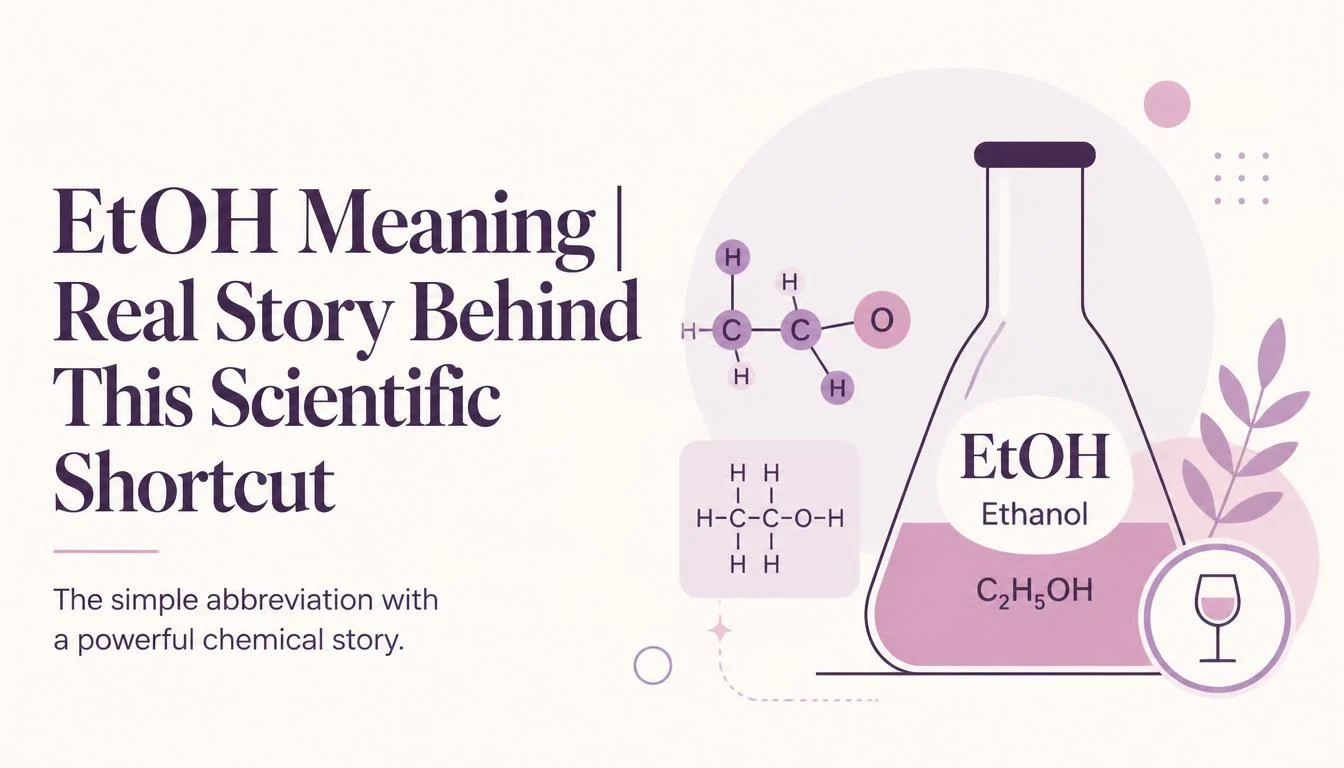
EtOH stands for ethanol, also known as ethyl alcohol. Chemically, this etoh abbreviation meaning breaks down as follows:
- Et = the ethyl group (C₂H₅)
- OH = the hydroxyl group
Put together, EtOH represents the chemical formula C₂H₅OH the same alcohol found in beer, wine, and spirits, and the active compound most people simply refer to as “alcohol.”
So when someone asks “what does etoh mean,” the short answer is: it’s chemistry shorthand for ethanol, the specific type of alcohol consumed in beverages and used in countless industrial, medical, and laboratory applications.
Where Does the EtOH Abbreviation Come From?
The etoh stands for question has a straightforward answer rooted in organic chemistry naming conventions. Chemists commonly abbreviate alcohols by combining the prefix for their carbon-chain group with “OH,” since the hydroxyl group (-OH) is what defines a compound as an alcohol in the first place.
For example:
- MeOH = methanol (methyl alcohol)
- EtOH = ethanol (ethyl alcohol)
- IPA = isopropyl alcohol
This naming system makes it easy for chemists, lab technicians, and healthcare professionals to communicate quickly without writing out full chemical names every time. Over the decades, EtOH became so standardized that it crossed over from strictly academic chemistry into everyday clinical documentation which is largely why so many people now search for its meaning without a chemistry background.
EtOH Meaning in Chemistry
In chemistry, EtOH is standard notation used to simplify writing out the full molecular structure of ethanol. Instead of writing “ethyl alcohol” or the full formula repeatedly, chemists and lab technicians use EtOH as quick shorthand in:
- Reagent and solvent labeling
- Laboratory notebooks and reports
- Chemical reaction equations
- Safety data sheets (SDS)
- Bottle and container labeling in research and industrial settings
If you’re searching for etoh meaning in chemistry, know that it’s simply a widely accepted abbreviation not a different compound or a variation of alcohol. It’s ethanol, full stop. Ethanol itself is a colorless, volatile liquid with a distinct odor, widely used as a solvent, disinfectant, fuel additive, and of course the intoxicating ingredient in alcoholic beverages.
EtOH Meaning in Medical and Hospital Settings
This is where most people actually encounter the term. In clinical settings, EtOH meaning in medical terms refers specifically to alcohol consumption, alcohol levels, or alcohol-related conditions in a patient. Because healthcare documentation moves fast, especially in emergency departments, abbreviations like EtOH help providers chart efficiently without sacrificing clarity between colleagues.
Here’s how it typically appears on charts and in nursing documentation:
EtOH Level Meaning
When a chart notes “EtOH level,” it’s referring to the patient’s blood alcohol concentration (BAC) a measurement used to determine how much alcohol is present in the bloodstream at the time of testing. This is common in emergency rooms, especially for patients who are intoxicated, involved in accidents, or being evaluated for alcohol-related complications. It levels are typically reported in milligrams per deciliter (mg/dL) and help clinicians assess intoxication severity, potential overdose risk, and appropriate treatment.
EtOH Use Meaning
“EtOH use” is a standard phrase in patient history documentation. It simply denotes whether a patient consumes alcohol, and often includes frequency (“occasional EtOH use,” “heavy EtOH use,” or “denies EtOH use”). This is a routine part of a social history intake, alongside questions about tobacco and drug use, since alcohol consumption patterns can influence diagnosis, medication interactions, and treatment planning.
EtOH Abuse Meaning
When documentation references “EtOH abuse,” it points to a pattern of harmful or excessive alcohol consumption often tied to a diagnosis, treatment plan, or risk assessment. This terminology may appear in psychiatric evaluations, primary care notes, or substance use disorder treatment records.
EtOH Withdrawal Meaning
“EtOH withdrawal” refers to the physical and psychological symptoms that occur when someone who is dependent on alcohol suddenly stops or significantly reduces intake. Symptoms can range from mild anxiety, sweating, and tremors to more severe complications like seizures or delirium tremens (DTs) in extreme cases. Because withdrawal can escalate quickly, it’s closely monitored in clinical settings, often with scheduled medication protocols.
CIWA EtOH Meaning
You may also come across “CIWA EtOH,” which refers to the Clinical Institute Withdrawal Assessment for Alcohol (CIWA-Ar) a scoring tool healthcare providers use to assess the severity of alcohol withdrawal symptoms and guide treatment decisions. Nurses typically perform CIWA assessments at regular intervals for patients at risk of withdrawal, scoring symptoms like tremor, sweating, anxiety, and hallucinations to determine whether medication intervention is needed.
EtOH Odor Meaning
“EtOH odor” is documentation shorthand noting that a patient smells of alcohol often recorded during physical assessments as a clinical observation. This detail can be relevant in emergency settings, especially when assessing altered mental status or determining whether alcohol may be contributing to a patient’s symptoms.
EtOH Positive Meaning (Toxicology & Testing)
In toxicology reports or drug screening panels, “EtOH positive” indicates that alcohol was detected in a patient’s system during testing whether through blood, breath, or urine analysis. This terminology is common in:
- Emergency medicine
- Workplace drug and alcohol testing
- Forensic and legal toxicology reports
- DUI/DWI-related blood alcohol testing
A “negative” result, by contrast, means no alcohol was detected at the time of testing. In legal and workplace contexts, an EtOH positive result can carry significant consequences, which is why testing protocols and chain-of-custody procedures are typically strict and standardized.
EtOH vs Alcohol: Is There a Difference?
A common point of confusion is etoh vs alcohol. Here’s the clarification:
- “Alcohol” is a broad chemical category that includes many compounds (methanol, isopropyl alcohol, ethanol, etc.)
- “EtOH” refers specifically to ethanol the type of alcohol found in alcoholic beverages and used medically/clinically
So while all EtOH is alcohol, not all alcohol is EtOH. This distinction matters most in medical and chemical contexts, where precision prevents dangerous mix-ups. For example, ethanol is safe for consumption in regulated amounts, while methanol a chemically similar but far more toxic alcohol can cause severe poisoning, blindness, or death even in small quantities. This is exactly why chemists and clinicians rely on precise abbreviations like EtOH rather than the generic term “alcohol.”
Common Industrial and Everyday Uses of Ethanol (EtOH)
Beyond medical and laboratory contexts, ethanol plays a role in many everyday products and industries, including:
- Hand sanitizers and disinfectants ethanol-based formulas are effective at killing many types of bacteria and viruses
- Fuel production ethanol is blended with gasoline (commonly seen as E10 or E85 fuel) as a renewable energy source
- Cosmetics and personal care products used as a solvent or preservative in perfumes, lotions, and skincare items
- Food and beverage industry the primary alcohol in beer, wine, and spirits
- Pharmaceutical manufacturing used as a solvent in various medications and tinctures
This wide range of applications is part of why EtOH is such a commonly referenced compound across so many different industries and professional fields.
Why the Abbreviation Matters
Medical and chemical documentation relies heavily on abbreviations to save time and standardize communication. EtOH is one of the most frequently used shorthand terms because:
- It’s universally recognized across healthcare and laboratory settings
- It reduces charting time in fast-paced environments like ERs
- It maintains consistency across toxicology, nursing, and chemistry documentation
- It minimizes ambiguity compared to the broader term “alcohol”
Understanding this single abbreviation can help you make sense of medical records, lab reports, and clinical notes without needing a full glossary.
Quick Reference: EtOH Meaning Summary
| Term | Meaning |
|---|---|
| EtOH | Ethanol (ethyl alcohol) |
| EtOH level | Blood alcohol concentration |
| EtOH use | Documented alcohol consumption habits |
| EtOH abuse | Pattern of harmful alcohol use |
| EtOH withdrawal | Symptoms from stopping/reducing alcohol intake |
| CIWA EtOH | Clinical scoring tool for withdrawal severity |
| EtOH positive | Alcohol detected in toxicology testing |
| EtOH odor | Clinical note of alcohol smell during assessment |
FAQs
Is EtOH the same as rubbing alcohol?
No. Rubbing alcohol is usually isopropyl alcohol (IPA), not ethanol. While both can be used as disinfectants, they are different chemical compounds.
Is EtOH dangerous?
In regulated amounts, ethanol is generally safe for consumption, such as in alcoholic beverages, and is also widely used in sanitizers and industrial products. However, excessive intake or exposure to high concentrations can be harmful and may lead to alcohol use disorder, withdrawal complications, or toxicity.
What’s a normal EtOH level?
A normal EtOH level is typically considered zero, as ethanol is not naturally present in significant amounts in the body. Any detectable level suggests recent alcohol consumption. Legal intoxication limits vary by region but are often around 0.08% BAC for driving.
Why do doctors ask about EtOH use?
Doctors ask about alcohol use because it can impact medication interactions, surgical risks, liver health, and overall treatment decisions.
Conclusion
Whether you’ve spotted it on a chemistry label, a hospital chart, or a toxicology report, the etoh meaning always traces back to the same root: ethanol. Context changes how it’s used clinical documentation, lab work, or forensic testing but the core definition stays consistent.
If you’re ever unsure what a specific EtOH-related note means on a document you’ve received, it’s always best to ask the healthcare provider or lab that issued it, since context (like dosage levels or specific test results) can carry important clinical significance.
Read More Related Articles:
- GFY mean| What It Means in Text, Slang & Online Chats In 2026
- FDT Meaning | Texting, Slang & Hidden Meanings Uncovered In 2026
- PPL Mean | Decode the Slang Like a Pro In 2026











1 thought on “EtOH Meaning | Real Story Behind This Scientific Shortcut In 2026”