Quick Answer
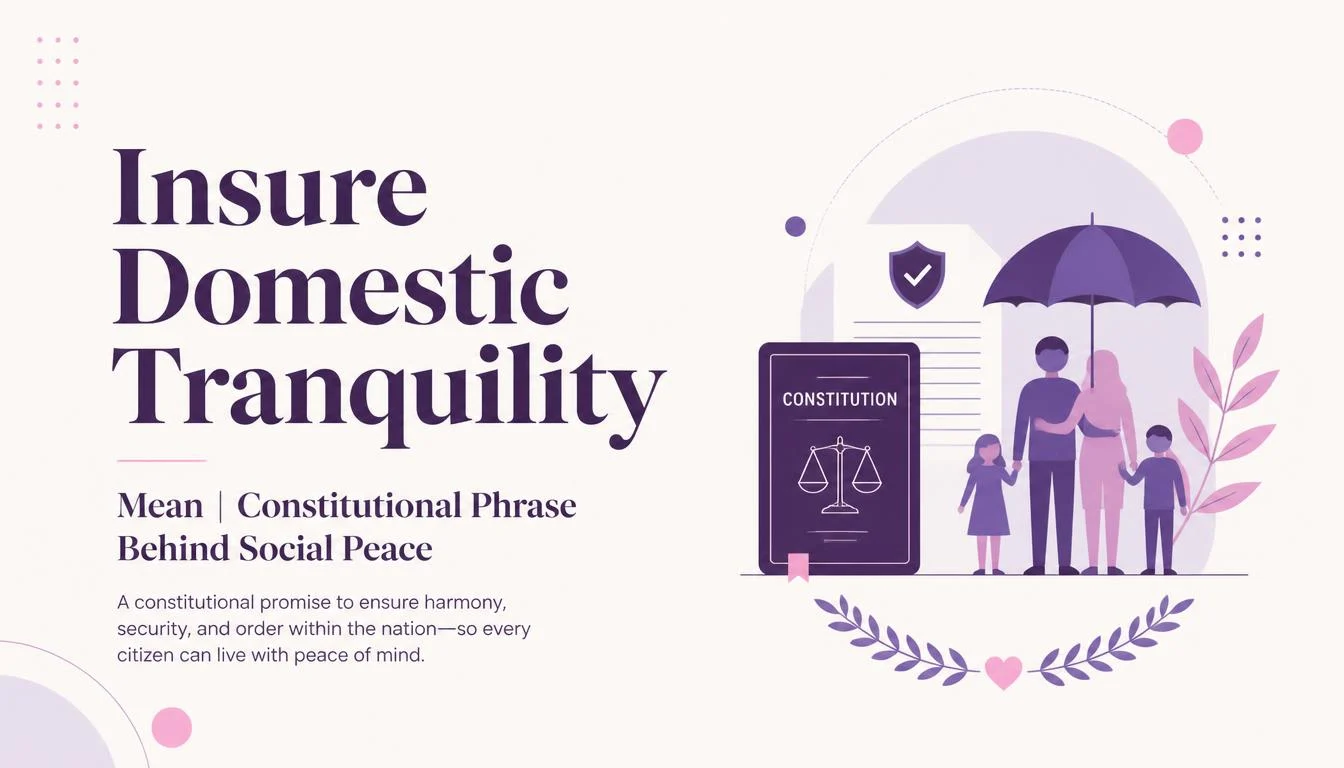
“Insure Domestic Tranquility” means to protect peace, stability, and harmony within a country or society. It emphasizes creating a safe and orderly environment where people can live without internal conflict or unrest.
“Insure Domestic Tranquility” is a phrase that highlights the importance of maintaining peace and stability within a nation. In simple terms, Insure Domestic Tranquility Mean focusing on keeping society calm, balanced, and free from internal disturbances. It is often used in political and constitutional contexts to describe one of the core responsibilities of a government.
In everyday understanding, this phrase reflects the idea of ensuring harmony among citizens so that communities can function smoothly. When we explore Insure Domestic Tranquility Mean, it shows how essential internal peace is for progress, security, and national unity. Without domestic tranquility, no country can truly grow or prosper.
Insure Domestic Tranquility: Definition
“Insure domestic Tranquility” means to guarantee peace, order, and stability within a nation’s own borders. It’s a promise to keep the peace at home preventing internal conflict, riots, rebellion, or civil unrest so that citizens can live safely and society can function smoothly. The phrase comes from the Preamble to the United States Constitution and reflects one of government’s core responsibilities: maintaining calm and order among its own people, not just defending against outside threats.
In short: it’s about keeping the peace inside the house, not just guarding the front door.
Where Does This Phrase Come From? (Origin & Context)
The phrase sits right in the Preamble of the U.S. Constitution, adopted in 1787. Here’s the relevant section for context:
“We the People of the United States, in Order to form a more perfect Union, establish Justice, insure domestic Tranquility, provide for the common defence, promote the general Welfare, and secure the Blessings of Liberty to ourselves and our Posterity, do ordain and establish this Constitution for the United States of America.”
At the time this was written, the young nation had just come out of the Revolutionary War and was struggling with internal chaos most notably Shays’ Rebellion, an armed uprising by farmers in Massachusetts in 1786–87 protesting debt and taxation. That uprising terrified the Founding Fathers. It showed them that a weak central government couldn’t keep order among its own citizens, let alone defend the country from outside threats.
So when they sat down to draft a new governing document, “insuring domestic tranquility” wasn’t just poetic language it was a direct response to a real, recent crisis. They wanted a stronger federal government capable of preventing similar uprisings and keeping peace between states and citizens.
A Note on Spelling: “Insure” vs. “Ensure”
Here’s a small detail that trips people up. Today, we typically use:
- Ensure to make certain something happens (general use)
- Insure to provide financial protection against loss (like insurance)
But in 18th-century English, “insure” and “ensure” were often used interchangeably. The Founding Fathers used “insure” in the sense we’d now spell as “ensure.” It wasn’t a typo it was simply how the word was commonly spelled at the time.
How Popular and Widely Used Is This Phrase Today?
Insure domestic tranquility” isn’t something people casually drop into conversation but it’s far from obscure either. Here’s where you’re likely to encounter it:
- Civics and history classrooms nearly every American student memorizes the Preamble at some point
- Citizenship tests the Preamble’s purpose is a common naturalization exam topic
- Political speeches politicians love invoking it during times of unrest or division
- Legal and academic writing constitutional scholars reference it when discussing federal power
- Pop culture and media occasionally quoted (sometimes mockingly) in movies, TV shows, or social commentary
While it’s a formal, constitutional phrase, its core idea peace and order at home is something people reference informally too, even if they don’t use the exact wording.
Real-World Examples and Tone Variations
The phrase itself is formal, but the concept it represents gets used in different tones depending on context. Here’s how it plays out:
Friendly / Educational Tone
- “One of the Constitution’s goals was to insure domestic tranquility basically, keep the peace among citizens. 🕊️”
- “Think of ‘domestic tranquility’ as the Founders’ version of saying, ‘let’s not have another rebellion, please.'”
Neutral / Academic Tone
- “The clause reflects the framers’ intent to establish federal authority capable of maintaining internal order.”
- “Domestic tranquility, in constitutional terms, refers to the absence of civil disorder within the nation.”
Dismissive / Sarcastic Tone
- “Sure, ‘insure domestic tranquility’ tell that to the country during an election year. 🙄”
- “Domestic tranquility? Have they seen the news lately?”
This last tone shows up a lot online, especially when people feel the country isn’t living up to that founding ideal. It’s become something of a rhetorical punchline when discussing political division or social unrest.
Insure Domestic Tranquility vs. Related Terms
People often confuse this phrase with similar-sounding constitutional or legal concepts. Here’s a side-by-side comparison to clear things up.
| Term | Meaning | Source | Focus |
|---|---|---|---|
| Insure Domestic Tranquility | Maintain internal peace and order among citizens | U.S. Constitution Preamble | Internal/civil stability |
| Provide for the Common Defence | Protect the nation from external threats | U.S. Constitution Preamble | External/military security |
| Establish Justice | Create a fair legal system | U.S. Constitution Preamble | Law and fairness |
| Promote the General Welfare | Support the overall well-being of citizens | U.S. Constitution Preamble | Public good, economic/social health |
| Domestic Policy | Government decisions affecting the home country | Modern political term | Internal governance (economy, healthcare, etc.) |
| Civil Order | The general state of law-abiding, peaceful society | Common legal/sociological term | Societal behavior |
| Martial Law | Military control imposed during emergencies | Legal/emergency term | Forced order during crisis |
Notice how “insure domestic tranquility” and “provide for the common defence” often get lumped together, but they’re actually opposites in focus one looks inward, the other looks outward.
Does “Domestic Tranquility” Have Any Other Meanings?
Outside of its constitutional context, “domestic tranquility” can occasionally be used more literally and personally, referring to:
- Peace within a household a calm, harmonious home life (e.g., “After the kids went to bed, domestic tranquility finally returned.”)
- Marital or family harmony sometimes used humorously to describe a peaceful relationship or living situation
This personal usage is much rarer and mostly shows up in literary or lightly humorous writing, but it’s worth knowing the phrase isn’t exclusively political.
Polite or Professional Alternatives
If you’re writing something formal an essay, a speech, a civics assignment and want alternatives to “insure domestic tranquility” or want to explain the concept differently, here are some solid options:
- Maintain civil order
- Preserve internal peace
- Uphold social stability
- Ensure public order
- Safeguard national harmony
- Sustain peaceful coexistence among citizens
- Keep the peace domestically
These alternatives work well in essays, presentations, or explanations where you want to paraphrase the constitutional language without directly quoting it.
Quick Reference Table: Usage at a Glance
| Context | Example Usage | Tone |
|---|---|---|
| Classroom/Civics | “The Preamble lists five goals, including insuring domestic tranquility.” | Neutral |
| Political Speech | “We must work together to insure domestic tranquility in these divided times.” | Formal/Persuasive |
| Casual Commentary | “Domestic tranquility? Yeah, right, have you seen Twitter today?” | Sarcastic |
| Academic Essay | “The clause underscores the framers’ concern with internal stability post-Shays’ Rebellion.” | Formal/Analytical |
| Personal/Literary | “With the house finally quiet, domestic tranquility settled in.” | Reflective/Personal |
FAQs
1. What does “insure domestic tranquility” mean in simple terms?
It means to keep peace and order within a country among its citizens, basically preventing internal chaos like riots or rebellion.
2. Where is the phrase “insure domestic tranquility” found?
It is found in the Preamble to the United States Constitution, right after “establish Justice” and before “provide for the common defence.”
3. Why did the Founding Fathers include this phrase?
They included it largely because events like Shays’ Rebellion showed how weak the government under the Articles of Confederation was at maintaining internal order.
4. Is “insure” a typo for “ensure” in the Constitution?
No, it is not a typo. In 18th-century English, “insure” and “ensure” were often used interchangeably, and the framers used “insure” in the sense we would write as “ensure” today.
5. What’s the difference between “domestic tranquility” and “common defence” in the Constitution?
“Domestic tranquility” refers to peace within the country’s borders (internal stability), while “common defence” refers to protection from external threats.
6. Is “domestic tranquility” only a legal or political term?
Mostly yes, but it can also be used more casually to describe peace within a household or family setting.
7. How is “insure domestic tranquility” used today?
It is mainly referenced in civics education, citizenship test preparation, political speeches, and academic discussions of constitutional law—sometimes sincerely, sometimes sarcastically when discussing social or political unrest.
8. What are some synonyms for “insure domestic tranquility”?
Some alternatives include “maintain civil order,” “preserve internal peace,” “uphold social stability,” and “safeguard national harmony.”
Conclusion:
Insure domestic tranquility” might sound like a mouthful of old-fashioned formality, but its meaning is refreshingly simple: keep the peace at home. It’s one of the founding goals baked directly into the U.S. Constitution, born out of very real fears about internal rebellion and instability in the country’s earliest days.
Here’s the quick recap:
- It means maintaining peace, order, and stability within a nation’s own borders
- It comes from the Preamble to the U.S. Constitution, written in 1787
- It was partly inspired by real unrest, like Shays’ Rebellion
- “Insure” wasn’t a typo it reflected common 18th-century spelling
- It differs from “common defence,” which focuses on external protection
- The phrase pops up in civics classes, political speeches, and occasionally sarcastic commentary
- Alternatives like “maintain civil order” or “preserve internal peace” work well in formal writing
Read More Related Articles:
- Slime Someone Out Mean | Real Story Behind This Slang In 2026
- Adjacent Mean in Math | Easy Way to Get It Right In 2026
- Congruent Mean in Geometry | Learn the Secret of Identical Shapes In 2026










6 thoughts on ““Insure Domestic Tranquility” Mean | Constitutional Phrase Behind Social Peace In 2026”