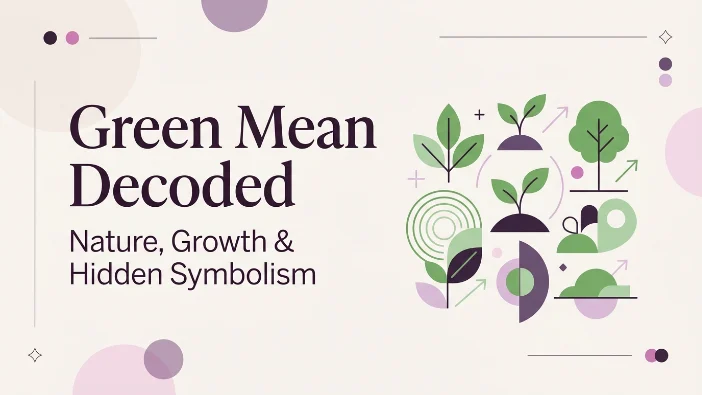
Have you ever stopped to consider how much power a single color holds? You see it every day, from the vibrant leaves of a spring tree to the reassuring glow of a traffic light telling you to go. But “green” is so much more than just a color. It’s a language, a movement, and a state of being. Welcome to the world of the green mean a phrase that encapsulates everything this incredible hue represents.
Whether you’re looking to understand its deeper symbolism, use it correctly in conversation, or explore what it means to live a greener life, you’ve come to the right place. Let’s dive into the fascinating spectrum of what it truly means to be green.
🟢 Definition: What Does “Green” Really Mean?
Let’s start with the basics. At its core, the definition of “green” is simple.
Green is the color perceived between blue and yellow on the visible spectrum. It is the color of grass, leaves, and most growing plants, often associated with nature, life, and renewal .
However, the “green mean” goes far beyond optics. It’s a term that has grown to encompass several key concepts:
- Environmental Awareness: Referring to practices, products, or policies that are friendly to the planet (e.g., “green energy,” “green living”) .
- Inexperience: Describing someone who is new to a job or activity (e.g., “He’s a bit green, but he’ll learn quickly”) .
- Health and Vitality: Representing freshness, growth, and life .
Understanding this multi-faceted meaning is the first step to using the word with confidence.
🌱 The Origin and Growing Popularity of “Green”
The word “green” has ancient roots. It comes from the Old English word grēne, which itself is derived from the Germanic root grō-, meaning “to grow” . This connection to growth and vegetation has been with us for centuries, tying the word inextricably to the natural world.
But how did a word about plants become a global symbol for a movement?
From a Simple Color to a Global Movement
For centuries, green was simply a color. It described nature, wealth (in some cultures), and even jealousy (think “green with envy”). Its modern popularity as a symbol of environmentalism and social responsibility is a relatively recent phenomenon.
This shift began in the 1960s and 1970s with the rise of the modern environmental movement. As concerns about pollution, deforestation, and climate change grew, “green” became the perfect shorthand for “eco-friendly” . It represented a return to nature, a call for sustainable development, and a new way of thinking about our relationship with the planet.
Today, being “green” is mainstream. It’s used in politics (Green Parties), business (“green marketing”), and everyday life (“green living”). The “green mean” has transformed from a descriptive adjective into a call to action.
🌍 Real-World Usage: How We Use “Green” Today
We use “green” in countless ways, and its meaning often depends on the context. Understanding these nuances is the key to clear communication.
1. The Environmental “Green”
This is arguably the most common usage today. It refers to anything aimed at protecting the environment and conserving natural resources .
- Green Energy: Renewable energy sources like solar, wind, and geothermal power.
- Green Products: Items that are made from recycled materials, are non-toxic, or have a lower carbon footprint.
- Greenwashing: A term you should know! It refers to the practice of making misleading claims about a product’s environmental benefits. It’s important to look beyond the color and see the substance.
2. The “Green” as Inexperience
When we say someone is “green,” we mean they are new, untrained, or naive .
- Usage Tip: This is a neutral term but can be slightly patronizing if used incorrectly. It’s best used in a mentoring context.
- Example: “I was completely green when I started my first job as a junior developer, but I learned so much from my team.”
3. The “Green” as a Signal
We also use green as a universal signal for “go,” “safe,” or “permission” .
- The Green Light: Giving someone the “green light” means giving them approval to proceed with a project or plan. The traffic light system is perhaps the most universal application of this.
- The Green Man: In the UK, the “Green Man” is the illuminated figure on a traffic signal that indicates it’s safe to walk across the road .
💬 Examples with Context: Tone and Nuance
The tone of “green” can change dramatically based on the context. Let’s look at some examples.
😊 Friendly and Positive Tone
This is the tone used when discussing nature, health, or positive environmental action.
- Example: “I love living in a city with so many green spaces. It feels so refreshing to walk through the park in the morning.” 🌳
- Example: “I’m trying to make my diet a little greener by adding more leafy vegetables and plant-based meals.”
😐 Neutral and Informative Tone
This is the tone used when describing a fact, a process, or a status.
- Example: “The traffic light turned green, so we proceeded through the intersection.”
- Example: “Please ensure all our packaging uses green materials that are 100% recyclable.”
🤨 Negative or Dismissive Tone
This is rarer but occurs, especially when describing inexperience or a lack of skill.
- Example: “He’s still pretty green; I wouldn’t trust him with that complex task unsupervised.” (This is a professional, objective observation, but it’s clearly a critique).
⚠️ Cautionary Note
A “green” look can also mean someone is looking ill or nauseous .
- Example: “Are you okay? You’ve gone a bit green around the gills.”
🆚 Green vs. Other Terms: A Comparison
Sometimes, the “green mean” overlaps with other concepts, and it helps to know the difference.
| Term | Definition | Relationship to “Green” |
|---|---|---|
| Sustainable | Able to be maintained at a certain rate or level; meeting the needs of the present without compromising the future. | “Green” focuses on environmental friendliness, while sustainable is broader, encompassing social and economic factors. A “green” product should be sustainable, but not all sustainable things are simply “green.” |
| Eco-Friendly | Not harmful to the environment. | This is a synonym for “green” in the environmental sense. |
| Naïve | Showing a lack of experience, wisdom, or judgment. | This is a near-synonym for “green” when referring to a person, but it carries a more negative connotation. “Green” is more forgiving of newness, while “naïve” can imply foolishness or gullibility . |
| Organic | Produced or involving production without the use of chemical fertilizers, pesticides, or other artificial agents. | Organic products are often “green,” but “green” is a much broader term. You can have a “green” policy, but that doesn’t mean it’s “organic. |
Key Takeaway: “Green” is the accessible, everyday word. “Sustainable” is the more formal, academic term that covers the entire system .
🔄 Alternative Meanings of “Green” You Might Not Know
While we’ve covered the main uses, “green” has a few more cards up its sleeve.
- Money: In American slang, “green” often refers to money (due to the color of US banknotes).
- Marijuana: In British slang, “green” is sometimes used as a slang term for cannabis .
- Politics: A member of a Green Party or an environmentalist .
- Sports: The putting green on a golf course .
- Fruit: An unripe fruit (like a green apple) .
💡 Polite and Professional Alternatives to “Green”
If you want to avoid ambiguity or sound more formal, here are some alternatives depending on the context.
- For Environmental Contexts:
- Eco-friendly
- Sustainable
- Low-impact
- Renewable (for energy)
- Carbon-neutral
- For Inexperience:
- New
- Fresh
- Inexperienced
- Novice
- Budding
- For Health:
- Unwell
- Ill
- Nauseous
📊 Example Table: Green in Different Contexts
| Context | Meaning | Example Sentence | Tone |
|---|---|---|---|
| Environment | Eco-friendly | “Our company is committed to using green packaging.” | Positive/Neutral |
| Inexperience | New; Untrained | “The intern is still green, but she has a great attitude.” | Neutral/Directive |
| Signal | Go; Proceed | “We’ve got the green light from the board to start the project.” | Positive/Formal |
| Health | Sickly; Nauseous | “He was looking a little green after the boat trip.” | Neutral/Caution |
| Politics | Environmentalist | “She voted for the Green Party in the local elections.” | Formal/Neutral |
❓ FAQs
Let’s answer some of the most common questions people have about the “green mean.”
1. What does it mean to “go green”?
To “go green” means to adopt a lifestyle or practice that minimizes your negative impact on the environment. This could involve using less plastic, conserving water, switching to renewable energy, or buying from sustainable brands.
2. Is “green” a color or a political movement?
It’s both. It is primarily a color, but over time, it has become a powerful symbol for environmental and political movements (like Green Parties) that advocate for ecological sustainability and social justice .
3. Can “green” describe a person?
Yes, absolutely. It can describe someone who is very interested in environmentalism (“She’s a green consumer”), or it can describe someone who is new and inexperienced (“He’s still a bit green at this job”) .
4. Why is the color green associated with nature?
Because the primary source of green pigment in nature is chlorophyll, which is essential for photosynthesis the process plants use to convert sunlight into energy . We are visually wired to connect green with life, growth, and vitality.
5. What is “green energy”?
Green energy is energy that is generated from natural resources that can be replenished, such as sunlight, wind, rain, tides, and geothermal heat. These are sources that do not produce significant greenhouse gas emissions .
6. What is “greenwashing”?
Greenwashing is a deceptive marketing practice where a company or organization spends more time and money on advertising themselves as “green” than on actually implementing environmentally friendly practices. It’s a way to capitalize on consumer demand for sustainable products without delivering real benefits.
7. Is it rude to call someone “green”?
It depends on the tone and context. It’s generally not considered offensive if used constructively. Saying, “He’s a bit green, but he’s learning quickly,” is a gentle observation. However, using it dismissively could be considered patronizing.
8. What’s the difference between “green” and “sustainable”?
“Green” generally relates to environmental friendliness and reducing harm to the planet. “Sustainable” is a broader concept that ensures we can maintain a certain practice indefinitely without depleting resources or causing damage, encompassing economic and social factors as well . You can think of a “green” product as a component of a “sustainable” system.
💎 Conclusion:
The “green mean” is a powerful phrase that beautifully captures the multiple layers of meaning in a single word. It connects our ancient world of nature and growth to our modern challenges of climate change and sustainability. It teaches us about new beginnings both in our careers and in the life cycles of the planet.
Key Takeaways:
- It’s Multi-Dimensional: Green is a color, a call for environmental action, a label for inexperience, and a signal for permission.
- Context is King: The meaning of green is entirely dependent on the situation. Understanding the speaker’s intent is crucial.
- It’s Actionable: Going green isn’t just a tagline; it’s a commitment to making more conscious choices in our daily lives.
- It’s About Growth: Whether it’s a young plant, a new employee, or a new eco-friendly initiative, green reminds us that growth is always possible.
So next time you see the color green or use the word, remember the depth it carries. Whether you’re writing a report on sustainable business practices, comforting a new colleague, or simply enjoying a walk in the park, you’re tapping into the rich and vibrant world of the “green mean.”
Read More Related Articles:
- Clemency Meaning | Pronunciation, Definition & Examples In 2026
- Mercy Meaning | Powerful Lesson Behind Kindness and Forgiveness In 2026
- Stubborn Mean | Why It’s Not Always a Bad Thing In 2026








3 thoughts on “Green Mean Decoded | Nature, Growth & Hidden Symbolism In 2026”