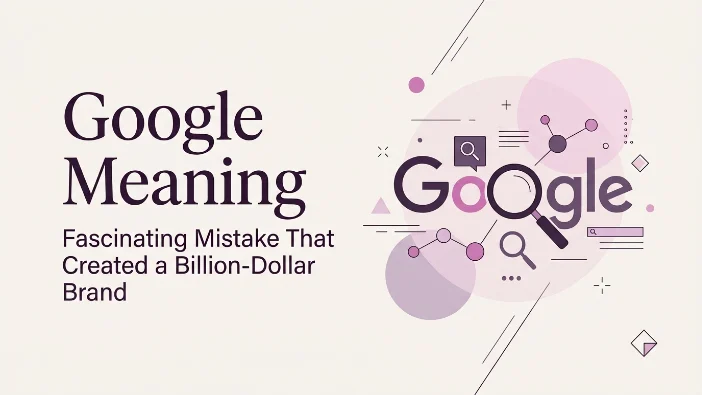
Have you ever stopped mid-scroll, looked at that colorful search bar, and wondered, What does Google actually mean? 🤔
You’re not alone. Despite being one of the most recognized words globally, the meaning of “Google” remains a delightful puzzle for many. And here’s the kicker: it’s all thanks to a spelling mistake! That’s right one of the world’s most powerful brands owes its name to a typo. Let’s uncover the fascinating truth behind the search engine we can’t live without.
Google: Definition and Meaning
The term “Google” is a misspelling of the mathematical word “googol.” A googol is the number 1 followed by 100 zeros (10¹⁰⁰), representing an unimaginably vast quantity.
So, when Sergey Brin and Larry Page chose this name for their search engine, they were making a bold statement. They aimed to organize the seemingly infinite amount of information available on the internet a database of knowledge as large as a googol.
Today, “Google” means so much more than a number. It’s a verb, a noun, a cultural phenomenon, and arguably the most powerful tool ever created by humanity.
The Origin of Google: From BackRub to a Billion-Dollar Typo
Before the world started “Googling” things, the project had a much less glamorous name: BackRub.
The BackRub Era
In 1996, Larry Page and Sergey Brin, Ph.D. students at Stanford University, were working on a search engine project. Unlike other search engines at the time that ranked pages simply by how many times a word appeared, BackRub analyzed “backlinks” links from one site to another to determine a page’s importance.
This was revolutionary thinking. The more websites linked to you, the more important you must be. It’s the same logic that still powers Google’s search algorithm today, just with way more sophisticated math.
The Brainstorming Session
By 1997, the duo realized BackRub wasn’t going to cut it as a permanent name. It sounded silly, and frankly, people kept making jokes about it. During a brainstorming session with fellow Stanford grad Sean Anderson, they wanted a name that reflected the massive scale of data they were indexing.
The “Googol” Idea
Anderson suggested the term “googolplex” (an even larger number: 1 followed by a googol of zeros). Larry Page liked the shorter version: “Googol.”
It made perfect sense. Their search engine was designed to handle endless information. The name would symbolize their ambition to organize the world’s data, no matter how much there was.
The Historic Misspelling
The final act of naming was pure serendipity. When Sean Anderson checked if the domain name “googol.com” was available, he accidentally typed “google.com“ a common spelling error. He wasn’t a great speller, and the rest is history.
Larry Page liked the misspelled version immediately. It was quirky, memorable, and available. Within hours, they registered the now-famous “google.com” domain. Imagine if they’d caught the typo we might all be saying “googol it” right now!
Why “Google” Works for the Company
While the original intent was mathematical, the lucky typo turned out to be a branding masterstroke.
- Memorable: It’s catchy, fun to say, and unique. You can’t forget it once you hear it.
- Actionable: It quickly became a verb. “Just Google it” is now universal shorthand for “search online.” Very few brands achieve this level of linguistic takeover.
- Scalable: The name fits the company’s mission to organize massive amounts of data, from search to cloud storage and YouTube.
- Playful: Unlike serious-sounding tech names like “IBM” or “Microsoft,” Google feels approachable. It invites curiosity.
The name also sounds modern and energetic. The repetition of the “o” and “g” sounds makes it pleasing to say. It rolls off the tongue effortlessly, which is exactly what you want for a global brand.
The Evolution of Google Over Time
From a Stanford dorm room to a multi-trillion-dollar company, Google’s journey is nothing short of extraordinary.
The Early Days
In 1998, Google operated out of a garage in Menlo Park, California. The founders rented it from Susan Wojcicki, who later became YouTube’s CEO. The original setup was humble: a few servers, some desks, and massive ambition.
The Dot-Com Boom
Google survived the dot-com crash when so many others failed. Why? Because they actually had a working product that people loved. They weren’t selling hype; they were selling answers.
The Advertising Revolution
Google introduced AdWords in 2000, completely changing how businesses reach customers online. Instead of annoying banner ads, Google showed small text ads based on what people were searching for. This was genius and remains the company’s primary revenue source.
The Google Empire
Today, Google is everywhere. Here’s what the company owns:
- Android (the world’s most popular mobile operating system)
- YouTube (the second-largest search engine globally)
- Gmail (over 1.5 billion users)
- Google Maps (navigation for billions)
- Google Cloud (powering businesses worldwide)
- Chrome (the most used web browser)
- Google Drive, Docs, Sheets, and more
It’s mind-blowing to think a misspelled word led to this.
Tone and Usage Examples
Depending on the context, “Google” (used as a noun or verb) can carry very different tones.
1. Neutral & Informative 🧐
This is how we use it 99% of the time simply as a tool or action.
“I’ll Google the restaurant hours to see if they’re open.”
“The definition of Google is actually quite interesting.”
2. Friendly & Curious 😊
Used to spark conversation or share knowledge.
“You should Google a picture of a googolplex it’s mind-blowing how many zeros that is!”
“Hey, Google that song lyric for me, will you?”
3. Dismissive or Playful 🙄
Often used when someone asks a question that could easily be answered with a quick search. While it can be rude, it’s often said among friends in a joking manner.
“Have you tried to Google it?”
In the Philippines, you might hear the slang abbreviation “GMG” (“Google mo, gago!”), which roughly translates to “Google it, you fool!”
4. Professional or Formal 🧑💼
In business settings, “Google” is used with proper capitalization and respect.
“Our marketing strategy relies heavily on Google Ads.”
“We conducted thorough research using Google‘s search console tools.”
Comparison: Googol vs. Google vs. Google LLC
It helps to understand the difference between the term, the search engine, and the tech empire.
| Term | Meaning | Context |
|---|---|---|
| Googol | The mathematical number 1 followed by 100 zeros. | Mathematics, The inspiration for the name. |
| The misspelled version of Googol; the search engine. | Search engine, Everyday language, “Google it.” | |
| Google LLC | The multinational technology company that owns the search engine, Android, YouTube, etc. | Business, Technology, “Google is releasing a new Pixel phone.” |
Google as a Verb: Language Takeover
One of the most fascinating things about “Google” is how it became a verb. Few brand names achieve this status. Think about it: we don’t say “I’ll Xerox it” much anymore, and “Kleenex” is fading. But “Google” is stronger than ever.
The Oxford English Dictionary Recognition
In 2006, the Oxford English Dictionary officially recognized “Google” as a verb. The definition? “To use the Google search engine to obtain information on the Internet.”
This was a huge moment. It validated what everyone already knew Google had become a fundamental part of modern language. You don’t just search anymore; you Google.
Global Usage
“Google” as a verb transcends languages. Here’s how it looks in different places:
- Spanish: “Googlear” (to Google)
- Portuguese: “Googlar” (to Google)
- German: “Googeln” (to Google)
- Korean: “구글링” (Googling)
This global adoption is rare for any brand. It shows how deeply Google has embedded itself into daily life worldwide.
Alternate Meanings of “Google”
While the company dominates the definition, there are a couple of lesser-known references:
1. Gogle (Slang)
This is a deliberate or accidental misspelling used in specific online subcultures. It can mean looking up images of attractive people online (a blend of “Google” and “ogle”) or a common typo in general internet searches.
2. Go Mean Green (GMG)
An acronym used by fans of the University of North Texas, completely unrelated to the search engine.
3. Google as a Proper Noun
Always capitalize “Google” when referring to the company. When using it as a verb, the rules are a bit looser, though style guides generally recommend keeping the capital “G.”
Polite Alternatives to “Just Google It”
Sometimes “Go Google it” can sound a little curt. Here are professional or polite alternatives:
- “I’m not sure, let me look that up for you.”
- “We can likely find the answer using a quick online search.”
- “Let’s check the details on the company website.”
- “Could you research that and get back to me when you have a moment?”
- “I think a quick search might give us the answer.”
These alternatives are great for work environments where you don’t want to come across as dismissive or impatient. They maintain professionalism while still encouraging independent research.
Google’s Impact on How We Learn and Think
It’s impossible to overstate how Google has changed human behavior. We no longer memorize phone numbers, directions, or trivial facts. Why bother when the answer is always a search away?
The Google Effect
Psychologists have identified something called the “Google Effect.” This is the tendency to forget information that’s easily accessible online. Our brains have become external hard drives. We don’t store information anymore; we store where to find it.
5 Fun Facts About Google You Probably Didn’t Know
- Google’s first server was made from LEGO bricks. They were literally building their search engine out of children’s toys.
- The company’s original office was a garage rented from YouTube’s future CEO.
- Google’s famous “I’m Feeling Lucky” button costs them millions in lost ad revenue each year.
- The company has a dog policy. Yes, you can bring your dog to work at Google headquarters.
- Google has a “Death by GPS” warning in some maps to prevent people from relying blindly on navigation.
Positive Effects
Google has democratized knowledge. Anyone with an internet connection can learn virtually anything. It’s empowered businesses, students, researchers, and curious minds everywhere.
Negative Effects
There’s also a downside. Misinformation spreads quickly. Filter bubbles are real. And our attention spans have shortened dramatically. We skim instead of read. We glance instead of absorb.
Why SEO Loves Google
Understanding the name isn’t just trivia; it’s also relevant to how the search engine works. The goal of Google’s algorithm is to display the most relevant information, just like it did with BackRub’s page-ranking system.
The name signifies that the tool is meant to find the needle in the haystack or the one in a googol. That’s why SEO professionals spend countless hours trying to understand Google’s ever-changing algorithms.
Tips for Ranking on Google
If you want your content to appear on Google (which you probably do), here are some basics:
- Use Keywords Naturally: Don’t stuff them in unnaturally. Write for humans first.
- Create High-Quality Content: Google values useful, well-researched information.
- Optimize for Mobile: Most searches happen on phones now.
- Get Backlinks: Just like BackRub’s original idea, links from reputable sites matter.
- Improve Page Speed: Nobody likes waiting. Google knows this.
FAQs
1. Is Google a real word?
Yes! While it originated as a misspelling of a mathematical term, “Google” was officially recognized as a verb in the Oxford English Dictionary in 2006. It’s now a permanent part of our language.
2. What is the full form of Google?
This is a common myth. There is no official full form. The belief that it stands for “Global Organization of Oriented Group Language of Earth” is incorrect. It’s simply a misspelled mathematical term.
3. What is a Googolplex?
A googolplex is an even larger number: a 1 followed by a googol of zeros. It was the first suggestion Sean Anderson made before Larry Page shortened it to just “googol.” It’s a number so large it can’t be written out in any practical sense.
4. Why did they change the name from BackRub to Google?
They thought “BackRub” sounded unserious and unprofessional. They wanted a name that reflected the immense scale of data their search engine could process. “Google” fit that vision perfectly.
5. Is Googol spelled the same as Google?
No. “Googol” is the correct spelling of the mathematical term. “Google” is the brand name born from a misspelling. People confuse them all the time, so you’re in good company if you’ve mixed them up.
6. What does it mean when people say “Google it”?
It’s a colloquial way of saying “search for it on the internet,” specifically using the Google search engine. It’s one of the most recognized phrases worldwide.
7. Who invented the name Google?
The name came from a collaborative brainstorm between Larry Page, Sergey Brin, and Sean Anderson. Anderson accidentally misspelled “googol” while checking for the domain, and Page loved the mistake.
8. Is Google just a search engine?
No. While search is its flagship product, Google LLC is a massive tech company offering Gmail, Android, Google Cloud, Google Maps, Google Drive, and hundreds of other products and services.
Conclusion:
The meaning behind “Google” is a beautiful story of ambition colliding with a simple human error. It’s a reminder that sometimes, the best things in life and in tech aren’t always perfectly planned.
From “BackRub” to a billion-dollar typo, the name encapsulates the company’s mission to organize the world’s infinite information. It represents scale, ambition, and a touch of playfulness.
So, next time you Google something, remember you’re using a name that represents a 1 with 100 zeros, all because someone couldn’t spell! 😊
The brand has grown far beyond its original mathematical inspiration. Today, Google isn’t just a number or a search engine. It’s a verb, a noun, and a fundamental part of how we navigate the modern world.
Read More Related Articles:
- What Does WTM Mean in Text | Common Uses You Should Know In 2026
- What Does ACC Mean | Every Meaning Made Simple In 2026
- JSP Meaning | Internet Acronym Everyone Gets Wrong In 2026






2 thoughts on “Google Meaning | Fascinating Mistake That Created a Billion-Dollar Brand In 2026”