Quick Answer
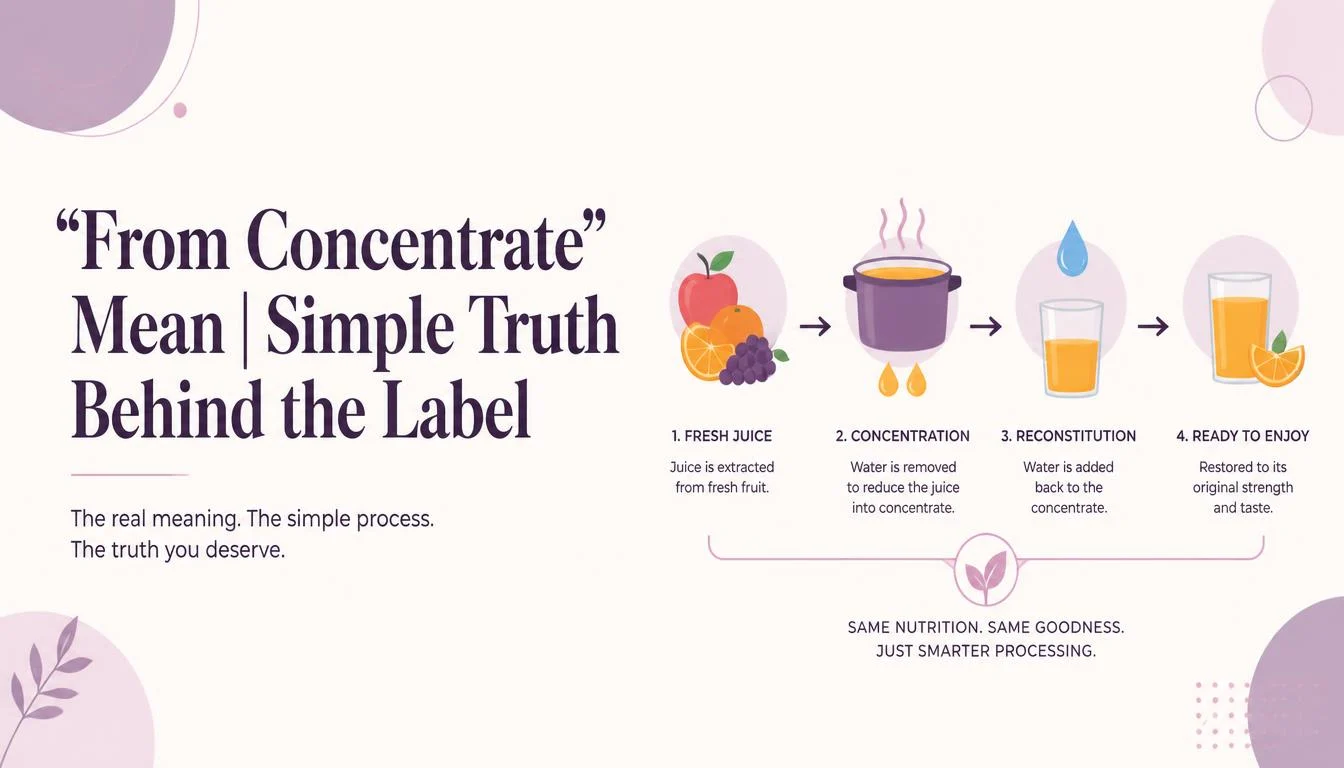
“From Concentrate” Mean means a food or drink was made by removing much of its water, then adding water back before packaging or serving. It is commonly seen on fruit juice labels.
Understanding “From Concentrate” Mean can also help you compare juice labels and understand how a product differs from not-from-concentrate juice. This guide explains the process and what the label really means.
If you’ve ever wondered “From Concentrate” Mean on a juice carton, the term refers to how the juice was processed. Water is removed from the original juice to create a concentrated form, making it easier to store and transport.
“From Concentrate” : Definition
“From concentrate” means a juice (or similar liquid product) was made by first removing most of the water from the original juice, storing or shipping it in that condensed form, and then adding water back in before it’s bottled and sold.
In short: the juice was concentrated, transported or stored, and then reconstituted (watered back down) to its original strength before it reached your fridge.
It’s a manufacturing and labeling term, not a comment on quality, safety, or taste on its own though it does affect flavor, cost, and nutrition in small ways, which we’ll get into below.
Where Did the Term Come From? A Quick Bit of Origin
The phrase “from concentrate” isn’t slang or internet-speak it’s an old food-industry and labeling term that became mainstream because of orange juice, of all things.
Here’s the short version of the story:
- In the mid-20th century, scientists developed frozen concentrated orange juice (FCOJ) as a way to preserve juice for long-distance shipping without it spoiling.
- Removing the water from juice makes it lighter, more compact, and cheaper to freeze, store, and transport in bulk.
- Once the concentrate arrived at a bottling plant, manufacturers would simply add water back to restore it to drinkable juice this became known as juice “made from concentrate.”
- As “not from concentrate” (NFC) juice became a premium selling point in the 1980s and ’90s, food labeling regulations required companies to clearly state which method was used, giving us the label you see today.
So the phrase didn’t originate as marketing lingo it grew out of genuine food science and later became a labeling requirement, which is why you now see it printed clearly on packaging worldwide.
How Popular Is the Term Today?
“From concentrate” has become a fairly common, everyday phrase especially in:
- 🥤 Grocery shopping conversations (“Is this one from concentrate or not?”)
- 📰 Nutrition and health articles comparing juice quality
- 🛒 Product labels, required by food safety authorities in many countries
- 💬 Casual conversation, sometimes used jokingly or metaphorically (more on that below)
It’s not a trendy buzzword it’s a stable, decades-old term that shows no sign of disappearing, mostly because juice labeling laws keep it in constant public view.
How “From Concentrate” Is Used in Real Life
1. Literal, Product-Label Usage (Most Common)
This is the everyday, neutral use simply describing how a beverage was produced.
Examples:
- “This apple juice is made from concentrate, so it’s a bit cheaper than the fresh-pressed kind.”
- “I prefer orange juice that’s not from concentrate it just tastes fresher to me.”
- “Check the label; a lot of cranberry juices are from concentrate.”
Tone: Neutral, informational no judgment attached.
2. Casual Comparison / Shopping Talk
People often use it to explain a purchasing decision, sometimes with a slightly opinionated tone.
Examples:
- “I only buy juice that’s not from concentrate now; it just tastes better.”
- “Honestly, from-concentrate juice is fine for smoothies you’re blending it anyway.”
Tone: Friendly, mildly opinionated, everyday conversational.
3. Figurative / Metaphorical Usage (Less Common but Real)
Occasionally, people borrow the phrase outside of food entirely, using it to describe something that feels diluted, reconstituted, or “watered down” from its original form much like reconstituted juice.
Examples:
- “That apology felt like it was from concentrate like it had been diluted before it reached me.” 😒
- “This remake is basically the original movie, but from concentrate.”
Tone: Dismissive, sarcastic, or critical implying something lost its original strength or authenticity.
This figurative use isn’t in dictionaries as an idiom yet, but it shows up occasionally in reviews, social media, and witty commentary, precisely because the imagery (diluted, reconstituted, less “pure”) translates well to non-food contexts.
“From Concentrate” vs. Similar Terms
It helps to see how this term stacks up against related labels you’ll often spot right next to it on packaging.
| Term | What It Means | Typical Tone/Perception |
|---|---|---|
| From Concentrate (FC) | Water removed, then added back before bottling | Neutral; seen as standard/budget-friendly |
| Not From Concentrate (NFC) | Juice bottled at (roughly) its original strength, never dehydrated | Often marketed as “fresher” or “premium” |
| 100% Juice | Contains no added sugar/water beyond what’s needed to reconstitute concentrate can still be from concentrate | Sometimes confused with NFC, but it’s a separate label |
| Juice Cocktail / Juice Drink | Contains real juice, but diluted with added water, sugar, or flavoring | Perceived as lower quality or less “real” |
| Freshly Squeezed | Extracted directly from the fruit, no concentration or pasteurization implied at all | Highest perceived freshness/quality |
| Reconstituted | A more technical synonym for “from concentrate” | Neutral, used more in scientific/industry contexts |
Key takeaway: “From concentrate” and “100% juice” are not opposites a product can be both. The real opposite of “from concentrate” is “not from concentrate” (NFC).
Does “From Concentrate” Mean Lower Quality?
This is the question most people are actually trying to answer, so let’s tackle it directly.
Short answer: Not necessarily.
- Nutrition: Studies generally show the nutritional difference between FC and NFC juice is minimal. Some heat-sensitive vitamins (like certain B vitamins) may be slightly reduced during the concentration process, but manufacturers often fortify juice to compensate.
- Taste: This is where the real difference shows up. Many people report that NFC juice tastes fresher and less “processed,” while FC juice can taste slightly flatter due to the loss of some natural aromatic compounds during evaporation (these are sometimes added back separately as “flavor packs”).
- Price: FC juice is almost always cheaper, since it’s more efficient to ship and store.
- Shelf life & safety: Both types are pasteurized and safe; concentration doesn’t make a product less safe.
So “from concentrate” is a manufacturing choice, not a red flag it mainly affects taste and price, not safety.
Alternate Meanings of “Concentrate” (Briefly)
The word “concentrate” itself has a few different meanings depending on context, which is worth knowing so you don’t get confused when you see it elsewhere:
- Verb to focus attention: “I need to concentrate on my homework.”
- Noun a condensed substance: juice concentrate, protein concentrate, cannabis concentrate, etc.
- Chemistry/Industry term: a substance with reduced solvent (usually water) content, meant to be diluted before use.
“From concentrate” as a phrase almost always refers to the food/beverage sense a condensed product that’s later diluted back to normal strength.
Polite, Professional, or Clearer Alternatives
If you’re writing product copy, a nutrition article, or just want to sound more precise, here are some solid alternatives depending on context:
| Instead of… | You could say… | Best used when… |
|---|---|---|
| “It’s from concentrate” | “It’s made using reconstituted juice” | Writing formal or technical content |
| “This juice is from concentrate” | “Water was added back after concentration” | Explaining the process to someone unfamiliar with it |
| “That felt from concentrate” (figurative) | “That felt diluted / insincere / watered-down” | Everyday, clearer conversation |
| “From concentrate” (label) | “Reconstituted from concentrate” | Regulatory or ingredient-list language |
Real-World Example Sentences (With Context & Tone)
| Sentence | Tone | Context |
|---|---|---|
| “This mango juice is from concentrate, but it’s still tasty.” | Neutral/Friendly | Everyday grocery chat |
| “I always check if it’s not from concentrate before buying.” | Preference-driven | Health-conscious shopper |
| “From-concentrate juices are usually more affordable.” | Informative | Budgeting advice |
| “Ugh, this juice is from concentrate no wonder it tastes weird.” | Slightly negative | Taste complaint |
| “His excuse sounded like it was from concentrate.” 😅 | Sarcastic/Figurative | Casual banter |
| “The label clearly states ‘from concentrate,’ so we know how it was processed.” | Neutral/Technical | Food science or labeling discussion |
FAQs
1. What Does “From Concentrate” Mean on a Juice Label?
It means most of the water has been removed from the juice during processing. The concentrated juice is then stored or transported and later mixed with water again before bottling.
2. Is Juice From Concentrate Bad for You?
No, juice from concentrate is not inherently unhealthy. The nutritional differences between concentrate-based and non-concentrate juice are generally small, and both can be safe to drink as part of a balanced diet.
3. Is “Not From Concentrate” Always Better?
Not necessarily. NFC juice may taste fresher and retain more of its natural flavor, but it often costs more and has a shorter shelf life than juice made from concentrate.
4. Does “From Concentrate” Mean Added Sugar?
No. The term refers to how water is removed and added back during processing, not whether sugar has been added. Check the ingredient list and nutrition label to determine if a product contains added sugar.
5. Why Do Companies Use Concentrate Instead of Fresh Juice?
Concentrating juice reduces its volume and weight, making it easier and more affordable to transport, store, and preserve over long distances.
6. Can “From Concentrate” Apply to Drinks Other Than Juice?
Yes. Similar concentration and reconstitution methods are used in some sports drinks, cordials, and other flavored beverages.
7. Is “From Concentrate” Used Outside Food and Drinks?
Occasionally, the phrase can be used figuratively to describe something that seems diluted, reworked, or less authentic than the original, such as a forced apology.
8. How Can I Tell If Juice Is From Concentrate?
Check the ingredients list. If it mentions ingredients such as “water” and “orange juice concentrate,” the product is made from concentrate. If it lists the juice without a separate water addition, it may be not from concentrate (NFC).
Conclusion:
- “From concentrate” simply means a juice was condensed by removing water, then had water added back before sale it’s a production method, not a quality verdict.
- It originated from frozen concentrated orange juice production decades ago and became a standard labeling term.
- It’s mostly used literally on food labels, but occasionally shows up figuratively to describe something diluted or less authentic.
- Compared to “not from concentrate”, the main real-world differences are taste and price, not safety or (significantly) nutrition.
- When writing or speaking more formally, “reconstituted” or “made from concentrate” are cleaner, more precise alternatives.
Next time you’re standing in the juice aisle, you’ll know exactly what that little label is telling you and you can pick your carton based on taste and budget, not confusion. 🧃
Read More Related Articles:
- THOT Meaning Explained |Slang Word You Need to Know In 2026
- Papi Chulo Mean | Guide to This Spicy Spanish Slang Term In 2026
- Hard R Meaning | Unpacking the Slang, the Slur and Confusion In 2026











1 thought on ““From Concentrate” Mean | Simple Truth Behind the Label In 2026”