Quick definition:
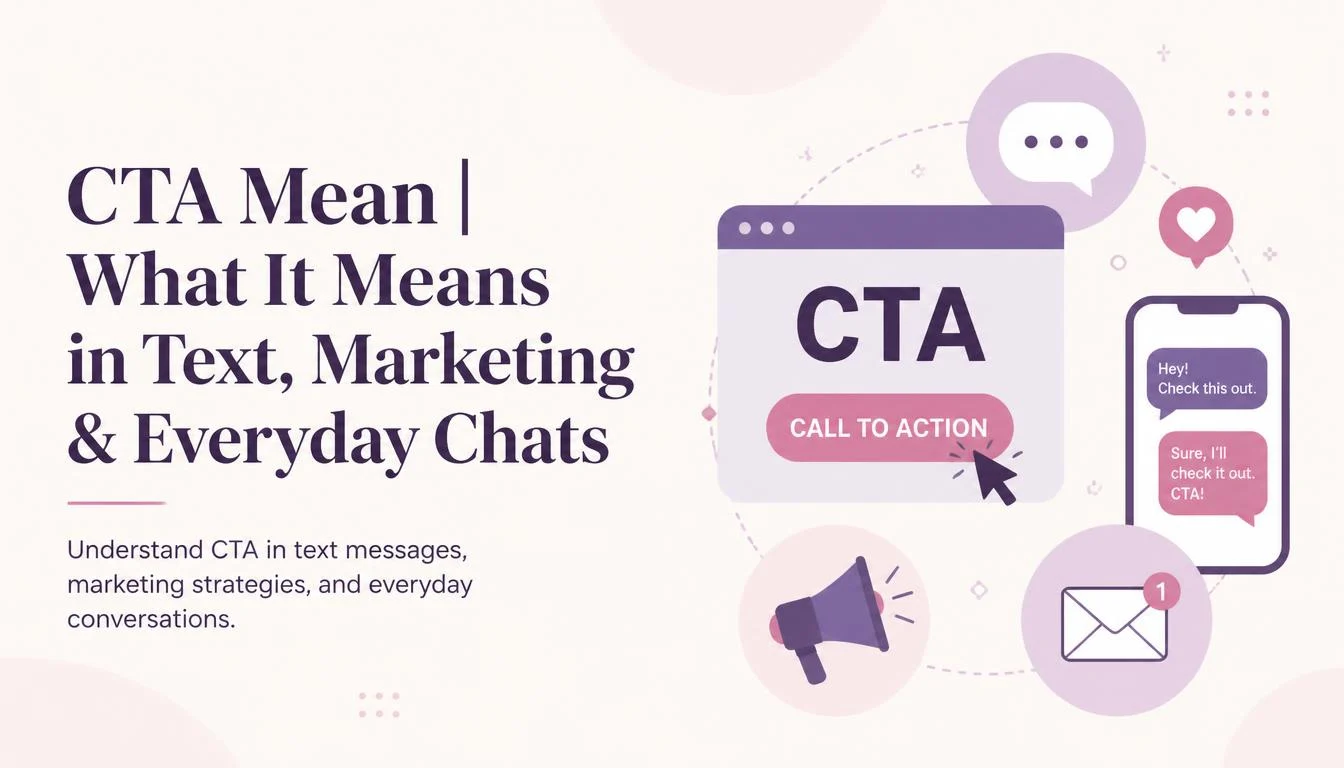
CTA mean usually refers to CTA meaning, where CTA stands for Call to Action. A call to action is a word, phrase, or instruction that encourages someone to take a specific next step, such as Buy Now, Sign Up, Learn More, Contact Us, or Click Here.
If you’ve come across CTA Mean while reading about marketing, social media, or websites, it simply refers to the meaning of CTA, or Call to Action. CTAs guide people toward a specific next step, whether that means clicking a link, making a purchase, subscribing, or contacting a business.
Understanding CTA is especially useful for creating effective digital content. From catchy buttons to short phrases in ads and emails, a well-written CTA can encourage users to engage and take action.
cta mean Meaning & Definition
If you searched for cta mean, you are most likely asking, What does CTA mean?
CTA stands for Call to Action. In simple terms, it tells a person what action they should take next.
You can see CTAs everywhere online and offline:
- Shop Now
- Buy Now
- Learn More
- Subscribe
- Sign Up
- Download the Guide
- Contact Us
- Book a Demo
- Get Started
- Follow Us
- Read More
For example:
Want better photos? Download our free editing guide.
The phrase Download our free editing guide works as the CTA because it tells readers exactly what to do.
A CTA does not always involve clicking a button. It can encourage someone to make a purchase, send an email, call a business, leave a comment, share content, register for an event, or take another desired action.
What does CTA mean in text?
In a text message, social media post, email, or online conversation, CTA can still mean Call to Action.
For example:
Check out our new collection and shop now.
Here, shop now is the CTA.
However, context matters. CTA can have other meanings in specialized fields, which we will cover later.
You probably encounter CTAs more often than you realize. Every time a website asks you to Sign Up, an email tells you to Download Now, or an Instagram post asks you to Comment below, you are seeing a call to action.
The purpose of a CTA is simple: guide people toward the next step.
Without a clear CTA, someone may enjoy your content but remain unsure about what to do afterward. A strong CTA removes that uncertainty by giving the reader a direct and understandable instruction.
Understanding cta mean is especially useful if you work with social media, blogging, email marketing, advertising, ecommerce, content creation, websites, or digital marketing.
A CTA can be short and direct, such as Buy Now, or more conversational, such as Want to learn more? Take a look at our guide.
The best CTA depends on the audience, platform, goal, and tone.
Origin
The abbreviation CTA comes from the phrase Call to Action, a long-standing concept in advertising and marketing.
The underlying idea is much older than the abbreviation itself. Traditional advertisements often encouraged audiences to perform a specific action, such as visiting a store, contacting a salesperson, ordering a product, or responding to an offer.
As marketing moved into newspapers, magazines, radio, television, websites, email, and social media, the call to action remained an important part of communication.
The internet made CTAs particularly visible because digital platforms allow users to take immediate actions.
For example, a website can display a button that says:
Start Free Trial
A visitor can click it and immediately begin the signup process.
Similarly, an email can include:
Download the Report
The reader can select the link and access the requested material.
Today, CTA is a standard term in:
- Digital marketing
- Search engine optimization
- Content marketing
- Social media marketing
- Email marketing
- Ecommerce
- Advertising
- Web design
- Conversion rate optimization
- Sales
- Mobile apps
Popularity
CTA became especially popular as digital marketing developed and businesses began measuring online actions such as clicks, registrations, purchases, downloads, and subscriptions.
A CTA provides a clear bridge between content and action.
For example, a blog post might explain how to improve website speed. At the end, the website could invite readers to:
Get a Free Website Audit
The content educates the visitor, while the CTA encourages the next step.
CTAs are also common on social media.
You may see phrases such as:
- Save this post for later
- Share this with a friend
- Follow for more tips
- Comment your favorite
- Visit the link in our bio
- Send us a message
- Tell us what you think
These are all examples of calls to action.
The term has become common enough that marketers often simply say CTA instead of writing the full phrase Call to Action.
How It Is Used
The meaning of CTA stays fairly consistent, but its use changes according to context.
CTA in marketing
Marketing CTAs encourage potential customers to take a commercially useful action.
Examples include:
- Shop Now
- Claim Your Discount
- Start Your Free Trial
- Get a Quote
- Book Your Consultation
The goal could be a sale, lead, registration, or another conversion.
CTA in social media
Social media CTAs encourage engagement or traffic.
Examples:
- Follow us for more
- Comment below
- Share this post
- Save this tip
- Tag someone who needs this
- Visit our profile
A social media CTA does not necessarily ask someone to buy something.
CTA in email
Email CTAs often direct recipients toward a particular page or action.
For example:
We just published our new guide to Instagram marketing. Read the full guide.
Here, Read the full guide is the CTA.
Other examples include:
- Register Today
- Download Now
- View the Collection
- Reserve Your Spot
- Learn More
CTA on websites
Website buttons frequently contain CTAs.
A homepage might include:
Explore Our Services
A product page might use:
Add to Cart
A software company might use:
Start Free Trial
The CTA should make the expected action obvious.
CTA in content writing
Bloggers and publishers use CTAs to move readers toward another useful action.
For example:
Enjoyed these photography tips? Read our beginner’s camera guide.
This CTA can help readers discover related content while keeping them engaged with the website.
CTA in advertising
Advertising usually relies on direct CTAs because advertisements have limited space and need to communicate a clear next step quickly.
Examples:
Get 20% Off
Order Today
Learn More
Download Free
Book Now
Examples
The meaning of CTA becomes easier to understand when you see it in realistic sentences.
| Context | Example | CTA |
|---|---|---|
| Ecommerce | Explore our summer collection. Shop Now. | Shop Now |
| Our new report is ready. Download the Report. | Download the Report | |
| Social media | What do you think? Comment below. | Comment below |
| Blog | Want more tips? Read our complete guide. | Read our complete guide |
| SaaS | Ready to try it? Start Your Free Trial. | Start Your Free Trial |
| Service business | Need help with your project? Get a Quote. | Get a Quote |
| Newsletter | Enjoy weekly tips? Subscribe Today. | Subscribe Today |
| Event | Seats are limited. Reserve Your Spot. | Reserve Your Spot |
Friendly Examples
A friendly CTA sounds natural and inviting rather than demanding.
- Example 1:
Like this idea? Give it a try and let us know how it goes.
- Example 2:
Want more simple tips? Follow us for more.
- Example 3:
Found this helpful? Save it for later.
- Example 4:
Have a favorite? Tell us in the comments.
Friendly CTAs work particularly well on social media, personal blogs, newsletters, and community-focused websites.
Professional Examples
Professional CTAs tend to be clear, specific, and action-oriented.
- Example 1:
Request a Free Consultation
- Example 2:
Download the Full Report
- Example 3:
Schedule a Product Demo
- Example 4:
Contact Our Sales Team
- Example 5:
View Pricing Options
A professional CTA should avoid unnecessary ambiguity.
For example, Click Here tells the reader very little. View Pricing Plans communicates the destination and purpose more clearly.
Funny Examples
CTAs can also have a humorous personality when the brand and audience support it.
Examples:
- Okay, Show Me the Good Stuff
- Take My Money
- Let’s Do This
- Feed My Curiosity
- I Need This
- Show Me More
- Yes, I’m Interested
Humorous CTAs work best when they match the brand voice. A playful clothing brand may use humor successfully, while a legal or financial service may need a more professional approach.
Comparison with Similar Terms
CTA is closely related to several marketing and communication terms, but these terms are not always interchangeable.
| Term | Meaning | Main Purpose |
|---|---|---|
| CTA | Call to Action | Encourage a specific action |
| CTA button | Clickable button containing a CTA | Make the action easy to take |
| Conversion | Desired completed action | Measure the result |
| Lead | Potential customer or contact | Begin a sales relationship |
| Slogan | Memorable brand phrase | Build brand recognition |
| Headline | Main attention-grabbing text | Attract interest |
| Tagline | Short brand-associated phrase | Communicate brand identity |
| Link | Clickable destination | Send users elsewhere |
| Offer | Something presented to encourage action | Create motivation |
CTA vs. slogan
A slogan communicates an idea associated with a brand or campaign.
A CTA asks the audience to do something.
For example:
Slogan:
Built for everyday adventure.
CTA:
Shop the collection.
CTA vs. conversion
These terms describe different parts of the process.
A CTA encourages the action.
A conversion occurs when the person completes the desired action.
For example:
Start Your Free Trial
is the CTA.
If the visitor actually registers for the trial, that completed registration can count as a conversion.
CTA vs. CTA button
A CTA can appear as plain text, a link, a button, or spoken language.
A CTA button is specifically a clickable interface element.
For example:
Learn More
could appear as a button on a website.
Alternate Meanings
Although CTA most commonly means Call to Action in marketing and online communication, the abbreviation can represent other terms in different industries.
Some possible meanings include:
| CTA Meaning | Context |
|---|---|
| Call to Action | Marketing, advertising, content, social media |
| Chicago Transit Authority | Public transportation in Chicago |
| Computed Tomography Angiography | Medical imaging |
| Clinical Trial Agreement | Medical research and healthcare |
| Certified Technical Architect | Certain professional or technology contexts |
This means you should always consider the surrounding context.
If someone says:
Make the CTA more visible
they almost certainly mean Call to Action.
If someone discusses Chicago trains, CTA may refer to the Chicago Transit Authority.
If a medical professional uses CTA in a clinical discussion, it may refer to Computed Tomography Angiography.
Professional or Polite Alternatives
If you are explaining CTA to someone unfamiliar with marketing terminology, you do not need to use the abbreviation.
Instead, you can write:
- Call to action
- Next step
- Action prompt
- Action button
- Invitation to act
- Recommended next step
- Suggested action
- Response prompt
For example, instead of:
Please improve the CTA.
You could say:
Please make the call to action clearer.
Or:
Please make the next step more obvious for readers.
For customer-facing communication, a natural phrase is often better than marketing jargon.
Common Mistakes
1. Assuming CTA always means Call to Action
In digital marketing, this is usually correct, but CTA has other meanings.
Always consider context.
2. Making the CTA too vague
Click Here is technically a CTA, but it does not explain what the user will get.
Better:
Download the Free Guide
3. Using too many CTAs
Giving visitors several competing actions can make the next step unclear.
For example, a page might simultaneously ask users to:
- Buy now
- Subscribe
- Download a guide
- Book a call
- Follow on Instagram
- Read another article
Sometimes fewer choices create a clearer path.
4. Making every CTA sound like a sales pitch
Not every audience wants to be pushed toward a purchase.
Instead of:
BUY NOW!
a softer approach may work better:
Explore the Collection
5. Ignoring context
A CTA should match the content immediately before it.
If a blog post teaches beginners how to create a website, an appropriate CTA might be:
Download the Beginner’s Website Checklist
That feels connected to the reader’s current interest.
6. Using unclear language
Avoid complicated wording when a simple instruction works.
Instead of:
Initiate the process of accessing our resources.
Use:
Download the Resources
Clear language usually improves usability.
Quick Tips
Use these practical tips when creating or interpreting a CTA:
- Know the goal. Decide what you want the audience to do.
- Use action-oriented language. Words such as download, explore, book, join, and shop can make the action clear.
- Keep it understandable. The reader should know what happens next.
- Match the CTA to the audience. A professional audience may prefer direct language, while social media audiences may respond well to conversational wording.
- Show the benefit when possible. Compare Download Now with Download the Free SEO Checklist.
- Avoid unnecessary urgency. Use phrases such as Limited Time only when they accurately describe the offer.
- Make important CTAs easy to find. On a website, placement, design, and readability matter.
- Test different wording. Marketers often compare CTA variations to see which performs better.
- Do not rely only on buttons. Context around the CTA can also influence whether people act.
- Respect user intent. A helpful CTA should feel like a logical next step rather than an interruption.
CTA examples by goal
| Goal | CTA Example |
|---|---|
| Purchase | Shop Now |
| Registration | Sign Up Today |
| Download | Download the Guide |
| Contact | Contact Us |
| Consultation | Book a Consultation |
| Information | Learn More |
| Engagement | Leave a Comment |
| Social growth | Follow for More |
| Newsletter | Subscribe |
| Event | Reserve Your Seat |
FAQs
1. What does CTA mean?
CTA means Call to Action. It refers to a word, phrase, button, or instruction that encourages someone to take a specific action.
2. What does CTA mean in text?
In texting or online communication, CTA usually means Call to Action when the conversation involves marketing, content, social media, or business. It can also have other meanings depending on context.
3. What is an example of a CTA?
Common CTA examples include Buy Now, Learn More, Sign Up, Download Now, Contact Us, and Book a Demo.
4. What does CTA mean in marketing?
In marketing, CTA means Call to Action. It directs an audience toward a desired next step, such as making a purchase, registering for an account, downloading content, or contacting a business.
5. What is a CTA button?
A CTA button is a clickable website or app element designed to encourage a particular action. Examples include Start Free Trial, Shop Now, and Get Started.
6. What is the difference between CTA and conversion?
A CTA encourages an action, while a conversion is the completed action or desired outcome. For example, Sign Up is a CTA, while a completed registration may be the conversion.
7. Is CTA only used in digital marketing?
No. Calls to action can appear in advertisements, emails, websites, social media, printed materials, presentations, sales conversations, and other forms of communication.
8. What is another word for CTA?
Depending on the context, alternatives include call to action, next step, action prompt, suggested action, or action button. In marketing, call to action is the clearest full form.
Conclusion
So, cta mean generally refers to CTA meaning: Call to Action. A CTA tells an audience what to do next, whether that means buying a product, downloading a resource, signing up for a service, reading another page, or simply leaving a comment.
You can find CTAs in websites, emails, advertisements, blogs, social media posts, ecommerce stores, apps, and almost every form of modern digital marketing.
The most effective CTAs are usually clear, relevant, specific, and appropriate for the audience. Instead of simply saying Click Here, give people a better idea of what they will receive, such as Download the Free Guide or View Our Pricing Plans.
Read More Related Articles:
- Mercy Meaning | Powerful Lesson Behind Kindness and Forgiveness In 2026
- Mija Meaning In Spanish | Sweet Nickname You’ll Hear Everywhere In 2026
- Punta Meaning In Spanish | From Literal Meaning to Everyday Usage In 2026

Michael Turner is a U.S.-based content writer and blogger who enjoys uncovering the stories and meanings behind words. Through his work at Meanvora, he delivers well-researched, easy-to-read articles that help readers expand their vocabulary and gain a deeper understanding of language.








6 thoughts on “CTA Mean | What It Means in Text, Marketing & Everyday Chats In 2026”