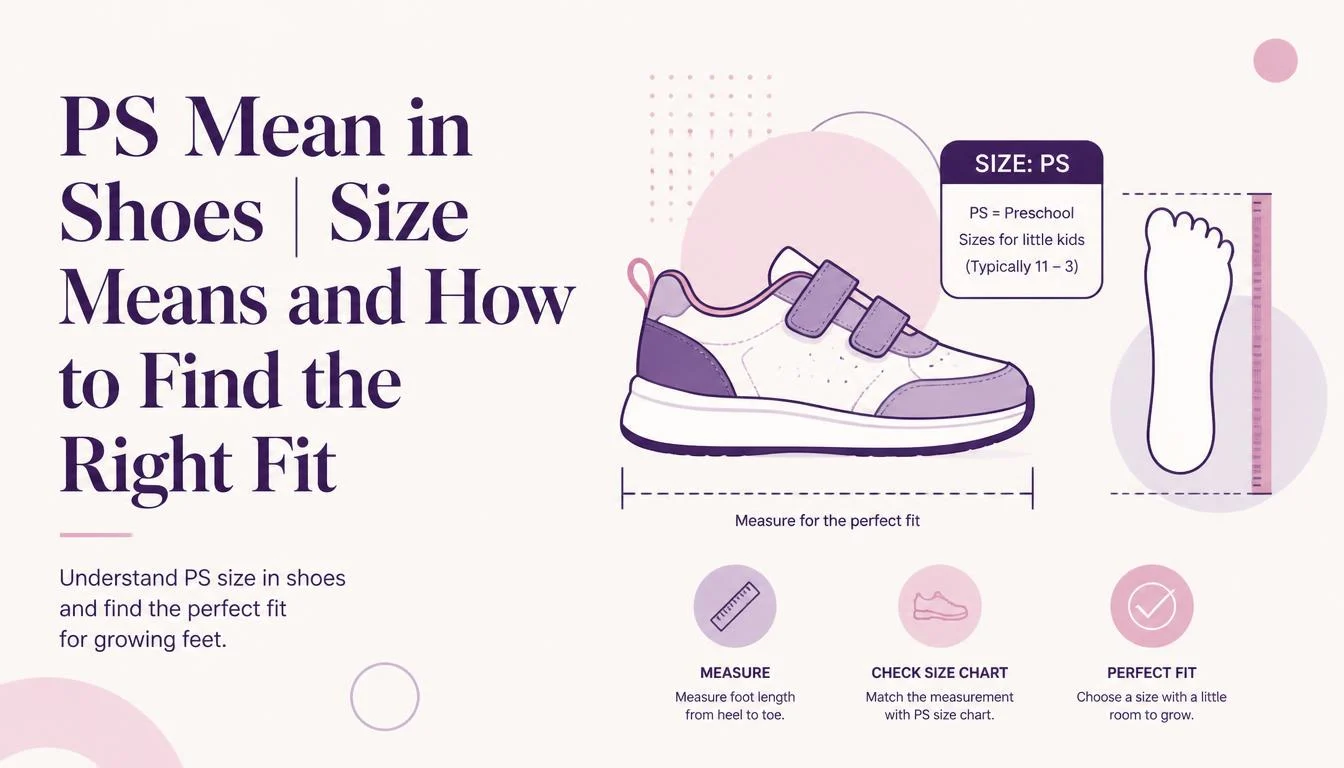
Quick definition:
In footwear, PS means Preschool. It identifies a children’s shoe size category generally intended for preschool-age kids, sitting between toddler sizing and larger grade-school or youth sizing. The exact size range varies by brand, so the age label should never replace an actual foot measurement.
Seeing PS beside a sneaker name can be confusing, especially when shopping for Nike, Jordan, Adidas, or other popular kids’ footwear. You might wonder whether PS describes the shoe’s design, material, performance level, or something else.
In most sneaker and footwear listings, PS means Preschool. It tells you that the shoe belongs to a sizing category created for young children. PS shoes usually sit between TD (Toddler) and GS (Grade School) sizing.
This abbreviation appears frequently in online sneaker stores, product titles, size charts, resale marketplaces, and brand catalogs. For example, a listing might say Nike Air Force 1 PS, Jordan 1 Retro PS, or Adidas Superstar PS. In each case, PS generally points to the preschool version rather than an adult version of the same shoe.
The important thing to remember is that PS is a sizing category, not a guarantee of age or exact fit. Children’s feet grow at different rates, and brands can use slightly different measurements. Therefore, checking the manufacturer’s size chart and measuring the child’s foot is more reliable than choosing a PS shoe based only on age.
PS Mean in Shoes: Meaning & Definition
PS in shoes stands for Preschool.
It is commonly used to identify footwear designed for young children who have moved beyond toddler sizing but have not yet reached the larger grade-school range.
A simple way to understand the progression is:
Infant → Toddler (TD) → Preschool (PS) → Grade School (GS) → Adult
However, this sequence is a general guide rather than a universal sizing system. Different brands organize children’s sizes differently.
For example, StockX specifically lists PS as Preschool, GS as Grade School, TD as Toddler, and I as Infant among common sneaker sizing abbreviations.
What does PS mean on sneakers?
When you see something such as:
- Nike Air Max PS
- Jordan PS
- Adidas Campus PS
- Puma Suede PS
the PS usually means the model is available in Preschool sizing.
It does not normally mean that the shoe has a special performance feature or a particular material.
What age is PS shoe size for?
PS shoes are generally associated with children around 3 to 5 years old, although age should only serve as a rough reference. A child’s actual foot length matters much more than their age
Some children may move into or out of PS sizing earlier or later because children’s feet develop at different rates.
Origin of PS Shoe Sizing
The use of PS as an abbreviation for Preschool developed from the need to organize children’s footwear into recognizable size categories.
Children’s footwear cannot simply use adult sizing because children’s feet change considerably during their early years. Retailers and footwear brands therefore separate products into categories that make shopping easier.
The terminology commonly seen today includes:
- I = Infant
- TD = Toddler
- PS = Preschool
- GS = Grade School
- Y = Youth
- W = Women’s
Modern sneaker marketplaces also use these abbreviations to distinguish versions of the same model made for different age groups or sizing systems.
The popularity of sneaker culture has made these abbreviations even more visible. A parent shopping for children’s sneakers may encounter the same shoe model offered in TD, PS, GS, and adult versions.
That means knowing what PS means can prevent an easy but costly mistake: ordering a shoe that looks exactly like the desired model but comes in the wrong size category.
Popularity of PS Shoes
PS sizing has become particularly common in the sneaker market.
Brands such as Nike, Jordan, Adidas, and Puma frequently offer children’s versions of popular footwear models. Retailers and sneaker marketplaces then use labels such as PS and GS to make those versions easier to identify. (Best Walking Feet)
There are several reasons PS shoes are popular.
1. Kids can wear versions of popular sneakers
Many iconic sneaker designs come in children’s sizes. Parents can buy a smaller version of a popular model without purchasing an adult-sized shoe.
2. Easier shopping
The PS label quickly tells shoppers that the product belongs to a preschool sizing category.
3. Practical children’s construction
Preschool versions may include features suited to younger children, such as simpler closures, flexible construction, and durable materials. However, these features vary by model and manufacturer.
4. Strong sneaker culture
Sneaker collecting and matching family outfits have increased interest in children’s versions of popular footwear.
How PS Is Used in Shoes
You will usually see PS in one of three places:
- Product names
- Size charts
- Online sneaker listings
For example:
Air Jordan 1 Low PS
Here, PS tells you that the product is the preschool version.
You might also see:
Size 12C PS
In this situation, the number represents the shoe size while PS identifies the children’s category.
PS on Nike shoes
Nike commonly uses PS for Little Kids or Preschool footwear. A Nike PS chart can include sizes from around 10.5C through 3Y, with measurements varying by size
The important point is that you should not assume every Nike PS shoe has exactly the same fit as a PS shoe from another brand.
PS on Jordan shoes
Jordan products frequently use PS to distinguish preschool versions from toddler and grade-school versions.
For example:
Air Jordan 1 Retro High OG PS
means the sneaker is the preschool-sized version of that Jordan model.
PS on Adidas shoes
Adidas and other major brands may also use PS to identify children’s or preschool versions. However, the exact measurements and available sizes can differ between brands and individual models.
Examples of PS in Shoes
Understanding the abbreviation becomes easier when you see it in real shopping situations.
Friendly Examples
Here are some natural examples:
- “I found these sneakers in PS for my daughter.”
- “Do you have this style in PS?”
- “The PS version looks just like the bigger kids’ model.”
- “Check the PS size chart before ordering.”
- “These Jordan PS shoes should work if the measurements match.”
These examples use PS as ordinary shopping terminology.
Professional Examples
Retailers, customer-service teams, and product descriptions might use wording such as:
- “This model is available in PS sizing.”
- “Please check the brand’s PS size chart before purchasing.”
- “The product shown is the preschool version.”
- “PS sizes are intended for younger children and may differ from GS sizing.”
- “Please measure the child’s foot before selecting a PS size.”
This style is clearer because it explains what PS means instead of assuming every customer knows the abbreviation.
Funny Examples
PS can also appear casually in social media captions:
- “Tiny feet, serious sneaker game: PS edition 👟”
- “Big sneaker energy in a little-kid size.”
- “PS today, GS tomorrow. They grow fast! 😂”
- “Mini sneakers, maximum style.”
- “The shoes are small, but the attitude is not. 😎👟”
These are not official sizing definitions, but they show how people may talk about children’s sneakers online.
PS Shoe Size Chart: What You Should Know
There is no single universal PS size chart that works perfectly for every brand.
A general PS range may cover children’s sizes from approximately 10.5C to 3Y, but the exact range depends on the manufacturer. Nike’s published-style chart, for example, includes PS/Little Kids sizes progressing from 10.5C upward into youth sizing.
| Term | Common Meaning | General Category |
|---|---|---|
| I | Infant | Babies |
| TD | Toddler | Toddlers |
| PS | Preschool | Young children |
| GS | Grade School | Older children |
| Y | Youth | Youth sizing |
| W | Women’s | Women’s sizing |
Important: These categories are not interchangeable. A numerical size can also mean something different depending on whether it is labeled C, Y, men’s, or women’s.
Comparison With Similar Terms
Understanding PS becomes much easier when you compare it with other common sneaker abbreviations.
| Abbreviation | Meaning | Typical User | Position |
|---|---|---|---|
| I | Infant | Babies | Smallest |
| TD | Toddler | Toddlers | Before PS |
| PS | Preschool | Young children | Between TD and GS |
| GS | Grade School | Older children | After PS |
| Y | Youth | Children/teens | Larger youth sizing |
| W | Women’s | Women | Adult category |
PS vs TD
PS means Preschool, while TD means Toddler.
TD sizing generally comes before PS. If a child has outgrown toddler shoes, PS may be the next category to investigate.
However, don’t automatically switch categories just because of age. Compare the child’s foot measurement with the brand’s chart.
PS vs GS
This is one of the most important comparisons.
PS = Preschool
GS = Grade School
GS generally represents a larger children’s or youth category than PS. StockX also identifies PS as Preschool and GS as Grade School in its sneaker sizing terminology.
PS vs Youth
PS and youth sizing are related but should not be treated as identical.
A product labeled PS is specifically marketed within the preschool category, while Y generally refers to youth sizing.
Some size ranges transition from C, meaning Child, into Y, meaning Youth.
PS vs Adult Shoes
A PS shoe is not simply an adult shoe made smaller.
The sizing system, proportions, intended wearer, and sometimes construction can differ. That’s why an adult numerical size should never be assumed to equal the same number in PS or youth sizing.
Alternate Meanings of PS
In the context of shoe sizing, PS almost always refers to Preschool when it appears beside a children’s sneaker size or model.
However, the letters PS can have completely different meanings outside footwear.
For example, PS may refer to:
- PlayStation in gaming
- Postscript in writing
- Photoshop in casual conversation
- A product-specific abbreviation created by a particular manufacturer
Context matters.
If you see PS after a sneaker model, such as “Air Jordan PS,” the footwear meaning is generally Preschool.
If you see “PS” at the end of a personal letter or email, it may mean postscript instead.
Professional or Polite Alternatives
If you’re writing product descriptions or explaining PS to customers, avoid assuming that everyone understands the abbreviation.
Instead of:
“Available in PS.”
you can write:
“Available in Preschool (PS) sizing.”
This is especially useful for ecommerce websites.
Other clear alternatives include:
- Preschool size
- Preschool footwear
- Preschool shoe sizing
- Children’s preschool size
- Little Kids sizing
- Preschool version
- Kids’ PS size
Better ecommerce wording
A product description could say:
“This sneaker is available in Preschool (PS) sizing for young children. Please check the brand-specific size chart and measure the child’s foot before ordering.”
That wording is more helpful than simply writing “PS available.”
Common Mistakes
1. Assuming PS means a shoe feature
PS usually describes the sizing category, not cushioning, material, technology, or performance.
2. Choosing PS based only on age
Age is only a rough guide.
A 4-year-old may need a different size from another 4-year-old. Always prioritize foot length and the manufacturer’s chart.
3. Treating every brand’s PS sizing as identical
This is one of the biggest shopping mistakes.
Different manufacturers can have different size measurements and fit characteristics. StockX recommends checking the product’s sizing information and consulting the manufacturer for brand-specific fit guidance.
4. Confusing PS with GS
PS and GS are different categories.
If you’re buying a shoe for a younger child, make sure the listing actually says PS rather than GS.
5. Assuming the same number fits the same everywhere
A numerical size without its category can be misleading.
For example, 3Y is not necessarily equivalent to a men’s size 3. Sizing systems use different standards and labels.
6. Ignoring foot width
Length is important, but width also affects comfort.
A shoe can have the correct length but still feel too narrow or too loose.
Quick Tips for Buying PS Shoes
Follow these steps when shopping for preschool sneakers:
- Measure both feet. One foot can be slightly longer than the other.
- Use the larger measurement. Choose a size that accommodates the longer foot.
- Check the brand’s size chart. Don’t rely solely on an age recommendation.
- Look at the C or Y designation. These letters can provide additional sizing context.
- Check the return policy. This is especially important when buying online.
- Consider width. Length alone doesn’t determine comfort.
- Try shoes later in the day when possible. Feet can naturally change slightly in volume throughout the day.
- Allow comfortable growing room. Avoid buying excessively large shoes simply because children’s feet grow quickly.
- Check both shoes. Have the child walk around to make sure the heel and toe feel secure.
- Recheck the fit regularly. Young children’s feet can change quickly.
A simple measurement method
If you’re ordering PS shoes online:
- Place the child’s foot on a sheet of paper.
- Keep the heel gently against a straight surface.
- Mark the longest toe.
- Measure the heel-to-toe distance.
- Repeat for the other foot.
- Compare the larger measurement with the manufacturer’s chart.
This method is generally more reliable than guessing from age alone.
PS Shoes and Sneaker Shopping: Practical Example
Imagine you’re shopping for a pair of children’s Jordan sneakers.
You see three listings:
| Listing | Meaning |
|---|---|
| Jordan 1 TD | Toddler version |
| Jordan 1 PS | Preschool version |
| Jordan 1 GS | Grade School version |
If your child is between toddler and older-child sizing, the PS option may be the appropriate category, but the actual size still needs to match the child’s measurements.
For example, simply saying “My child is four, so I need PS” isn’t enough. The better process is:
Age → measure foot → check brand chart → select size → check fit
That approach reduces the chance of ordering shoes that are too tight or too loose.
FAQs
1. What does PS mean in shoes?
PS means Preschool in shoe and sneaker sizing. It generally identifies footwear intended for young children between toddler and grade-school sizing categories.
2. What age is PS shoe size for?
PS sizing is commonly associated with children around 3 to 5 years old, but age is only a general guideline. Foot measurements provide a better indication of the correct size
3. What does PS mean in Nike shoes?
In Nike footwear, PS means Preschool and identifies a children’s sizing category. Nike’s Little Kids/PS sizing can extend from around 10.5C through 3Y, depending on the product and size system.
4. Is PS the same as toddler sizing?
No. PS means Preschool, while TD means Toddler. TD generally represents an earlier children’s sizing category, followed by PS and then larger youth or GS categories.
5. Is PS the same as GS?
No. PS stands for Preschool, while GS stands for Grade School. GS generally represents a larger children’s sizing category.
6. What size is PS in shoes?
There isn’t one universal PS size. Many brands use a range around 10.5C to 3Y, but the exact measurements and available sizes vary. Always check the individual brand’s chart.
7. Does PS mean kids’ shoes?
Yes. In sneaker sizing, PS generally indicates Preschool or young children’s footwear. It is particularly common in children’s versions of popular sneaker models.
8. How do I choose the right PS shoe size?
Measure the child’s foot from heel to the longest toe, measure both feet, and compare the larger measurement with the manufacturer’s size chart. Don’t choose solely according to age.
Conclusion
So, what does PS mean in shoes? The answer is simple: PS means Preschool.
It is a children’s footwear category commonly positioned between toddler and grade-school sizing. You’ll often see PS on Nike, Jordan, Adidas, Puma, and other sneaker listings, particularly when popular shoe models are available in multiple children’s sizes.
The most important thing to remember is that PS describes a sizing category, not an exact foot size. A child’s age can provide a rough starting point, but foot length, width, brand-specific measurements, and the actual shoe design matter more.
If you’re buying PS shoes online, measure both feet, use the larger measurement, check the manufacturer’s chart, and confirm the return policy before ordering. Once you understand the difference between PS, TD, GS, and Y, children’s sneaker listings become much easier to read and compare.
Read More Related Articles:
- DILF Meaning | Why This Slang Term Is Trending Online In 2026
- “Show in Shared with You” Meaning | What This Option Really Does In 2026
- “Live” Mean on Find My iPhone | Complete Guide to Real-Time Location Sharing In 2026




2 thoughts on “PS Mean in Shoes | Size Means and How to Find the Right Fit In 2026”