Quick Answer
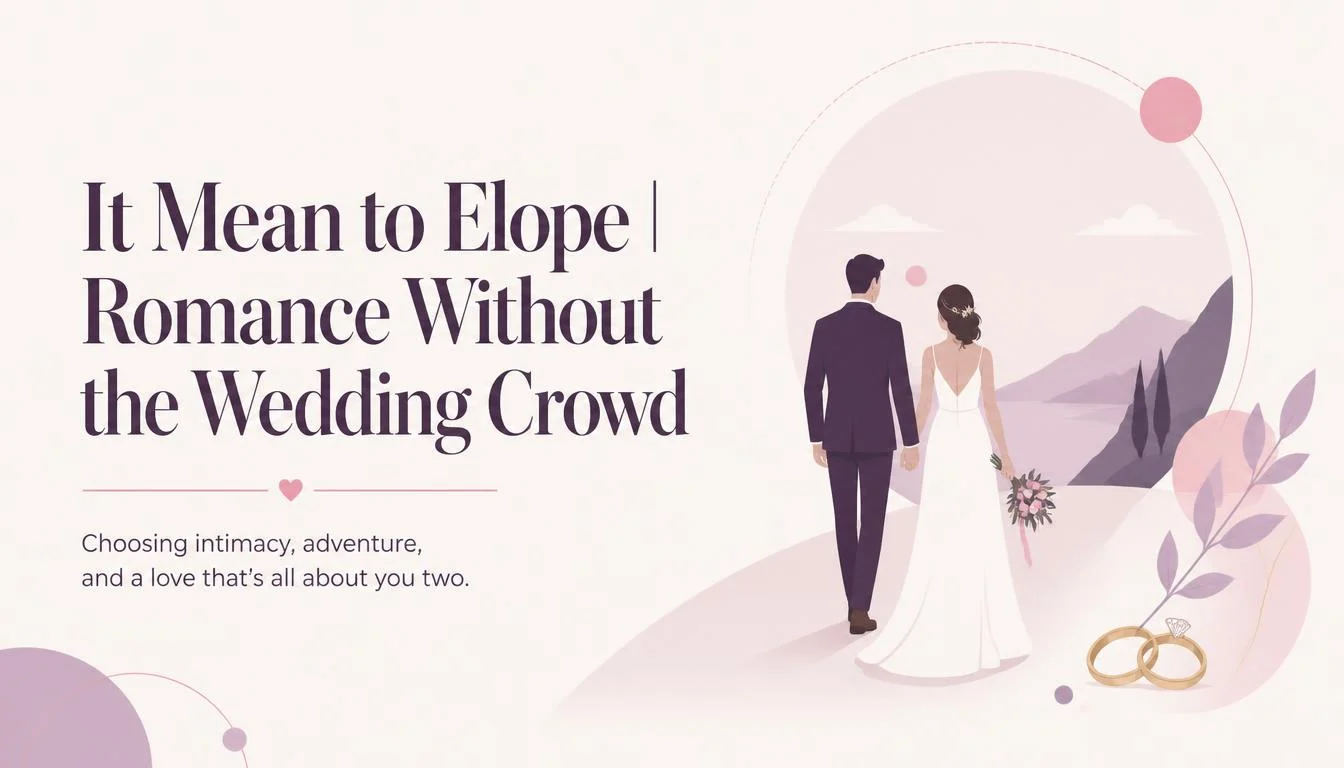
To elope means to get married privately and usually without a large traditional wedding. Today, couples may choose to elope for simplicity, privacy, lower costs, or a more personal wedding experience.
Wondering What Does It Mean to Elope? The term traditionally referred to couples running away secretly to get married. Today, eloping usually means choosing a small and private wedding without the planning and expense of a large ceremony.
For many couples, eloping is a meaningful way to focus on their commitment rather than a big celebration. It can involve just the couple or a few close family members and friends depending on their preferences.
Elope Meaning: Definition
Elope (verb): To leave home secretly in order to get married, usually without the knowledge or consent of parents or without holding a traditional wedding ceremony. In modern usage, “to elope” more broadly means to marry in a small, private, low-key way often just the couple, sometimes with a tiny group of witnesses instead of throwing a large, traditional wedding.
Elopement (noun): The act or event of eloping; a small, intimate wedding that skips the large guest list, formal reception, and traditional planning process.
Quick snapshot for a fast answer:
| TermPart of SpeechSimple Meaning | ||
|---|---|---|
| Elope | Verb | To get married secretly or privately, often without a big ceremony |
| Elopement | Noun | The private or secret wedding event itself |
| Eloper | Noun (informal) | A person who elopes |
| Eloping | Verb (present participle) | The ongoing act of choosing a private wedding path |
That’s the one-line version. Now let’s dig into where this word came from and how its meaning has quietly shifted over the centuries.
Origin of the Word “Elope”
The word “elope” has a surprisingly long history, and it didn’t always have anything to do with weddings.
- It traces back to the Anglo-Norman word aloper, which described a woman running away from her husband with a lover.
- Some etymologists connect it to the Middle Dutch word lopen, meaning “to run” or “to leap.”
- By the 17th century, English law had adopted “elope” to describe a wife who left her husband, often carrying legal and property implications at the time.
- It wasn’t until later around the 18th and 19th centuries that “elope” softened into its more familiar modern meaning: a couple running off together to marry, usually against their families’ wishes.
So historically, eloping was tangled up with rebellion, scandal, and sometimes even legal trouble. Think Shakespearean subplots, secret midnight departures, and disapproving fathers chasing carriages down country roads.
How Popular Is the Word “Elope” Today?
Fast forward to today, and “elope” has had a full image makeover. It’s no longer just about sneaking away it’s become a mainstream, even trendy, wedding choice.
Here’s why the word has surged back into everyday conversation:
- Wedding costs have skyrocketed. Many couples are choosing smaller, more intentional ceremonies over expensive traditional weddings.
- Destination elopements are booming. Search interest in terms like “elopement packages,” “how to elope,” and “elopement photographer” has grown steadily as couples opt for adventurous, photo-worthy ceremonies in places like national parks, mountains, and coastlines.
- Social media normalized it. Elopement photography has become its own genre on Instagram and Pinterest, turning what used to feel like a “lesser” wedding option into an aspirational one.
- Pandemic-era shifts stuck around. Many couples who eloped out of necessity during 2020–2021 loved the experience so much that eloping is now seen as a legitimate, even preferable, wedding style rather than a backup plan.
In short: the modern meaning of “elope” has moved from “secret and scandalous” to “small, intentional, and stress-free.” The word still implies privacy, but it’s lost most of its taboo.
Real-World Usage: How People Actually Use “Elope”
Context changes everything with this word. Depending on the tone, “we eloped” can sound romantic, practical, rebellious, or even a little judgmental. Here’s how it plays out in real conversations.
1. Friendly / Romantic Tone
- “We eloped to Iceland last spring just the two of us, a photographer, and the most epic waterfall backdrop. 💍”
- “Honestly, eloping was the best decision we made. No stress, no drama, just us.”
- “They eloped on a whim during their trip to Italy and I am SO here for it.”
2. Neutral / Informational Tone
- “The couple eloped in October and plans to host a larger celebration next summer.”
- “Elopements typically involve two to ten people, compared to the 100+ guests at a traditional wedding.”
- “She explained that they chose to elope for financial and logistical reasons.”
3. Negative / Dismissive or Disapproving Tone
- “They just eloped without telling anyone my mom is still upset about it.”
- “I can’t believe they eloped; it felt like we were shut out of something important.”
- “Back then, eloping was basically the scandal of the town. 😳”
Notice the pattern: older or more traditional usage leans toward secrecy and disapproval, while modern, wedding-industry usage leans toward empowerment and simplicity. Both meanings are still very much alive today, so context (and tone of voice) matters a lot.
Elope vs. Similar Terms: What’s the Difference?
People often use “elope” interchangeably with a few other wedding-related terms, but they’re not identical. Here’s a clear comparison.
| Term | Meaning | Guest Count | Secrecy Level | Typical Vibe |
|---|---|---|---|---|
| Elope | Private marriage, often skipping a traditional wedding | 0–10 people | Can be secret or simply private | Intimate, spontaneous, personal |
| Courthouse Wedding | Legal marriage ceremony performed at a courthouse or city hall | 0–5 people | Usually not secret, just simple | Quick, official, low-cost |
| Micro Wedding | A scaled-down version of a traditional wedding | 10–50 people | Not secret | Still has traditional elements (dress, vows, reception) |
| Runaway Marriage | An older/dramatic term for eloping, often implying family disapproval | Usually just the couple | Highly secretive | Romantic-rebellious, often dramatic |
| Destination Wedding | A wedding held away from home, but can still be large | Varies widely | Not secret | Travel-focused celebration |
| Elopement (modern) | A planned, intentional small wedding, often with photography and a scenic location | 2–10 people | Private, not necessarily secret | Adventurous, romantic, curated |
Key takeaway: All elopements are private, but not all private weddings are technically “elopements.” A courthouse wedding, for example, might be quick and small but doesn’t carry the same emotional or symbolic weight the word “elope” often implies.
Alternate Meanings of “Elope”
While the marriage-related meaning dominates modern usage, “elope” has a couple of lesser-known meanings worth a quick mention:
- Legal/historical usage: In older legal contexts, “elopement” referred specifically to a wife leaving her husband, sometimes for another man, and carried consequences related to property and inheritance rights.
- Figurative/rare usage: Very occasionally, “elope” is used loosely and informally to describe any sudden, secretive departure not necessarily related to marriage at all (e.g., “she eloped from the meeting without a word”). This usage is uncommon and mostly poetic or old-fashioned.
These alternate meanings are rare in everyday conversation, but they explain why the word feels a little more loaded or dramatic than a plain term like “getaway wedding.
Polite and Professional Alternatives to “Elope”
If you’re writing something formal a wedding announcement, a professional bio, or an invitation to a small ceremony you might want softer or more descriptive alternatives. Here are some solid options:
- “We had a private ceremony.”
- “We chose an intimate wedding.”
- “We got married in a small, personal ceremony.”
- “We celebrated with a courthouse wedding.”
- “We held a destination elopement with close family.”
- “We opted for a minimalist wedding experience.”
These phrasings keep the meaning intact while sounding a bit more formal or diplomatic useful for announcements, resumes (yes, some people mention life events briefly in bios), or conversations with more traditional family members who might react strongly to the word “elope” itself.
Examples in Context: A Labeled Table
Here’s a quick-reference table showing how “elope” shifts meaning based on tone and setting.
| Example Sentence | Tone | Context |
|---|---|---|
| “We eloped to Santorini and it was magical.” | Friendly / Romantic | Casual conversation, social media caption |
| “The couple eloped last month; a reception will follow in spring.” | Neutral | Wedding announcement or news blurb |
| “They eloped without even telling their parents.” | Negative / Disapproving | Family gossip or disappointed reaction |
| “Eloping saved us over $20,000 compared to a traditional wedding.” | Practical / Informational | Wedding-planning blog or financial article |
| In the 1800s, eloping could mean being disowned by your family. | Historical | Academic or historical writing |
| “We’re eloping this weekend just us and the mountains. 🏔️💕” | Excited / Personal | Text message or social post |
Why Do Couples Choose to Elope? (Common Reasons)
Understanding the “why” behind eloping helps explain why the word has become so popular again. Common reasons include:
- Budget-friendly: Traditional weddings can cost tens of thousands of dollars; eloping dramatically cuts costs.
- Less stress: No seating charts, vendor juggling, or family drama to manage.
- More adventure: Couples can marry somewhere meaningful a national park, a foreign city, a mountaintop without needing to accommodate 100+ guests.
- Privacy: Some couples simply prefer to keep their vows personal and low-key.
- Faster timeline: Elopements can be planned in weeks instead of the year-plus timeline of a big wedding.
- Avoiding family conflict: In some cases, couples elope specifically to sidestep disapproving relatives or complicated family dynamics.
FAQs
1. What Does It Mean to Elope With Someone?
To elope with someone means to marry them privately and quietly. It often means skipping a traditional wedding, large guest list, or elaborate ceremony. Historically, the word could also imply getting married without telling family beforehand.
2. Is Eloping the Same as Getting Married in Secret?
Not necessarily. In the past, eloping often involved keeping the marriage secret from family and friends. Today, many couples tell their loved ones ahead of time and simply choose a smaller and more private wedding.
3. Do You Need Witnesses to Elope?
In many places, legal marriage requires one or more witnesses. However, the exact requirements depend on local marriage laws. Couples should check the rules in their chosen location before planning an elopement.
4. Can You Legally Elope Anywhere?
Eloping is not a separate legal category. It is simply a private way of getting married. As long as the couple meets the normal marriage requirements such as obtaining a license, meeting age requirements, and having witnesses when required, the marriage can be legally valid.
5. How Is Eloping Different From a Courthouse Wedding?
A courthouse wedding is one specific type of small and private wedding. It usually takes place at a government office and follows a simple legal process. Eloping is broader and can happen in many settings such as a beach, forest, rooftop, or courthouse.
6. Can You Elope and Celebrate Later?
Absolutely. Many couples choose to elope first and celebrate with family and friends later. They may organize a reception, dinner, party, or casual gathering for loved ones who were not present at the ceremony.
7. Why Do People Use the Word “Elope”?
The word “elope” carries more meaning than simply saying “get married quietly.” It can suggest romance, spontaneity, privacy, or even a touch of rebellion. That emotional feeling makes it a more expressive way to describe a private wedding.
8. Is Eloping Disrespectful to Family?
That depends on the family and how the decision is communicated. Some relatives may feel hurt because they expected to be involved in the wedding. Others may completely support the couple’s choice. Being honest and communicating expectations can help prevent misunderstandings.
Conclusion:
So, what does it mean to elope? At its core, it means choosing a small, private, intentional path to marriage one that skips the large guest list, the drawn-out planning, and (historically) sometimes even skips telling anyone at all.
Here’s the quick recap:
- Elope originally meant running away secretly to marry, often against family wishes.
- Today, it more commonly means having a small, private wedding, whether or not secrecy is involved.
- The tone of “elope” can be romantic, neutral, or disapproving, depending on context.
- It’s different from but related to terms like courthouse wedding, micro wedding, and destination wedding.
- Couples elope for reasons ranging from budget and stress reduction to adventure and privacy.
- If you want a softer alternative, phrases like “private ceremony” or “intimate wedding” work well in formal contexts.
Read More Related Articles:
- JSP Meaning | Internet Acronym Everyone Gets Wrong In 2026
- What Does WTM Mean in Text | Common Uses You Should Know In 2026
- What Does ACC Mean | Every Meaning Made Simple In 2026

Michael Turner is a U.S.-based content writer and blogger who enjoys uncovering the stories and meanings behind words. Through his work at Meanvora, he delivers well-researched, easy-to-read articles that help readers expand their vocabulary and gain a deeper understanding of language.







5 thoughts on “It Mean to Elope | Romance Without the Wedding Crowd In 2026”