Quick Definition
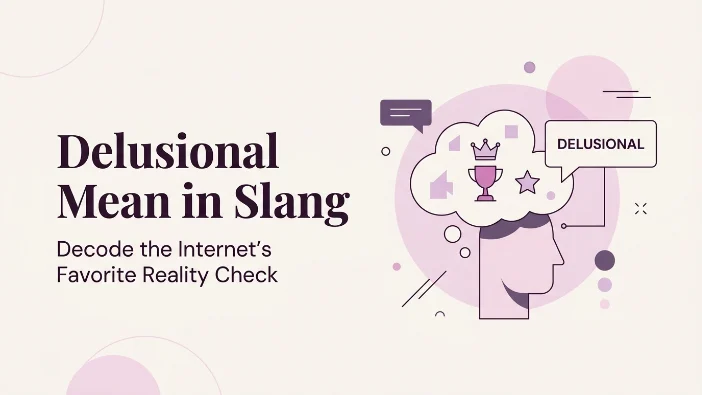
Delusional (adjective) refers to holding false beliefs or opinions that persist despite clear evidence to the contrary. In clinical psychology, it describes a symptom of certain mental health conditions where an individual maintains fixed, untrue beliefs even when presented with contradictory facts.
Wondering about Delusional Mean in Slang? Online, “delusional” is often used casually to describe someone who has unrealistic expectations, especially about relationships, celebrities, or everyday situations.
On TikTok, Instagram, and other social platforms, the word can be playful rather than serious. Its meaning depends heavily on the context and tone of the conversation.
By the end of this article, you’ll not only know exactly what delusional means, but you’ll also understand the cultural nuances, the psychological weight, and the social contexts that make this word so uniquely versatile. Let’s get started! 🚀
Origin
Every word has a story, and delusional‘s tale begins in ancient Rome.
The Latin Roots 🇮🇹
The word traces back to the Latin verb dēlūdere, which combines:
- *De-* (meaning “away” or “from”)
- Lūdere (meaning “to play” or “to mock”)
Together, they formed a word that meant “to deceive” or “to mock.” The noun form, dēlūsiō, referred to “a deceiving” or “mockery.”
Journey to English
From Latin, the word evolved through:
- Old French: delusion
- Middle English: delusioun (14th century)
- Early Modern English: delusion (16th century)
The adjective delusional as we know it today first appeared in English between 1850 and 1860. It was formed by adding the suffix “-al” to the noun delusion, creating an adjective that meant “pertaining to or characterized by delusion.”
Clinical Evolution 🏥
Interestingly, while the word itself has been around for centuries, its clinical usage became prominent in the 19th century as psychiatry emerged as a formal discipline. The definition has remained remarkably consistent: “a fixed false belief that persists despite contradictory evidence.”
Popularity
If you think delusional has been everywhere lately, you’re not wrong. But the reasons might surprise you.
The Rise of “Delulu” 📱
In the early 2010s, something fascinating happened in K-pop fandom communities. Fans of Korean pop music began using delulu a playful shortening of delusional to describe fans who had unrealistic fantasies about their favorite idols. Think: believing you’re in a secret relationship with a BTS member or that your favorite singer wrote their latest song just for you.
By 2020, delulu had escaped the confines of K-pop Twitter and entered mainstream internet vocabulary. But then, in 2023, something even more interesting occurred.
“Delulu Is the Solulu” 💫
This catchy phrase exploded on TikTok and Instagram, especially among young women. It’s shorthand for “delusion is the solution the idea that being a little bit delusional about your goals can actually help you achieve them.
The philosophy goes something like this:
- Want that dream job? Be delulu enough to apply even if you don’t meet all the requirements.
- Want to start that business? Be delulu enough to believe it’ll succeed despite the odds.
- Want to land that partner? Be delulu enough to put yourself out there.
It’s essentially “fake it till you make it” with a Gen Z glow-up.
Mainstream Recognition
The cultural impact has been significant enough that:
- Cambridge Dictionary officially added “delulu” to its pages
- Australian Prime Minister Anthony Albanese used it in Parliament in early 2025
- Major brands have incorporated it into marketing campaigns
The Double-Edged Sword ⚔️
However, this trend hasn’t been without controversy. Mental health advocates have raised concerns that turning delusional into a cute, aspirational term trivializes serious psychiatric symptoms. For someone who actually suffers from delusions as part of a mental illness, seeing their condition turned into a TikTok trend can feel dismissive and hurtful.
How It Is Used
The way you use delusional depends entirely on your context. Let’s explore the three main domains.
Clinical/Psychiatric Context 🏥
In mental health, delusional is a serious term. A delusion is defined as:
“A strongly held false belief that is not amenable to change in light of conflicting evidence.”
Key characteristics of clinical delusions:
- Fixed: The belief doesn’t change, even when presented with contradictory facts
- False: The belief doesn’t correspond to reality
- Unshakeable: Attempts to reason with the person are typically unsuccessful
Common Types of Delusions
| Type | Description | Example |
| Persecutory | Belief that others are plotting against you | “The government is tracking me through my phone” |
| Grandiose | Belief in exceptional abilities or fame | “I’m actually a secret billionaire” |
| Erotomanic | Belief that someone is in love with you | “Taylor Swift writes songs about me” |
| Jealous | Unfounded belief of partner’s infidelity | “My spouse is cheating with the neighbor” |
| Somatic | Belief about physical defects or illness | “I have parasites all over my body” |
| Religious | False beliefs about divine status or mission | “God speaks directly to me” |
Colloquial Usage 🗣️
In everyday conversation, delusional is used more loosely to describe:
- Unrealistic thinking: “He’s delusional if he thinks he can get that job without a degree.”
- Overconfidence: “She’s delusional about her singing abilities.”
- Denial: “My dad is delusional about how much he spends on fishing gear.”
Internet/Social Media Culture 🌐
This is where delulu and delusional take on entirely new meanings:
- Self-deprecating humor: “Me delulu thinking he’ll text me back”
- Aspirational confidence: “Manifesting that CEO position, delulu style ✨”
- Supportive cheerleading: “Stay delulu, bestie! You got this!”
Examples
Let’s explore how delusional plays out in different tones and contexts.
Friendly Examples 😄
These are casual, lighthearted uses among friends:
- “I was delusional thinking I could spree-watch an entire season and still wake up early for work.”
- “Sarah’s delusional if she thinks her cat loves her more than it loves me.”
- “Honestly, am I being delusional or is this dress actually cute?”
- “We were so delusional in college thinking we’d stay best friends forever jokes on us, we did! 🤪”
Professional Examples 💼
These are more formal or workplace-appropriate uses:
- “Management seems delusional about meeting these quarterly targets without additional resources.”
- “The board’s belief that they can increase market share without innovation is simply delusional.”
- “Any politician who thinks they can win without addressing healthcare is delusional.”
- “The report concluded that the company’s projections were delusional and not supported by market data.”
Funny Examples 😂
- “My dog is under the delusion that he’s a 100-pound guard dog he’s a 7-pound chihuahua.”
- “I was delusional to think I’d start going to the gym in January. New year, same me.”
- “He suffers from delusions of grandeur ever since he got promoted to assistant manager.”
- “Me: buys a single plant Also me: I am a gardener now, a master of nature 🪴”
Dismissive Examples 🙄
These are more negative or critical uses:
- “That’s the most delusional thing I’ve heard all week.”
- “If you think that’s going to work, you’re completely delusional.”
- “His delusions about his qualifications are frankly embarrassing.”
- “Please stop being delusional and face reality.”
Comparison with Similar Terms
This is where things get tricky. Delusional, illusion, and hallucination are often used interchangeably in everyday speech but they mean very different things.
Comprehensive Comparison Table
| Term | Definition | Domain | Example | Can be corrected? |
| Delusion | False belief maintained despite evidence | Cognitive (thoughts) | Believing you’re a famous celebrity | Rarely, without treatment |
| Illusion | Misperception of a real stimulus | Sensory (perception) | Mistaking a shadow for a person | Yes, with clarification |
| Hallucination | Perception of something not present | Sensory (perception) | Hearing voices that others don’t hear | Requires medical attention |
| Deluded | Deceived into believing something false | Cognitive (thoughts) | Believing the scammer’s promises | Yes, with evidence |
Key Distinctions
- Delusions are beliefs (thoughts). Illusions and hallucinations are perceptions (sensory experiences).
- Delusions are fixed. No amount of evidence or reasoning will typically change them. Illusions can be corrected by examining the stimulus more closely.
- Hallucinations involve the senses you actually see, hear, or feel something that isn’t there. Delusions don’t involve sensory experiences.
Real-World Example
Imagine someone says they’re being followed by the FBI:
- If they’re delusional: They believe it firmly despite no evidence, and nothing you say will convince them otherwise.
- If they’re having an illusion: They saw a black SUV parked outside and incorrectly interpreted it as surveillance.
- If they’re hallucinating: They physically see or hear FBI agents that aren’t actually there.
Alternate Meanings
Delusional has taken on some interesting alternative meanings and variations:
1. “Delusions of Grandeur”
A specific phrase referring to grandiose delusions the belief that one is exceptionally important, talented, or famous. Often used humorously.
2. “Delulu” (Internet Slang)
A playful shortening popularized by K-pop fandoms and now mainstream Gen Z vocabulary. Can be positive, negative, or self-deprecating.
3. “Positive Delusions” (Psychological Concept)
Some psychologists discuss “positive illusions slightly inflated self-perceptions that can actually be mentally healthy and help with resilience.
4. “Collective Delusions”
Beliefs shared by a group that aren’t based in reality. Examples include mass hysteria or conspiracy theories.
5. “Delusion Is the Solution”
A modern mantra suggesting that unrealistic optimism can help you achieve your goals through self-fulfilling prophecy.
Professional or Polite Alternatives
Sometimes delusional is too harsh, too clinical, or too confrontational. Here are diplomatic alternatives:
| Scenario | Instead of… | Try… | Why it works |
| In the workplace | “Your projections are delusional” | “Your projections seem somewhat optimistic” | Less confrontational, still gets point across |
| With a friend | “You’re delusional” | “Are you sure about that? Maybe reconsider?” | Gentler, invites reflection |
| In a formal report | “The proposal is delusional” | “The proposal appears unrealistic given current constraints” | Professional and objective |
| With someone sensitive | “That’s delusional thinking” | “That belief seems unfounded” | Softer, less clinical |
| In a debate | “Your argument is delusional” | “Your argument lacks evidentiary support” | Intellectual and respectful |
| With a client | “You’re being delusional” | “Let’s align expectations with reality” | Collaborative and constructive |
When to Use Which
- Misguided: When someone has good intentions but is wrong
- Unrealistic: When something isn’t practically feasible
- Overly optimistic: When someone is too positive (but not necessarily wrong)
- Out of touch: When someone lacks awareness of current reality
- Uninformed: When someone lacks necessary information
- Naive: When someone lacks experience or critical judgment
Common Mistakes
❌ Mistake 1: Using It Casually in Mental Health Contexts
Problem: Making jokes about being delusional around someone who actually struggles with mental illness can be deeply insensitive.
Solution: Know your audience. If you’re not sure, use milder language.
❌ Mistake 2: Confusing with Illusion/Hallucination
Problem: Mixing up these terms shows a lack of understanding and can cause confusion.
Solution: Remember:
- Delusions = beliefs (thoughts)
- Illusions = misperceptions (sensory)
- Hallucinations = false perceptions (sensory)
❌ Mistake 3: Overusing in Professional Settings
Problem: Using delusional in a business context can make you sound unprofessional and potentially create workplace conflict.
Solution: Stick to words like unrealistic, optimistic, or challenging.
❌ Mistake 4: Using “Delulu” Without Understanding Its Context
Problem: Using Gen Z slang incorrectly can make you look out of touch or worse, accidentally insensitive.
Solution: Understand that delulu is a playful term used in specific social media contexts. Don’t use it in serious conversations.
❌ Mistake 5: Assuming All Delusions Are Mental Illness
Problem: Not all unrealistic beliefs are psychiatric delusions. Everyone has some unrealistic beliefs or biases.
Solution: Reserve clinical language for clinical contexts.
❌ Mistake 6: Using It as a Personal Attack
Problem: Calling someone delusional in anger is rarely productive and often just escalates conflict.
Solution: Focus on specific behaviors or beliefs rather than labeling the person.
Quick Tips
✅ For Social Media
- Use delulu casually in lighthearted contexts
- Pair it with other internet slang for maximum authenticity
- Remember: “delulu is the solulu” is a vibe, not a medical diagnosis
- Emojis enhance the playful tone: 🤪✨💫
- For Mental Health Discussions
- Use precise, clinical language when appropriate
- Never joke about serious psychiatric conditions
- If discussing delusions, explain the clinical definition
- Show empathy and avoid stigma
- For Professional Settings
- Choose milder alternatives like unrealistic
- Focus on evidence and facts, not labels
- Be constructive, not confrontational
- Frame feedback in terms of outcomes, not personality
- For Everyday Conversation
- Use it playfully with friends who understand the context
- Be mindful of tone (are you teasing or criticizing?)
- Consider if there’s a kinder way to say it
- When in doubt, soften it with humor
- For Writing
- Define the term clearly if you’re using it in technical writing
- Consider your audience’s familiarity with the term
- Use examples to illustrate meaning
- Vary your language to avoid repetition
FAQs
1. What does delusional mean in simple terms?
In simple terms, being delusional means believing something that clearly isn’t true, even when faced with evidence that proves otherwise. For example, believing you’re a billionaire when your bank account has $50. It’s holding onto a false belief despite obvious contradictory information.
2. What’s the difference between delusional and deluded?
They’re closely related but slightly different. Deluded often means you’ve been deceived (possibly by someone else) into believing something false. Delusional suggests a more internally generated false belief that persists despite evidence. However, in everyday speech, they’re frequently used interchangeably.
3. Can someone be delusional without having a mental illness?
Yes! In clinical terms, delusions are a symptom of conditions like schizophrenia, bipolar disorder, or delusional disorder. But in everyday language, delusional is used loosely to describe anyone who’s being unrealistic. Think of someone who thinks they can become a professional athlete despite zero talent you might call that delusional in casual conversation, but it’s not a psychiatric diagnosis.
4. What does “delulu” mean on TikTok?
Delulu is playful slang for delusional popularized on TikTok and other social media. It’s often used to describe optimistic, “fake it till you make it” confidence. The phrase “delulu is the solulu” means “delusion is the solution the idea that unrealistic optimism can help you achieve your goals. However, it’s important to note this is very different from clinical delusions.
5. What are the most common types of delusions?
The most common types include:
- Persecutory: Believing you’re being targeted or harmed
- Grandiose: Believing you have exceptional abilities or fame
- Erotomanic: Believing someone famous or powerful is in love with you
- Jealous: Unfounded belief of a partner’s infidelity
- Somatic: False beliefs about physical health or appearance
6. Is it rude to call someone delusional?
It can be, depending on context. Among close friends in a lighthearted setting, it might be fine. In professional or sensitive situations, it’s often considered rude or dismissive. If you need to communicate that someone’s thinking is unrealistic, try softer alternatives like “unrealistic,” “overly optimistic,” or “misguided” instead.
7. How can I tell if someone is clinically delusional?
Key signs include:
- Firmly held false beliefs despite contradictory evidence
- Inability to consider alternative explanations
- The belief causes significant distress or impairment
- The belief persists even when it’s clearly illogical
- Other symptoms like disorganized thinking or hallucinations may be present
If you’re concerned about someone, gently encourage them to see a mental health professional.
8. Is “delulu” considered offensive?
It depends on the context and who you’re talking to. Some mental health advocates find it offensive because it trivializes serious psychiatric symptoms. Others (especially Gen Z) use it as harmless slang. The safest approach is to use it only in casual, lighthearted settings with people who understand and appreciate the context. In professional or mental health discussions, stick to clinical terms.
Conclusion
So, what does delusional really mean? As we’ve discovered, it’s a word with remarkable depth one that carries different weights depending on who’s using it and in what context.
Words matter. And delusional is a perfect example of how language evolves, adapts, and takes on new meanings over time. What started as a clinical term in 19th-century psychiatry has become a versatile piece of vocabulary that can be serious, playful, or aspirational depending entirely on context.
The most important thing is to be mindful. Use it precisely in professional settings, playfully with friends who get it, and never dismissively when it could hurt someone.
Now you know the full picture. Go forth and use delusional wisely whether you’re diagnosing a symptom, roasting a friend, or manifesting your dreams with some positive delulu energy. ✨
Read More Related Articles:
- Mercy Meaning | Powerful Lesson Behind Kindness and Forgiveness In 2026
- Mija Meaning In Spanish | Sweet Nickname You’ll Hear Everywhere In 2026
- Punta Meaning In Spanish | From Literal Meaning to Everyday Usage In 2026






4 thoughts on “Delusional Mean in Slang | Decode the Internet’s Favorite Reality Check In 2026”