Quick Answer:
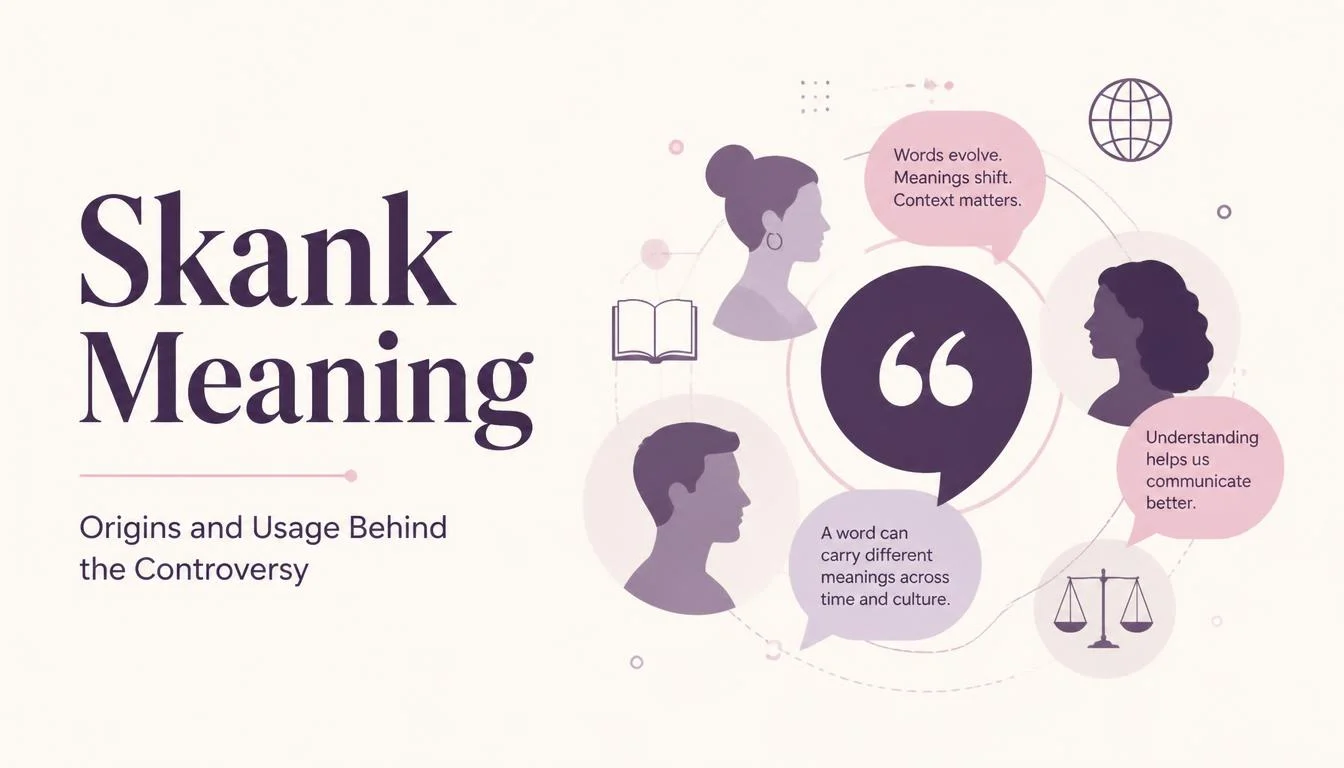
Skank is an insulting slang word used to describe someone, usually a woman, judged as sexually promiscuous or unattractive. It can also refer to a style of dancing associated with ska and reggae music, depending on the context.
The meaning of skank depends on how and where the word is used. In everyday conversations, it is often a rude or offensive insult directed at someone’s appearance, behavior or perceived sexual activity. Because it can sound disrespectful and judgmental, it is important to understand its tone before using it in a conversation, text message or social media post.
In music and dance culture, skank has a different meaning. It can describe a lively dance style associated with ska, reggae and punk music. The word may also appear in song lyrics, movies and online discussions with different meanings. Understanding the context helps you recognize whether someone is using it as an insult or referring to music and dance.
What Does Skank Mean in Everyday English?
In everyday English, skank is most commonly recognized as a negative slang term for a person. It may suggest that someone is dirty, sexually promiscuous, or morally objectionable, depending on the speaker’s intention. The word is especially insulting when aimed at a woman, although it can also be used against men or people of any gender.
It is not a neutral description. Calling someone this word can express contempt, jealousy, anger, or an attempt to humiliate them. Even when the speaker claims to be joking, the person hearing it may interpret it as disrespectful.
For example, imagine someone says, “He called her a skank after the argument.” The sentence tells you that the speaker used a derogatory label, but it does not establish whether the accusation was true. It describes an insult, not a reliable judgment about the person being discussed.
Does It Always Refer to Sexual Behavior?
No. Sexual judgment is one common association, but the word can also suggest that someone is dirty, disreputable, unpleasant, or generally disliked. In some conversations, it functions as a broad insult without a precise definition.
Consider these two sentences:
- “She called the character a skank because of his behavior.” Here, the speaker is using the word to criticize a fictional character.
- “That skank stole my seat.” In this example, the word expresses anger and contempt. The speaker may not be making any claim about sexual behavior.
The difference matters because slang often communicates emotion more strongly than factual information. A person using this term may be trying to shame someone rather than describe anything objectively.
Is It a Formal or Informal Word?
It is an informal slang term, not a suitable choice for most professional or respectful conversations. You might encounter it in movie dialogue, online arguments, song lyrics, or casual speech. It is much less appropriate in a workplace email, academic paper, or formal discussion.
If you need to describe a specific behavior, a more precise word is usually better. For example, dishonest, rude, or untrustworthy identifies a particular criticism without relying on a degrading label.
Where Did the Word Come From?
The history of skank is not as straightforward as its modern slang use might suggest. English slang has changed over time, and the word developed associations with unpleasantness before becoming familiar in several music-related settings.
The term is recorded in twentieth-century English, and its history includes meanings associated with something dirty or disreputable. Its exact origins are uncertain, so it is best not to assign it a single definitive source or claim that every modern use comes from one original meaning.
Over time, the word gained a more personal and insulting sense. It became associated with people whom a speaker wanted to portray as dirty, undesirable, or sexually disreputable. This development reflects a broader pattern in slang: words describing unpleasant things can become labels for people.
How Its Meaning Changed Over Time
The word now appears in at least two distinct cultural settings. In general conversation, it can be a derogatory label. In reggae and ska music, it has a recognized musical and dance-related use.
These meanings should not be treated as interchangeable. A musician discussing a skank rhythm is not necessarily insulting anyone. Likewise, someone using the word during an argument is unlikely to be discussing musical technique.
This split illustrates why dictionary definitions alone may not be enough to interpret slang. The subject of the conversation, the speaker’s tone, and the words surrounding the term all contribute to its meaning.
How Skank Is Used in Different Contexts
The easiest way to understand this word is to look at the situation in which it appears. Although the spelling remains the same, the meaning can shift significantly across conversations and cultural settings.
| Context | Meaning | Typical tone |
|---|---|---|
| Everyday conversation | A derogatory label for a person considered dirty, promiscuous, or unpleasant | Insulting |
| Text messages | An expression of anger, contempt, or mockery | Often hostile or sarcastic |
| Social media | An insult used in comments, arguments, or gossip | Negative or provocative |
| Reggae music | A rhythmic guitar or keyboard pattern, depending on usage | Musical and neutral |
| Ska dancing | A characteristic dance associated with ska and related music | Playful and energetic |
| Friendly banter | A teasing label among people who accept that style of humor | Depends on the relationship |
The Meaning Depends on the Speaker
Suppose someone writes, “That was such a skank thing to do.” The person may be criticizing behavior they consider dishonest, mean, or embarrassing. The exact accusation remains unclear without more information.
Now compare that with, “The band played a great skank rhythm.” The second sentence is about music. There is no reason to interpret it as a personal attack.
This is why context is essential. A single word can have a negative social meaning in one conversation and a specialized technical meaning in another.
Can It Be Used as a Verb?
Yes. In musical contexts, to skank can describe dancing to reggae or ska music or playing a characteristic rhythmic pattern. The precise meaning depends on whether the speaker is talking about movement or instrumental performance.
For example, a person might say, “Everyone started skanking when the band played the faster song.” Here, the verb describes dancing rather than insulting someone.
This use is particularly important because it demonstrates that the term is not inherently offensive in every setting. Its musical meaning has its own cultural history and conventions.
Skank in Text Messages and on Social Media
Online conversations often make slang harder to interpret because readers cannot hear the speaker’s voice or see their facial expressions. A message that one person intends as a joke may appear genuinely hostile to someone else.
In texting, the term is commonly used as an insult during arguments, gossip, or conversations about relationships. It can also appear in memes, fictional dialogue, and deliberately exaggerated comments.
Common Texting Examples
Example 1: An argument between friends
Person A: “I heard she was talking about you behind your back.”
Person B: “She’s such a skank.”
The reply expresses anger and disapproval. It does not prove that the accusation is accurate. It simply shows how the speaker feels about the other person.
Example 2: A sarcastic social media comment
User A: “He flirted with three people at the party.”
User B: “What a skank.”
The comment uses the word to criticize someone’s perceived romantic or sexual behavior. Depending on the relationship and context, it may be intended as serious condemnation or exaggerated mockery.
Example 3: A music discussion
User A: “What kind of rhythm is the guitarist playing?”
User B: “It’s a classic skank pattern.”
In this exchange, the term refers to a musical rhythm. Reading it as an insult would lead to the wrong interpretation.
Does It Have a Special Meaning on TikTok or Instagram?
There is no single universal social media definition that differs completely from the word’s established meanings. On platforms such as TikTok and Instagram, people generally use it according to the same broad patterns found in everyday English.
A comment may use the term as a direct insult, a reaction to fictional drama, or a reference to music and dancing. Its interpretation depends on the video, caption, replies, and overall discussion.
Online trends can also change how a word sounds to a particular audience. Some users may repeat slang ironically or quote it from entertainment. That does not mean everyone understands or accepts it in the same way.
What If Someone Calls You This Word?
The best response depends on the situation. If the person is trying to provoke you, arguing over the label may give them the reaction they want. You can ask what they mean, set a boundary, or disengage from the conversation.
For example, a direct response such as “Don’t call me that” communicates that the language is unwelcome without escalating the exchange. If the term appears in repeated harassment, keeping records of the messages and using the platform’s reporting tools may be appropriate.
You do not have to accept a degrading label simply because someone describes it as a joke.
Skank in Reggae, Ska, and Dance Culture
One of the most interesting aspects of this word is its role in music. In reggae and ska, skank can refer to a distinctive offbeat rhythmic pattern or a dance performed to music with that characteristic feel.
This use is separate from the insulting slang meaning. It is familiar to musicians, dancers, and fans of Jamaican music and related genres.


8
What Is a Skank Rhythm?
In reggae and ska, guitarists and keyboard players often emphasize the offbeats, creating a rhythmic effect that contrasts with the main pulse. An offbeat is a subdivision of the musical beat that falls between the main beats or receives less emphasis in a particular meter.
A guitarist might play short, clipped chords between the stronger beats instead of sustaining long chords throughout the measure. This helps create the distinctive rhythmic feel associated with many ska and reggae arrangements.
The exact pattern varies by song, performer, and subgenre. It is therefore better to think of the term as a family of related rhythmic practices rather than one fixed sequence of notes.
What Does Skanking Mean as a Dance?
In ska and reggae scenes, skanking describes a style of dancing that responds to the music’s rhythm. Depending on the subgenre and local scene, dancers may alternate their arm and leg movements, step energetically, and move in time with the offbeat accents.
The dance is associated with ska culture, including the British ska revival and later ska-punk communities. Its appearance varies widely, so there is no single movement that every dancer must perform.
For someone attending a ska concert, hearing the word in this setting is entirely ordinary. It may refer to what the crowd is doing or to the rhythmic structure of the music.
How Jamaican Music Influenced the Term
Ska emerged in Jamaica in the late 1950s and developed into rocksteady and reggae during the following decade. These genres helped establish musical traditions built around distinctive rhythmic patterns, bass lines, and the relationship between the beat and offbeat accents.
Artists such as The Skatalites, a Jamaican ska band, helped shape the early ska sound. Toots and the Maytals became an important name in Jamaican music, while Bob Marley and the Wailers helped bring reggae to international audiences.
The later British ska revival included groups such as Madness and The Specials. Their music introduced ska influences to new audiences and helped sustain the association between the genre, energetic dancing, and offbeat rhythms.
These musical examples provide useful context for the word’s non-insulting meaning. A lyric, album review, or discussion of guitar technique may use it in a completely ordinary musical sense.
Skank vs. Similar Slang Words
Several English slang terms overlap with this word, but they are not perfect substitutes. Some focus on personal hygiene, others judge sexual behavior, and some simply express general contempt.
| Word | Common meaning | Main difference |
|---|---|---|
| Skank | An insulting label suggesting that someone is dirty, sexually promiscuous, or unpleasant | Can also refer to a music rhythm or dance |
| Slut | A derogatory term used to judge someone’s perceived sexual behavior | More directly centered on sexual activity or reputation |
| Sleaze | A person or thing considered morally unpleasant or disreputable | Often suggests dishonesty, corruption, or vulgarity |
| Creep | Someone whose behavior makes others uncomfortable or suspicious | Focuses more on unsettling behavior |
| Jerk | A rude, selfish, or inconsiderate person | Usually criticizes behavior without a necessary sexual association |
| Trashy | Something or someone considered vulgar or lacking good taste | Often describes style, conduct, or perceived social respectability |
These distinctions are general rather than absolute. Slang changes between regions and social groups, and a speaker may use a term more broadly than its common definition suggests.
Skank vs. Slut
Both words can be used to shame someone over perceived sexual behavior. However, slut is more directly tied to judgments about a person’s sexuality, while skank can also suggest dirtiness or general unpleasantness.
Neither term is a neutral way to describe someone’s relationships. Both can carry a strong sense of contempt and may be used to enforce unfair social judgments.
Skank vs. Creep
Calling someone a creep usually suggests that their actions, presence, or behavior makes others uncomfortable. For instance, someone who repeatedly ignores personal boundaries might be described this way.
Calling that same person a skank would communicate a different kind of insult. The latter does not specifically mean that a person is threatening or makes others feel unsafe.
Choosing a more precise term helps explain what actually happened rather than relying on a broad personal attack.
Real-World Examples of the Word in Use
The following examples show how the intended meaning changes according to the sentence. They are illustrative examples, not quotations from specific people or songs.
Example 1: In a Relationship Argument
“After their breakup, he called his ex a skank.”
The word is being used to insult a former partner. It may reflect anger, resentment, or an attempt to damage the person’s reputation.
Example 2: In a Group Chat
“Stop calling people names just because you disagree with them.”
This sentence could be a response to someone using the term during an argument. It challenges the insulting language rather than accepting it as a fair description.
Example 3: In a Music Review
“The guitarist used a sharp skank rhythm throughout the song.”
Here, the term describes a musical technique. It has no necessary connection to the negative slang meaning.
Example 4: At a Ska Concert
“The crowd started skanking as soon as the band played the opening chords.”
The verb refers to dancing in response to the music. The sentence conveys movement and energy rather than criticism.
Example 5: In a Discussion of a Movie
“The character uses the word to humiliate another woman.”
This example describes the term as part of a character’s dialogue. Its presence may reveal hostility, prejudice, or an attempt to control how another person is perceived.
Example 6: In an Online Comment
“That was a skank thing to say.”
The writer is expressing disapproval, but the precise criticism is unclear. Without additional context, it is impossible to know whether the writer means rude, dishonest, cruel, or something else.
The main lesson is simple: identify what the conversation is about before deciding which definition fits.
Why the Word Can Be Offensive
Language does more than communicate information. It can also influence how people are treated, especially when a word is used to shame someone publicly.
The insulting sense of this term can reinforce sexual double standards. A person may be judged harshly for dating choices, clothing, or perceived sexual behavior, even when those judgments are based on gossip rather than facts.
It can also reduce a complicated person to a degrading label. Instead of discussing a specific action, the speaker attacks the person’s character. That shift can make an ordinary disagreement more hurtful and harder to resolve.
Is It Ever Acceptable Among Friends?
Some friends use harsh slang jokingly when they understand one another’s humor and boundaries. In those situations, the speaker may intend teasing rather than genuine hostility.
However, familiarity does not guarantee that everyone is comfortable with the word. A joke that feels harmless to one person may be humiliating to another, particularly when it refers to sexuality or personal reputation.
The setting matters, too. A private conversation between close friends differs from a public comment where strangers can see and repeat the insult. When in doubt, a less degrading expression is usually the safer choice.
Better Alternatives for Clear Communication
If you are trying to explain someone’s behavior, choose a word that describes the action rather than attacking the person.
- Use rude when someone speaks disrespectfully.
- Use dishonest when someone deliberately lies.
- Use selfish when someone repeatedly puts their own interests first.
- Use inconsiderate when someone ignores other people’s feelings.
- Use untrustworthy when someone’s actions give you a genuine reason not to trust them.
These words do not guarantee that a conversation will be pleasant, but they make the criticism more specific. They also allow the other person to respond to what happened instead of defending themselves against a degrading label.
How to Understand the Word Correctly
When you encounter this term, a few simple clues can help you identify the intended meaning.
First, look at the subject. If the conversation is about a person during an argument, the insulting definition is likely. If it concerns a guitarist, a reggae track, or a ska performance, the musical meaning is more plausible.
Second, examine the surrounding words. Expressions of anger, accusations, and personal attacks often signal a negative use. References to chords, rhythm, dancing, or a live performance point toward the music-related meaning.
Third, consider the tone and relationship between the speakers. Sarcasm and teasing can make an insult sound playful, but the intention is not always obvious in a written message. If the meaning remains unclear, asking for clarification is better than assuming.
Finally, remember that understanding a word does not require adopting its attitude. You can recognize what someone intends while still disagreeing with the way they express it.
FAQs
Is skank considered a swear word?
It is generally considered an offensive slang insult, although it is not usually classified in the same way as the strongest English profanity. Its impact depends on the setting, the target, and the speaker’s tone. In music discussions, the same word can be neutral.
Can men be called skanks, too?
Yes. Although the insult has often been directed at women, speakers can apply it to men or people of any gender. The intended criticism may involve perceived sexual behavior, poor hygiene, or general contempt.
What does skank mean in British English?
In British English, it can be used as a derogatory slang term, much as it is elsewhere. It also appears in British ska culture, where it can refer to a dance or musical rhythm. The sentence and situation determine which sense is intended.
Does skank have a meaning in reggae lyrics?
Yes. In reggae and related musical styles, it can refer to an offbeat rhythm played on guitar or keyboard. The word can also describe dancing to this music. A lyric or musician’s explanation should be interpreted within its musical context rather than automatically treated as an insult.
Is skank the same as trashy?
Not exactly. Both can express disapproval, but trashy often describes something considered vulgar, tasteless, or socially disreputable. Skank is more commonly used as a personal insult and may carry a stronger association with sexual shaming.
What should I do if someone uses this word against me?
You can set a clear boundary, ask the person to explain their comment, or choose not to engage. If the message is part of repeated online harassment, consider saving evidence and using the platform’s blocking or reporting options. You do not need to prove your worth to someone who is trying to humiliate you.
Conclusion
The word skank has more than one established use, and the context determines whether it is an insult or a reference to music and dancing. In everyday conversation, it is generally derogatory and can carry associations with sexual shaming, dirtiness, or contempt. In reggae and ska culture, it can describe a distinctive rhythm or an energetic dance. Understanding these differences helps you interpret the word accurately without mistaking a musical term for a personal attack or overlooking the harm an insult can cause.
Read More Related Articles:
- Sisi Meaning | Deep Look Into Its Everyday Digital Use In 2026
- Finna Meaning | From AAVE Roots to Modern Internet Use In 2026
- Aperitif Meaning | Why People Drink It Before Meals In 2026







4 thoughts on “Skank Meaning | Origins and Usage Behind the Controversy In 2026”