Quick Answer
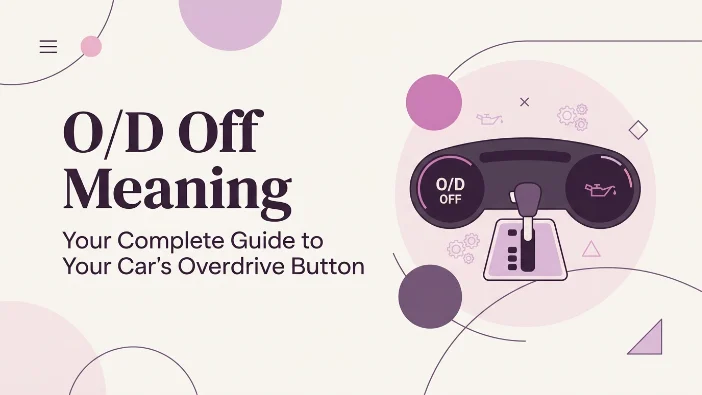
O/D Off means your vehicle’s overdrive gear (typically the highest gear in an automatic transmission) has been manually disabled. When you press the O/D button on your gear shifter, the transmission stops using this top gear, keeping the engine running at higher RPMs for increased power output and engine braking especially useful for towing, climbing steep hills, or navigating mountain descents.
Imagine you’re cruising down the highway, music playing, windows down, when you notice a mysterious “O/D Off” light illuminated on your dashboard. Panic sets in. Is something wrong with your car? Did you accidentally press something you shouldn’t have? You glance at the gear shifter and spot a small button you’d never noticed before.
Take a deep breath. That little light isn’t a warning sign it’s actually a feature that gives you more control over your vehicle’s performance. And understanding it could make you a more confident and capable driver.
The Evolution of Overdrive: From Luxury Feature to Standard Equipment
To truly understand what “O/D Off” means, it helps to know a bit about automotive history. Overdrive technology has been around for decades, originally appearing in luxury and performance vehicles as a way to reduce engine strain during highway cruising.
The Early Days: In the 1930s and 1940s, overdrive was considered an advanced feature that allowed engines to spin slower at high speeds, reducing wear and tear while improving fuel economy. It wasn’t until the 1970s and 1980s that overdrive became more common in mainstream vehicles, as automakers sought ways to meet increasingly strict fuel economy standards.
The Modern Era: Today, virtually all automatic transmission vehicles come equipped with an overdrive gear. You’ll typically find it as the highest gear in a 4-speed, 5-speed, or even 6-speed automatic transmission. The button that controls it often labeled simply “O/D” has become a standard feature on gear shifters across manufacturers like Toyota, Honda, Ford, Suzuki, and many others.
How Overdrive Actually Works
Let’s break down the mechanics in a way that actually makes sense.
Most automatic transmissions have multiple gears, just like a bicycle. Think of it this way:
- Lower gears (1st, 2nd, 3rd): These give you more power for acceleration and climbing but require higher engine RPMs (revolutions per minute). Your engine works harder and consumes more fuel.
- Higher gears (4th, 5th, etc.): These allow your engine to spin slower while maintaining speed, improving fuel efficiency and reducing engine wear.
Overdrive is your transmission’s highest gear let’s call it the “cruising gear.”
When you’re driving at highway speeds (typically above 50-60 mph), your transmission shifts into overdrive. Your engine RPMs drop significantly. For example, you might be cruising at 60 mph with the tachometer reading just 1,800-2,000 RPM instead of 3,000+ RPM in a lower gear. This means:
✅ Better fuel economy
✅ Quieter cabin (less engine noise)
✅ Reduced engine wear
✅ Smoother highway cruising
But here’s the thing: when you need quick acceleration say, to pass another vehicle on a two-lane highway being in overdrive actually works against you. The engine is essentially “lugging,” producing less immediate power.
This is where the O/D button comes in.
When and Why You’d Actually Use the O/D Off Button
Pressing that little button isn’t just for show. Here are the practical situations where disabling overdrive makes sense:
1. Highway Merging and Passing
Scenario: You’re on the highway doing 55 mph and need to quickly accelerate to 75 mph to merge into fast-moving traffic.
What happens with O/D on: Your car is in overdrive (4th gear). You press the gas, but the response feels sluggish almost like the car is hesitating.
What happens when you press O/D Off: The transmission downshifts from 4th to 3rd gear. Your RPMs jump up, and suddenly you feel a noticeable surge of power. This is what many drivers describe as a “burst of speed.”
Tip: Press the O/D button just before you need to pass or merge. You’ll feel the difference immediately. Once you’re up to speed, press it again to turn overdrive back on.
2. Mountain Driving and Steep Hills
Scenario: You’re driving through the mountains or a hilly area. The road goes up steep grades and down sharp descents.
Ascending: When climbing a steep hill, your car may “hunt” between gears, constantly shifting up and down as it struggles to maintain speed. Turning O/D off locks out the highest gear, keeping your RPMs in the power band for better climbing ability.
Descending: Coming down a steep hill? O/D Off provides engine braking meaning your engine helps slow the car down, reducing the need to ride your brakes. This is especially important on long descents where brakes can overheat and fail.
3. Towing Heavy Loads
Scenario: You’re pulling a trailer, boat, or camper.
Why O/D Off helps: Towing adds significant weight, making your engine work harder. In overdrive, the engine may lug or strain, potentially causing transmission damage over time. Disabling overdrive keeps your transmission in a lower gear, reducing stress on internal components.
4. Stop-and-Go City Traffic
Scenario: You’re in bumper-to-bumper traffic, constantly accelerating and braking.
Why O/D Off can help: In overdrive, your transmission may try to shift into higher gears too early, then immediately downshift when you slow down. This constant shifting can be annoying and potentially causes wear over time. Turning O/D off keeps the transmission in a more responsive range for city driving.
What the Dashboard Light Actually Means
Here’s one of the most common points of confusion:
- Light OFF = Overdrive is ON (your car is using all gears, including the highest overdrive gear)
- Light ON = Overdrive is OFF (your car is NOT using the highest gear)
Yes, it’s somewhat counterintuitive. The light indicates that you’ve disabled the overdrive feature not that there’s a problem with it.
When you start your car, the O/D Off light typically stays off, meaning overdrive is activated. You can tell because your transmission will shift through all available gears as you accelerate.
Press the button once: the light comes on, and your transmission will no longer shift into overdrive. Press it again: the light turns off, and overdrive re-engages.
O/D Off vs. Similar Terms: Clearing Up the Confusion
Important Note: Some drivers confuse “O/D Off” with the odometer reading (ODO) on their dashboard. The two are completely different. The odometer shows your total mileage, while the O/D button controls your transmission’s highest gear.
Real-World Examples: What It Feels Like in Action
Example 1: The Highway Pass (Neutral Tone)
“I was cruising on I-95 at 65 mph when I noticed a slow-moving truck ahead. I pressed the O/D button, felt the transmission downshift, and the car surged forward with enough power to pass safely. Once I was clear, I pressed the button again and settled back into relaxed highway cruising.”
Example 2: Mountain Descent (Friendly Tip)
“Headed down the mountain pass, I turned O/D off to let engine braking do its thing. The car held speed without me riding the brakes the whole way. Huge relief when you’re on winding roads with steep grades!”
Example 3: City Driving (Neutral Observation)
“In stop-and-go traffic, I keep O/D off. The car feels more responsive, and it doesn’t hunt for gears every time I slow down for a red light.”
Example 4: Towing (Professional Advice)
“When I tow my boat, I always turn O/D off. I don’t want the transmission constantly shifting in and out of overdrive under load that’s how you burn up a transmission.”
The Benefits of Using O/D Off
When You Should Use O/D Off:
| Situation | Why It Helps |
|---|---|
| Towing trailers or boats | Reduces transmission strain |
| Climbing steep hills | More power for climbing |
| Descending mountains | Engine braking saves brakes |
| Passing on highways | Quicker acceleration response |
| Stop-and-go traffic | Reduced gear hunting |
When You Should Keep O/D On:
| Situation | Why It Helps |
|---|---|
| Flat highway cruising | Better fuel economy |
| Most daily commuting | Smoother ride, quieter cabin |
| Driving with low fuel | Maximizes MPG |
| Long road trips | Reduces engine wear |
Potential Downsides to Consider
While disabling overdrive is a useful tool, there are a few things to keep in mind:
Fuel Economy: Running with O/D off keeps your RPMs higher, which will reduce your fuel efficiency. You might notice your gas gauge dropping faster than usual.
Engine Noise: Higher RPMs mean more engine noise in the cabin. It’s not harmful, but it can be annoying on long drives.
Unnecessary Wear: There’s no benefit to driving with O/D off in normal conditions. Constantly driving at high RPMs without reason can increase wear on engine components over time.
Forgetting to Turn It Back On: It’s easy to press the button and forget about it. You might drive for miles with the O/D off, wondering why your fuel economy has suddenly gotten worse.
Professional Tips for Using Your O/D Button
- Know Your Transmission: Some vehicles have 4-speed automatics where 4th gear is overdrive. Others have 5, 6, or even more speeds. Check your owner’s manual to understand exactly what your “O/D Off” button does.
- Use It Proactively: Don’t wait until you’re struggling to pass or climb. Press the button a few seconds before you need the extra power.
- Don’t Press It at High RPMs: While modern transmissions can handle it, it’s generally best to press the O/D button when you’re accelerating or at moderate speeds not when you’re already redlining the engine.
- Use It with Braking: On steep downhill grades, combine O/D Off with gentle braking for maximum control. The engine helps slow you down, but you still need brakes for actual stopping.
- Remember to Reset: Before you park and turn off your engine, check that O/D is back on. Most vehicles will reset automatically when you restart, but not all.
O/D Off vs. “2” and “L” Gear Settings
Many automatic transmissions have additional gear selections like “2” (second gear only) or “L” (low gear). How do these compare to O/D Off?
| Feature | O/D Off | “2” or “L” Gear |
|---|---|---|
| Gears Used | All except highest | Only 1st and 2nd (or just 1st) |
| Best For | Highway passing, mild hills | Extreme grades, off-road, heavy towing |
| Engine Braking | Moderate | Maximum |
| Speed Range | 45-65+ mph | Under 30-40 mph |
| Fuel Efficiency | Reduced | Significantly reduced |
In steeper descents where engine braking alone isn’t enough, shifting into “2” or “L” provides even more control.
Professional Alternatives and Polite Explanations
If you’re explaining “O/D Off” to someone else, here are clear, professional ways to phrase it:
- Direct explanation: “O/D Off means your car won’t shift into its highest gear, giving you more power for passing or climbing hills.
- Technical explanation: “Disabling overdrive keeps your transmission in a lower gear ratio, which increases engine RPMs and available torque for better performance.”
- In a car manual: “Press the O/D button to limit transmission gear selection. Use when towing, climbing, or descending steep grades.”
Don’t Confuse It With These Common Abbreviations
FAQs
1. Will driving with O/D off damage my transmission?
No, driving with O/D off won’t damage your transmission. It simply limits the gears your transmission uses. However, extended driving at highway speeds with O/D off will increase engine RPMs, which can reduce fuel economy and potentially increase engine wear over very long periods.
2. Does O/D off use more gas?
Yes, definitely. When O/D is off, your engine runs at higher RPMs, which consumes more fuel. You’ll typically see a noticeable drop in MPG, especially on highways.
3. Why does my O/D off light flash?
A flashing O/D off light is usually a warning sign. It can indicate:
- Transmission fluid is low or overheating
- A faulty transmission sensor
- Internal transmission issues
- Electrical problems
If your O/D light is flashing, don’t ignore it. Have your vehicle checked by a mechanic as soon as possible.
4. Should I drive with O/D on or off in snow?
In snowy or slippery conditions, you generally want O/D on to prevent wheel spin. Lower gears can cause wheels to spin more easily on ice. However, when descending slippery hills, turning O/D off for engine braking can help you maintain control without relying solely on brakes.
5. Does O/D off give you more horsepower?
Not exactly. O/D off doesn’t increase your engine’s horsepower. Instead, it keeps your transmission in a lower gear, which multiplies the available torque and makes the engine feel more responsive. Think of it as using the power you already have more effectively.
6. Can I shift into O/D while driving?
Yes! The O/D button is designed to be pressed while driving. You don’t need to stop or slow down. Just press the button, and the transmission will respond accordingly. However, avoid pressing it while accelerating aggressively or at very high RPMs.
7. Why does my car feel slower with O/D on?
That’s normal. With overdrive engaged, your transmission is in the highest gear, which prioritizes fuel efficiency over immediate power. When you need quick acceleration, the engine has to work harder to overcome that gearing. Pressing O/D off downshifts the transmission, putting the engine in a better power band for acceleration.
8. Does every automatic car have an O/D button?
Most modern automatic vehicles have an overdrive gear, but not all have an accessible O/D button. Some newer vehicles integrate overdrive control into other driving modes (like “Sport” or “Eco” modes), while others simply don’t offer manual control and manage it automatically.
Conclusion
Understanding what “O/D Off” means transforms a potentially confusing dashboard light into a useful driving tool. Whether you’re towing a trailer, navigating mountain passes, or just need that extra burst of speed for a highway pass, your O/D button gives you more control over your vehicle’s performance.
Here are the key takeaways:
- O/D Off simply prevents your transmission from using its highest gear
- Use it when you need more power, engine braking, or reduced gear hunting
- Remember: Light ON = Overdrive OFF (counterintuitive, but true!)
- Turn it back on for regular driving to save gas and reduce engine wear
- A flashing O/D light is a warning sign get it checked
- Don’t confuse it with your odometer, which tracks total distance traveled
Next time you see that little O/D Off light on your dashboard, you’ll know exactly what it means and how to use it to become a smarter, more confident driver.
Read More Related Articles:
- What Does WTM Mean in Text | Common Uses You Should Know In 2026
- What Does ACC Mean | Every Meaning Made Simple In 2026
- JSP Meaning | Internet Acronym Everyone Gets Wrong In 2026