Quick Answer
A flashing yellow traffic light means you are allowed to proceed through the intersection or make a turn, but you must do so with caution. It signals drivers to slow down, be alert, and yield to oncoming traffic and pedestrians before proceeding .
Have you ever been cruising down the road, approaching an intersection, only to be greeted by a puzzling, blinking yellow light? You know it’s not the solid yellow that’s about to turn red, but it’s also not a green light giving you the all-clear. For a split second, you might hesitate: Do I stop? Do I go? What exactly is this signal telling me?
You are not alone. In fact, this little blinking beacon is one of the most misunderstood – yet brilliantly designed – traffic signals on our roads today. But once you understand its purpose, you’ll see it’s actually a lifesaver (and a time-saver). Let’s cut through the confusion so you can drive with confidence and courtesy the next time you see one.
Think of it as the traffic light’s way of saying, “The coast is clear for you to move forward, but I trust you to use your best judgment.” Unlike the solid yellow light, which is a strict warning to prepare to stop, the flashing yellow is an invitation to go provided you do so safely.
Here at Driving Theory 101, we’re dedicated to making the rules of the road simple and clear. We’ve analyzed the data from the National Highway Traffic Safety Administration (NHTSA) and state DMV handbooks to bring you the definitive guide on what a flashing yellow light means. We’ll explore why it was invented, how to use it correctly in different scenarios, and why it’s rapidly becoming the gold standard for left-turn lanes across the country.
Flashing Yellow Light Meaning
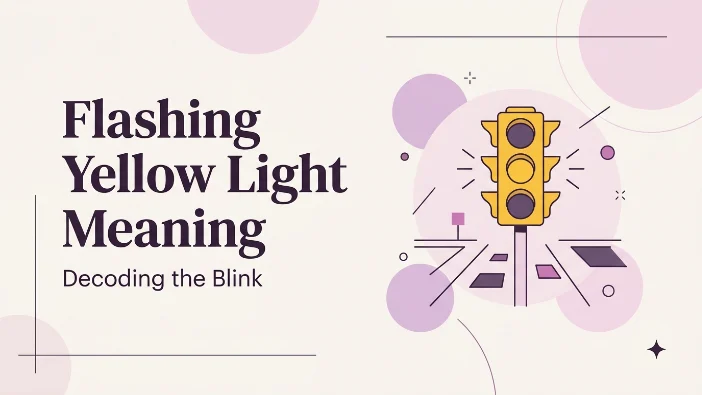
To put it simply, a flashing yellow light is a “Proceed with Caution” signal. It is a warning to drivers that they are entering an intersection where the standard right-of-way rules might not apply, and they need to be extra vigilant.
When you approach a flashing yellow signal, you are not required to come to a complete stop. However, you are legally obligated to reduce your speed and be prepared to yield to any traffic or pedestrians that have the right-of-way .
Here is the critical distinction to remember:
- Solid Yellow Light = “Prepare to stop.” The light is about to turn red. Stop if you can do so safely.
- Flashing Yellow Light = “Proceed with caution.” The light is not changing. You may go, but you must yield to others.
The Golden Rule: Flashing Yellow Arrow vs. Flashing Yellow Light
While the rule of “caution” applies to both, there is a subtle but significant difference depending on whether you are dealing with a standard flashing yellow bulb or a flashing yellow arrow. Let’s break down the two primary scenarios.
Scenario 1: The Flashing Yellow Arrow (Left Turns)
This is the most common place you will see a flashing yellow signal today. It is often a dedicated arrow in a left-turn lane.
What it means: You may make a left turn, but you do not have the right-of-way. Oncoming traffic has a green light. You must yield to all oncoming vehicles and any pedestrians in the crosswalk. You can only turn left when there is a safe gap in the traffic .
Scenario 2: The Flashing Yellow Ball (Intersection)
This is usually a standard traffic light hanging over the intersection that is flashing yellow in all directions (often during late-night hours or when traffic is light), or you might see it at a pedestrian crossing.
What it means: You can proceed straight through the intersection, but you must slow down and be alert. You don’t need to stop, but you must be prepared to stop if necessary .
Why Are Flashing Yellow Lights Used?
You might be wondering, “Why don’t they just use a green arrow?” That is a great question. Here is a quick history lesson.
For decades, left turns were often controlled by a solid green light with a “Yield” sign, or a solid green arrow that gave you the absolute right-of-way but stopped traffic in the other direction. The problem? Drivers often saw the green light and focused only on the “go” part, forgetting to yield to oncoming traffic. This led to confusion and serious T-bone collisions .
In December 2009, the Federal Highway Administration (FHWA) authorized the use of the flashing yellow arrow nationwide after extensive testing . A national study by the National Cooperative Highway Research Program found that drivers made fewer mistakes with flashing yellow arrows compared to the traditional “yield-on-green” signals .
Here is why cities love them:
- They are Safer: The flashing yellow arrow does a better job of communicating “caution” than a solid green light does. Drivers are more likely to slow down and look for oncoming traffic when they see yellow .
- They Reduce Delays: Traditional solid green arrows stop oncoming traffic and force you to wait, even if the road is empty. The flashing yellow arrow allows you to turn when you have a gap, which keeps traffic moving, especially during off-peak hours .
- They Are More Intuitive: As one traffic official noted, “Often times drivers see green and they think ‘go.’ When they see yellow, they often associate that with caution” .
How to React in Different Scenarios
To make it even clearer, let’s look at how to react in a few real-world driving situations.
Comparing Flashing Yellow to Similar Signals
To help you solidify the knowledge, here is a comparison of the most commonly confused traffic signals.
FAQs
Here are 8 of the most common questions drivers ask about flashing yellow lights.
1. Do I have to stop at a flashing yellow light?
No. You are not required to stop. The law states you may proceed with caution. If you are making a left turn, you must yield to oncoming traffic, but you do not need to come to a full stop to look for traffic .
2. What is the difference between a solid yellow light and a flashing yellow light?
A solid yellow light means “slow down and stop” because the light is about to turn red . A flashing yellow light means “proceed with caution” but the light is not turning red; it gives you a permissive “go” signal .
3. Can I get a ticket for going through a flashing yellow light?
No. Since it is not a red light, you are not breaking the law by proceeding through it. However, you could get a ticket if you fail to yield to oncoming traffic while turning left and cause an accident.
4. Why are flashing yellow lights used instead of green arrows?
Green arrows give you the absolute right-of-way and force oncoming traffic to stop. Flashing yellow arrows let you turn when safe, reducing traffic delays and making intersections more efficient .
5. What does a flashing yellow arrow mean?
It means you may turn left, but you must yield to oncoming traffic and pedestrians. You can only turn when it is safe and clear .
6. If a traffic light is out, does it flash yellow?
Often, yes. If a traffic light loses power or is malfunctioning, it often enters “flash mode.” If you see a flashing yellow on your side, the cross-traffic likely has a flashing red (treat as a stop sign), allowing you to proceed with caution.
7. What if I am in the intersection and the yellow arrow turns solid yellow?
If the flashing yellow arrow changes to a solid yellow arrow, you are legally allowed to clear the intersection if you are already in it. However, it is a warning that the light is about to turn red .
8. Are flashing yellow arrows standard across the US?
Yes, they were approved for use nationwide by the Federal Highway Administration in 2009 . You will see them in most states, though they are more common in newer traffic lights or areas that have been recently updated .
Conclusion:
The flashing yellow light is a perfect example of how traffic design evolves to make our roads safer and more efficient. It shifts the responsibility from the traffic light to the driver, trusting you to make a judgment call.
The Golden Rules to Remember:
- See a flashing yellow ball? Proceed with caution and slow down.
- See a flashing yellow arrow? You can turn, but you must yield to oncoming traffic and pedestrians.
By understanding that a flashing yellow light is a permissive signal an invitation to go when safe, rather than a command to stop you will navigate intersections with more confidence and safety. So, next time you see that little yellow blink, don’t panic. Just slow down, look around, and drive safely.
Read More Related Articles:
- Clemency Meaning | Pronunciation, Definition & Examples In 2026
- Mercy Meaning | Powerful Lesson Behind Kindness and Forgiveness In 2026
- Stubborn Mean | Why It’s Not Always a Bad Thing In 2026

Michael Turner is a U.S.-based content writer and blogger who enjoys uncovering the stories and meanings behind words. Through his work at Meanvora, he delivers well-researched, easy-to-read articles that help readers expand their vocabulary and gain a deeper understanding of language.