Quick Answer:
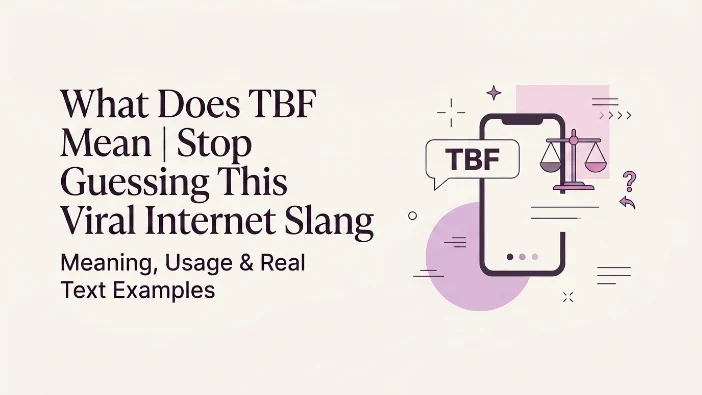
TBF stands for “To Be Fair” and is used to introduce a balanced perspective or alternative viewpoint in digital conversations. It signals that you’re considering all sides of an argument before sharing your opinion.
In online conversations and social media chats, slang terms often evolve quickly, and understanding them is important for clear communication. One commonly used expression is TBF Mean, which appears in texting, comments, and casual digital discussions. People often search for it to better understand how it is used in real conversations.
From an EEAT perspective, TBF Mean is widely recognized in informal English as an abbreviation of “to be fair.” It is typically used when someone wants to present a balanced opinion or add a fair point in a discussion. In most contexts, it helps the speaker show objectivity or soften a statement while keeping the conversation respectful and natural.
Quick Answer Box
| Feature | Details |
|---|---|
| Meaning | To Be Fair |
| Context | Used to introduce a balanced perspective or alternative viewpoint in a discussion |
| Primary Usage | Text messaging, social media, online forums, casual conversations |
| Common Platforms | WhatsApp, Snapchat, TikTok, Twitter/X, Reddit, Instagram, Discord |
| Example | “TBF, the acting was great, but the plot had some holes.” |
| Tone | Considerate, balanced, non-confrontational, reasonable |
What Does TBF Mean?
Core Definition
TBF stands for “To Be Fair.” It’s an acronym used primarily in text-based communication to signal that you’re about to offer a balanced perspective, acknowledge an alternative viewpoint, or add context that might change how something is understood .
Think of TBF as a conversational tool that says, “I see where you’re coming from, but let’s also consider this other angle.”
The Purpose Behind TBF
Using TBF serves several important functions in conversation:
- Introducing balance: When a discussion seems one-sided, TBF helps bring in missing perspectives .
- Softening criticism: It can make negative feedback feel less harsh by acknowledging positives first .
- Showing empathy: TBF demonstrates you’ve considered someone else’s situation before judging .
- Signaling open-mindedness: Using TBF shows you’re willing to consider different viewpoints .
- De-escalating arguments: It can reduce tension in heated debates by showing you’re being reasonable .
Key Characteristics
| Characteristic | Explanation |
|---|---|
| Type | Internet slang / initialism |
| Primary Meaning | To Be Fair |
| Secondary Meaning | To Be Frank (less common) |
| Tone | Considerate, balanced, thoughtful |
| Formality | Informal; best for casual conversation |
| Safe for Work | Yes |
| Safe for Children | Yes |
Context & Usage
When to Use TBF
TBF is appropriate in several scenarios:
1. Introducing a Counterargument
When you disagree with someone but want to acknowledge their point first:
“I understand why you’re upset about the delay. TBF, the team did warn us there might be issues.”
2. Adding Missing Context
When someone doesn’t have all the information:
“He seemed rude, but TBF, he’d just received bad news.”
3. Defending Someone or Something
When you want to explain someone’s actions :
“She didn’t finish the project on time. TBF to her, she was dealing with a family emergency.”
4. Offering a Nuanced Opinion
When you want to acknowledge both sides:
“The movie wasn’t perfect. TBF, the cinematography was outstanding.”
5. Softening Your Own Criticism
When you need to give negative feedback:
“TBF, I think we could have prepared better for the presentation.”
When NOT to Use TBF
While TBF is versatile, there are times when it’s better to avoid it:
- Formal or professional writing: In business emails, reports, or academic writing, spell out “to be fair” or find a more formal alternative .
- When you’re being dismissive: Using TBF to shut down someone’s legitimate concerns comes across as condescending rather than fair.
- When fairness isn’t actually the goal: If you’re using TBF just to sound reasonable while pushing your own agenda, people will see through it.
- In serious or sensitive conversations: Sometimes, using casual acronyms undermines the gravity of the discussion.
The Difference Between TBF and TBH
Many people confuse TBF with TBH (To Be Honest), but they serve different purposes :
| Aspect | TBF (To Be Fair) | TBH (To Be Honest) |
|---|---|---|
| Primary Focus | Balancing perspectives, acknowledging other views | Expressing personal truth or unfiltered opinion |
| When Used | To add context or alternative viewpoint | To be blunt or share a controversial opinion |
| Tone | Diplomatic, measured, considerate | Direct, candid, sometimes blunt |
| Example | “TBF, the team had very little time to prepare.” | “TBH, I didn’t like the movie at all.” |
You can even use them together: “TBH, I’m not a fan of the new design. TBF, I can see why others might like it.”
Real-Life Examples
1: Disagreeing Respectfully
Alex: “I can’t believe they chose her for the promotion. She’s only been here six months.”
Jordan: “TBF, she’s brought in three major clients and has incredible results. Experience isn’t everything.”
2: Defending Someone
Sam: “He completely ignored my question in the meeting. So rude.”
Taylor: “TBF, he was presenting and probably didn’t see your hand. Maybe send him a message after.”
3: Offering Balanced Feedback
Morgan: “The restaurant was terrible. I’m never going back.”
Casey: “TBF, the appetizers were delicious. The main course was disappointing, but I wouldn’t write the whole place off.”
4: Adding Missing Context
Riley: “I can’t believe she didn’t RSVP to the wedding.”
Avery: “TBF, she told me last week she was having travel issues. She might still be figuring it out.”
5: Softening Your Own Position
Drew: “The new software is buggy and slow.”
Quinn: “TBF, we only started using it yesterday. Maybe we need more time to learn the system.”
Platform-Specific Meaning
On WhatsApp, TBF appears in personal conversations, often to soften opinions or add context in private chats. It’s commonly used when texting friends about sensitive topics .
Example: “She was a bit cold today. Tbf, she’s been stressed about exams.”
Snapchat
Snapchat users often use TBF in snaps or chat conversations, especially when reacting to friends’ stories or sharing opinions. The informal, ephemeral nature of the platform makes acronyms like TBF especially useful .
Example: “TBF, that outfit actually looks great on you!”
TikTok
TikTok comments frequently feature TBF when users want to offer alternative perspectives on viral videos or controversial content .
Example: “TBF, she had a point even if her delivery was harsh.”
Twitter/X
Twitter’s character limit makes TBF particularly valuable. Users often include it in tweets or replies to add nuance to hot takes .
Example: “TBF, I understand why people love the new album. It just doesn’t click with me.”
Reddit discussions often feature TBF in debates, particularly in subreddits where nuanced discussion is valued. It’s commonly used to present balanced arguments in comments .
Example: “TBF, both sides made valid points in that debate. It’s not as clear-cut as people think.”
In Instagram comments, TBF can provide context for opinions shared under posts, especially when there’s disagreement in the comments section .
Example: “TBF, the lighting is incredible. The composition could be better though.”
Discord
Discord servers and group chats frequently use TBF during discussions, particularly in gaming or interest-based communities .
Example: “TBF, we would have won if our teammate hadn’t disconnected.”
Alternative Meanings
While “To Be Fair” is the most common meaning, TBF can stand for other things in different contexts :
Common Alternative Meanings
- To Be Frank: Used similarly to “to be honest”
- Trial By Fire: Referring to learning through difficult experience
- Taken By Force: Military or gaming context
- Total Batters Faced: Baseball statistic
- Time Between Failures: Technical/engineering term
Less Common Meanings
- To Be Furnished
- To Be Filed
- Turbo Fax
- Token Bucket Filter (networking)
- The Boston Foundation
- The Bass Federation
- Türkiye Basketbol Federasyonu (Turkish Basketball Federation)
- Temporary Block Flow (telecommunications)
- Grumman Avenger Torpedo Bomber (WWII aircraft designation)
TBF Variations
Some users create variations of TBF for specific situations :
Related Terms / NLP Variations
Synonyms and Related Phrases
- To be honest (TBH)
- To be frank
- In all fairness
- To give credit where it’s due
- In defense of
- In fairness to
- Fair point
- That being said
- Having said that
- However
- Nevertheless
- To be clear
- Honestly though
Semantic Relationships
How to Respond / Reply
Best Ways to Reply
When someone uses TBF with you, here are some appropriate response strategies:
1. Acknowledge Their Point
“That’s a fair point. I hadn’t considered that angle.”
2. Build on Their Perspective
“You’re right, TBF. And actually, that reminds me of another factor…”
3. Concede Gracefully
“Fair enough. I can see why you’d see it that way.”
4. Offer Additional Context
“TBF, I didn’t know that. Let me add some more information…”
5. Express Appreciation
“Thanks for keeping it balanced. I appreciate the perspective.”
6. Ask Clarifying Questions
“TBF, that makes sense. Can you tell me more about why you think that?”
What NOT to Do
- Don’t dismiss their balanced perspective as irrelevant
- Don’t use TBF back immediately to re-counter without consideration
- Don’t ignore the fair point they raised
Misinterpretations
Common Mistakes
1. Assuming TBF Always Means You Agree
Mistake: Thinking someone using TBF is taking the other person’s side.
Reality: They may just be acknowledging a valid point while still disagreeing overall.
2. Confusing TBF with Defensiveness
Mistake: Interpreting “TBF” as someone being defensive or making excuses.
Reality: Often, it’s about adding important context, not making excuses .
3. Overusing TBF
Mistake: Using TBF before every opinion, which dilutes its impact.
Reality: Save it for when you’re genuinely adding balance or context.
4. Misreading Tone
Mistake: Assuming TBF always introduces a negative criticism.
Reality: It can introduce positive points too, as in “TBF, she’s an incredible singer.”
Clarifying the Misunderstandings
| Misunderstanding | Clarification |
|---|---|
| TBF means I’m being sarcastic. | Not necessarily. While TBF can be used sarcastically, it’s usually sincere . |
| “TBF is the same as TBH.” | Different purposes: TBF balances, TBH is candid . |
| “TBF is only for arguments.” | It works in casual conversations too, not just debates. |
When NOT to Use TBF
Situations to Avoid
1. Formal Writing
Professional emails, academic papers, business reports, and formal letters should avoid TBF. Spell out “to be fair” instead, or choose more formal alternatives.
2. When It Undermines Authority
If you’re in a position of authority and need to be decisive, overusing TBF might make you seem indecisive.
3. When You’re Not Actually Being Fair
Using TBF to sound reasonable while pushing an agenda is transparent and counterproductive.
4. In Sensitive Conversations
Some topics require direct, empathetic communication that casual acronyms don’t support.
5. When It Adds No Value
Don’t use TBF as filler. Only use it when you’re genuinely adding a different perspective.
Examples of Inappropriate Use
- In a job interview: “TBF, I do have relevant experience” (sounds too casual).
- In a crisis situation: “TBF, we made mistakes” (too lighthearted for serious issues).
- As a deflection: “TBF, what about their mistakes?” (dismissive, not genuinely fair).
Usage Tips
How to Master TBF
1. Know Your Audience
TBF works best with peers, friends, and in casual online communities. For professional contexts, use “to be fair” or “in fairness” instead.
2. Use Sparingly
Like any conversational tool, TBF loses impact when overused. Save it for moments when balance genuinely matters.
3. Match the Tone
TBF can be formal or casual depending on context. In a serious debate, it sounds considered. In a lighthearted chat, it can be playful. Match your tone to the conversation.
4. Consider Your Goal
Are you:
- Offering a balanced view? → Use TBF.
- Just sharing an opinion? → Consider TBH or IMO.
- Wanting to be blunt? → Use “no cap” or “FR” instead.
5. Test the Waters
If you’re new to using TBF, observe how others in your community use it before jumping in.
6. Use Capitalization Flexibly
TBF works in uppercase or lowercase (“tbf”). Both are acceptable .
7. Combine Thoughtfully
Feel free to combine TBF with other acronyms: “TBF, TBH, I think we both have valid points.”
FAQs
1. What does TBF mean in texting?
TBF means “To Be Fair” in texting. It’s used to introduce a balanced perspective or alternative viewpoint in a conversation .
2. What does TBF mean in a relationship context?
In relationships, TBF is used to acknowledge your partner’s perspective or defend their actions. For example, “TBF to her, she did tell me she was going to be late.”
3. Does TBF mean “to be frank”?
Sometimes. TBF can mean “To Be Frank” as a secondary meaning, though “To Be Fair” is much more common .
4. Is TBF appropriate for professional communication?
Generally no. TBF is casual slang best suited for text messages, social media, and informal chats. For professional communication, use “to be fair” or “in fairness” instead .
5. How is TBF different from TBH?
TBF (To Be Fair) introduces a balanced perspective or alternative viewpoint. TBH (To Be Honest) expresses a candid opinion or truth. They serve different conversational purposes .
6. When was TBF first used?
TBF emerged in the late 1990s and early 2000s with early internet chatrooms. The first Urban Dictionary entry for TBF was added in 2005 .
7. Where do people most commonly use TBF?
TBF is common on WhatsApp, Snapchat, TikTok, Twitter/X, Reddit, Instagram, and Discord .
8. Can I use TBF in a professional email?
It’s better to avoid TBF in professional emails. Use the full phrase “to be fair” or choose a more formal alternative like “in fairness” or “to give credit where it’s due.”
9. Is TBF used in British or American English?
Both, though TBF originated more strongly in British English before spreading globally . It’s now used internationally across English-speaking countries.
10. What are some similar acronyms to TBF?
Similar acronyms include TBH (To Be Honest), IMO (In My Opinion), IMO, and FR (For Real) .
11. Can TBF be used sarcastically?
Yes, TBF can be used sarcastically, like “TBF, I didn’t break the vase” when it’s obvious someone did .
12. What does TBF mean on Snapchat?
On Snapchat, TBF means “To Be Fair.” It’s often used in chat conversations or captions to share balanced opinions or soften statements .
Conclusion
TBF short for “To Be Fair” has become an essential part of internet vocabulary. This three-letter acronym lets you acknowledge different perspectives, soften criticism, and show you’re considering all angles in a conversation.
Whether you’re texting friends, commenting on social media, or debating on Reddit, TBF helps create balanced, thoughtful discussions.
The key to using TBF effectively is understanding when and how to use it. It’s not a magic phrase that automatically makes you sound fair you actually need to be fair when you use it. Overuse diminishes its impact, and using it in inappropriate contexts can make you seem dismissive rather than balanced.
As digital communication continues to evolve, acronyms like TBF help us communicate complex social intentions quickly and effectively. Used well, TBF can transform potentially heated arguments into productive conversations where all perspectives are considered.
Ready to use TBF in your next conversation? Remember: use it thoughtfully, use it genuinely, and use it when you actually want to be fair.
Read More Related Articles:
- Street Cred Meaning | Cool Slang Everyone Should Know In 2026
- Root “Bel” Meaning | Master This Word Root in Just Minutes In 2026
- Root “Dec” Meaning | Unlock the Power Behind 10 Common Words In 2026

Michael Turner is a U.S.-based content writer and blogger who enjoys uncovering the stories and meanings behind words. Through his work at Meanvora, he delivers well-researched, easy-to-read articles that help readers expand their vocabulary and gain a deeper understanding of language.








7 thoughts on “TBF Mean | Stop Guessing This Viral Internet Slang In 2026”