Quick Answer
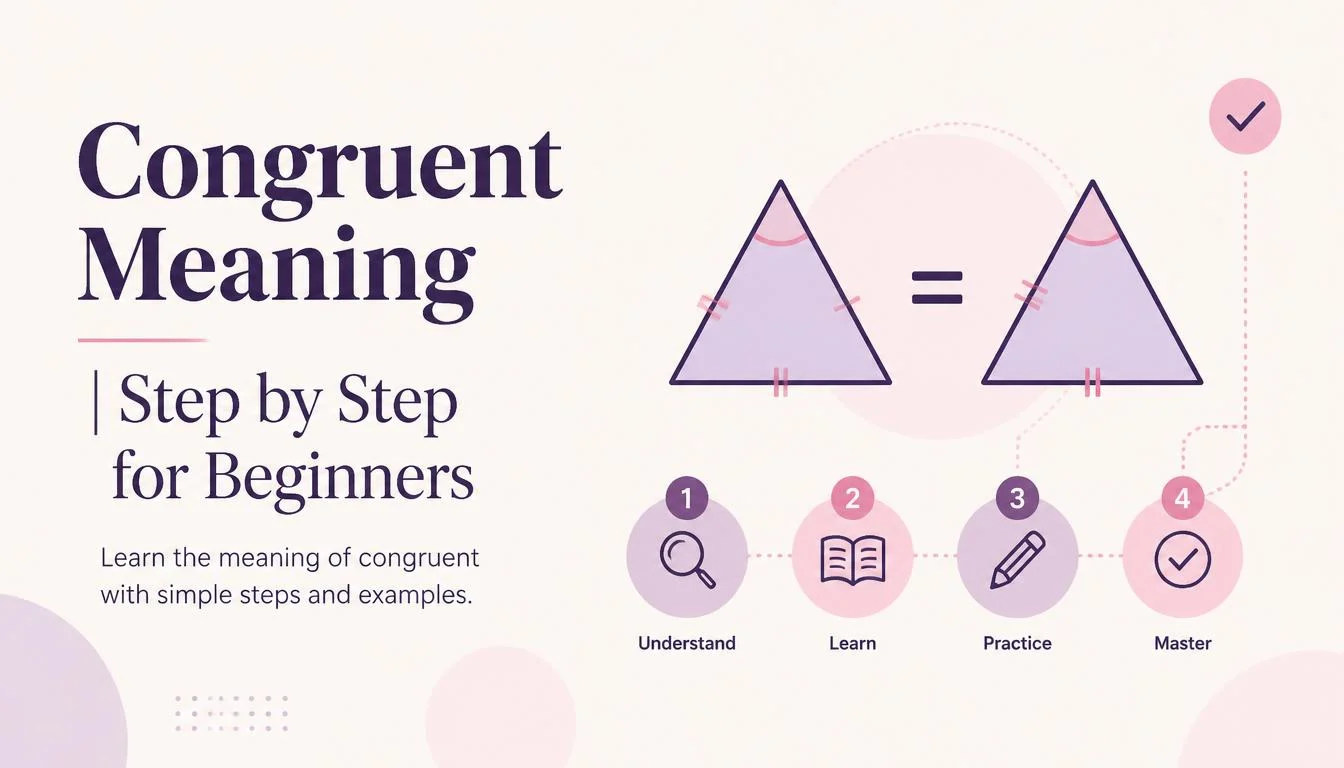
“Congruent” means exactly matching in shape and size when placed on top of each other. In geometry, two figures are congruent if every side and angle is identical. The idea also appears in algebra and logic, where it describes elements that match under specific rules or transformations.
The term congruent meaning is commonly used in mathematics and everyday language. In geometry, it describes shapes that are exactly equal in size and shape, meaning they fit perfectly when superimposed. This concept helps students understand equality between angles, lines, and figures in a clear way.
Outside mathematics, congruent meaning is used to show agreement or consistency between ideas, actions, or feelings. When someone’s words and behavior match, they are said to be congruent. This makes the term useful in communication, psychology, and daily life understanding.
Definition of Congruent
In mathematics, two objects are called congruent when they have the same shape and size. If one object is moved, rotated, or flipped, and it still matches another exactly, they are congruent.
This idea comes from Euclidean geometry, the system developed by the ancient Greek mathematician Euclid, who studied shapes, lines, and spatial relationships.
Congruence is not about appearance alone. It is about measurable equality of structure. Every corresponding part must match perfectly.
For example:
- Two triangles with identical side lengths are congruent
- Two circles with the same radius are congruent
- Two line segments with equal length are congruent
Everyday vs Mathematical Usage
The term appears in both technical and general language, but the meaning shifts slightly.
| Context | Meaning of Congruent | Example |
|---|---|---|
| Geometry | Same shape and size | Two identical triangles |
| Algebra | Equivalent under a rule or transformation | Matrices related by transformation |
| Modular arithmetic | Same remainder when divided by a number | 17 and 5 are congruent mod 12 |
| General language | In agreement or alignment | Words matching actions |
In everyday speech, people often use it to describe consistency between ideas, actions, or values.
Types of Congruence in Mathematics
Congruence appears in several branches of mathematics, each with its own rules.
1. Geometric Congruence
This is the most familiar form. Two figures are congruent if one can be transformed into the other using:
- Translation (sliding)
- Rotation (turning)
- Reflection (flipping)
No resizing is allowed.
2. Congruence in Number Theory
In modular arithmetic, numbers are congruent if they leave the same remainder when divided by a fixed number.
Example:
- 17 and 5 are congruent modulo 12 because both leave remainder 5 when divided by 12.
This is written as:
17 ≡ 5 (mod 12)
3. Matrix Congruence
In linear algebra, two matrices A and B are congruent if:
B = PᵀAP
where P is an invertible matrix.
This concept appears in advanced studies of quadratic forms and transformations.
Real-World Examples of Congruence
Here are practical examples across different areas:
1. Congruent Triangles
Two triangles with sides 3 cm, 4 cm, and 5 cm are congruent if all corresponding sides match exactly.
2. Circles in Geometry
All circles with radius 10 cm are congruent, no matter where they are drawn.
3. Line Segments
A 7 cm segment on one page is congruent to another 7 cm segment elsewhere.
4. Modular Numbers
The numbers 22 and 10 are congruent modulo 12 because both leave remainder 10 when divided by 12.
5. Matrix Transformations
In engineering and physics, congruent matrices help describe systems that behave the same under coordinate changes.
These examples show how the idea stretches from simple shapes to advanced mathematics.
Deep Dive: Congruent Triangles in Geometry
Triangles are the most studied case of congruence in school mathematics.
Two triangles are congruent if all corresponding sides and angles match exactly. This means they are identical in every measurable way, even if they are rotated or flipped.
Criteria for Triangle Congruence
There are standard tests used to prove congruence:
| Rule | Meaning | Example |
|---|---|---|
| SSS (Side-Side-Side) | All three sides equal | 3-4-5 triangle matching another 3-4-5 triangle |
| SAS (Side-Angle-Side) | Two sides and included angle equal | Two triangles sharing same included angle |
| ASA (Angle-Side-Angle) | Two angles and included side equal | Common in geometric proofs |
These rules are widely taught in school geometry and form the base of many mathematical proofs.
Why It Matters
Congruent triangles help solve:
- Engineering design problems
- Architectural symmetry checks
- Mapping and surveying calculations
Even small structures depend on accurate congruence to maintain balance and stability.
Congruent vs Similar: Key Differences
People often confuse congruent and similar shapes, but they are not the same.
| Feature | Congruent Shapes | Similar Shapes |
|---|---|---|
| Size | Same size | Can differ |
| Shape | Same shape | Same shape |
| Angles | Equal | Equal |
| Sides | Equal lengths | Proportional |
| Transformation | Rigid motion only | Scaling allowed |
A square drawn larger or smaller is still similar to another square but not congruent unless size matches exactly.
This distinction is important in geometry and design work.
Applications in Math and Science
Congruence is not just theoretical. It appears in many real systems.
1. Engineering and Construction
Engineers use congruent shapes to ensure parts fit together perfectly. Bridges, machine components, and architectural designs rely on this principle.
2. Computer Graphics
Digital modeling uses congruent transformations to rotate and move objects without changing their shape.
3. Cryptography and Coding Theory
Modular arithmetic congruence supports encryption systems used in digital security.
4. Education Standards
Organizations like the National Council of Teachers of Mathematics (NCTM) include congruence as a core geometry concept in school curricula.
FAQs
1. Is congruent the same as equal?
Not exactly. In math, congruent means identical in shape and size, while equal usually refers to numbers or values.
2. Can two objects be congruent if rotated?
Yes. Rotation does not affect congruence as long as shape and size remain unchanged.
3. What is the symbol for congruence?
The symbol is ≅, used to show two figures are congruent.
4. Are all squares congruent?
Only squares with the same side length are congruent. Others are only similar.
5. Why is congruence important in geometry?
It helps prove relationships between shapes and supports accurate mathematical reasoning.
Conclusion
Congruence is a precise idea that connects geometry, algebra, and number systems through exact matching rules. It describes when two structures share identical form, even if their position or orientation changes. From basic triangles to advanced matrix systems, the concept remains a foundation of mathematical thinking and practical design.
Read More Related Articles:
- Slime Someone Out Mean | Real Story Behind This Slang In 2026
- Adjacent Mean in Math | Easy Way to Get It Right In 2026
- Congruent Mean in Geometry | Learn the Secret of Identical Shapes In 2026