Quick Definition:
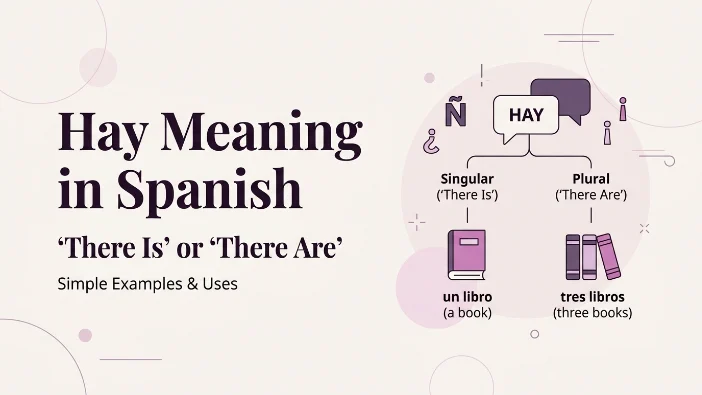
Hay is a Spanish word that means “there is” or “there are” in English. It comes from the verb haber and is used to indicate that something exists or is present. Unlike English, hay does not change whether you’re talking about one thing or many things.
If you’re searching for the Hay Meaning in Spanish, this simple word is one of the most useful expressions to learn in everyday Spanish. Hay comes from the verb haber and is commonly used to talk about people, places, objects, and situations that exist or are available.
Understanding hay can make Spanish conversations much easier because it appears frequently in questions, statements, and everyday expressions. In this guide, you’ll learn what hay means, how to use it correctly, and see simple examples with English translations.
What Does Hay Mean in Spanish? Meaning & Definition
If you’re learning Spanish, hay is one of the first and most useful words you’ll encounter. It appears in everyday conversations, textbooks, travel phrases, signs, and even Spanish songs.
In simple terms:
- Hay = There is
- Hay = There are
The same word works for both singular and plural nouns.
For example:
| Spanish | English |
| Hay un perro. | There is a dog. |
| Hay dos perros. | There are two dogs. |
| Hay una mesa aquí. | There is a table here. |
| Hay muchas personas. | There are many people. |
| Hay tiempo. | There is time. |
| Hay problemas. | There are problems. |
Unlike English, you never change hay depending on the number of objects.
Correct:
- Hay una silla.
- Hay cinco sillas.
Incorrect:
- ❌ Hays cinco sillas.
- ❌ Hayes cinco sillas.
This simple rule makes hay one of the easiest Spanish grammar concepts to remember.
Imagine walking through Madrid and asking where the nearest café is. Someone replies:
“Hay una cafetería al final de la calle.”
Even if you don’t know every word, understanding hay immediately tells you there is a café at the end of the street.
That’s why learning hay is so valuable. It helps you describe places, ask questions, give directions, explain situations, and understand everyday conversations.
Whether you’re a beginner learning Spanish, preparing for a language exam, travelling to a Spanish-speaking country, or simply curious about Spanish vocabulary, mastering hay will improve both your speaking and listening skills.
One reason learners like this word is its simplicity. Unlike many Spanish verbs that change depending on the subject, hay always stays exactly the same.
You’ll hear it in situations like:
- Describing a city.
- Talking about food.
- Explaining what’s inside a room.
- Asking if something exists.
- Giving travel directions.
- Discussing events.
- Speaking about opportunities or problems.
Because of its versatility, hay appears in thousands of everyday sentences.
Origin
The Spanish word hay has a long linguistic history that traces back to Latin.
It comes from the verb haber, one of the most important auxiliary verbs in Spanish. Modern Spanish inherited haber from the Latin verb habēre, which originally meant to have or to possess.
Over centuries, the language evolved, and one particular form of haber developed a special function. Instead of meaning “to have,” it began expressing existence, much like the English phrases there is and there are.
Today, hay serves as the impersonal present tense form of haber.
Here’s how the evolution looks:
| Stage | Form | Meaning |
| Latin | Habēre | To have |
| Old Spanish | Haber | To have, to exist |
| Modern Spanish | Hay | There is, There are |
Unlike regular verbs, hay does not identify who performs an action. Instead, it simply tells us that something exists.
For instance:
- Hay agua.
- Hay una solución.
- Hay muchas posibilidades.
Each sentence focuses on existence rather than ownership.
Popularity
Few Spanish words are as common as hay.
Language learners encounter it almost immediately because it appears in nearly every type of conversation.
You’ll hear hay in:
- Schools
- Restaurants
- Hotels
- Airports
- Hospitals
- Tourist attractions
- Business meetings
- Television shows
- Movies
- News reports
- Podcasts
- Books
- Social media posts
Native speakers use hay naturally without thinking about grammar.
Examples include:
- Hay café.
- Hay tráfico.
- Hay descuento.
- Hay ofertas.
- Hay un problema.
- Hay esperanza.
It’s also common in announcements.
Examples:
- Hay una reunión mañana.
- Hay un retraso en el vuelo.
- Hay asientos disponibles.
- Hay cambios importantes.
If you’re travelling in Spain, Mexico, Argentina, Colombia, Peru, Chile, or nearly any Spanish-speaking country, understanding hay will help you understand countless everyday conversations.
How It Is Used
The primary purpose of hay is to show that something exists or is available.
Let’s look at the most common situations where it’s used.
Talking About Places
One of the most frequent uses is describing what’s in a location.
Examples:
- Hay un parque cerca.
- Hay una farmacia aquí.
- Hay varios restaurantes.
- Hay una estación de metro.
- Hay un supermercado nuevo.
These sentences help travellers ask and answer questions about locations.
Describing Objects
You can describe what’s inside a room or building.
Examples:
- Hay una cama.
- Hay dos ventanas.
- Hay una televisión.
- Hay muchas plantas.
- Hay una computadora.
Talking About People
Hay also introduces people.
Examples:
- Hay mucha gente.
- Hay un médico.
- Hay varios estudiantes.
- Hay turistas.
- Hay niños jugando.
Talking About Events
Examples:
- Hay una fiesta esta noche.
- Hay una conferencia mañana.
- Hay un concierto.
- Hay una boda.
- Hay una reunión importante.
Talking About Problems
Examples:
- Hay un error.
- Hay una emergencia.
- Hay dificultades.
- Hay demasiadas preguntas.
- Hay una solución.
Talking About Nature
Examples:
- Hay nieve.
- Hay viento.
- Hay lluvia.
- Hay mucho calor.
- Hay niebla.
Talking About Food
Examples:
- Hay pizza.
- Hay pan fresco.
- Hay café.
- Hay frutas.
- Hay agua fría.
Asking Questions with “Hay”
You can also form questions.
Examples:
- ¿Hay café?
- ¿Hay habitaciones disponibles?
- ¿Hay alguien aquí?
- ¿Hay un banco cerca?
- ¿Hay wifi?
Notice that hay remains exactly the same.
Examples
Seeing hay in real conversations is the fastest way to understand how it works.
Friendly Examples
These examples reflect casual conversations between friends, classmates, family members, or travellers.
| Spanish | English |
| Hay pizza en la cocina. | There is pizza in the kitchen. |
| Hay café si quieres. | There is coffee if you want some. |
| Hay una película buena esta noche. | There is a good movie tonight. |
| Hay mucho tráfico hoy. | There is a lot of traffic today. |
| Hay espacio para todos. | There is room for everyone. |
| Hay muchas fotos nuevas. | There are many new photos. |
| Hay una tienda cerca. | There is a shop nearby. |
| Hay tiempo para descansar. | There is time to rest. |
| Hay helado en el congelador. | There is ice cream in the freezer. |
| Hay una sorpresa para ti. | There is a surprise for you. |
| Hay buena música aquí. | There is good music here. |
| Hay una piscina enorme. | There is a huge swimming pool. |
| Hay mucha gente en la playa. | There are many people at the beach. |
| Hay flores por todas partes. | There are flowers everywhere. |
| Hay una fiesta el sábado. | There is a party on Saturday. |
Professional Examples
In workplaces and formal situations, hay is often used to provide information clearly and politely.
| Spanish | English |
| Hay una reunión a las diez. | There is a meeting at ten o’clock. |
| Hay nuevas políticas de la empresa. | There are new company policies. |
| Hay vacantes disponibles. | There are vacancies available. |
| Hay un informe pendiente. | There is a report pending. |
| Hay oportunidades de crecimiento. | There are growth opportunities. |
| Hay cambios en el horario. | There are changes to the schedule. |
| Hay una conferencia internacional. | There is an international conference. |
| Hay documentos importantes. | There are important documents. |
| Hay una actualización del sistema. | There is a system update. |
| Hay un problema técnico. | There is a technical problem. |
Funny Examples
These playful examples show how hay appears in humorous situations.
| Spanish | English |
| Hay más café que paciencia. | There is more coffee than patience. |
| Hay demasiada tarea. 😅 | There is too much homework. |
| Hay un gato en mi silla otra vez. | There is a cat on my chair again. |
| Hay cero motivación hoy. | There is zero motivation today. |
| Hay pizza, ahora sí voy. | There’s pizza, now I’m coming. |
| Hay chocolate escondido. | There is hidden chocolate. |
| Hay alguien comiendo mi comida. | Someone is eating my food. |
| Hay demasiadas pestañas abiertas. | There are too many browser tabs open. |
| Hay lunes otra vez. | It’s Monday again. |
| Hay una razón por la que necesito vacaciones. | There is a reason I need a holiday. |
Comparison with Similar Terms
Spanish learners often confuse hay with other common words because they all relate to existence, location, or possession. Understanding the differences will help you avoid common grammar mistakes.
| Word | Meaning | When to Use | Example | English Translation |
| Hay | There is, There are | To show something exists | Hay un libro. | There is a book. |
| Está | Is located | To describe where one specific thing is | El libro está en la mesa. | The book is on the table. |
| Están | Are located | To describe where multiple things are | Los libros están aquí. | The books are here. |
| Tiene | Has | To show possession | Ella tiene un coche. | She has a car. |
| Existe | Exists | Formal way to express existence | Existe una solución. | A solution exists. |
| Había | There was, There were | Past tense of existence | Había mucha gente. | There were many people. |
| Habrá | There will be | Future existence | Habrá una reunión. | There will be a meeting. |
Hay vs Está
This is one of the biggest challenges for beginners.
Use “hay” when introducing something for the first time.
Example:
- Hay una cafetería cerca.
- There is a café nearby.
Once the object is known, use está to describe its location.
Example:
- La cafetería está al lado del banco.
- The café is next to the bank.
Hay vs Tiene
These words have completely different meanings.
Hay indicates existence.
- Hay un ordenador en la oficina.
- There is a computer in the office.
Tiene indicates ownership.
- La oficina tiene un ordenador.
- The office has a computer.
Hay vs Existe
Both express existence, but their tone differs.
Hay
- Common in daily conversation.
- Natural and conversational.
Examples:
- Hay problemas.
- Hay opciones.
- Hay tiempo.
Existe
- More formal.
- Often used in academic, legal, or scientific writing.
Examples:
- Existe evidencia científica.
- Existe una posibilidad.
Alternate Meanings
Although hay almost always means there is or there are, it can appear in different grammatical contexts.
Part of Other Verb Forms
The root verb haber appears in many Spanish tenses.
Examples:
- Hay
- Había
- Hubo
- Habrá
- Habría
- Haya
Each serves a different grammatical purpose.
Used in Idiomatic Expressions
Native speakers use hay in many fixed expressions.
Examples:
- Hay que estudiar.
- One must study.
- Hay que esperar.
- We have to wait.
- Hay que tener paciencia.
- You have to be patient.
In these phrases, hay que expresses necessity rather than simple existence.
Regional Usage
The meaning of hay stays consistent across the Spanish-speaking world.
Whether you’re in:
- Spain
- Mexico
- Argentina
- Colombia
- Chile
- Peru
- Guatemala
- Costa Rica
the word still means there is or there are.
Pronunciation may vary slightly by region, but the grammar and meaning remain the same.
Professional or Polite Alternatives
In formal writing or business communication, you may choose more refined expressions depending on the situation.
| Casual Expression | More Formal Alternative | English Meaning |
| Hay un problema. | Existe un inconveniente. | There is an issue. |
| Hay una oportunidad. | Existe una oportunidad. | There is an opportunity. |
| Hay información nueva. | Se dispone de nueva información. | New information is available. |
| Hay cambios. | Se han realizado cambios. | Changes have been made. |
| Hay espacio disponible. | Hay disponibilidad. | Availability exists. |
Formal alternatives often appear in:
- Business emails
- Government documents
- University writing
- Research papers
- Official announcements
Common Mistakes
Many learners make the same mistakes with hay. Knowing them early will improve your Spanish quickly.
Using “hay” with definite articles
Incorrect:
- ❌ Hay el coche.
Correct:
- ✅ Hay un coche.
- ✅ Está el coche.
Changing the Form
Some learners try to make hay plural.
Incorrect:
- ❌ Hays
- ❌ Hayes
Correct:
- ✅ Hay
It never changes.
Confusing Hay and Está
Incorrect:
- ❌ Hay mi mochila aquí.
Correct:
- ✅ Mi mochila está aquí.
Forgetting That Hay Works for Singular and Plural
Correct:
- Hay un perro.
- Hay cinco perros.
The word remains exactly the same.
Translating Word for Word
English learners sometimes think every sentence using “there is” requires hay.
Remember:
- Hay introduces something.
- Está describes where something already known is located.
Quick Tips
Keep these simple rules in mind whenever you use hay.
- Think of hay as “there is” or “there are.”
- Use it to introduce new information.
- Never change its spelling.
- Use it with singular and plural nouns.
- Do not use it to show ownership.
- Use está after the object has already been identified.
- Learn common expressions like hay que, as they appear frequently in everyday Spanish.
- Practice with real-life examples instead of memorising isolated rules.
FAQ
What does hay mean in Spanish?
Hay means there is or there are. It expresses that something exists or is present.
Is hay singular or plural?
It is both. The same word works with singular and plural nouns.
Examples:
- Hay un libro.
- Hay muchos libros.
Is hay a verb?
Yes. It is an impersonal present tense form of the Spanish verb haber.
How do you pronounce hay?
It is pronounced approximately like the English word eye, with a light h that is silent in Spanish.
What is the difference between hay and está?
Hay introduces something that exists.
Está tells where a specific object or person is located.
What does “hay que” mean?
Hay que means it is necessary to, one must, or you have to.
Examples:
- Hay que estudiar.
- Hay que salir temprano.
Can hay be used in questions?
Yes.
Examples:
- ¿Hay café?
- ¿Hay un hotel cerca?
- ¿Hay alguien aquí?
Is hay used in every Spanish-speaking country?
Yes. It is standard Spanish and is used throughout Spain and Latin America.
Conclusion
Understanding what does hay mean in Spanish is an essential step toward becoming more confident in the language. While the word is small, it plays a major role in everyday communication because it expresses existence in a simple and consistent way.
Remember that hay always means there is or there are, regardless of whether you’re talking about one object or many. It never changes form, making it one of the easiest yet most useful Spanish grammar rules to master.
As you continue learning Spanish, pay attention to how native speakers use hay in conversations, signs, books, films, and everyday situations. Practising with real examples will help you recognise the difference between hay, está, and tiene, making your Spanish sound much more natural.
Whether you’re travelling, studying for an exam, or learning Spanish for fun, mastering hay will make it easier to describe places, ask questions, understand conversations, and communicate with confidence.
Read More Related Articles:
- Amor Meaning | Romantic Word Behind Love and Affection In 2026
- Flashing Red Light Meaning | Don’t Ignore These Warning Signs In 2026
- Mercy Meaning | Powerful Lesson Behind Kindness and Forgiveness In 2026

Michael Turner is a U.S.-based content writer and blogger who enjoys uncovering the stories and meanings behind words. Through his work at Meanvora, he delivers well-researched, easy-to-read articles that help readers expand their vocabulary and gain a deeper understanding of language.










1 thought on “Hay Meaning in Spanish | “There Is” or “There Are” Simple Examples & Uses In 2026”